Ardhanarishvara Meaning: Shiva, Shakti, and the Wisdom of Wholeness
Ardhanarishvara unites Shiva and Parvati in one sacred form. Explore its meaning, iconography, philosophy, and practical wisdom without reducing it to a simple idea of balance.
A single sacred image can hold a truth that argument keeps dividing: consciousness and creative power were never separate.
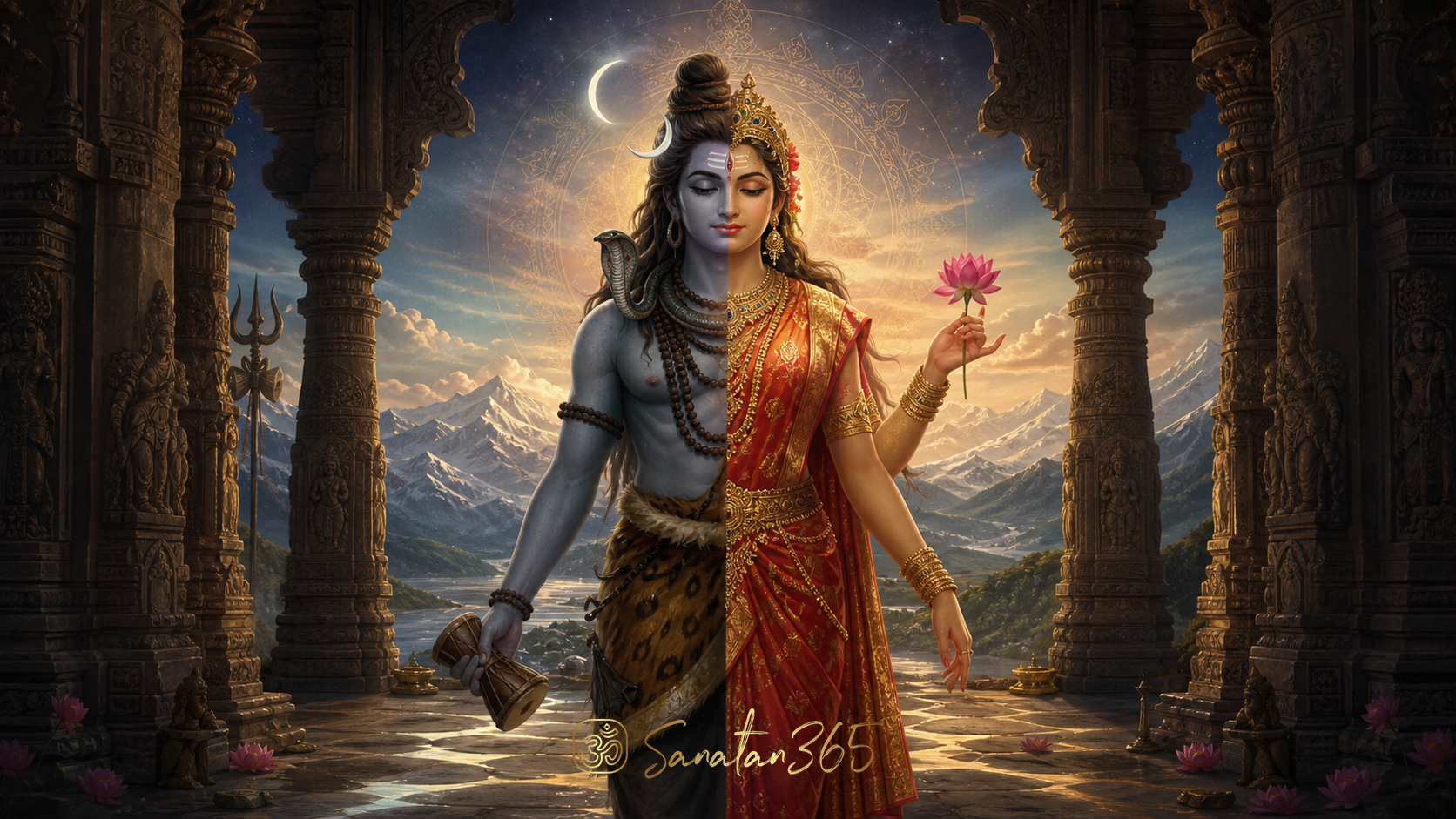
Ardhanarishvara meaning begins with its name: ardha (अर्ध, half), nari (नारी, woman), and ishvara (ईश्वर, Lord). The form unites Lord Shiva and Goddess Parvati in one body, commonly divided along a vertical axis. It is not a puzzle made from two incomplete beings. Ardhanarishvara presents divine reality as wholeness, in which still awareness and active power, ascetic depth and fertile life, distinction and unity belong together.
What is the Ardhanarishvara meaning in Hindu tradition?
Ardhanarishvara is the composite form of Shiva and Parvati. In sculpture and painting, one half bears signs associated with Shiva and the other with Parvati. Encyclopaedia Britannica summarizes the central symbolism as the inseparability of male and female principles. Hindu traditions, however, allow the image to speak at several levels at once: theological, philosophical, devotional, artistic, and personal.
At the theological level, Shiva and Shakti (शक्ति, divine power or energy) are inseparable. Shiva is not imagined as a remote principle who later acquires energy from somewhere else. Shakti is the power through which consciousness manifests, creates, sustains, transforms, and becomes knowable. The opening verse of the Saundarya Lahari expresses this sharply: Shiva united with Shakti is able to create; without her power, he cannot even stir (Wisdom Library, Saundarya Lahari, verse 1).
At the devotional level, Ardhanarishvara honours Shiva and Parvati without turning their relationship into competition. Neither side erases the other. Neither is a decorative addition. Their union reveals a sacred completeness that includes difference without hostility.
At the philosophical level, the image asks whether familiar opposites are as separate as they appear. Stillness and movement, contemplation and work, discipline and tenderness may be distinguishable, yet a mature life needs them to cooperate.
Key takeaway: Ardhanarishvara represents the inseparable unity of Shiva and Shakti, not the victory of one principle over another.
What does Ardhanarishvara symbolism show in sacred art?
The iconography varies across periods and regions, so no single checklist describes every murti (मूर्ति, consecrated or sacred form). A common arrangement places Shiva on the right and Parvati on the left, although artistic traditions can vary. Shiva's side may show matted hair, a crescent moon, a serpent ornament, a broad chest, tiger-skin clothing, a trishula (त्रिशूल, trident), or a damaru (डमरु, hand drum). Parvati's side may show styled hair, jewellery, a curved form, silk garments, a lotus, or a mirror.
These details are not costume trivia. They establish a visual grammar:
- Matted locks evoke tapas (तपस्, disciplined spiritual heat) and ascetic focus.
- Ornament and flowing cloth evoke beauty, relationship, abundance, and embodied life.
- The damaru suggests rhythm, vibration, and unfolding creation.
- The lotus suggests purity and life emerging without losing its sacred centre.
- Shiva's bull Nandi and Parvati's lion or other associated elements may appear in supporting compositions.
A seventh-century sandstone Ardhanarishvara in The Metropolitan Museum of Art demonstrates how sculptors could communicate difference and unity through posture, hairstyle, jewellery, and bodily modelling while preserving a single stable presence. The line dividing the form does not break it. The composition remains one.
This artistic discipline matters. Ardhanarishvara should not be reduced to a novelty image of “half man, half woman.” The icon is a theological statement shaped through proportion, gesture, attributes, and sacred presence. Each half is legible, yet the eye is invited to perceive the whole.
Key takeaway: Ardhanarishvara iconography uses visible difference to reveal a deeper, indivisible unity.
How do Shiva and Shakti express consciousness and power?
One influential reading associates Shiva with pure consciousness and Shakti with the power of manifestation. This language should be handled carefully. It does not mean that men possess consciousness while women possess energy, nor that human personalities must fit rigid gender boxes. Shiva and Shakti are cosmic principles expressed through divine imagery, not stereotypes imposed on every person.
Consciousness without expression would remain unmanifest. Power without awareness would lack sacred orientation. Their union offers a way to understand reality as both luminous awareness and dynamic becoming. A flame and its power to burn can be distinguished in thought, but not separated in fact. Likewise, Shiva and Shakti can be worshipped in distinct forms while remaining inseparable at the deepest level.
Different schools explain this relationship in different ways. Some Shaiva traditions speak of Shiva as the supreme reality whose freedom appears as Shakti. Shakta traditions may foreground the Goddess as the ultimate power and ground of manifestation. Non-dual traditions may treat the distinction as a teaching device that finally resolves into one reality. Devotional communities may approach the form through loving worship rather than abstract metaphysics.
These interpretations need not be forced into one formula. Sanatan Dharma preserves multiple darshanas (दर्शन, philosophical viewpoints or ways of seeing). Ardhanarishvara can therefore teach unity without demanding intellectual uniformity.
Key takeaway: Shiva and Shakti are distinguishable in teaching and worship, yet inseparable as consciousness and its power.
Does Ardhanarishvara simply mean gender equality?
Ardhanarishvara can inspire reflection on dignity, mutuality, and the refusal to treat the feminine as secondary. But saying the icon “simply means gender equality” makes an ancient sacred form carry only a modern slogan. Its theological horizon is wider.
The image certainly challenges the idea that completeness belongs to one gendered principle alone. Parvati is not placed below Shiva or outside him. She shares the same body and sacred centre. The form can therefore support a deeply respectful recognition that masculine and feminine principles are mutually necessary.
Yet Ardhanarishvara also reaches beyond social categories. It speaks of the unity behind many apparent dualities:
- consciousness and energy;
- silence and sound;
- renunciation and household life;
- transcendence and immanence;
- form and the formless;
- the observer and the unfolding world.
This broader meaning prevents two mistakes. The first is using sacred symbolism to justify rigid stereotypes, as if every man must embody only one set of traits and every woman another. The second is stripping the icon of worship and treating it only as a political emblem. A more faithful reading respects both its spiritual depth and its capacity to illuminate human dignity.
The form also reminds devotees that wholeness is not sameness. Shiva's and Parvati's attributes remain visible. Unity does not require difference to disappear; it requires difference to cease becoming a reason for domination or fragmentation.
Key takeaway: Ardhanarishvara can illuminate mutual dignity, but its meaning extends to the cosmic unity behind many forms of duality.
Where is Ardhanarishvara worshipped and remembered?
Ardhanarishvara appears across Indian sculpture, temple architecture, devotional poetry, and performance. The form has a particularly rich presence in South Indian Shaiva art. Temple walls and bronzes allow devotees to encounter philosophy not only through books but through darshan (दर्शन, sacred seeing).
One celebrated temple is the Ardhanareeswarar Temple at Tiruchengode in Tamil Nadu, where the hill itself becomes part of the sacred geography of Shiva-Parvati unity (Tamil Nadu Tourism). The form also appears in major museum collections and historical sites, showing how widely artists explored its visual possibilities across centuries. Readers exploring Shiva's sacred attendants may also visit Nandi Meaning: Why Shiva's Sacred Bull Faces the Lingam.
Regional names deepen the emotional vocabulary. In Tamil usage, Ammaiyappan, “Mother-Father,” is among the names associated with the united form, making cosmic philosophy intimate (Government Museum Chennai, Ardhanarishvara bronze catalogue). The Divine is encountered as the source holding both maternal and paternal dimensions without limitation.
Classical dance can express the icon through contrasting gestures, stance, costume, and rhythm. The well-known Ardhanarishvara theme appears in Indian dance repertoires as an embodied presentation of the united deity (Sangeet Natak Akademi journal archive). A dancer may articulate Shiva's grounded force on one side and Parvati's grace on the other, then reveal that both belong to one continuous body. When performed reverently, the result is not imitation for spectacle but embodied philosophy.
For a devotee, seeing Ardhanarishvara during Shravana (श्रावण, the Hindu lunar month commonly called Shravan), a season strongly associated with Shiva worship, may add a gentle correction: devotion to Shiva does not require forgetting Shakti (Drik Panchang, Sawan Somwar). The still mountain and the living river belong to the same sacred landscape. Adiyogi Shiva Meaning: Why Shiva Is Called the First Yogi offers a related exploration of Shiva's contemplative dimension, while Bilva Patra Meaning: Why Bael Leaves Are Offered to Shiva explains a familiar devotional offering.
Key takeaway: Temple, sculpture, poetry, and dance turn Ardhanarishvara philosophy into an experience of sacred seeing.
How can Ardhanarishvara philosophy guide daily life?
Sacred symbolism becomes useful when it changes how a person sees and acts. Ardhanarishvara does not ask devotees to imitate iconographic details. It invites the integration of capacities that modern life often separates.
Hold stillness and action together
Before acting, pause long enough to see clearly. After reflection, act rather than hiding in endless contemplation. Shiva-like stillness and Shakti-like movement are strongest together.
Join discipline with compassion
Discipline without compassion becomes harsh. Compassion without discernment can become unstable. A complete response needs both a clear boundary and a caring heart.
Respect complementary strengths
In a family, team, or community, another person's different way of thinking need not threaten one's own. Difference can become cooperation when nobody insists on being the whole by themselves.
Refuse spiritual fragmentation
Prayer, work, care, rest, study, and service should not become unrelated compartments. A sacred life integrates them through dharma (धर्म, sustaining right order and responsibility).
Examine inner imbalance without shame
Some people act constantly but rarely become quiet. Others reflect deeply but avoid necessary action. Some give easily but cannot receive; others protect boundaries so strongly that tenderness disappears. Ardhanarishvara offers a compassionate diagnostic: which neglected capacity would help life become more whole?
A short reflection practice can begin with three breaths. On the first, notice awareness itself. On the second, notice the energy moving through body and mind. On the third, hold both together and choose one dharmic action. This is not a traditional ritual or a replacement for lineage-based practice. It is a simple contemplation inspired by the icon's central insight.
Key takeaway: Daily wholeness grows when contemplation and action, clarity and care, difference and cooperation are consciously integrated.
FAQ
What does Ardhanarishvara mean literally?
The name combines ardha (half), nari (woman), and ishvara (Lord). It refers to the united form of Lord Shiva and Goddess Parvati in one body.
Is Ardhanarishvara Shiva or Parvati?
Ardhanarishvara is both Shiva and Parvati in an indivisible composite form. The icon reveals their inseparability rather than asking devotees to choose one over the other.
Why is Shiva often shown on the right side?
Many well-known images place Shiva on the right and Parvati on the left, following established iconographic conventions. Historical works can vary, and the spiritual meaning rests in their unity rather than a simplistic ranking of sides.
What is the main Ardhanarishvara symbolism?
Its central symbolism is the inseparability of Shiva and Shakti: consciousness and divine power, stillness and manifestation, distinction and wholeness.
Can Ardhanarishvara be understood beyond gender?
Yes. The form honours masculine and feminine principles while also pointing toward the unity behind many dualities, including consciousness and energy, silence and expression, and contemplation and action.
Ardhanarishvara does not solve difference by erasing it. The sacred form keeps Shiva and Parvati visible while revealing that neither stands alone. That is its enduring wisdom: wholeness is not a lonely perfection, but the awakened recognition that life-giving powers belong together.
About the author
Sanatan365 Editorial
Bringing Sanatan Dharma to modern seekers through authentic, scripture-grounded content.
Related in Deities
 Deities
Ushas, the Vedic Goddess of Dawn: Light, Renewal, and Time
Ushas, the Vedic goddess of dawn, appears in the Rigveda as radiant light that awakens life, calls beings to activity, and reveals both ren…
 Deities
Chitragupta Meaning: Divine Records and Ethical Accountability
Chitragupta is remembered as the divine keeper of karmic records in Yama's court. His symbolism connects writing, memory, justice, and ethi…
 Deities
Varuna Deva Meaning: Rta, Waters, and Cosmic Order
Discover Varuna Deva's Vedic role as guardian of rta, his bond with waters, and what his hymns teach about truth, accountability, and mercy.

