Adiyogi Shiva Meaning: Why Shiva Is Called the First Yogi
Adiyogi Shiva means Shiva as the first yogi and primordial teacher of yoga, a form that connects silence, discipline, dissolution, and inner freedom.
A yogi covered in ash can teach more about modern restlessness than a shelf of productivity advice.
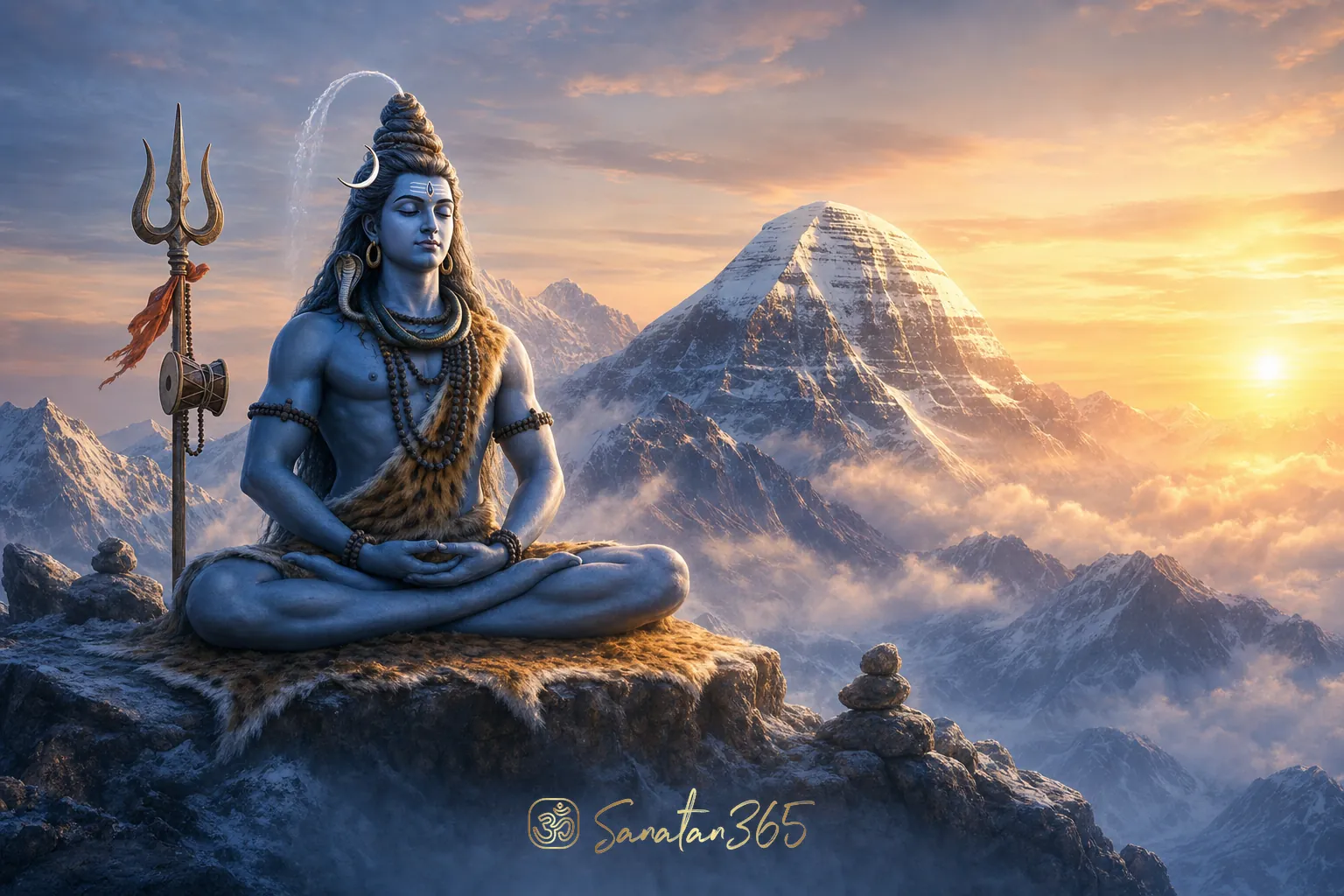
Adiyogi Shiva meaning begins with this simple idea: Shiva is revered as the first yogi, the primordial teacher who shows that yoga is not only posture, breath, or fitness, but union with the deepest Self. Adiyogi (आदियोगी, first yogi) points to Shiva as the source of yogic stillness, tapas (तपस्, disciplined inner heat), and meditation that burns confusion into clarity.
This matters especially during global Yoga Week, when yoga is often seen mainly through movement. The image of Shiva as Adiyogi brings the practice back to its Hindu philosophical root: the transformation of consciousness.
What Is Adiyogi Shiva Meaning in Hindu Tradition?
Adiyogi Shiva meaning is the understanding of Lord Shiva as the original yogi and the first teacher of inner discipline. Adi (आदि) means first or primordial, and yogi means one who is established in yoga, the state of union, integration, and spiritual steadiness.
In Hindu tradition, Shiva is not only worshiped as Mahadeva, the great deity, or as Nataraja, the cosmic dancer. He is also Yogeshvara (योगेश्वर, Lord of Yoga), the silent master whose stillness reveals the path inward. Britannica notes Shiva's association with yogic asceticism and his role as a teacher of yoga. The Hindu American Foundation's Hindu roots of yoga project also places yoga within the larger Hindu darshana (दर्शन, philosophical viewpoint) tradition.
The name Adiyogi therefore does not reduce Shiva to one historical teacher with a classroom and date. It expresses a sacred archetype: consciousness so still that it becomes a teaching. Shiva teaches through silence, posture, presence, dissolution, and the refusal to be ruled by surface identity.
Several Shiva symbols carry this yogic meaning:
- The third eye suggests jnana (ज्ञान, liberating knowledge) that sees beyond habit.
- The ash on Shiva's body reminds the seeker that ego, possessions, and status are temporary.
- The crescent moon points to mastery over time and mind.
- The Ganga flowing from his matted hair suggests grace descending into the world.
- The damaru, Shiva's small drum, carries rhythm, creation, and sacred sound.
Key takeaway: Adiyogi Shiva is not merely "Shiva doing yoga"; he is Shiva as the source-symbol of yoga's inner purpose.
Why Is Shiva Called the First Yogi?
Shiva is called the first yogi because Hindu yoga tradition sees him as the primordial source of yogic wisdom: meditation, inner absorption, self-mastery, detachment, and the stillness behind action.
The phrase "first yogi" must be read with cultural care. It is not a narrow historical claim meant to compete with academic timelines. It is a devotional and philosophical way of saying that Shiva embodies the beginning of yoga as a sacred technology of consciousness. In this frame, yoga is not invented as an exercise system. It is revealed as a way of knowing reality.
Patanjali's famous definition in the Yoga Sutra says:
Yogah chitta vritti nirodhah.
Yoga is the stilling of the movements of the mind. Chitta (चित्त) means the mind-field or inner consciousness, vritti (वृत्ति) means mental modification, and nirodha (निरोध) means restraint or stilling. Shiva as Adiyogi visually expresses this sutra before it is explained in words: seated, unmoving, inward, awake.
This is why Shiva iconography often shows him in meditation rather than in courtly display. He sits on Kailash, wears simple marks, and remains untouched by ordinary measures of success. He is not restless because he does not need the world to confirm his being.
For a modern reader, this is the challenging part. Adiyogi does not say, "Escape life." Shiva also appears as a householder with Parvati and as father of Ganesha and Kartikeya. His yogic teaching is subtler: be fully present in life without being possessed by it.
That is why related practices like Pranayama Meaning: Yogic Breath as a Hindu Practice of Prana and Ashtanga Yoga Meaning: Patanjali's Eight Limbs of Inner Discipline matter. Breath, restraint, ethics, meditation, and devotion are not separate fragments. They are pathways toward the same inner steadiness that Shiva represents.
Key takeaway: Shiva is called the first yogi because he personifies yoga as the stilling, clarifying, and freeing of consciousness.
What Does Adiyogi Teach About Meditation?
Adiyogi teaches that meditation is not a performance. It is a return.
In many modern settings, meditation is explained as stress relief. That is useful, but it is not the whole Hindu vision. Dhyana (ध्यान, meditation) is a disciplined resting of attention in a deeper truth. Shiva's stillness is powerful because it is not sleepy or withdrawn. It is alert, vast, and capable of both compassion and fierce clarity.
The third eye is central here. In common language, it is sometimes reduced to intuition. In Shiva symbolism, it points to insight that burns falsehood. When Kama, desire, disturbs Shiva's meditation in a well-known narrative tradition, Shiva's third eye burns the force of uncontrolled craving. The point is not hatred of love or beauty. The point is mastery over compulsion.
Meditation in the Adiyogi frame asks three practical questions:
- What keeps pulling the mind away from truth?
- What desire or fear is being mistaken for identity?
- What remains when the noise is allowed to settle?
This is why Shiva is both peaceful and fearsome. A real meditative life is gentle, but not weak. It softens the heart while making illusion harder to protect.
Adiyogi also teaches the discipline of silence. Mauna (मौन, sacred silence) is not merely refusing to speak. It is the practice of listening below speech. In this sense, Shiva's silence is not emptiness. It is full transmission. The seeker learns because the teacher's presence makes scattered thinking look unnecessary.
The practice can begin simply:
- Sit with the spine steady and the breath natural.
- Offer one quiet remembrance to Shiva or to the Divine in the form you worship.
- Watch the movement of thought without arguing with it.
- Let the breath become softer before using a mantra, if that is part of your tradition.
- End with gratitude rather than abrupt distraction.
Key takeaway: Adiyogi meditation is not about appearing spiritual; it is about seeing clearly enough that the mind no longer rules the whole life.
How Does Shiva's Symbolism Explain Yoga Beyond Exercise?
Shiva's symbolism explains yoga beyond exercise by showing that yoga includes body, breath, ethics, devotion, knowledge, time, death, and liberation.
The body matters in Hindu yoga, but the body is not the endpoint. Asana (आसन, steady posture) prepares the seeker. Pranayama (प्राणायाम, disciplined breath) refines life-force awareness. Dharana (धारणा, concentration) gathers attention. Dhyana deepens it. Samadhi (समाधि, absorption) points toward union beyond the ordinary sense of separation.
Shiva's form holds these teachings visually.
The ash says: remember impermanence. The body is sacred, but it is not permanent property. A yoga practice that never reflects on impermanence can become another form of self-decoration.
The serpent around Shiva's neck says: fear can be held without panic. The yogi does not pretend danger is unreal. He learns not to be enslaved by it.
The crescent moon says: the mind has phases. Some days are bright, some partial, some hidden. Yoga does not demand that the mind always feel perfect. It teaches one to remain anchored through change.
The trishul (त्रिशूल, trident) can be read as mastery over three forces: inertia, activity, and clarity; or past, present, and future; or body, mind, and spirit. Interpretations vary by tradition, but the broad point remains: Shiva gathers what is divided.
The damaru says: silence and sound belong together. Mantra (मन्त्र, sacred sound formula) arises from stillness and returns to stillness. This is why Shiva worship often includes both quiet meditation and resonant chanting such as Om Namah Shivaya.
This broader view protects yoga from becoming rootless. It also avoids turning yoga into a sectarian claim. Yoga has become global, and many people benefit from it. But a respectful global yoga culture should remember that its philosophical soil is deeply connected to Hindu traditions, including the image of Shiva as Adiyogi.
Key takeaway: Shiva's symbols teach that yoga is a complete path of integration, not only a sequence of physical techniques.
How Can a Devotee Relate to Adiyogi Shiva Today?
A devotee can relate to Adiyogi Shiva today by using his image as a mirror for daily discipline: steadier breath, cleaner intention, simpler desire, and deeper surrender.
This does not require dramatic renunciation. A student, parent, founder, artist, engineer, or homemaker can all practice Adiyogi's lesson in ordinary life. The form changes; the principle remains.
Here are five ways to bring the teaching into the day:
-
Begin with one minute of stillness. Before touching the phone, sit quietly and breathe. Let the first act of the day belong to awareness, not reaction.
-
Offer one action without ego. Choose one task and do it as seva (सेवा, selfless service), without demanding immediate praise.
-
Practice restraint before speech. Shiva's silence can become a modern discipline: pause before replying when emotion is high.
-
Remember impermanence without sadness. The ash on Shiva's body is not pessimism. It is clarity. When something feels urgent, ask whether it will matter in the light of dharma.
-
Use a simple mantra with reverence. Om Namah Shivaya is a widely loved Shiva mantra. Learn pronunciation respectfully from a trusted tradition or teacher, and chant with steadiness rather than speed.
For diaspora families, Adiyogi can also become a bridge. Children may first meet yoga through school, sport, or wellness culture. Shiva as Adiyogi helps families explain that yoga is also connected to meditation, sacred stories, Sanskrit vocabulary, and Hindu philosophy.
For seekers approaching Hindu Dharma from outside India, the same principle applies: begin with respect. Learn the names correctly. Avoid flattening Shiva into a wellness mascot. Receive the tradition as living wisdom, not as decoration.
Key takeaway: To remember Adiyogi today is to bring a little more stillness, responsibility, and sacred awareness into ordinary life.
Why Does Adiyogi Shiva Matter During Yoga Week?
Adiyogi Shiva matters during Yoga Week because he helps restore yoga's depth at the very moment yoga is most visible.
International Yoga Day has made yoga a global language. That visibility can be beautiful when it leads people toward health, discipline, humility, and respect. But visibility can also thin a tradition if the deepest meanings are forgotten. Adiyogi brings the center back.
He reminds the practitioner that:
- Flexibility without humility is incomplete.
- Breathwork without ethics can remain self-centered.
- Meditation without truthfulness can become escape.
- Spiritual language without discipline becomes decorative.
- Devotion without awareness can become habit.
In the Hindu view, yoga is not only about feeling better. It is about becoming truer. Shiva's stillness asks the seeker to examine the ego, not merely soothe it.
This is also why Shiva is both ascetic and compassionate. He does not reject the world because it is worthless. He refuses to be trapped by it because the Self is larger. That is the yogic balance: participate, serve, love, create, and still remember the silent ground beneath all of it.
During Yoga Week, a devotee might honor Adiyogi by reading a few verses from the Yoga Sutras, chanting a Shiva mantra, learning about Ishvara Pranidhana Meaning: Surrender as a Daily Yoga Practice, or practicing five minutes of breath-aware silence. The action can be small. The orientation should be sincere.
Key takeaway: Adiyogi Shiva matters because he turns Yoga Week from a wellness event into a reminder of inner freedom.
Conclusion
Adiyogi Shiva meaning is the recognition of Shiva as the first yogi, the silent teacher who reveals yoga as a path of stillness, discipline, wisdom, and liberation. His symbols are not distant mythology; they are practical mirrors. The ash asks for humility, the third eye asks for clarity, the crescent moon asks for steadiness through change, and the meditative posture asks the seeker to return inward.
The single key takeaway: Adiyogi Shiva teaches that the deepest yoga begins when the mind becomes quiet enough to remember what is sacred.
FAQ
What does Adiyogi Shiva mean?
Adiyogi Shiva means Lord Shiva as the first yogi and primordial teacher of yoga. The word adi means first or original, while yogi refers to one established in yoga, inner union, and spiritual discipline.
Why is Shiva called the first yogi?
Shiva is called the first yogi because Hindu tradition reveres him as the source-symbol of yogic stillness, meditation, tapas, detachment, and inner liberation. The phrase is devotional and philosophical, not merely a modern historical label.
Is Adiyogi Shiva connected to Patanjali Yoga?
Adiyogi Shiva and Patanjali Yoga are connected through the shared aim of stilling the mind and realizing deeper consciousness. Patanjali gives a concise philosophical system; Shiva as Adiyogi gives a sacred visual and devotional form to yogic stillness.
Is yoga only physical exercise in Hindu tradition?
No. Physical practice is one part of yoga, but Hindu tradition also includes ethics, breath discipline, concentration, meditation, devotion, knowledge, and liberation. Shiva's Adiyogi form points to this fuller meaning.
How can someone honor Adiyogi Shiva respectfully?
A person can honor Adiyogi Shiva through quiet meditation, respectful mantra practice, learning the Hindu roots of yoga, practicing self-restraint, and approaching Shiva's symbols with reverence rather than treating them as casual decoration.
About the author
Sanatan365 Editorial
Bringing Sanatan Dharma to modern seekers through authentic, scripture-grounded content.
Related in Deities
 Deities
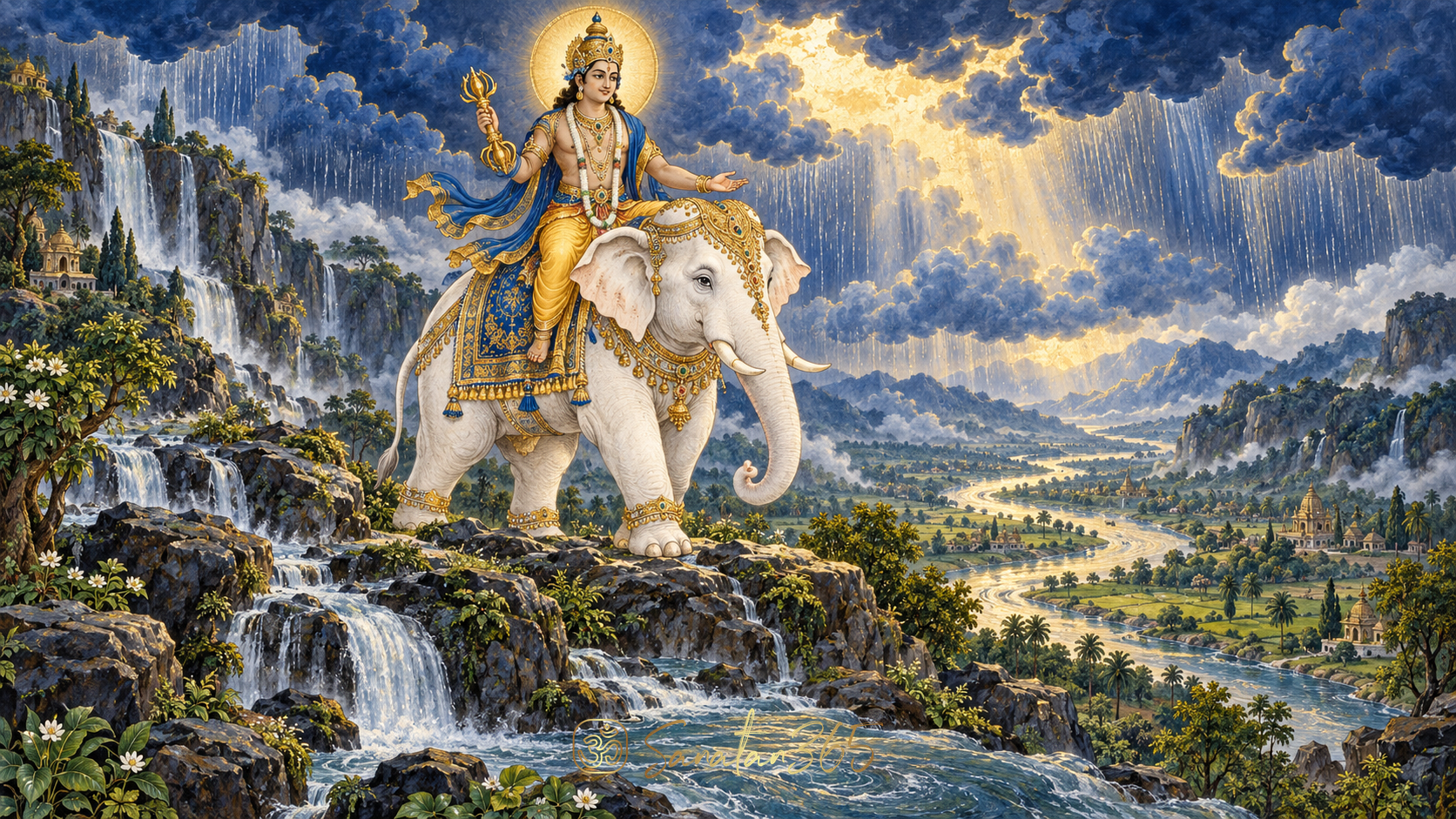
Indra Deva Meaning: The Vajra, Rain, and Responsible Power
Indra links the thunderbolt and released waters with a demanding question: what is strength for? Read his Vedic imagery and later lessons w…
 Deities
Agni Deva Meaning: Sacred Fire and the Divine Messenger
Meet Agni as the Vedic priest and messenger, read the first Rig Veda hymn, and understand sacred fire without reducing a living deity to a…
 Deities
Brahma Deva Meaning: Four Faces, Creation, and Sacred Knowledge
Understand Brahma, the Hindu creator deity, through his four faces, lotus imagery, sacred knowledge, and a careful distinction from Brahman…