Sita Swayamvara in the Ramayana: Shiva's Bow and the Meaning of the Marriage
Read the Bala Kanda account of Rama, Sita, Janaka and Shiva's bow, and separate the text's sequence from later devotional retellings.
A bow can break in a moment. A marriage, in the Ramayana, takes more than that moment to unfold.
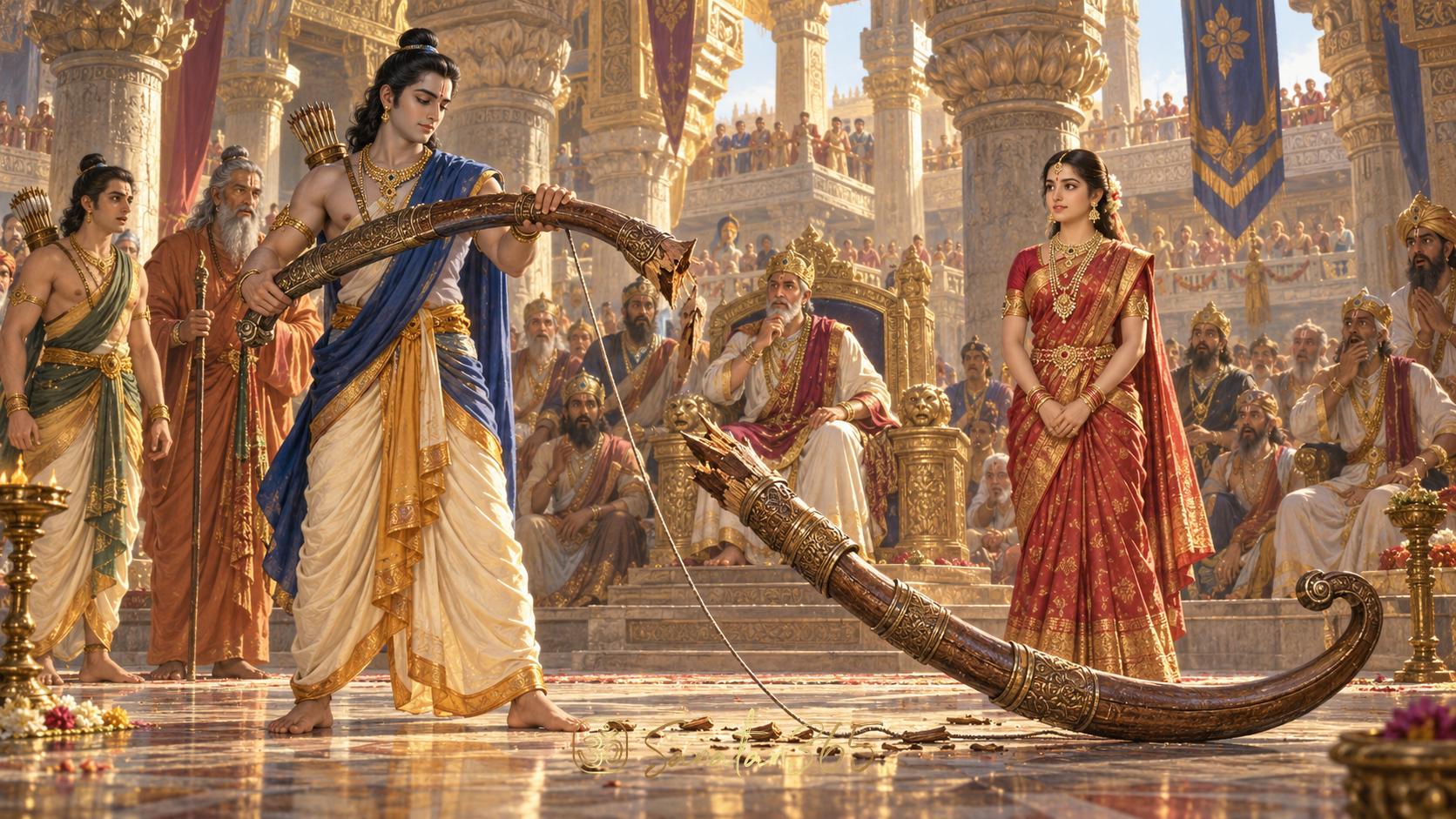
Sita swayamvara is the popular name for the episode in which Rama meets King Janaka's condition for Sita's marriage by handling and stringing Shiva's great bow; the bow breaks as Rama draws it. In Valmiki's Bala Kanda (the epic's opening book), the event is followed by messages to Ayodhya, family deliberation and a wedding rite. Reading the whole sequence reveals more than a feat of strength: it asks how a promise, public responsibility and a relationship are brought together. The word swayamvara (स्वयंवर, a marriage-choice occasion) is a familiar label for this story, but the text's particulars deserve attention rather than being flattened into a modern contest scene.
What is Sita swayamvara in the Bala Kanda?
The narrative begins before Rama touches the bow. Vishvamitra, the sage accompanying Rama and Lakshmana, asks Janaka to show the princes the remarkable bow in his keeping. Janaka replies by telling its history and the condition attached to his daughter's marriage. These details appear in Bala Kanda 66. The setting is Mithila, the kingdom associated with Janaka and Sita, and the bow is an object of inherited sacred trust. It is not simply sporting equipment placed in a hall for spectacle.
Janaka explains that Sita came forth from a furrow as he prepared a ritual field. Her name is connected with the Sanskrit sītā (सीता, furrow). The story presents this as sacred narrative, not as a historical claim to be proved by archaeology. Janaka raised her as his daughter. His account of her arrival matters because it establishes Sita's identity and the responsibilities he feels toward her before any suitor enters the picture. To begin with Rama's strength alone is to miss the person whose marriage gives the event its meaning.
The popular shorthand “bow-breaking contest” also compresses time. Janaka recalls earlier kings who sought Sita's hand and could not even handle the bow. Their response, in his telling, led to conflict with Mithila. Rama's arrival is not the opening round of a tournament with those kings standing in a line. It comes after that history, when Vishvamitra and the two princes ask to see the bow. This distinction does not diminish later artistic retellings; it helps readers know which version they are describing.
Key takeaway: In Valmiki's account, Sita's origin, Janaka's vow and the bow's sacred custody give context to Rama's act.
Why did Janaka set a condition involving Shiva's bow?
Janaka says the bow had been entrusted to his lineage after its association with Shiva. He describes Sita as vīryaśulkā (वीर्यशुल्का): the marriage condition is the prospective groom's demonstrated vīrya (वीर्य, strength or heroic capacity), rather than a payment in wealth. Translating this as “the strongest man wins a prize” loses both Janaka's language and the moral difficulty of treating a daughter as an award. The text presents a royal father's declared condition; it does not invite a reader to erase Sita's personhood.
Janaka's test is also public. A king's word has consequences beyond a private wish. Having set a condition, he cannot simply pretend it did not exist when a persuasive visitor appears. At the same time, a physical feat by itself cannot constitute the meaning of marriage. That is why the chapters after the bow matters: messengers, elders, families and ritual commitments make the relationship socially accountable. The epic's sequence lets us hold these truths together without inventing a modern dialogue that the text does not record.
It is worth distinguishing several terms often blurred together. Dharma (धर्म, an order of right conduct and duty) is not a single rule that can be applied without judgment. Janaka's fidelity to a promise is one part of his duty; care for Sita and respectful dealings between families are others. Svayamvara has a range of uses in Sanskrit narrative, and no one modern phrase captures every version. When discussing this specific episode, “Janaka's bow condition for Sita's marriage” is more precise than claiming every detail of a later televised or oral retelling belongs to the Bala Kanda.
The prior suitors' anger adds another contrast. Their inability to handle the bow did not make the city their property to threaten. Janaka recounts their assault on Mithila after he refused them. In narrative terms, the problem is not weakness; it is entitlement. The later arrival of Rama, who acts when Vishvamitra asks and does not demand Sita before the agreed process unfolds, is drawn against that background. This is an interpretation of the sequence, not a claim that the epic supplies a modern psychological profile for each character.
Key takeaway: The bow condition concerns Janaka's public vow, yet the story's fuller measure of dignity lies beyond physical prowess.
What happens when Rama lifts and strings the bow?
In Bala Kanda 67, Janaka has the bow brought before the visitors. It is so massive that attendants carry it in a great chest. Vishvamitra then directs Rama to look at it. Rama lifts the bow, prepares to string it and draws it; it breaks with a tremendous sound. The text gives the event a scale fitting an epic, but its order remains simple: invitation, handling, stringing, breaking. The sound and the astonishment of witnesses are consequences of that action, not a substitute for the action itself.
This detail matters when familiar phrases say Rama “broke the bow to win Sita.” He does break it, but Janaka's stated measure was the ability to handle and string the bow. The break occurs as Rama draws it. The narrative therefore need not be embellished with a supposed instruction to destroy a sacred object. Nor should the episode be used to suggest disrespect toward Shiva. The bow is revered; the event is told as an extraordinary fulfillment of the condition. Readers can appreciate devotion to both Shiva and Rama without constructing a rivalry between them.
Janaka announces that his vow has been met and proposes Sita's marriage to Rama. Yet Rama does not simply take his bride and leave. Janaka sends for King Dasharatha, Rama's father, and the following chapters prepare for the families' meeting. This pause is easy to omit in a one-minute summary. It is also ethically revealing: an astonishing moment must still be received into relationships and obligations. For another Ramayana episode in which courage is inseparable from responsibility, see the story of Jatayu's brave choice.
The scene can be read as a lesson in proportion. We may admire the power of the bow episode, yet an interpretation that says only “power proves worth” is too small. Janaka's word, Vishvamitra's guidance and the later wedding rite all have narrative weight. Strength is conspicuous because the bow makes it visible. Reliability becomes clearer in what everyone does afterward. Such a reading stays close to the sequence while allowing reflection; it does not pretend that one image exhausts the epic.
Key takeaway: Rama's feat meets the declared condition, while the chapters that follow turn an extraordinary act into a publicly honoured marriage.
What does the text say about Sita and the marriage arrangements?
A careful reader should neither erase Sita nor invent speeches for her. In this stretch of Valmiki's Bala Kanda, Janaka speaks extensively about his daughter and the marriage condition; the wedding narration does not give Sita a lengthy speech of choice at the bow scene. That is a limitation of what this passage explicitly records, not evidence that Sita lacks importance elsewhere in the epic. She is not merely a device through which Rama displays strength. The opening account of the furrow gives her a distinct sacred identity, and the marriage scene places her alongside Rama at the ritual fire.
The later chapters move to genealogy, consent between royal households and preparations for the ceremony. Bala Kanda 73 describes the altar, offerings and the presence of sages. Janaka addresses Rama as he gives Sita's hand. A wedding is thus narrated, not presumed complete at the instant the bow breaks. The text also recounts marriages involving Rama's brothers. The story grows from a single dramatic act into a network of kinship, rites and shared duties.
This is where devotional care and textual care can support each other. It is possible to honour Sita's courage, wisdom and steadfastness across the Ramayana without attributing to this passage dialogue that belongs to another version or to a modern screen adaptation. It is also possible to question a simplistic “prize” framing without claiming the ancient passage describes marriage in contemporary legal language. The responsible method is to say what the chapter says, name what it leaves unstated and then make one's ethical interpretation openly.
Sita's name, her emergence from the furrow and her presence at the altar make the narrative more than a test for Rama. The image of a furrow joins earth, cultivation and care. Janaka is asked to keep faith with the daughter he raised, and Rama's act is carried into the ordinary human work of family commitment. These are devotional reflections on the account, not claims that every later region or tradition tells the story in the same words. Readers interested in how another Ramayana figure's worth emerges through patient devotion may also read Shabari's story.
Key takeaway: The bow scene is only one part of Sita and Rama's marriage narrative; the text's silences should be acknowledged, not filled with invented quotations.
How do popular retellings differ from Valmiki's sequence?
The Ramayana has lived in Sanskrit poetry, regional languages, theatre, recitation, painting and family storytelling. These traditions can deepen affection for Sita and Rama. They can also give the bow episode staging that differs from the sequence in Bala Kanda 66–73. A crowded public contest, elaborate exchanges among unsuccessful kings or a precisely described garland scene may be vivid and meaningful in a retelling. They should not automatically be presented as verbatim details of Valmiki's passage unless one can locate them there.
A practical reading habit is to ask three questions. First, which text or performance is being described? “The Ramayana says” may conceal important differences between traditions. Second, what is directly narrated? Janaka's recollection of earlier suitors is not necessarily a live contest at Rama's arrival. Third, what is interpretation? A reflection about humility, promise or responsible strength can be valuable even when it is not a quotation from a verse. Labelling these layers preserves both intellectual honesty and devotional generosity.
The word “swayamvara” itself benefits from such care. It is a widely understood way of naming Sita and Rama's marriage episode, useful for finding the story and joining cultural conversation. Yet it can prompt a reader to imagine an identical ceremony in every telling. In Valmiki's account, Janaka's bow condition and the subsequent family wedding are the details to follow. The best approach is neither to police every popular telling nor to flatten them all into one supposed original. Honour the living tradition, then cite the particular source when making a factual claim about it.
This is especially useful for families reading together. One person may know the episode through a film; another may know a local performance; another may be opening the Sanskrit epic for the first time. They need not treat those encounters as enemies. They can compare which detail belongs to which telling, what each emphasizes and how the story encourages respectful conduct. In this way, an episode of sacred literature becomes a practice of attentive listening rather than an argument over whose memory is allowed.
Key takeaway: Devotional retellings and Valmiki's narrative can be appreciated together when their details are attributed honestly.
What can readers learn without reducing the story to a contest?
The bow is memorable because it gives a visible form to a difficult threshold. Yet the most useful question may be what happens after a threshold is crossed. Janaka must act on his word. Rama waits for the proper family process. Sita is received within a solemn rite rather than treated as an object seized in victory. One can reflect on these themes without pretending ancient royal marriage practices are a simple instruction manual for modern relationships.
For a contemporary reader, the story suggests three modest disciplines. Keep a promise with care: a public commitment should not become an excuse to neglect people affected by it. Use strength without entitlement: capacity deserves respect when it is joined to restraint, not when it demands possession. Read the whole sequence: a spectacular scene often depends on quieter acts of consultation, preparation and responsibility. These are interpretations grounded in the passage's movement from Janaka's vow to the wedding, not guaranteed outcomes for anyone who repeats a story.
It may also help to remember that the Ramayana contains many forms of courage. Jatayu's action for Sita is courageous even when he cannot win, while Shabari's long faithfulness is not a public feat of force. Reading across episodes prevents the bow from becoming a claim that physical dominance is the epic's only measure of value. It leaves room for fidelity, compassion and thoughtful action, qualities whose meaning cannot be reduced to a single contest result.
The image worth carrying forward, then, is not only a broken bow. It is a sacred story moving from an inherited object and a father's vow toward an acknowledged relationship. Read with attention, Sita swayamvara invites admiration for Rama's extraordinary act and equal care for Sita's dignity, the families' responsibilities and the varied ways tradition remembers the event.
Key takeaway: The enduring question is how power, promise and care meet after the dramatic moment has passed.
FAQ
What happened at Sita swayamvara in the Valmiki Ramayana?
Janaka described a condition involving Shiva's bow for Sita's marriage. When Vishvamitra brought Rama and Lakshmana to Mithila, Rama lifted and strung the bow; it broke as he drew it. Janaka then arranged contact with Dasharatha's household, and the wedding followed. The sequence is narrated across Bala Kanda 66–73.
Was Sita swayamvara a contest among kings at Rama's arrival?
Janaka recounts earlier suitors who failed to handle the bow and later threatened Mithila. Valmiki's account of Rama's arrival does not require imagining all those kings lining up to compete in the same moment. Some popular retellings stage the episode differently.
Why is Shiva's bow important in the story?
Janaka says the bow came into his family's care through a sacred lineage. Its difficulty gives visible form to the condition he had declared for Sita's marriage. The text treats it as revered, not as a disposable prop or evidence of rivalry between Shiva and Rama.
Does the bow-breaking itself complete Sita and Rama's marriage?
No. The bow episode establishes that Janaka's condition has been met. The text then describes communication between households and a wedding rite. Reading only the dramatic break leaves out an essential part of the story.
Key takeaway: In the Bala Kanda, the bow breaks quickly; the meaning of Sita and Rama's marriage unfolds through the responsibilities that follow.
About the author
Sanatan365 Editorial
Bringing Sanatan Dharma to modern seekers through authentic, scripture-grounded content.
Related in Stories
 Stories
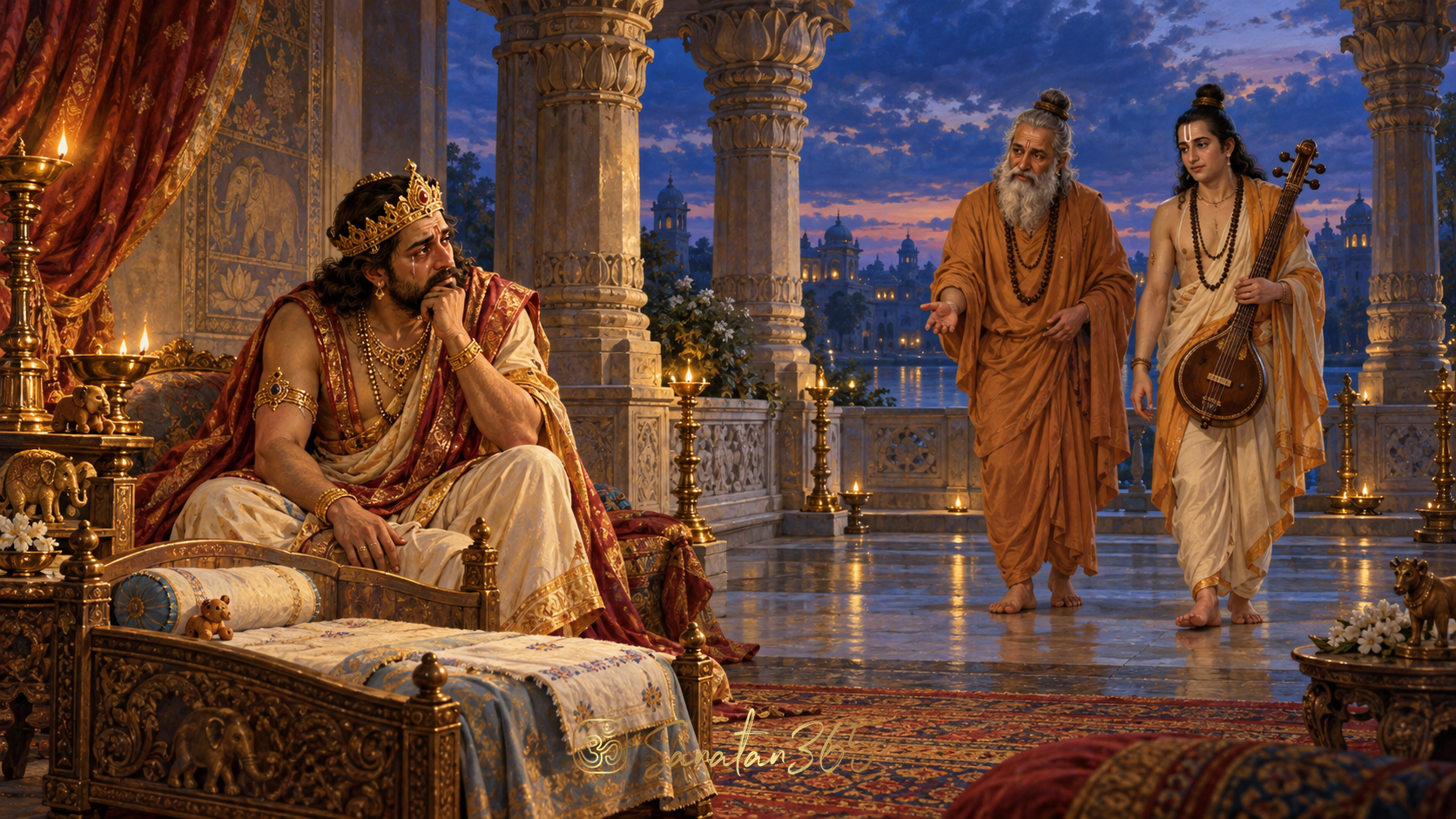
King Chitraketu Story: Grief, Wisdom, and Humility in the Bhagavata
The Bhagavata Purana tells how King Chitraketu met devastating loss, listened to Narada and Angira, and learned a difficult humility. Read…
 Stories
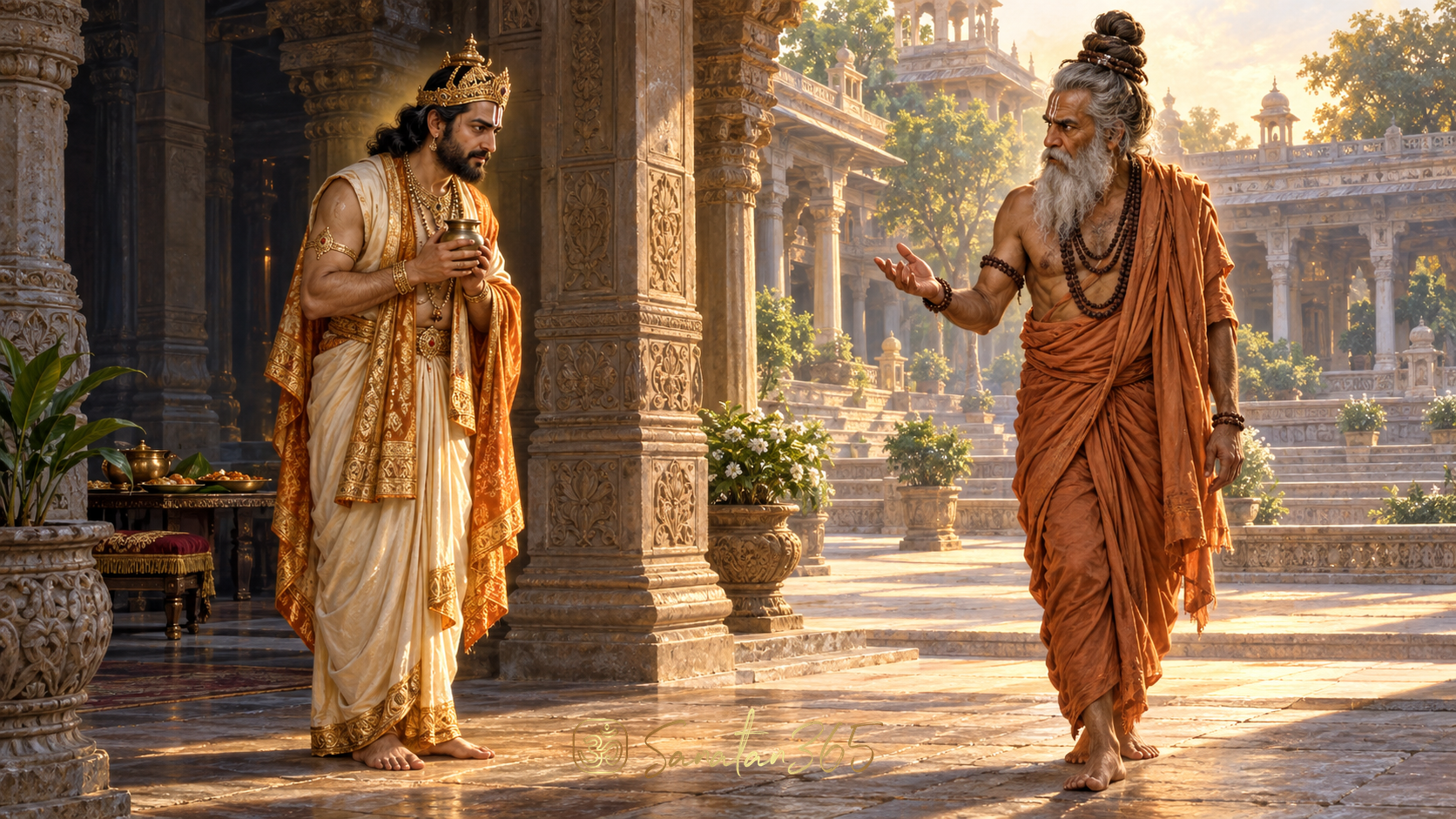
King Ambarisha and Durvasa: A Story of Devotion and Humility
The Bhagavata Purana story of King Ambarisha and Sage Durvasa explores a difficult fast, an angry visitor, and the restraint behind devotio…
 Stories
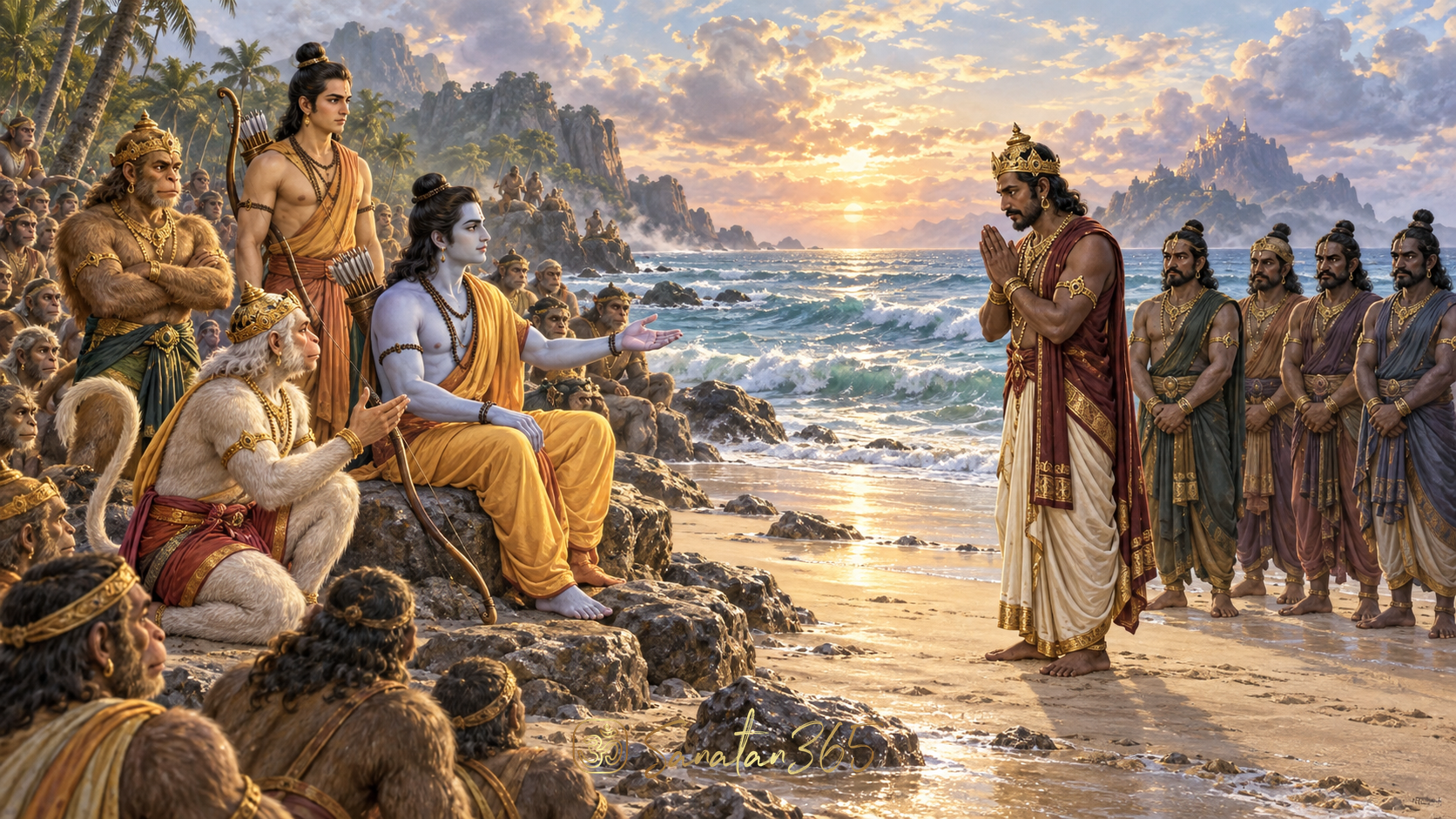
Vibhishana's Story: Why Rama Welcomed Him
Why did Vibhishana leave Lanka, and why did Rama welcome him? Read the Ramayana's debate about refuge, trust, and dharma with nuance.

