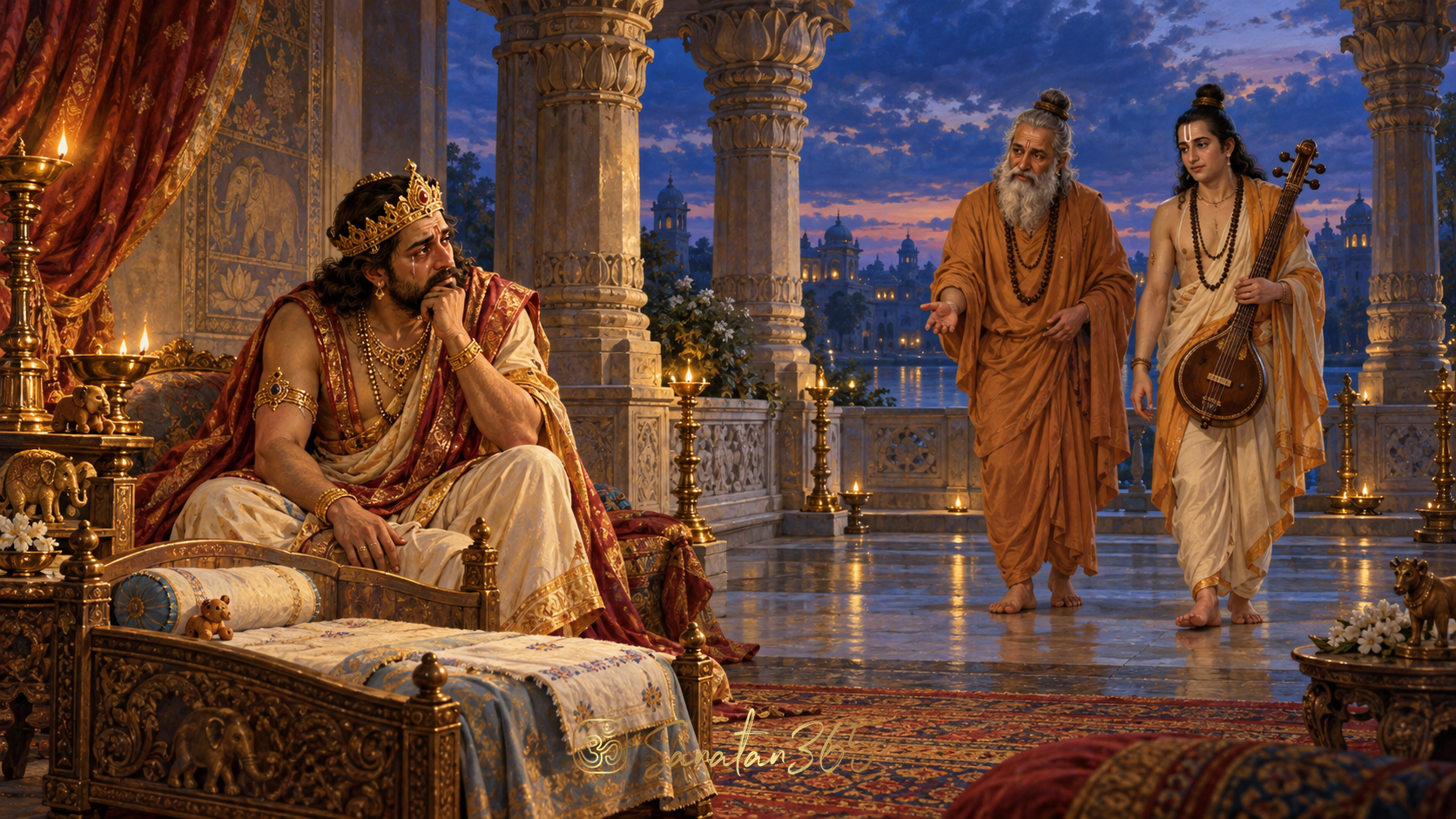
King Chitraketu Story: Grief, Wisdom, and Humility in the Bhagavata
The Bhagavata Purana tells how King Chitraketu met devastating loss, listened to Narada and Angira, and learned a difficult humility. Read the story without turning grief into a slogan.
A king can be surrounded by power and still be helpless beside his child's body. That painful image is the turning point of the King Chitraketu story.
In the Bhagavata Purana, Chitraketu longs for a son, receives one through sage Angira's intervention, and then loses the child. Angira returns with Narada to speak to the grieving parents about the changing bonds of embodied life. The account does not end with a neat cure for sorrow: Chitraketu enters devotional practice and later faces another lesson in humility when he speaks rashly in the presence of Shiva and Parvati. The story is found principally in Book 6, chapters 14–17 of the Bhagavata Purana. It is a religious narrative about attachment, insight, devotion, and conduct, not a promise that loss will feel easy.
What is the King Chitraketu story?
Chitraketu is a king with many queens but no child. His longing troubles him even while his kingdom prospers. When the sage Angira visits, the king reveals what his public abundance cannot solve. Angira arranges a rite, and the chief queen Krtadyuti gives birth to a son. The narrative of Book 6, chapter 14 makes a difficult point through this gift: a desired blessing can also become a place of vulnerability. The child brings joy, but the household's unequal attention and jealousy lead to catastrophe. The text says the other queens poison the boy; the parents' grief is then described without disguising its intensity.
This plot should not be flattened into a simple warning against loving one's children. The king's love is intelligible, and the narrative itself lingers beside the body rather than hurrying past it. The distinction is between love and the belief that anything beloved can be possessed permanently. Chitraketu's title cannot prevent bereavement. His spiritual teachers do not arrive to deny that he loved; they arrive because he is overwhelmed and needs a wider frame.
The story is also not a model for blaming bereaved parents. The destructive act belongs to those who acted from jealousy. Reading it responsibly means holding the moral weight of that act alongside the philosophical teaching that follows. Spiritual reflection should not erase wrongdoing or make a family's pain seem deserved.
Key takeaway: Chitraketu's loss exposes the limits of status and control, not a failure of parental love.
Why do Angira and Narada speak to a grieving father?
Book 6, chapter 15 brings Angira back with Narada, the wandering sage associated with devotion. They ask Chitraketu to consider what makes someone “mine” across the changing conditions of birth and death. Their examples concern temporary associations: people meet for a time, just as objects or travelers come together and later separate. The point is metaphysical, not a request to switch off affection on command.
The Sanskrit word atman (आत्मन्, the self) matters here. In the story's spiritual framework, embodied relationships are real experiences, yet the self is not exhausted by one bodily role. A father, mother, or child is more than the role by which another person knows them. Traditions interpret the precise nature of the self differently; the immediate narrative claim is that a relationship's present form is not the whole measure of a life.
That claim can sound severe if lifted out of its scene. The sages speak to parents whose sorrow the text has already shown. Their counsel is not permission for a bystander to tell a grieving family to “move on.” Compassion changes how a teaching is given. Someone facing fresh bereavement may need meals, company, silence, ritual support, or professional care before philosophical discussion is useful. The Bhagavata places teaching within an encounter, not on a poster detached from human need.
Angira also acknowledges that the son's arrival was bound up with joy and sorrow. This does not mean the child was a mistake. It means the expected permanence of any particular joy can become an additional source of pain. Chitraketu is asked to notice that difference: loving a person deeply and demanding that life guarantee their continued presence are not the same act.
Key takeaway: The sages invite a wider view of identity and impermanence; they do not make tenderness or practical care unnecessary.
What does the son's reply teach about impermanence?
In Book 6, chapter 16, Narada calls the departed son's self to speak. This is a sacred narrative event, not an ordinary experience that readers should expect or attempt to reproduce. The son's response asks, in effect, which of the many parents known across different lives these particular parents are. He speaks of the self passing through forms and associations, then departs. The scene puts the sages' teaching into a startling voice close to the parents' grief.
The argument depends on the Bhagavata's understanding of samsara (संसार, the cycle of embodied birth and death). That is a theological horizon, not a laboratory claim about a person's memories. Within it, “my child” names a precious relationship in one life, while the self's story is larger than one household can see. The narrative's answer to impermanence is not indifference. It asks whether love can be honored without claiming ownership over another self.
A modern reader may find the episode consoling, difficult, or both. The fact that a text offers a view beyond death does not remove the immediate ache of absence. Nor should the teaching be used to make specific claims about where a deceased person is now. The chapter gives a religious account of the self; it does not license confident personal predictions.
The parents' movement after the reply is significant. The text describes rites for their son and a transition toward spiritual instruction. Ritual here is not a mechanism to cancel grief. It gives action, community, and reverence a place where words alone are inadequate. Practices vary across families and regions, and no single reading of Chitraketu's story should be imposed on someone else at a funeral.
Key takeaway: The son's reply broadens the story's view of life, while the family's loss remains worthy of care and ritual dignity.
How does Chitraketu's devotion change him?
Narada instructs Chitraketu in devotional discipline after the funeral. The account in Book 6, chapter 16 moves from bereavement to a sustained practice of attention to the Divine. Chitraketu's spiritual change is not instantaneous emotional erasure. The plot gives him teaching, practice, and time before depicting a vision of the Lord.
The Sanskrit word bhakti (भक्ति, devoted participation or loving devotion) is useful here. It does not mean bargaining for another favorable event. In the Bhagavata's telling, devotion reorients Chitraketu from a single hoped-for outcome toward relationship with the Divine even when circumstances cannot be restored. This does not make every grieving person responsible for reaching the same state. It describes one scriptural character's path.
That path also changes the meaning of kingship. At the opening, his royal reach cannot secure what he wants. After instruction, the question is less “How do I command a result?” and more “How do I live when no result is guaranteed?” This is a sober question for anyone with responsibility for others. A parent, leader, or caregiver may do everything within their power and still face uncertainty. Spiritual practice may support humility and steadiness, but it is not a substitute for ordinary duties.
The devotional passages also caution against treating Chitraketu as a flawless hero. The story continues. His insight has grown, yet the later episode shows that a changed inner life still requires care in speech. The Bhagavata refuses the easy ending in which one revelation solves all ethical challenges.
Key takeaway: Devotion redirects Chitraketu's attention without making his humanity or responsibility disappear.
Why does the encounter with Shiva test humility?
Later, Chitraketu sees Shiva seated with Parvati in an assembly and laughs at their intimate posture. The encounter in Book 6, chapter 17 can be read too quickly if treated as a sectarian contest. Chitraketu's remark, Parvati's response, and Shiva's interpretation belong to a layered narrative about speech, dignity, and the limits of one's perspective. The chapter depicts Parvati cursing him; Chitraketu descends, bows, and accepts what has occurred. Shiva then speaks about the composure of a devotee.
One need not turn any figure into a villain to see the ethical tension. Chitraketu is not entitled to make an assembly's private relationship a public lesson merely because he thinks he has spiritual insight. Parvati's response marks that his words have consequences. His later humility matters precisely because he cannot edit the remark away. At the same time, the text honors Shiva and Parvati; it gives no basis for claiming that one deity's devotees are superior to another's.
The episode also complicates the word vairagya (वैराग्य, freedom from possessive attachment). Detachment is not permission to mock what another person reveres. Nor is spiritual confidence a warrant to correct everyone in public. When Chitraketu bows, the gesture is more than etiquette: it accepts that he is not the sole judge of the scene. One can learn from that without pretending the chapter supplies a simple rule for every human disagreement.
Traditional readers connect the curse to Chitraketu's later birth as Vritrasura, whose story appears elsewhere in Book 6. That narrative continuity matters, but it need not crowd out the immediate lesson. In this chapter, a king who has learned to face loss must also learn to face the consequences of his own speech.
Key takeaway: Chitraketu's later test is not whether he knows a teaching, but whether he can remain humble when his words cause harm.
How can readers approach this story with care?
A thoughtful reading keeps three levels apart. First is what the text narrates: a child's death, the counsel of sages, an extraordinary reply, devotional instruction, and a later encounter with Shiva and Parvati. Second is how a tradition interprets it: impermanence, the self's continuity, devotion, and humility. Third is what a reader may practice: accompanying someone in sorrow, speaking with restraint, and admitting when certainty is limited. Moving between these levels is valuable; confusing them can wound people.
For example, a person can sit with a grieving friend without quoting the son's speech. They might ask what practical help would matter today, remember the child by name if invited, or make space for the family's chosen rites. Someone who wants to study the text can begin with chapters 14–17 in sequence, noticing when a voice is narrator, teacher, parent, or son. A study circle might ask: What do the sages say after the text shows the king's lament? What changes in Chitraketu before the assembly scene? What does accepting a consequence reveal about humility?
This is not therapy, and spiritual reading should never be offered as a replacement for bereavement support, medical attention, or professional mental-health care when needed. A religious story can help some readers find language for love and impermanence. Others may need only compassionate presence for now. Both responses deserve respect.
The larger insight is subtle: Chitraketu is neither saved by royal power nor reduced to his worst moment. He suffers, learns, practices, speaks unwisely, and bows. The Bhagavata gives spiritual growth a human texture. That makes the story worth reading slowly, with attention to its narrative details and to the living people who may hear it.
Key takeaway: Read Chitraketu as a whole human figure, and let the story deepen care rather than furnish slogans about loss.
FAQ
Who was King Chitraketu in the Bhagavata Purana?
Chitraketu is the king whose longing for a son, the child's death, and subsequent instruction by Angira and Narada are narrated in Bhagavata Purana Book 6, chapters 14–16. Chapter 17 continues his story through an encounter with Shiva and Parvati.
Why did Narada and Angira visit Chitraketu after his son's death?
They came to address the king's overwhelming grief and to teach about the self and temporary forms of embodied relationship. Their counsel is part of the story's religious framework, not a reason to deny a bereaved person practical support.
Did Chitraketu's dead son speak in the story?
Yes. In Bhagavata Purana 6.16, Narada calls the departed son's self, which speaks about relationships across lives. This is a scriptural event, not a claim that such an event can be produced through ordinary practice.
What happened between Chitraketu and Shiva?
Chitraketu laughed and spoke on seeing Shiva with Parvati in an assembly. Parvati cursed him, and he bowed and accepted the consequence. The scene is often discussed as a lesson in humility and careful speech; it is not a basis for sectarian rankings.
What is the main lesson of the King Chitraketu story?
The story holds together the fragility of cherished relationships, devotion amid uncertainty, and humility after a mistaken word. Its teaching should lead to compassion toward grieving people, not pressure them to feel less.
About the author
Sanatan365 Editorial
Bringing Sanatan Dharma to modern seekers through authentic, scripture-grounded content.
Related in Stories
 Stories
King Ambarisha and Durvasa: A Story of Devotion and Humility
The Bhagavata Purana story of King Ambarisha and Sage Durvasa explores a difficult fast, an angry visitor, and the restraint behind devotio…
 Stories
Vibhishana's Story: Why Rama Welcomed Him
Why did Vibhishana leave Lanka, and why did Rama welcome him? Read the Ramayana's debate about refuge, trust, and dharma with nuance.
 Stories
Upamanyu’s Story: Discipline, Discernment, and the Ashvins’ Grace
Upamanyu’s early Mahabharata story follows a hungry student tested by his teacher, blinded after eating harmful leaves, and restored by the…

