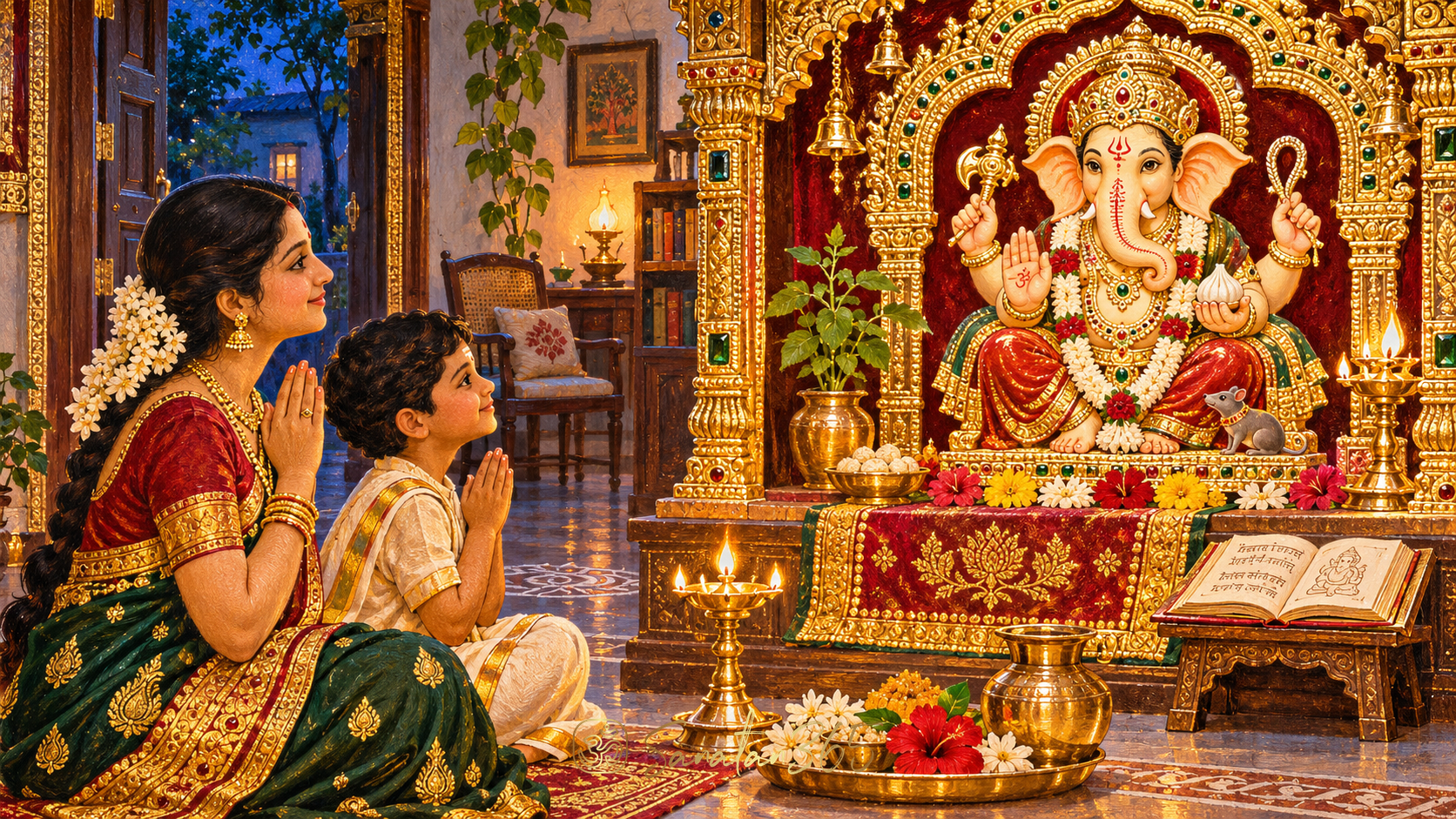
Avahana Meaning: Welcoming the Divine into Puja
Understand avahana as a devotional welcome, its place beside dedication and offerings, and why a household should learn the invocation within its own practice.
A welcome changes the meaning of a prepared room. Flowers, water and a carefully placed lamp become part of an address to someone, rather than an arrangement waiting to be admired.
Avahana meaning is invocation or invitation: āvāhana (आवाहन) is the devotional act of welcoming the deity in pūjā (पूजा, reverential worship). It gives the worship a clear relational beginning. The devotee invites the Divine to accept the attention and offerings being prepared. Its wording and actions belong to a particular form of worship, so understanding the invitation is more useful than assuming every opening prayer follows one universal script.
Avahana meaning: what does the invitation express?
The central idea is simple enough to recognise in the language of welcome. An invitation identifies whom it addresses, opens a relationship and gives the following actions their setting. In puja, that relationship is devotional: the offerings are presented to the deity with reverence.
Kauai’s Hindu Monastery labels āvāhanam (आवाहनम्, invocation) “Welcoming Offering” in its Ganesha Home Puja resources. Its published sequence places this after the dedication of the worship and before the subsequent offerings. This is a concrete institutional example, not a claim about the order of every Hindu ceremony.
The word can help a beginner hear the difference between speaking about a deity and addressing the deity. An explanatory sentence says what an offering is. An invitation begins the act of offering within a relationship. Learning both meanings allows the ritual to be understood without reducing it to a list of objects.
The welcome also gives attention a particular direction. A person may have spent time gathering flowers, finding a clean vessel and arranging the worship space. Avahana marks an opportunity to turn from the practical work toward the presence being honoured. The preparations remain useful; they now serve their devotional purpose.
This is a way of understanding the act, rather than a promise that a particular feeling must arise at once. A welcome can be sincere even when someone is still learning the words. Reverence grows through attention, practice and an increasing understanding of the form being followed.
It also helps to keep the invitation attached to its actual recipient. In worship centred on Ganesha, the devotee welcomes Ganesha. In another established form, the invocation addresses the deity of that form. Naming the relationship makes the act clearer than speaking vaguely of an unspecified force.
Key takeaway: Avahana expresses a devotional welcome that gives the offerings their personal and sacred setting.
How does welcoming give offerings their devotional setting?
A flower can be admired for its colour, placed on a table for decoration or offered in worship. The physical object may be similar in each case, but its relationship to the action changes. A welcome helps make the devotional relationship explicit.
The same can be seen in a simple household example. Before a guest arrives, a host may arrange a seat and set out water. When the guest is received, those preparations become expressions of attention to that person. This comparison is a reading aid for understanding welcome; it does not make every detail of human hospitality an exact explanation of divine worship.
In a devotional setting, the attention is directed toward the deity through the form of worship being followed. Mūrti (मूर्ति) names a sacred form or image through which the deity is worshipped. A reader encountering the term should understand that the devotee’s relationship is with the Divine honoured through that form, rather than merely with an attractive object.
The ritual language gives ordinary acts a purposeful sequence. Preparing, inviting and offering belong together. If the opening welcome is hurried past without any understanding, the next actions can seem disconnected: a flower here, water there, a lamp later. Learning what the invitation expresses helps the sequence become intelligible.
There is room for simplicity. A meaningful welcome does not depend on making the worship space appear expensive. A household can learn the significance of the accepted offerings in its own practice and care for them thoughtfully. Adding objects without knowing their place can make the arrangement harder to understand.
Nor does the interpretation require treating a deity as limited to the practical needs of a human visitor. The language of hospitality gives devotion an approachable form. The worshipper can offer attention and care while learning the fuller theological explanation from the tradition being followed.
A useful question is therefore: what is this action offering? It may offer a welcome, a seat, refreshment or light within a particular ritual. The question keeps the objects connected with meaning. The wider explanation of flowers as a devotional offering provides one example of that relationship.
Key takeaway: The welcome helps a sequence of physical offerings become a coherent expression of devotional attention.
How is avahana different from dedication and offering a seat?
Several actions can appear close together near the beginning of worship. They should be understood in the sequence being used, with enough clarity to recognise what each contributes.
In the monastery’s Ganesha resources, the dedication of the puja is listed separately from the welcoming offering. Saṅkalpa (सङ्कल्प, an intention or formal resolve) concerns the undertaking of the worship. Avahana concerns the invitation addressed to the deity. These are related moments, but their emphasis is different.
A separate example appears in Sri Rama Ramanujachari’s Puja Workbook. In its extended worship section, contemplation of the specific deity is followed by invocation, with an offering of a seat presented separately. The workbook supplies deity-specific examples. Its arrangement makes the distinctions visible without requiring a beginner to copy the entire liturgy.
The terms can be understood as follows:
- Dhyānam (ध्यानम्, contemplation): attending to the deity’s sacred form in the worship being described.
- Āvāhanam (आवाहनम्, invocation): inviting the deity to accept the worship.
- Āsanam (आसनम्, a seat): presenting a seat as an act of honour in that sequence.
These explanations introduce the functions of the words. They do not establish an unvarying order for every household or temple. A shorter ceremony, a different manual or another lineage may organise its worship differently.
For someone learning, the distinction can make a page of unfamiliar instructions less confusing. Rather than seeing several nearly identical opening lines, the reader can ask whether the action concerns intention, contemplation, invitation or an offering of service. Understanding the purpose makes it easier to follow a teacher’s explanation.
The same care prevents a common reading problem: assuming that a translation of one word is a complete account of the rite. “Invocation” is a helpful English starting point. The surrounding words, gesture, focal form and place in the sequence add the particular meaning of the invocation being performed.
The related article on sankalpa and sacred intention develops that neighbouring subject. Here the focus remains the welcome: whom the devotee addresses and how the following offerings are received within that relationship.
Key takeaway: Dedication, contemplation, invitation and offering a seat have distinguishable purposes, even when they occur close together.
Why do invocation forms change with the deity and tradition?
A prayer addressed to a particular deity carries the language of that relationship. The names, descriptions and focal form are meaningful parts of the address. They should not be treated as details that can be exchanged casually without learning the practice.
The workbook’s extended section illustrates this through invocations associated with Vishnu, Shiva and Devī (देवी, the Goddess). Its Shiva example refers to presence in the liṅga (लिङ्ग, the sacred form or sign of Shiva) for the duration of the worship. Its Devi example asks the Mother to accept the worship offered. The point here is the variety of address, not the reproduction of those invocations as a new combined procedure.
A household reading one source may also encounter a different number of steps from the one used at a nearby centre. That difference does not, by itself, establish that someone has omitted the meaning of welcome. It shows why a practice should be learned with its source and context visible.
Local guidance is especially useful when a family joins worship in a community with an unfamiliar format. Listening to how the leader explains the action, watching respectfully and asking an appropriate question afterward can provide a better introduction than trying to insert a remembered line from elsewhere.
Several questions keep that learning concrete:
- Which deity and sacred form does this invocation address?
- Which guide or teacher provides this sequence?
- What does the invitation mean in this setting?
- Is the learner observing, joining a response or being taught to perform the rite?
These questions express an interest in understanding. They need not become an examination of another household’s sincerity. A guest can respect a family’s way of worship while recognising that further instruction is needed before adopting it personally.
The visible focal point also deserves care. If the worship is directed toward Ganesha, the image, words and explanation should make that clear. If another established form is being honoured, the same principle of clarity applies. The relationship becomes easier for a child or visitor to understand when the family can explain whom it is welcoming.
Key takeaway: Invocation belongs to a specific devotional address and practice; learn that context before combining words or actions from different sources.
How can a household learn the welcome with care?
A household can begin with meaning before trying to master an entire sequence at once. It helps to choose the guidance relevant to the worship already being followed, then learn a manageable part with patience.
The following are practical learning suggestions, not a new avahana procedure:
- Keep one reliable reference nearby. A text that includes a clear explanation and suitable pronunciation support is easier to learn from than a collection of disconnected quotations.
- Understand the recipient and purpose. Be able to explain, in ordinary words, whom the invocation addresses and what is being offered through it.
- Learn pronunciation with support. Ask an appropriate teacher to demonstrate the wording or use the recording supplied with the chosen guide. A printed transliteration is helpful, but listening can clarify what the marks represent.
- Prepare before beginning. Arrange the materials needed for that practice so that learning the words is not repeatedly interrupted by searching for things.
- Ask about uncertainty. If a direction is unclear, keep the question specific and return to the guide or teacher instead of inventing an extra rule.
A child’s question can be a good measure of clarity. “Who are we welcoming?” can be answered with the deity’s name and the family’s explanation of the act. There is no need to replace a simple question with a long list of terms before the child understands the relationship.
A learner can also distinguish care from display. Care means attending to the practice, learning the words and preparing thoughtfully. Display becomes the focus when the arrangement matters chiefly as something to photograph or compare. This is a question for personal reflection, rather than a judgement about another family’s worship.
The connection with the wider ritual should remain visible. The invitation opens into offerings and an appropriate conclusion within the same practice. Our explanation of visarjana (विसर्जन, a ritual farewell), developed in the conclusion of puja, offers context for another part of worship; it is not an instruction to attach one universal ending to every form.
A thoughtful welcome can be both reverent and understandable. Learning its meaning allows the devotee to approach the words with attention, the offerings with care and the whole sequence as a relationship of worship.
Key takeaway: Learn the invitation as part of one coherent practice, with clear meaning, supported pronunciation and room for honest questions.
FAQ
What is the simple meaning of avahana?
Avahana means invocation or invitation. In puja it expresses a devotional welcome to the deity, inviting acceptance of the worship and offerings. The exact wording and action depend on the practice being followed.
Are avahana and sankalpa the same?
They have different emphases. Sankalpa concerns the undertaking or dedication of worship, while avahana expresses the invitation addressed to the deity. The monastery’s Ganesha resources list them as separate parts of its sequence.
Is the same invocation used for every deity?
The primary sources discussed here present specific forms of address. The priest-authored workbook includes examples for different deities, while the monastery provides a Ganesha-centred practice. A learner should use guidance appropriate to the intended worship.
Does learning the meaning replace learning the ritual?
Meaning provides a foundation. Pronunciation, actions and sequence still need to be learned from suitable guidance when a person is undertaking a particular rite. This article explains the welcome and offers study suggestions; it does not prescribe a complete ceremony.
About the author
Sanatan365 Editorial
Bringing Sanatan Dharma to modern seekers through authentic, scripture-grounded content.
Related in Rituals
 Rituals
Visarjana Meaning: The Sacred Farewell That Concludes Puja
Understand visarjana as a formal farewell in worship, distinguish it from immersion, and read two traditions’ concluding prayers with care.
 Rituals
Tambula Meaning: Why Betel Leaves Are Offered After Food in Puja
Understand tambula, the betel-leaf and areca-nut offering in puja: its place after food, its distinct materials and the care owed to differ…
 Rituals
Vastra Offering Meaning: Why Clothing Is Offered in Puja
The offering of cloth turns ordinary care into sacred hospitality. Understand vastra in Hindu worship without confusing expense with devoti…

