Tambula Meaning: Why Betel Leaves Are Offered After Food in Puja
Understand tambula, the betel-leaf and areca-nut offering in puja: its place after food, its distinct materials and the care owed to differing traditions.
The meal has been offered, but the welcome is not quite finished.
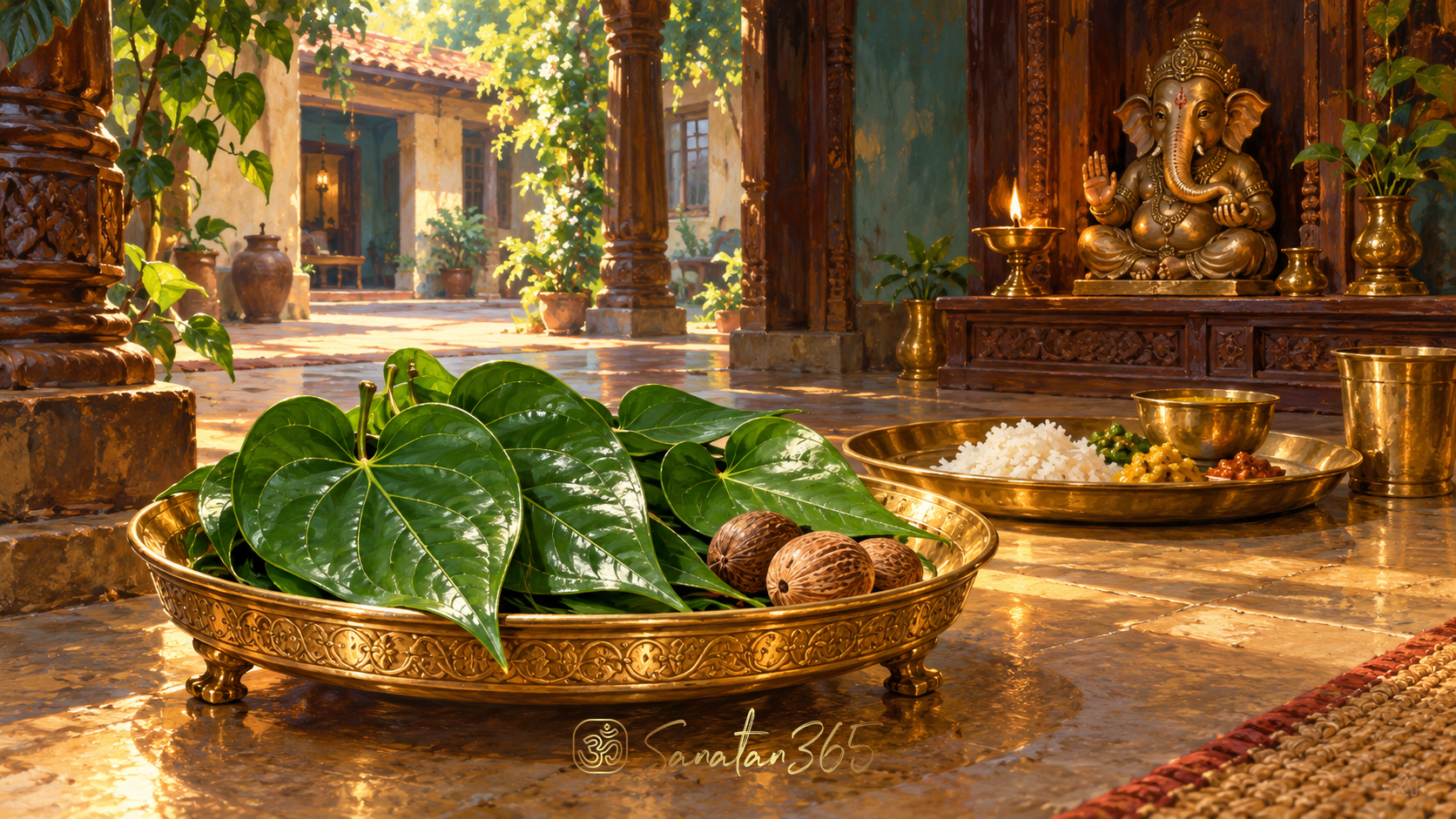
Tambula meaning becomes clear at this quiet point in Hindu worship. Tāmbūla (ताम्बूल, the betel-leaf and areca-nut offering) is presented in many forms of pūjā (पूजा, reverential worship) after naivedya (नैवेद्य, food offered to the Divine). It continues the courtesy shown to an honoured guest after a meal. The leaf and nut are distinct materials, and the offering's number, arrangement and accompanying words depend on the practice being followed. It is not a universal prescription for every household.
A fresh green leaf on a small plate can seem minor beside lamps, flowers and a prepared meal. Yet its place in the sequence makes it unusually revealing. Worship attends not only to arrival and nourishment, but also to what follows: the unhurried completion of a welcome. Understanding that place helps a beginner see an ordered act rather than a mysterious extra item on a shopping list.
Tambula meaning: where does it belong in a puja sequence?
The Hindu American Foundation's guide to traditional sixteen-step puja identifies a stage called Tambulam. It describes betel nut and leaves being offered as mouth fresheners after the meal. This is the ritual context of the offering, not advice to prepare or consume a chewing mixture.
The same guide explains worship through the hospitality extended to the chosen form of the Divine. A seat, water, clothing, fragrance, light and food become ways of receiving and honouring that presence. Tambula belongs within this language of care. The practical domestic courtesy behind it helps explain why it appears after food rather than among the opening acts of welcome.
Two material distinctions prevent common confusion:
- The betel leaf is the green leaf offered in this context.
- The areca nut, often called betel nut in English, is the nut associated with it. Leaf and nut are not two parts of the same plant.
The name of the offering can also be written as tambulam or tamboolam in English-language guides. Those spelling differences do not, by themselves, establish different rites. A reader should look at the materials, recipient and point in the ceremony before deciding what a particular instruction means.
The Foundation's practical home puja guide gives a helpful cross-check. Its expanded offering list includes food, seasonal fruits, tambula, a monetary offering and a concluding waving of flame. The two guides need not number or group every act identically for the basic relationship to remain intelligible: tambula comes in the later, post-food portion of worship.
Key takeaway: Tambula is best understood by its materials and its place after food, not by a rigid step number copied from one list.
Why do betel leaves follow the food offering?
A ritual sequence can preserve the small courtesies of ordinary life while giving them devotional depth. Receiving a guest does not end the instant a plate is placed before them. Attention continues through serving, allowing time, offering what custom provides afterwards, and concluding the encounter graciously.
Puja gives that attention a sacred recipient. The Divine is not being reduced to an ordinary visitor with ordinary needs. Rather, familiar acts of welcome become an intelligible form of reverence. The devotee offers time and thought through material things, acknowledging a relationship that exceeds those things.
The order matters because similar-looking objects can express different acts. Food offered as naivedya is not simply interchangeable with a later betel-leaf offering. Nor does placing every item on a tray at the start mean that all items perform the same role. Preparation can be simultaneous while dedication remains sequential.
Consider a household that arranges its offerings before beginning. A small food plate stands beside a separate dish holding leaves and nuts. The two may be only a few centimetres apart, yet the worshipper's attention moves from one service to another. The sequence, rather than the cost or abundance of the materials, gives each act its distinct meaning.
This also explains why the conclusion deserves care. A person may prepare an elaborate opening and then hurry through the final acts because the main food offering feels like the finish. Tambula invites a different pace: complete the service that has been undertaken, without treating the remaining details as leftovers.
The wider relationship between food offering and the sharing of prasad provides useful context. Prasāda (प्रसाद, grace and the blessed offering received after worship) concerns reception and sharing. Tambula names a particular offering within the service. These ideas can meet in a ceremony, but they should not be collapsed into one undifferentiated category.
Key takeaway: The post-food position teaches continuity of attention: sacred hospitality includes the way a welcome is completed.
How is tambula different from other sacred leaves and gifts?
A puja tray may contain several leaves, each with a different purpose. Visual resemblance alone is an unreliable guide. A leaf may be dedicated in worship, used to hold another item, or belong to a particular deity's established offering tradition. Those uses are not automatically equivalent.
Betel leaves in tambula should therefore not be casually substituted for every other leaf named in an instruction. The distinctive place of bilva leaves in Shiva worship, for example, belongs to another specific devotional context. Learning the difference respects both customs instead of turning all greenery into a generic ritual ingredient.
Three questions help clarify an unfamiliar offering:
- What is being presented? Identify the actual materials rather than relying only on a translated label.
- To whom is it being offered? An offering before a sacred image and a gift to a visitor have related but distinguishable settings.
- Where does it occur in the sequence? Placement after food, during a welcome, or when guests depart may explain the action more accurately than the object alone.
A further distinction concerns money. In the Foundation's practical guide, dakṣiṇā (दक्षिणा, a monetary offering) is listed separately from tambula. Its older sixteen-step explanation also notes monetary offerings near the tambulam stage. A household may therefore encounter closely associated items without needing to declare that every associated item is part of one fixed, universal definition.
The separate meaning of dakshina as an offering of gratitude and support can help a beginner read such a list. A coin placed beside a leaf does not make the leaf and the coin identical services. Grouping, local language and the occasion all matter.
Similarly, when a host uses a familiar word for a customary gift packet, ask what the term includes in that setting. It is better to receive a local explanation than to insist that a short internet definition must account for every ceremony. Related forms of courtesy can develop their own arrangements while remaining recognisably part of a culture of welcome.
Key takeaway: Distinguish the offering, the material and the recipient. Shared objects do not erase the differences between acts.
Which details depend on family and regional practice?
The Foundation's sixteen-step guide explicitly acknowledges differences in sequence and grouping across regional, community, family and devotional traditions. That qualification belongs at the centre of a practical explanation, not in a footnote after a list of supposedly compulsory rules.
A family in Tamil Nadu, a household in Karnataka and relatives worshipping in a diaspora apartment may not use identical terminology or arrange every offering in the same way. This observation is not a region-by-region rulebook. It is a reason to ask which tradition a set of instructions represents before applying it elsewhere.
The details most likely to require local guidance include:
- the number of leaves and nuts;
- whether the leaf remains whole or is arranged in a particular manner;
- the position of the small dish relative to other offerings;
- any accompanying fruit, money or other customary material;
- the words used for dedication;
- how the dedicated materials are handled afterwards.
No single count or orientation is prescribed here. A precise instruction can be entirely appropriate within the ceremony for which it was given without becoming a command binding every Hindu household. Conversely, acknowledging variation does not mean that details are meaningless. They may carry memory, discipline and devotional significance for the people who practise them.
Beginners can ask a priest or knowledgeable family elder a concrete question: “For the worship we are doing, what do we offer at this stage, and how do we conclude it?” That question is more useful than asking which arrangement is the only correct one everywhere.
The Foundation's home guide also addresses circumstances in which space, schedules and access to materials differ. This is particularly relevant outside India. A household should not invent an elaborate substitute from unrelated plants, or assume an unfamiliar packaged product is an appropriate ritual ingredient, simply to reproduce a photograph. Ask for a suitable approach within the practice being followed.
Key takeaway: Learn exact details from the relevant tradition. Variation calls for attentive questions, not a contest over whose household is correct.
How can a household prepare and conclude the offering with care?
The following is a preparation framework, not a replacement for a family's ritual instructions. It focuses on understanding and handling the offering rather than introducing a new ceremony.
First, establish the intended worship. Identify the sacred image or other accepted focal point, the occasion and the instructions being followed. This avoids collecting materials first and only later wondering what service they belong to.
Second, identify the items clearly. Keep the betel leaves and areca nuts distinct from the food offering and from leaves intended for another purpose. Purchase only what the actual practice requires. A small, intelligible arrangement serves a beginner better than a crowded tray whose contents nobody can explain.
Third, prepare the place with ordinary care. Use a clean small plate or the vessel customary in the household. Keep ritual materials separate from wrappers and household clutter. Attend to nearby lamp flames without letting the desire for a pleasing arrangement compromise practical care.
Fourth, understand the act while performing it. The home guide gives tāmbūlaṁ samarpayāmi, meaning “I offer tambula,” as an offering phrase within its larger puja formula. This short explanation is not a substitute for a teacher's pronunciation guidance or a ceremony's full wording. It simply makes the action intelligible: something prepared with attention is being consciously dedicated.
Finally, finish responsibly. Ask how the leaves and nuts should be kept, shared or disposed of in the household's custom. Ritual use does not oblige every participant to consume an item. Do not leave nuts or other small materials where young children can put them in their mouths. Do not mix wrappers into organic offerings, and do not scatter ceremony remains in public waterways or shared spaces.
The devotional lesson is modest but durable. Completion can be an act of love rather than an administrative ending. The last small offering deserves the same quality of attention as the first welcoming gesture, even when nobody is watching and no photograph will be taken.
Key takeaway: Prepare only what is needed, know what the offering means, and extend reverence to its careful conclusion.
FAQ
What is tambula in Hindu puja?
Tambula is the betel-leaf and areca-nut offering found in many puja sequences. It commonly appears after the food offering, continuing the courtesy shown to the Divine as an honoured guest.
Are betel leaf and betel nut the same thing?
No. The betel leaf and the areca nut, often called betel nut, are distinct materials from different plants. Their association in an offering does not make them botanically identical.
Is tambula compulsory in every daily puja?
No single expanded list describes every daily practice. The Hindu American Foundation recognises both elaborate and much simpler forms of worship. Follow the guidance appropriate to the household, occasion and devotional tradition.
How many leaves and nuts should be offered?
Use the number specified by the practice being followed. Counts and arrangements should not be generalised from one family, ceremony or online image into a universal rule.
Must the offering be eaten afterwards?
No participant should be pressured to consume it. Ask how the dedicated materials are handled within the relevant custom. This article explains a ritual offering, not a recipe or recommendation for chewing betel preparations.
About the author
Sanatan365 Editorial
Bringing Sanatan Dharma to modern seekers through authentic, scripture-grounded content.
Related in Rituals
 Rituals
Vastra Offering Meaning: Why Clothing Is Offered in Puja
The offering of cloth turns ordinary care into sacred hospitality. Understand vastra in Hindu worship without confusing expense with devoti…
 Rituals
Madhuparka Meaning: Sweetness and Sacred Hospitality
Read madhuparka as a ceremonial honey mixture of welcome, exploring textual recipes, guest reception and its distinction from panchamrita.
 Rituals
Samavartana Meaning: Returning Home After Sacred Study
Samavartana marks the completion of traditional study through a ceremonial bath and return. Its lasting question is how learning becomes re…

