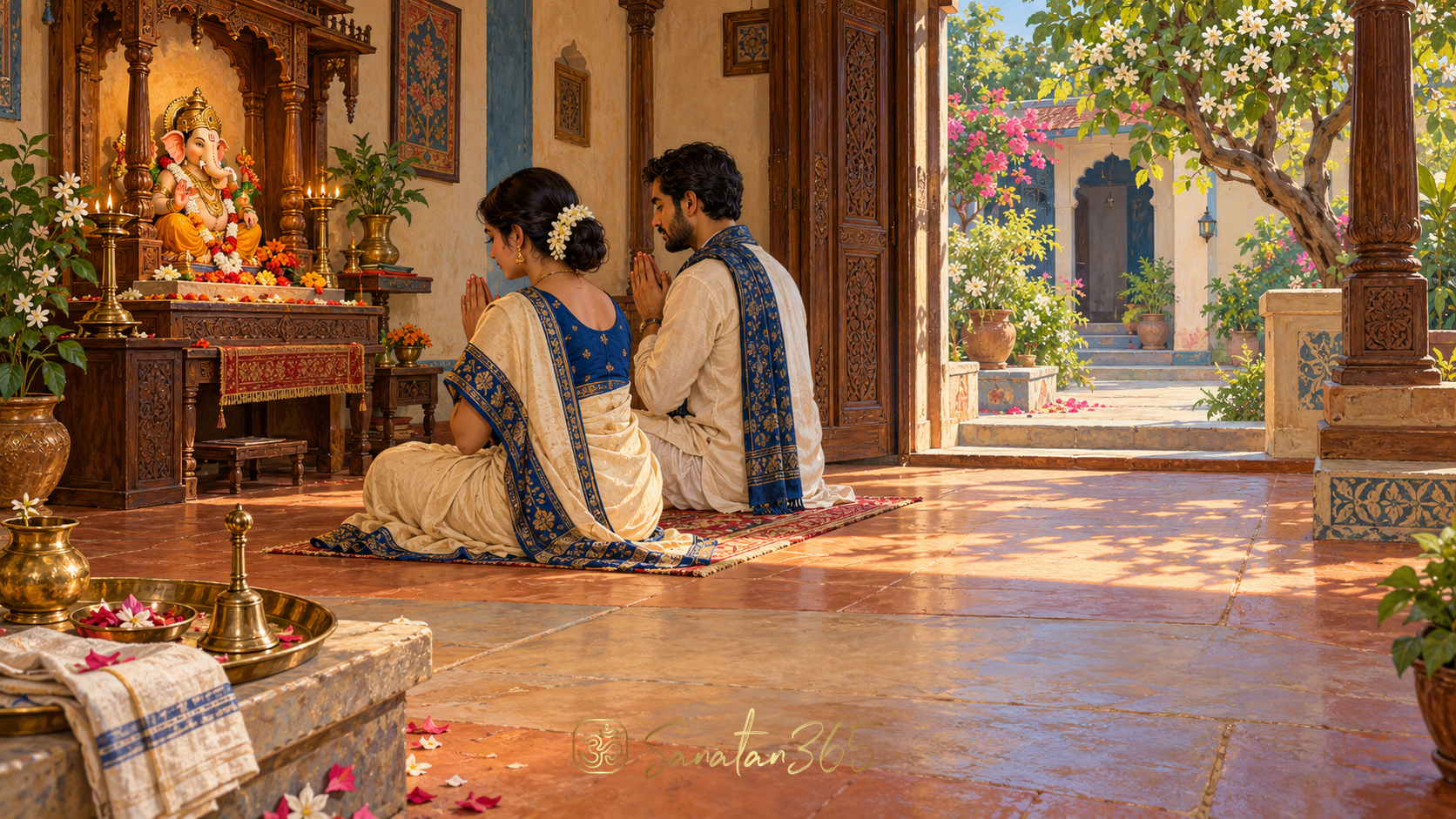
Visarjana Meaning: The Sacred Farewell That Concludes Puja
Understand visarjana as a formal farewell in worship, distinguish it from immersion, and read two traditions’ concluding prayers with care.
A prayer of farewell need not end at a riverbank. Visarjana meaning extends beyond the familiar festival image of immersion: विसर्जन (visarjana, a formal farewell or release) can name the concluding act of पूजा (pūjā, worship) itself. The ritual ending and the physical immersion of a temporary image are related in some celebrations, but they are not interchangeable instructions for every household shrine.
The distinction becomes clear through two living traditions: Himalayan Academy’s published home worship and Belur Math’s account of Durga Puja. Each offers a different view of how reverence finds a proper ending while devotion continues.
Visarjana meaning: a farewell with more than one form
For many readers, the word visarjan first brings to mind a procession, music and an image carried towards water. That association is understandable. It becomes limiting, however, when one familiar public scene supplies the meaning of every occurrence of the word in a worship manual.
A useful starting question is therefore quite concrete: what is being concluded, and what action does this particular tradition prescribe? A heading in a prayer book may introduce words spoken with folded hands. A festival programme may also describe a later procession and immersion. Understanding the setting matters as much as recognizing the term.
The Hindu American Foundation’s explanation of puja explicitly notes that visarjan may occur without water for a form without permanent consecration. This supports a careful distinction between the close of a particular invocation and the physical treatment of an image. It does not supply a universal procedure for all sacred forms.
Three ideas help keep the discussion clear:
- The prayer: words of farewell, gratitude or acknowledgment that bring worship to its conclusion.
- The ritual setting: the particular form of worship and the instructions governing it.
- The material action: what, if anything, is subsequently done with a temporary image or other ritual materials.
These are ways of reading a ceremony, not three mandatory stages newly added to it. Their value is practical. Someone trying to understand a closing prayer need not assume that every object on the altar must be taken away. Someone attending a festival immersion should equally avoid reducing the ceremony to the handling of an object.
The complementary term आवाहन (āvāhana, invocation or welcoming) helps explain the relationship. Welcoming and taking leave give a ceremony its shape. The language is relational: it expresses the devotee’s approach to the Divine. Reading it solely as a description of physical movement misses that devotional register.
This article concerns the closing act. The broader responsibilities associated with an established sacred image are discussed separately in the meaning of prana pratishtha (प्राणप्रतिष्ठा, prāṇa pratiṣṭhā, consecration of a sacred image). A general explainer about farewell should not be used to invent removal instructions for an existing shrine.
Key takeaway: Visarjana can name a formal conclusion of worship; the surrounding tradition determines whether immersion is also involved.
Why a concluding prayer includes an apology
In Himalayan Academy’s home puja manual, the final Visarjanam section joins farewell with an acknowledgment of imperfect ritual knowledge. Its prayer asks that shortcomings in invocation, worship and taking leave be forgiven. The accompanying directions place the devotee’s hands together and conclude the service reverently. The manual also encourages quiet meditation after worship.
The passage can be read as a lesson in humility. A devotee has prepared, offered and prayed, yet does not conclude by claiming complete mastery. The ending leaves room for the difference between sincere effort and perfect knowledge.
That distinction is especially useful for a beginner. Learning a rite involves several kinds of attention at once: following an order, understanding words, handling objects and listening to a teacher. An apology at the close need not become a rehearsal of everything that might have gone wrong. It can acknowledge the limits of the learner without turning those limits into the subject of the entire worship.
This is an interpretation of the prayer’s devotional tone, not a promise that instruction no longer matters. Careful learning and humility belong together. The person who admits uncertainty can ask a precise question afterwards: which line marks the farewell, what does it mean, and how is it recited in this household?
There is also a difference between asking forgiveness and treating worship as a performance for an audience. A family can notice a missed word without making a public lesson of someone’s mistake. A child who has watched quietly may understand the courtesy of the ending before learning its vocabulary. Neither example establishes a new ritual rule; both suggest a considerate way to support learning.
The closing apology offers another point for reflection. A ceremony often involves visible preparation: flowers arranged, vessels placed and offerings brought. The final words can redirect attention from what has been displayed to the spirit in which it was offered. The question becomes whether care and reverence accompanied the work, rather than whether the arrangement looked impressive.
A reader might pause over three questions after studying this prayer:
- What effort was made carefully today?
- What remains to be understood from the person teaching the rite?
- How can the next occasion be approached with greater attention?
These are optional reflection questions. They are not translations of the Sanskrit or requirements of the manual. Keeping that boundary clear allows a traditional prayer to be studied thoughtfully without attributing every modern teaching exercise to it.
The manual’s encouragement of quietness after worship also invites a simple observation: the last spoken line need not trigger an immediate scramble. Where circumstances allow, a brief, unhurried transition can give the ending its own dignity. The exact practice remains that of the household or teacher concerned.
Key takeaway: The concluding apology acknowledges imperfect knowledge while allowing sincere, careful worship to reach a reverent close.
Durga Puja at Belur Math: farewell before immersion
Belur Math’s account of Durga Puja provides a particularly clear example of why ritual farewell and immersion should be distinguished. Its description of दशमी (daśamī, the tenth lunar day) places a brief worship, food offering and आरती (ārati, worship with light) in the morning. The officiants then circumambulate the altar and perform visarjan.
In that rite, the Divine Mother, invoked in the consecrated image and नवपत्रिका (navapatrikā, a group of nine plants used in this observance), is entreated to return to her celestial abode. The account immediately affirms her continuing presence in devotees’ hearts. The procession to the river and immersion take place in the evening.
The order is the important detail. The institution describes a morning ritual of farewell and a later material immersion. A reader who treats the two as a single action loses the distinction made by the community performing the worship.
This example also helps with the language of departure. In the same account, farewell and continuing devotion stand together. The ceremonial request does not require the conclusion that divine relationship has become unavailable once a particular celebration ends.
For a family explaining the event to a younger observer, the sequence offers more than an abstract definition. One question can be asked while looking at the programme: when is the farewell prayer performed? Another follows: when does the procession occur? The answers make space for both the rite at the altar and the public culmination beside the river.
The example should remain named and local. It describes Belur Math’s practice; it is not a timetable for every Durga Puja. Nor does it establish a rule for another festival or a daily household shrine. Respect for tradition includes resisting the urge to turn one well-documented ceremony into a universal checklist.
It also keeps this discussion separate from a festival guide. Readers looking for the sequence and context of a different celebration can consult the Ganesh Chaturthi guide. The present question is narrower: how can a formal farewell be understood without confusing it with every action that may follow?
Key takeaway: At Belur Math’s Durga Puja, the documented farewell precedes the evening immersion, while the account explicitly affirms continuing devotion.
Bringing the distinction into household worship
The most useful household lesson is to identify the rite before copying its instructions. A permanent shrine, a temporary festival installation and a prayer offered before an image on a shelf may look similar in a photograph. That resemblance alone does not establish that their concluding procedures are the same.
An online reader can begin by checking what kind of document is being read. Is it a complete manual from a named tradition? A description of one institution’s festival? A short glossary? These sources answer different questions. A description can clarify meaning without giving the reader authority or sufficient instruction to reproduce the ceremony.
The two examples above work best in precisely that way. One shows a concluding prayer of humility in a home worship manual. The other shows a named community’s distinction between farewell and immersion. Together they correct a common confusion without pretending to replace a family’s existing practice.
For someone learning from an elder, teacher or priest, several questions are more useful than asking for a single rule about all pujas:
- Which passage is the conclusion of this particular worship?
- Does the instruction concern prayer, the invoked form, ritual materials, or more than one of these?
- Which actions belong specifically to the festival being observed?
- What should a learner understand before attempting any unfamiliar step?
The questions keep attention on the actual rite. They also make it easier to record an answer accurately. A short note headed with the name of the household tradition is more useful than a page titled “the correct Hindu method” assembled from unrelated sources.
Consider an ordinary learning situation. An adult helping a younger relative read a prayer book reaches a heading translated as farewell. The learner asks whether the household image must now be immersed. The teacher can first identify the kind of worship taking place and then explain the instructions used in that home. The conversation begins with meaning rather than an improvised action.
A second situation may arise after attending a large festival. A visitor remembers the procession most vividly and assumes that it alone constitutes visarjan. Reading the institution’s account afterwards can reveal prayers and acts performed earlier at the altar. The visible public event becomes part of a fuller ceremony, with its own beginning and conclusion.
Neither situation requires dismissing the learner’s first impression. It requires adding context. A respectful explanation can say that a word is used within a particular sequence and that the sequence must be understood before being borrowed.
The same care applies to Sanskrit vocabulary. A beginner benefits from learning the meaning of a closing prayer alongside its pronunciation. Recognizing the word for invitation or farewell provides orientation; it does not amount to mastery of the rite. Questions can be written down and taken to the person responsible for teaching it.
There is a broader devotional reflection here, offered as reflection rather than ritual law. A careful ending honours what has just taken place. Gratitude acknowledges the opportunity to worship; humility acknowledges the learner’s limits; returning to daily responsibilities gives those attitudes somewhere to be expressed.
That final movement does not need an elaborate personal resolution. It may mean putting away a reading book carefully, listening courteously to another family member, or completing an ordinary duty without irritation. Such examples describe possible conduct after worship, not effects guaranteed by a ceremony.
Key takeaway: Learn the conclusion appropriate to the actual household rite, and distinguish sourced instruction from personal reflection or a borrowed festival custom.
FAQ
Does visarjana always mean immersion in water?
No. It can refer to a formal farewell that concludes worship. Immersion belongs to particular observances involving temporary images or installations. The meaning of an instruction depends on the rite and its tradition.
Is a farewell prayer saying that devotion must end?
The documented examples do not support that conclusion. Belur Math’s account explicitly places the Divine Mother’s continuing presence in devotees’ hearts alongside the farewell. Ending a ceremony and ending devotion are different ideas.
Why does the concluding prayer ask forgiveness?
The Himalayan Academy example acknowledges incomplete knowledge and shortcomings in worship, asking that the offering be accepted. A useful reading is humility about the limits of one’s effort, together with a willingness to keep learning.
Should a household image be immersed after daily puja?
A general definition of visarjana is not an instruction to immerse a household image. Follow the practice appropriate to that shrine and ask its teacher or priest before changing how an established sacred image is treated.
Can these examples supply a complete farewell procedure?
No. They explain meaning through two named sources. Pronunciation, gestures and the precise closing sequence should be learned within the worship being followed, rather than combined from unrelated outlines.
The quiet close of worship deserves the same attention as its opening. Understanding visarjana allows a learner to recognize prayer, farewell and immersion in their proper settings, while carrying gratitude beyond the final words.
About the author
Sanatan365 Editorial
Bringing Sanatan Dharma to modern seekers through authentic, scripture-grounded content.
Related in Rituals
 Rituals
Avahana Meaning: Welcoming the Divine into Puja
Understand avahana as a devotional welcome, its place beside dedication and offerings, and why a household should learn the invocation with…
 Rituals
Tambula Meaning: Why Betel Leaves Are Offered After Food in Puja
Understand tambula, the betel-leaf and areca-nut offering in puja: its place after food, its distinct materials and the care owed to differ…
 Rituals
Vastra Offering Meaning: Why Clothing Is Offered in Puja
The offering of cloth turns ordinary care into sacred hospitality. Understand vastra in Hindu worship without confusing expense with devoti…

