Bhadrasana Meaning: What Makes This Seat Auspicious?
The older description and the modern demonstration share a name. The details of the seat explain what that name asks of attention.
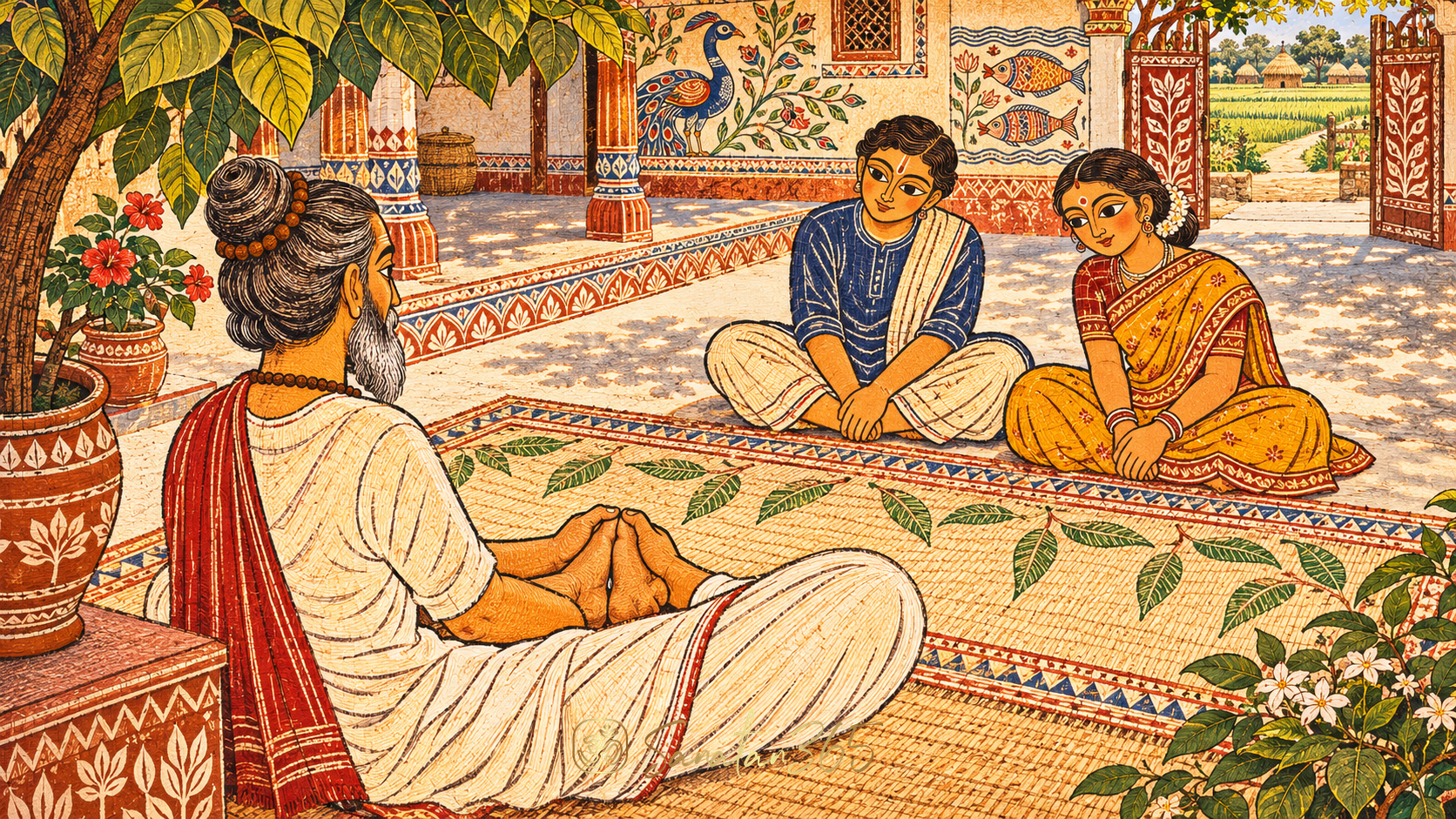
Two pictures can give the same yoga posture a different silhouette. The name can still tell the reader what the teacher is trying to show.
The Bhadrasana meaning is the firm or auspicious seat. Bhadrāsana (भद्रासन, firm or auspicious posture) combines bhadra (भद्र, auspicious or good, glossed as firm in the Common Yoga Protocol) with āsana (आसन, seat or posture). In the modern protocol demonstration, the practitioner sits upright with the soles together and the knees turned outward. The classical description gives particular attention to where the heels rest and how the feet are held. Comparing both accounts makes it easier to recognise the pose in context.
What is the Bhadrasana meaning?
The word “auspicious” usually brings to mind a welcome beginning or a setting in which something good can take place. Applied to a seat, it gives the name a different emphasis from a name that compares the body to an animal or a piece of equipment. The name identifies a posture and carries a positive sense of fitness or suitability. The Common Yoga Protocol puts the glosses “firm” and “auspicious” together. This gives a reader two complementary ways to think about the seat, one concerned with steadiness and the other with the character of a favorable beginning.
Think of a musician finding a place to sit before a rehearsal begins. One adjustment brings the instrument within comfortable reach. Another gives the arms room to move. Once these relationships are settled, the musician can give more attention to the music. The example helps explain the value of a well arranged seat without assigning the posture a result that its name alone cannot prove.
Terms that are translated into everyday English often acquire an extra emphasis. “Firm” can sound like an instruction to stiffen the whole body. In the name of this seat it can be understood as the quality of being settled and supported. “Auspicious” can sound like a promise about what will happen later. Read as a name, it indicates the posture's favorable or honored character. Neither gloss gives all the details of where a foot goes. Those details belong to the particular account or demonstration.
Key takeaway: The name brings the favorable character of the seat and its steadiness into the same description.
How does the classical text describe the seat?
The first chapter of the Haṭha Yoga Pradīpikā (हठयोगप्रदीपिका, a lamp on haṭha yoga) devotes a passage to Bhadrāsana. In Pancham Sinh’s translation, the description places the heels on their respective sides near the base of the trunk and describes holding the feet with both hands. The passage also associates the seat with the name Gorakṣāsana (गोरक्षासन, the posture of Gorakṣa). That alternative name belongs to the wording of this passage and provides a useful clue if a reader encounters it in an edition of the text.
Two details are easy to miss in a quick reading. The description names left and right separately, giving the reader a relation between the heels instead of only a broad picture of bent legs. It also involves both hands. This makes the hands part of the way the seat is described. An image with the sitter’s hands resting on the knees might convey a calm seated position while leaving out a detail the passage calls attention to.
A written description of that length also leaves choices for the reader or teacher. It does not provide a photograph, a sequence of directions for every learner, or a single angle from which the feet can be examined. The translator’s vocabulary can be quite precise about a location while still leaving a modern reader uncertain how to represent the whole figure. That is a reason to distinguish what the words establish from what an illustrator or a teacher adds to communicate them.
The title of a subsection can help readers locate the passage when verse numbering differs among editions. It is often more productive to look up the heading and compare a few lines on either side than to decide whether two verse numbers are interchangeable from memory. The continuity of the material about seated postures is easier to see when approached in that order.
Key takeaway: The classical account describes a particular relation of heels and hands and records the additional name Gorakṣāsana.
What does the modern Common Yoga Protocol show?
The Ministry of Ayush’s Common Yoga Protocol puts Bhadrāsana among the sitting postures. Its demonstration shows an upright figure, feet brought together in front and knees directed outward to either side. The hands take hold of the feet. The preparation and the completed posture are given as distinct parts of the demonstration. The chapter is designed to let a learner recognise the exercise and see how it follows from long sitting.
The finished position is helpful to identify by three relationships:
- The feet meet in front of the body, with their soles facing one another.
- The knees open to the sides, so the bent legs frame the feet.
- The trunk remains upright while the hands contact the feet.
Those relationships give an observer more information than the apparent height of either knee in a picture. A demonstration photographed slightly from above can make the legs look wider. A side view can make the torso easier to see while hiding one knee. The pose is easier to recognise when the viewer can combine a couple of clues, such as the joined feet and the hands holding them, before judging what the angle makes prominent.
The protocol gives a defined version for a shared learning setting. An older text answers a different kind of question in fewer words. In a classroom, a teacher can show the position from a second angle, demonstrate the transition, and explain what is characteristic of the version being taught. The classical passage is useful for understanding the name and the details its author stresses. The protocol makes the arrangement visible in a modern format.
The protocol's own appendix points to chapter 1, verses 53–54 of the Haṭha Yoga Pradīpikā for Bhadrāsana. This gives readers a direct way to move from the modern demonstration to an older description. It also helps explain why the two sources are useful together. One includes a visual sequence for group instruction. The other sits within a text concerned with the practice of yoga and describes the seat in a few lines.
Key takeaway: The protocol’s visible landmarks are the joined soles, outward knees, upright trunk and hands holding the feet.
Why can two pictures carry closely related pose names?
A posture name can refer to an established description in a book, a particular form taught at a school, or an arrangement labelled in an introductory lesson. When a reader moves from one setting to another, it helps to ask which description the name is attached to. The classical association with Gorakṣāsana shows that more than one name can be attached to a seat even within a single source. It gives little reason to assume that all modern captions using either name will show the same image.
In B. K. S. Iyengar’s Light on Yoga (plate 102), a reader encounters Baddha Koṇāsana (बद्ध कोणासन, bound-angle posture) with a similar joined-sole outline. The shape provides a useful visual comparison. The names draw attention to different aspects of what is shown. “Bound angle” directs the eye to the way the feet and bent legs are arranged. “Firm or auspicious seat” points toward the character of a seated posture. Details such as the distance of the feet from the body and the way an instructor asks the hands to hold them are best understood within that instructor’s own description.
A different comparison is available in Sukhasana, the easy seat. Both are sitting postures, and an upright trunk can appear in both. The legs and feet provide a clearer basis for telling them apart. In the familiar cross-legged arrangement of Sukhasana, the lower legs cross. In the protocol’s Bhadrāsana the soles meet and the legs frame the centre. This kind of comparison is more reliable than using the general idea of sitting calmly as the identifier.
Key takeaway: Compare the arrangement shown and the source naming it before treating similar photographs as equivalent.
What should a reader look for in a demonstration?
Start by identifying what the demonstration is trying to show. A class photograph might capture the finished seat, while a handbook may show a sequence. A wide artistic scene can communicate steadiness and attention with small figures, while a teaching photograph has to make the arrangement of the limbs legible. Each works at a different distance. A reader looking for the feet and hands should choose the view that actually shows them.
Next, trace a simple series of observations. The starting position has extended legs. The bend changes the angle of the knees. The feet meet in front and the hands make contact. Finally look from the base of the seat up to the trunk. These visual relationships give the watcher a way to follow the transition without guessing at hidden details. The contrast with Dandasana, the staff pose, where the legs stay extended, makes the change easy to see.
There is value in pausing on a single image and describing it plainly before attaching a name. For instance, a viewer might say that the seat stays low, the torso is upright, and the knees angle to either side around the joined feet. That description remains useful when comparing a photograph, a drawing and the wording of a passage. It also leaves room for the differences a tutor might explain in person. The deeper lesson of the name is easier to hear once the pressure to identify every seated figure at a glance is set aside. A well observed posture begins with seeing the support on which it rests.
Key takeaway: Follow the feet, knees, hands and trunk together. That tells more about the demonstration than a caption in isolation.
FAQ
What does Bhadrasana mean in Sanskrit?
It names a firm or auspicious posture. Bhadra supplies the sense of goodness or auspiciousness, and āsana means a seat or posture. The Common Yoga Protocol uses both “firm” and “auspicious” for its sitting posture.
Is Bhadrasana the same as Baddha Konasana?
The names are often associated with closely related seated shapes. A useful comparison begins with how the feet, knees, and hands are arranged in each description. Individual teaching traditions can supply their own details.
Where does the name Gorakshasana come from in this context?
The section on Bhadrāsana in the first chapter of the Haṭha Yoga Pradīpikā says the posture is also called Gorakṣāsana by accomplished yogis. The exact description in the edition is the useful point of reference.
How is the modern protocol version easiest to recognise?
Look for the soles together in front, the knees directed out to either side, and the hands holding the feet while the torso is upright. A view that includes the full seated figure makes those features easiest to see together.
About the author
Sanatan365 Editorial
Bringing Sanatan Dharma to modern seekers through authentic, scripture-grounded content.
Related in Wellness
 Wellness
Vrikshasana Meaning: Learning to Stand Like a Tree
Tree Pose combines one grounded leg with an upright form. Read its older description beside a modern teaching source, then approach the pos…
 Wellness
Dandasana Meaning: What Staff Pose Teaches Before a Seated Fold
Learn what Staff Pose is and how a simple seated baseline makes it easier to observe a fold or twist as it begins.
 Wellness
Shashankasana Meaning: Why Hare Pose Needs a Clear Description
Hare pose can describe different kneeling shapes. Read the Common Yoga Protocol version, distinguish crown-of-head Rabbit Pose, and learn w…

