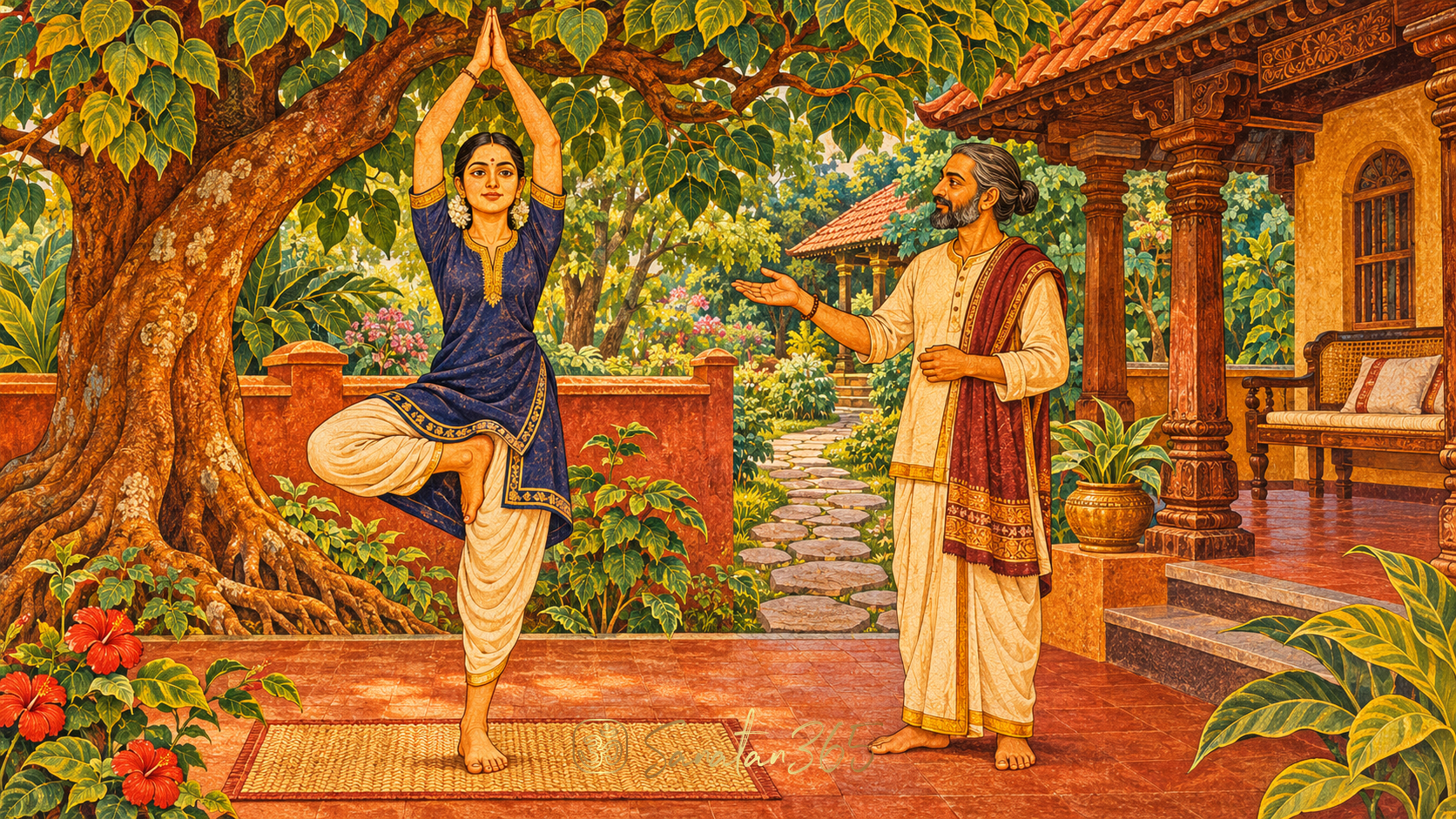
Vrikshasana Meaning: Learning to Stand Like a Tree
Tree Pose combines one grounded leg with an upright form. Read its older description beside a modern teaching source, then approach the posture with care.
A tree looks still, yet its branches can move in the breeze. The image offers a thoughtful way to approach a standing balance.
Vrikshasana meaning is Tree Pose. The Sanskrit words vṛkṣa (वृक्ष, tree) and āsana (आसन, posture) combine as vṛkṣāsana (वृक्षासन). Its recognisable form places one foot against the opposite inner thigh while the other leg supports an upright body. Reading a short traditional description beside a modern teaching source helps a learner understand the name, notice the posture’s details and approach learning with care.
What is Vrikshasana meaning?
The name asks the reader to notice a shape. One leg provides the visible support, the body rises above it, and the posture resembles a tree standing on the ground. The image is simple enough to remember before any technical vocabulary is introduced.
The Gujarat State Yog Board’s Tree Pose page explains the name through that resemblance. Its account belongs to a teaching context. A learner can use the name to recognise the posture while relying on appropriate instruction for how to learn it.
A tree image can also invite reflection. Roots, trunk and branches offer a way to think about support, uprightness and extension. That is a present-day interpretation of the image, rather than a claim that every part of a tree corresponds to a hidden bodily mechanism.
The distinction matters because a memorable metaphor can easily grow into an unsupported promise. Tree Pose does not need such promises to be worth understanding. Its form already gives a person something concrete to observe: the relationship between contact with the ground and the body above it.
A family discussing the posture might begin by asking what makes the tree comparison visible. One person may notice the supporting leg. Another may notice the extended arms in a modern demonstration. The answers can become more precise when the family distinguishes the central standing shape from details supplied by a particular teaching method.
The article on standing awareness in Tadasana introduces a related subject from a different posture. Here the interest lies in a one-legged standing form and the attention that its description invites.
Key takeaway: Vrikshasana means Tree Pose because of its visible tree-like form. The name can support understanding without being turned into a promise about outcomes.
What does the Gheranda Samhita describe?
The Gheraṇḍa Saṃhitā (घेरण्डसंहिता, Gheranda’s compendium) includes a short Tree Pose passage in its second chapter. The primary Sanskrit text at Sanskrit Documents places it under the heading for Vrikshasana:
वामोरुमूलदेशे च याम्यं पादं निधाय तु । तिष्ठेत्तु वृक्षवद्भूमौ वृक्षासनमिदं विदुः ॥
Vāmorumūladeśe ca yāmyaṃ pādaṃ nidhāya tu; tiṣṭhettu vṛkṣavadbhūmau vṛkṣāsanamidaṃ viduḥ.
In a close paraphrase, the passage places the right foot at the root of the left thigh and describes standing like a tree on the ground. Its emphasis is concise: placement, standing and resemblance. The reader can see why the name belongs to the posture.
The brevity also leaves room for an important reading habit. A familiar modern photograph may show palms joined above the head, but this short passage does not spell out that arm position. A reader should allow the words on the page to remain distinct from details learned elsewhere.
That does not require a dispute between text and teaching. A brief source and an expanded teaching description can serve different purposes. The source gives a compact statement; a teacher works with an actual learner who needs to understand the whole action.
It is useful to ask two questions while reading: what does the passage say, and what information has been added by the demonstration being viewed? Keeping those questions separate makes comparison more careful. It also helps a learner ask a teacher a clear question.
For example, a student might say, “The passage names the standing form and the foot placement. Could the arm position in this class be explained?” The question begins with something actually read. It gives the teacher a specific detail to discuss.
The online Sanskrit edition numbers this passage thirty-seven within the chapter. Other commonly encountered editions number the Tree Pose passage differently. Looking for its heading and wording is therefore more reliable than assuming a number alone identifies the exact text.
Key takeaway: The traditional passage gives a brief standing description. Read its actual words before adding the fuller details of a modern demonstration.
How does the modern Tree Pose description add detail?
A modern teaching description can help the learner see the posture as a sequence rather than a finished photograph. The Gujarat State Yog Board page begins with standing, includes a point of focus in front and describes the raised foot against the inner thigh of the supporting leg.
It then adds the arms extending upward with the palms joined, normal breathing during the posture, a return to standing and repetition on the other side. These are details of the particular form presented there. They make the teaching account more explicit than the short traditional passage.
The point of reading that description here is to recognise its parts. This article does not assess whether a particular reader should perform the full form. A qualified teacher can demonstrate the method and advise how an individual should approach learning.
The return deserves attention alongside the raised-arm image. A photograph often preserves the most recognisable moment, while the description continues beyond it. The learner comes out of the posture and returns to the initial standing position. The sequence has an ending as well as a shape.
Normal breathing is another modest but important detail in the teaching account. An observer may be drawn first to the lifted leg or hands. Reading the description brings attention to something less visible in a photograph. Understanding a posture involves more than reproducing its outline.
The same applies to the fixed point in front. A learner can ask a teacher where to direct the gaze and how to maintain it comfortably. That question is more useful than trying to copy every visual detail of another person’s demonstration.
The Dandasana introduction to a supported seated foundation offers another example of learning a posture through its arrangement and context. The poses are different, but the reading habit can carry over: identify the starting position, the main form and the return.
A learner preparing for a class can write those three headings on a page. Under each, record one detail from the source and one question for the teacher. The exercise is a study aid; it does not replace a live assessment or instruction.
Key takeaway: A teaching description adds a sequence, gaze, arm position, breathing and return. Understanding those parts is more useful than copying a finished outline alone.
How does standing balance invite steadiness and attention?
The tree image can become a gentle question about steadiness. What does it mean to remain attentive while the body is balancing? The answer need not begin with a long holding time or a comparison with someone else.
In an appropriately guided learning setting, attention can be directed toward the task the teacher has given. Perhaps the first learning point is recognising the starting stance. Perhaps it is understanding how the raised foot belongs in the demonstrated form. A clear focus makes the learning task more specific.
A small movement need not become a story about personal failure. It can be information to discuss with the teacher. What was being attempted? Was the instruction understood? Is a different learning approach needed? The questions keep the conversation close to the actual practice.
The metaphor of a tree is useful here if it remains a metaphor. A tree’s rootedness can suggest returning attention to support. Its upright trunk can suggest a clear direction of growth. Its moving leaves can remind a learner that stillness in a picture is only one way of seeing a living form.
These reflections are offered as ways to think about the name. They do not establish clinical effects, spiritual attainment or a measure of someone’s character. A person who finds a standing balance difficult has not failed a test of devotion.
For a child learning about yoga, naming an observation can be a good beginning. The child might identify which foot stays on the ground or notice when the demonstrator returns to standing. Observation can be welcomed without asking the child to imitate an unsuitable challenge.
An adult can practise the same patience in study. Watch one clear demonstration, listen to the instruction and ask about one unfamiliar detail. Trying to gather many impressive variations at once can make the basic form harder to understand.
The article on finding ease in a supported seat discusses a quieter arrangement. Its relevance here is the value of attending to an actual learner. Different people may need different instruction, and a photograph cannot answer every practical question.
A useful reflection after a suitable lesson might be, “Which instruction became clearer?” That question recognises learning even when the visible form remains modest. It gives attention a purpose beyond trying to hold a pose longer than another person.
Key takeaway: Let steadiness be a subject of attentive learning. A wobble or a modest form can prompt a useful question rather than a judgement about the person.
How should a learner read Tree Pose precautions?
Care begins with the limits of a general description. A public article can explain a name and compare sources. It cannot determine an individual reader’s suitability for a standing balance or provide a personalised progression.
The Gujarat State Yog Board’s page explicitly cautions against this practice in cases of arthritis or vertigo. Those source cautions should be taken seriously. Anyone uncertain about suitability should consult an appropriate healthcare professional, and learn physical practice with a qualified yoga teacher.
That leaves plenty of room for useful learning. A person can read the source, understand the tree comparison and ask questions without treating the full displayed posture as an immediate personal assignment. Knowledge of a posture and readiness to perform it are different matters.
Before a suitable class, a learner can bring a few concrete questions:
- What is the starting position for the form being taught?
- Where does the teacher want the gaze directed?
- How will the learner be guided into and out of the posture?
- What should the learner do if the task feels uncomfortable or unsteady?
- Is this particular practice appropriate for the learner’s circumstances?
These questions are preparation for instruction, not a substitute technique. A good answer should help the person understand what is being asked before attempting it. If an instruction remains unclear, asking again is a reasonable part of learning.
The same principle applies when reading an old verse. A short textual description should not be used to justify forcing the body into a position. The passage belongs within a tradition of study and practice; an isolated line cannot assess a present-day person’s needs.
There is also no need to add promises that the pose will cure a condition, increase height or produce a particular psychological result. This article makes none of those claims. Its focus is the name, the form, the source comparison and the quality of attention brought to learning.
A family can carry that approach into conversation after a lesson. Invite a learner to describe what was explained, what remained unfamiliar and which question would help next time. Such a conversation gives the experience room to become understood.
The final takeaway is simple: stand like a tree first in the imagination, then learn the actual posture through appropriate guidance. The name can invite patience, attention and respect for the person doing the learning.
Key takeaway: Read the cautions, seek appropriate guidance and let understanding lead the approach. Tree Pose is a subject to learn carefully, rather than a shape to force.
FAQ
What is Vrikshasana meaning in English?
Vrikshasana means Tree Pose. Its name combines the Sanskrit words for tree and posture, referring to the tree-like standing form.
Does the traditional passage describe the raised arms?
The short Gheranda Samhita passage discussed here describes the foot placement and tree-like standing. The modern teaching page adds an overhead joined-palms position.
Does a wobble mean the learner has failed?
It can be information to discuss with a qualified teacher. This article does not treat balancing ability as a judgement of character or devotion.
Is this article a personalised practice plan?
No. It explains the name and sources. Suitability and physical instruction should be discussed with qualified professionals as appropriate.
About the author
Sanatan365 Editorial
Bringing Sanatan Dharma to modern seekers through authentic, scripture-grounded content.
Related in Wellness
 Wellness
Dandasana Meaning: What Staff Pose Teaches Before a Seated Fold
Learn what Staff Pose is and how a simple seated baseline makes it easier to observe a fold or twist as it begins.
 Wellness
Shashankasana Meaning: Why Hare Pose Needs a Clear Description
Hare pose can describe different kneeling shapes. Read the Common Yoga Protocol version, distinguish crown-of-head Rabbit Pose, and learn w…
 Wellness
Makarasana Meaning: Crocodile Pose and the Value of Prone Rest
Learn the simple forehead-supported form of Makarasana, how it differs from Cobra and Shavasana (Corpse Pose), and why a resting posture ne…

