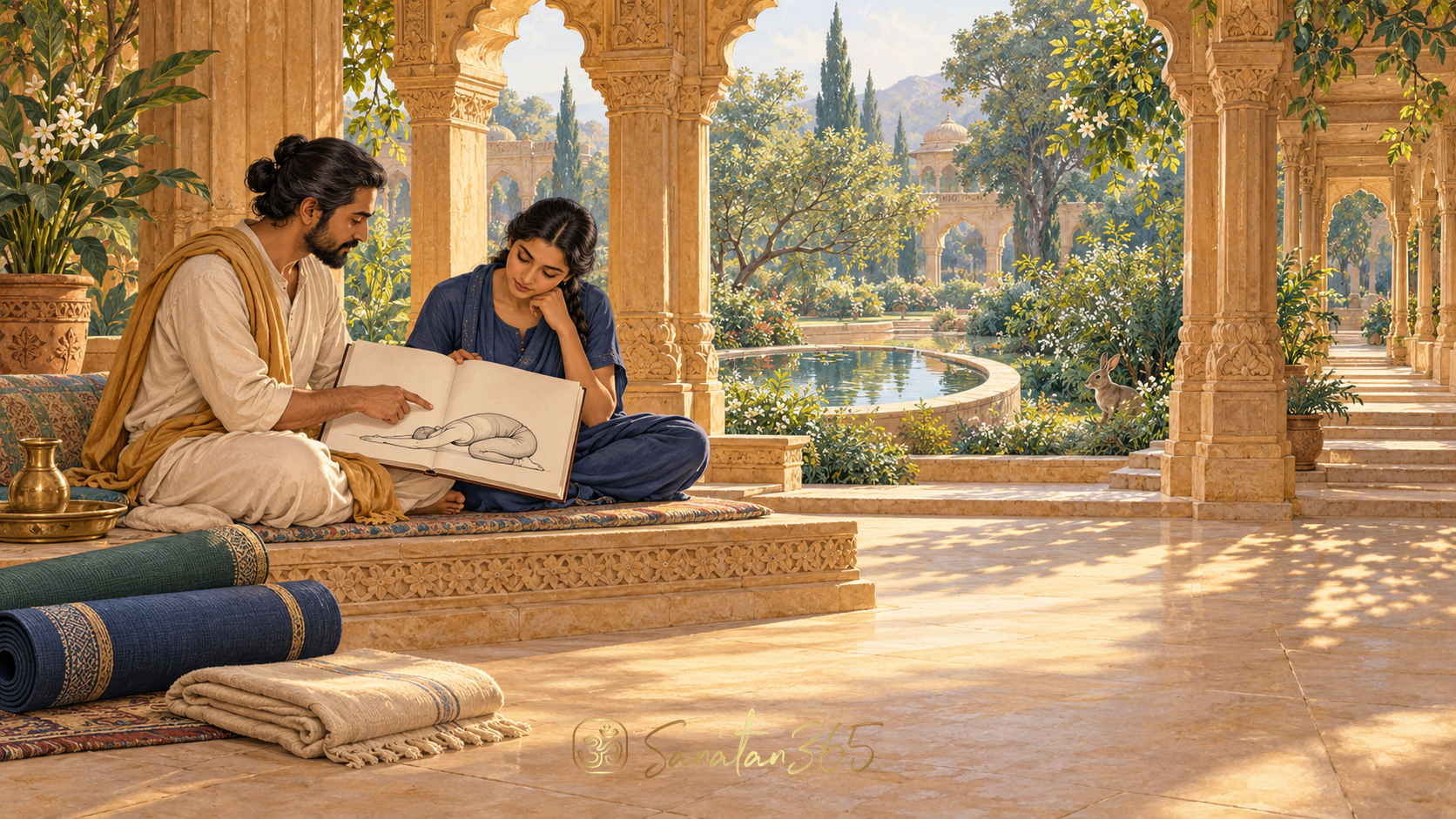
Shashankasana Meaning: Why Hare Pose Needs a Clear Description
Hare pose can describe different kneeling shapes. Read the Common Yoga Protocol version, distinguish crown-of-head Rabbit Pose, and learn what to ask before practice.
Shashankasana Meaning: Why Hare Pose Needs a Clear Description
A familiar pose name does not always describe a familiar movement. Shashankasana meaning is usually given as Hare Pose, a name drawn from the Sanskrit word for hare. Yet English-language yoga instructions may use Hare Pose or Rabbit Pose for noticeably different shapes. The practical question is therefore not just what the name means, but what a particular source asks the body to do. The Indian Common Yoga Protocol describes a kneeling, forward-reaching posture; another widely circulated Rabbit Pose places the crown of the head on the floor and raises the hips.
That distinction matters before anyone unrolls a mat. A name can offer a memorable image without providing enough information to practise. Reading carefully, asking a teacher and declining an unsuitable movement are all more useful than trying to reproduce a photograph. This article explains the naming difference and the questions it raises, without presenting either posture as medical treatment or offering a head-supported practice tutorial.
What does Shashankasana meaning tell us about Hare Pose?
The Ministry of AYUSH Common Yoga Protocol, hosted by India's Ministry of External Affairs, translates the posture's animal name as hare. In everyday Roman spelling, readers will encounter Shashankasana alongside other transliterations. Here, āsana (आसन, posture or seat) is the second part of the compound. The animal image makes the name easier to remember; it does not establish one universally agreed set of instructions.
This is an important distinction in learning yoga. A translated name is a label, while a method includes starting position, direction of movement, points of contact and a way of returning. Two teachers can use related labels but mean different arrangements of those elements. Conversely, a single movement may have more than one name across classes and manuals.
The sensible response is neither to declare every variation wrong nor to pretend that variations are interchangeable. A description should identify its source. “The Hare Posture in this edition of the Common Yoga Protocol” is more precise than “the one correct Rabbit Pose.” That precision respects the reader as well as the teaching tradition.
The distinction also helps with internet searches. Search results often place gentle kneeling folds beside much more compact, head-supported shapes. A reader looking only at the title may assume they are successive stages of one exercise. The name alone does not justify that assumption. The underlying instructions must be read before deciding whether an illustration is relevant.
Key takeaway: A posture name gives an image and a starting point for inquiry, not a complete movement prescription.
How does the Common Yoga Protocol describe the posture?
The cited protocol starts from Vajrāsana (वज्रासन, the kneeling Thunderbolt Seat). For readers unfamiliar with that base, the separate guide to Vajrasana and supported kneeling explains why a seated starting position deserves attention in its own right. It should not be treated as comfortable for every body merely because it precedes another posture.
In the institutional description, the knees are spread apart and the big toes remain touching. The palms are placed between the knees, the arms reach forward as the practitioner exhales, and the text describes bringing the chin to the ground. It then specifies parallel arms and looking ahead. The return is described with an inhalation, followed by returning to the kneeling seat and then to a long-legged resting position.
These details are a reading of that document, not an instruction to force the chin down. They are especially useful because they distinguish this version from a forehead-resting fold and from the crown-supported Rabbit Pose discussed below. The document's chosen contact point should not be silently replaced while claiming to reproduce its instructions exactly.
A reader may notice that a familiar classroom version instead rests the forehead on support. That observation can become a useful question for the teacher: “Are we following the Common Yoga Protocol version, or a different kneeling fold?” A careful answer can explain the intended arrangement without turning one lineage's terminology into a rule for all yoga.
The protocol also contains explicit cautions. It advises avoiding this posture with acute backache and exercising caution or avoiding the kneeling base in cases of knee osteoarthritis. These are the source's cautions, not a complete individual screening checklist. Pain, injury, pregnancy, recovery from surgery or uncertainty about an existing condition calls for appropriate professional guidance before trying a movement from an article.
No one needs to make contact with the floor to prove that they have understood the text. Understanding means recognising what is being described and whether it is appropriate to attempt with qualified guidance. It is possible to learn accurately while remaining seated in another comfortable position or simply watching a demonstration.
Key takeaway: The cited protocol describes a specific chin-down, forward-reaching form; its wording should be distinguished from other versions rather than blended with them.
Why can Rabbit Pose mean a different shape?
Yoga International's description of Sasangasana offers a clear example of the naming problem. Its Rabbit Pose begins from kneeling, uses the hands to hold the heels or lower legs, places the crown of the head on the floor near the knees and lifts the hips. The article itself notes that Sasangasana is sometimes written Shashankasana.
This is not simply a different English translation of the protocol's forward reach. The points of contact, hand placement, position of the pelvis and relationship of the head to the ground differ. Those differences change the practical questions a teacher must answer. A reader should not transfer instructions about the arms, head or exit from one version into the other.
For clarity, compare the descriptions rather than deciding from their shared animal name:
- Common Yoga Protocol example: arms reaching forward, knees apart, chin described at the ground, gaze ahead.
- Yoga International Rabbit Pose example: hands holding heels or lower legs, crown contacting the floor, hips lifting.
- A forehead-resting classroom fold: another arrangement that needs its own description; neither of the previous descriptions should be assumed to cover it automatically.
This comparison is intended to prevent mistaken imitation, not to teach a head-supported posture. That version requires direct, qualified instruction and appropriate individual assessment. A general article cannot assess neck loading, balance, range of movement or the suitability of a particular student's practice.
The second source also includes health-related claims. Their presence does not make those claims the purpose of this article, and they are not repeated here as promised outcomes. The useful evidence for the present question is the documented shape and the shared naming. A source can help resolve a terminology question without every statement on its page becoming an endorsement.
Names can be particularly confusing when a short video is detached from its original class. The caption may say only “rabbit,” while the demonstration depends on earlier preparation and a teacher's observations. Saving the clip does not save that missing context. Before attempting anything, the reader needs more than recognition of the animal word.
Key takeaway: Similar names do not make a forward-reaching kneeling fold and a crown-supported Rabbit Pose interchangeable.
What should a beginner ask before trying Hare Pose?
The most helpful first question is concrete: “Which part of the head, if any, is meant to touch the floor in this version?” That question immediately distinguishes several common interpretations. It also gives the teacher a chance to demonstrate instead of relying on a label the student may understand differently.
Other useful questions concern the starting seat, the hands, the pelvis and the return. Is the class beginning from a heel-sitting position? Are the hands reaching ahead or holding the heels? Are the hips intended to stay near the heels or rise? How should the student leave the posture? Asking these questions is part of responsible learning, not an interruption of it.
Before taking part, a reader can use this short conversation checklist:
- Name the version and the source being followed.
- Explain any relevant pain, injury or movement restriction privately to the teacher.
- Ask what a suitable alternative would be, including observing rather than performing.
- Confirm that there is no requirement to reach a particular floor contact.
- Learn the way out before beginning the way in.
A qualified teacher can help choose an appropriate position, but an article cannot replace individual care. Stop a movement that causes pain, dizziness or difficulty breathing. Readers with a relevant medical condition should seek advice from an appropriate healthcare professional rather than relying on a claim that a named pose is inherently gentle.
Support can be discussed without being prescribed universally. A folded blanket may change the experience of kneeling; a different resting position may be preferable to kneeling altogether. Neither option is a test of dedication. The relevant question is whether the arrangement is appropriate for that person and that lesson.
For a discussion of a different resting arrangement, the Makarasana posture guide explains the Common Yoga Protocol's prone rest. It is not an automatic substitute for everyone, but it shows why “resting pose” still requires a specific description. The same discipline applies to Hare Pose: an inviting name does not remove the need for clarity.
Key takeaway: Ask about actual contact points, support and the exit; do not let a reassuring name substitute for individual guidance.
How can a class make instructions clearer and more respectful?
A teacher can reduce confusion by pairing the Sanskrit-derived name with a short physical description. “Hare Pose, in today's forward-reaching version” is more informative than repeating the name louder. Naming the source, demonstrating slowly and stating an alternative can make the lesson easier to follow without erasing traditional vocabulary.
Students also benefit when a class distinguishes a demonstration from a demand. A teacher's body can show the intended direction of movement while acknowledging that the student's endpoint may differ. The floor is not a certificate of understanding. Attention to the instruction, willingness to ask and the ability to stop remain valuable even when the final shape is modest.
For Indian and diaspora learners, these naming differences may arise between a family practice, an institutional programme and a studio abroad. It is unnecessary to reduce that experience to a competition between “authentic” and “inauthentic” bodies. Better questions are: Which source is being used? Is the description coherent? Does the teacher recognise individual limits? Are traditional terms explained with care?
Printed notes and online captions can follow the same approach. Include a sentence describing the version rather than attaching a bare pose name to a photograph. If an image shows the crown of the head touching the floor, do not label it as the protocol's chin-down version. If a classroom practice rests the forehead, say so instead of borrowing another source's wording.
The broader lesson is that careful language serves embodied learning. Just as the Sukhasana guide separates the name “Easy Pose” from a promise of effortless sitting, a Hare Pose explanation should separate a memorable label from an assumed universal method. Precision makes room for learning rather than narrowing it.
A good conclusion is therefore simple: understand the version before considering the movement. The animal name can remain beautiful and memorable, while the explanation remains exact. Neither cultural respect nor personal care requires pretending that every teacher uses every name identically.
Key takeaway: Clear, source-specific language honours yoga's diversity while helping a student make an informed choice.
FAQ
What is the basic Shashankasana meaning?
It is commonly translated as Hare Pose. The cited Common Yoga Protocol explains the animal word as hare. The name identifies a posture family or teaching label, but its exact physical form must be established from the particular instructions.
Is Shashankasana always the same as Rabbit Pose?
No. English-language sources may use related names for different shapes. The Common Yoga Protocol's forward-reaching version differs from the crown-supported Sasangasana described by Yoga International. Check contact points, hand placement and hip position rather than assuming the names guarantee an identical method.
Does the Common Yoga Protocol place the forehead on the ground?
The edition cited here says chin, with parallel arms and a forward gaze. A forehead-resting classroom variation should be identified separately. This wording comparison is not a recommendation to force the chin to the floor.
Is Hare Pose suitable for every beginner?
No posture is appropriate for everyone simply because it appears in a beginner sequence. The protocol includes cautions about acute backache and the kneeling base. Ask a qualified teacher about suitability and seek appropriate healthcare advice for relevant conditions; observing is a valid choice.
Should a reader try the crown-supported version from this article?
No. This article identifies a naming difference and is not a tutorial for head-supported practice. Learn any such movement directly with qualified guidance and individual assessment rather than combining instructions from unrelated descriptions.
About the author
Sanatan365 Editorial
Bringing Sanatan Dharma to modern seekers through authentic, scripture-grounded content.
Related in Wellness
 Wellness
Vrikshasana Meaning: Learning to Stand Like a Tree
Tree Pose combines one grounded leg with an upright form. Read its older description beside a modern teaching source, then approach the pos…
 Wellness
Dandasana Meaning: What Staff Pose Teaches Before a Seated Fold
Learn what Staff Pose is and how a simple seated baseline makes it easier to observe a fold or twist as it begins.
 Wellness
Makarasana Meaning: Crocodile Pose and the Value of Prone Rest
Learn the simple forehead-supported form of Makarasana, how it differs from Cobra and Shavasana (Corpse Pose), and why a resting posture ne…

