Brahmarpanam Meaning: A Gita Verse Before the First Bite
Read Bhagavad Gita 4.24 as a verse about offering and see how a pre-meal recitation brings its imagery into an ordinary meal.
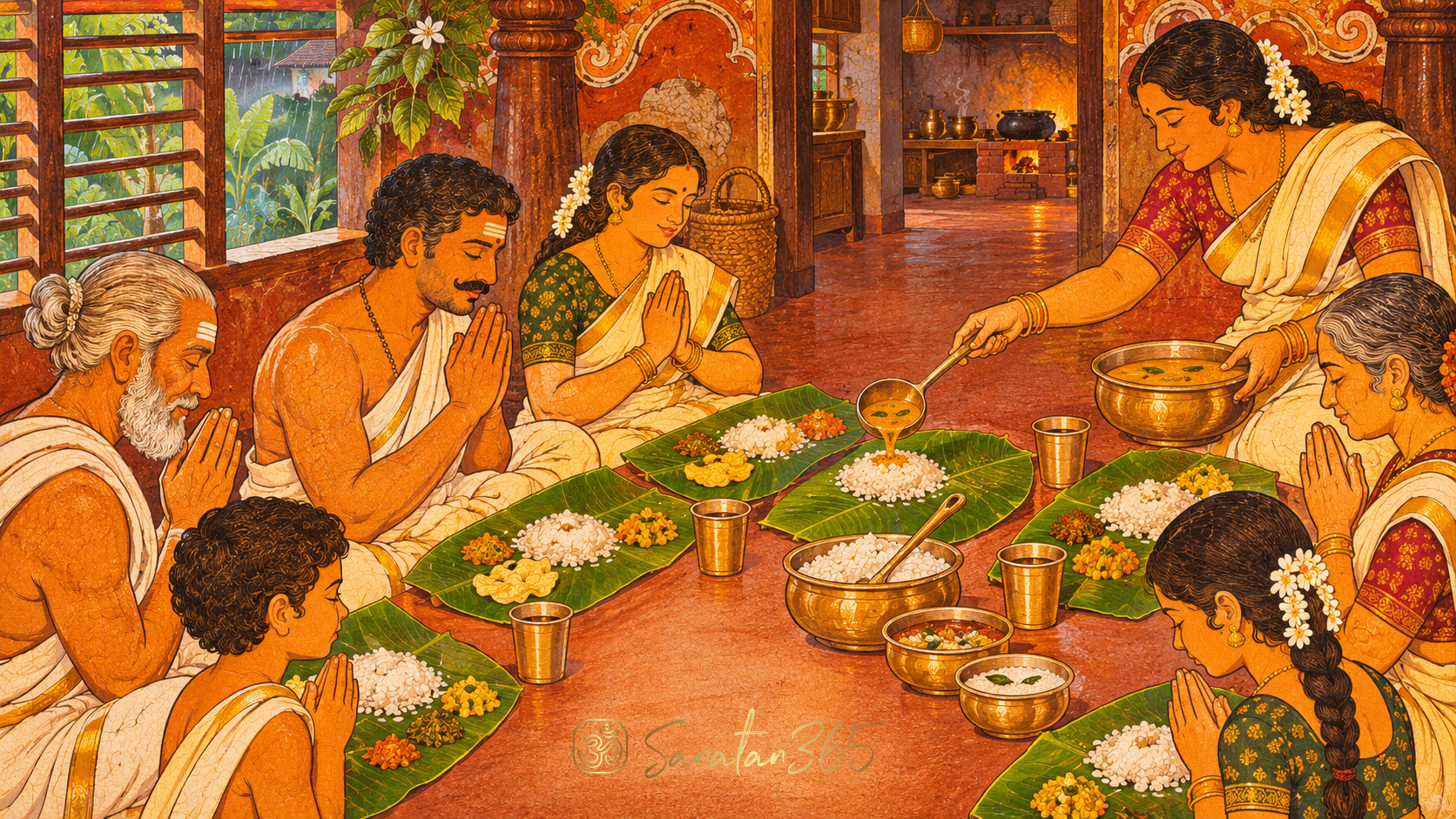
The serving spoon is still in the bowl when someone at the table begins a verse about a ladle, an offering and a fire. For the length of the verse, the meal has everyone's attention.
Brahmarpanam meaning comes from brahmārpaṇam (ब्रह्मार्पणम्, the offering instrument is Brahman), the opening expression in Bhagavad Gita 4.24. Its opening brings together Brahman (ब्रह्मन्, ultimate reality) and arpaṇam (अर्पणम्, an offering or its instrument). The verse sees the instrument, the offering, the fire and the act of offering in relation to Brahman. In some Hindu devotional settings it is recited before meals. The pause makes room to receive food with gratitude and remember the wider meaning of offering.
What is the Brahmarpanam meaning?
The name Brahmārpaṇam (ब्रह्मार्पणम्, the opening expression that identifies the offering instrument with Brahman) comes from the first words of the verse. Krishna speaks to Arjuna in the Bhagavad Gītā (भगवद्गीता, Song of the Lord). The Sanskrit text and translations at Heritage IIT Kanpur show how the passage returns to Brahman as it names each part of an offering.
ब्रह्मार्पणं ब्रह्म हविर्ब्रह्माग्नौ ब्रह्मणा हुतम् । ब्रह्मैव तेन गन्तव्यं ब्रह्मकर्मसमाधिना ॥ ४.२४ ॥
In a plain rendering, Brahman is the instrument and the offering. Brahman offers it into the fire of Brahman. The one absorbed in action as Brahman reaches Brahman alone. The repeated word holds together what a person might otherwise describe as several separate objects and actions.
A reader may encounter “ladle” in one translation and “instrument of offering” in another. These point to different levels of detail in the same image. A ladle is something a person can picture. “Instrument” names the role it plays in conveying what is offered. The commentaries collected by IIT Kanpur give room for these shades of meaning. The expression at the beginning should therefore be read in the context of the rest of the verse, where what is offered is named separately.
There is also a difference between recognising the verse at a meal and understanding the whole of its philosophical language. A person may already know its tune or cadence. Reading one translation slowly can reveal relationships that are easy to miss when the verse is familiar by sound alone. The guide to reading Hindu scripture in translation gives a way to keep the Sanskrit, a translator's choices, and a personal reflection distinct.
Key takeaway: The repeated reference to Brahman joins the parts of the offering into one field of attention.
Why does the verse name the ladle and the fire?
The scene evoked is yajña (यज्ञ, sacrificial offering). There is something to be offered, an instrument that carries it, a fire into which it is offered, and an action performed by someone. The imagery gives shape to an abstract teaching. A person can imagine the implement moving and understand what it means to consider the action along with the objects.
The ladle is particularly easy to overlook. A reader might remember the material being offered and the fire that receives it, while giving little thought to the tool that brings them together. The verse has room for that tool as well. Its attention extends to the means of the action, not only to its most conspicuous parts. Reading the line that way can help someone see why “offering” in this passage is more than the name of one thing.
The fire in the Sanskrit image belongs to the language of sacrifice. A household may draw an analogy between eating and receiving or offering food. The analogy works because the verse supplies relationships that can be reflected on at a meal. There is no need to recreate the original ritual scene at the table. The study of the image and the household practice can support one another while keeping their own settings.
One useful reading exercise is to underline each role in a translation: the tool, the gift, the place it goes, the one acting. Then read the verse aloud again and hear the word connecting the roles. The point of the exercise is to notice a pattern the verse already gives, rather than to assign a separate philosophical theory to every noun.
Key takeaway: The sacrifice image makes the teaching concrete by giving the act, its means and its material a place in the same verse.
Why is Brahmarpanam recited before meals?
One documented example comes from Amritapuri's account of Brahmarpanam before meals. It presents Bhagavad Gita 4.24 as a verse to recite before eating and connects the moment with gratitude for the food. That shows how the practice is taught in a specific devotional setting. It does not require a claim about the first historical meal at which anyone used the verse.
The move from the Gita's image to a plate can be understood through attention to what is received. Food is in front of someone because it has been grown, carried, prepared and served. The meal also involves a person receiving it and the act of eating. The verse gives a devotee language for remembering the Divine amid those relationships. Gratitude is one accessible way to begin understanding the practice, and the wider teaching of the verse gives that gratitude depth.
Amritapuri also describes a water observance that accompanies the recitation, with a small amount of water held in the palm and used around the plate. That detail helps a reader distinguish the verse itself from the form of practice taught alongside it. The words of 4.24 can be studied directly in the Gita. The accompanying actions can be learned from the tradition in which they are practised. Someone learning at home can ask what their household usually says and does, then compare that with the source.
The idea of receiving food with reverence can also be explored through the practice of receiving prasāda (प्रसाद, grace, often received as food after an offering). That subject has its own ritual context. The distinction helps when someone is learning several related practices at once. Here, the question is what this recited verse invites a person to notice before eating. A more specific account of how a particular offering is made belongs to the tradition in which it is performed.
Key takeaway: The meal practice gives the verse an ordinary occasion, while its teaching about offering remains larger than the meal.
How can a household learn the verse before eating?
Choose a time when the group can take a brief pause without rushing someone who needs to eat. The first task can be listening. One person may read the verse slowly while the others follow the sound or look at the text. If a learner wants pronunciation help, a person familiar with the recitation can take one short phrase at a time. A shared meal need not turn into a public test of who has memorised the words.
Next, connect one phrase to its meaning. Someone might remember the ladle because a serving spoon is in view, or the offering because a plate has just been placed in front of them. An adult can give a child a simple question: what had to happen before the food arrived? That opens a conversation about the actual work around the meal and lets the meaning grow from a concrete observation.
It may be useful to read the full explanation at another time. At the meal, a brief recitation can stay brief. Later, a learner can return to the source and see why a translation says “instrument,” why another says “ladle,” and what the concluding words mean in the wider passage. The household can preserve both an unhurried learning session and an uncomplicated meal.
If several people are present, participation can be invited in a way that makes room for a visitor or a beginner. Some may say the verse, some may listen, and some may simply wait for the group to finish. A little clarity about what is happening is often more welcoming than assuming everyone will know when to join. The prayer retains its character as a devotional act while the meal remains a shared occasion.
Key takeaway: Learn one phrase and its meaning at a comfortable pace, then bring that understanding to the shared recitation.
What can the pause change about sharing a meal?
A pause gives the group time to see something that an ordinary routine can hide. Someone has brought the plates. Someone has made enough food for the table. Someone may still be standing with a serving bowl while everyone else is seated. A person who has been thinking about the relationships in the verse might notice one of these facts and respond with ordinary care.
The response can be small: wait until someone has been served, make room for a guest, or thank the person who cooked. Such gestures are applications of reflection, not required steps in reciting 4.24. Their value comes from the actual circumstances. A meal eaten alone may invite a different kind of attention from a meal shared by several generations. The verse can accompany both without requiring them to feel alike.
One way to return to the practice over time is to let the image of the offering remain specific. On one day the reader may notice the object carried in a hand. On another, the person doing the serving. Keeping the Sanskrit verse close allows those observations to arise from a known source, rather than from a vague requirement to feel a particular way before every meal.
The serving spoon returns to the bowl after the prayer. The meal can proceed at its ordinary pace. The pause has given the people present a chance to recognise the act of receiving within a wider circle of action, care and remembrance. That is one grounded way to carry the verse from the page to the table.
Key takeaway: A short recitation can bring attention to the food, the act of receiving it, and the people whose work made it available.
FAQ
Which Bhagavad Gita verse begins with Brahmarpanam?
Bhagavad Gita 4.24 begins with that expression. It brings the instrument, the offering, the fire and the act of offering into relation with Brahman.
Why is Brahmarpanam said before food?
In documented devotional practice, the verse gives a person time to offer and receive food with remembrance and gratitude. Amritapuri is one source that explicitly teaches reciting it before eating.
Does arpanam mean the offering or the ladle here?
The wider word is associated with offering. In this verse, some translations use “ladle” and others use “instrument of offering.” The material offered is named separately in the same line.
Does a household have to follow one recitation format?
Household and institutional practices can vary. Someone learning the verse can begin with the Sanskrit and a reliable translation, then follow the custom of the group with whom they are eating.
About the author
Sanatan365 Editorial
Bringing Sanatan Dharma to modern seekers through authentic, scripture-grounded content.
Related in Practices
 Practices
Paduka Meaning: Sacred Sandals and the Practice of Remembrance
Why sacred sandals receive honour, what Rama and Bharata’s meeting reveals, and how paduka remembrance connects reverence with responsible…
 Practices
Pratipaksha Bhavana Meaning: Choosing an Ethical Response in Yoga
Read Yoga Sutras 2.33–2.34 as a practice of examining harmful reasoning and choosing a concrete ethical response in ordinary life.
 Practices
Parayana Meaning: Giving Sacred Reading a Steady Place
Understand parayana as sustained devotional reading or recitation, with distinctions from study and mantra repetition and a respectful way…

