Paduka Meaning: Sacred Sandals and the Practice of Remembrance
Why sacred sandals receive honour, what Rama and Bharata’s meeting reveals, and how paduka remembrance connects reverence with responsible daily conduct.
Paduka Meaning: Sacred Sandals and the Practice of Remembrance
A pair of sandals can ask more of a devotee than an elaborate decoration: whose footsteps will the day follow?
Paduka meaning begins with pādukā (पादुका), “sandal.” In Hindu devotional practice, sacred padukas honour the feet and remembered presence of a deity or spiritual teacher. They can become a focus for gratitude, reverence and the effort to live by a teaching. The object, the person or divine presence it represents, and the practice surrounding it belong together. Understanding that relationship helps explain why sandals may receive honour while ordinary footwear stays outside a worship space.
Paduka meaning: what do sacred sandals represent?
The simplest distinction is between footwear as a useful object and sandals received or established as a devotional symbol. Shape alone cannot explain the difference. A wooden pair in a museum, a teacher’s preserved sandals and a small pair intended for worship may look related while having different histories and uses.
Himalayan Academy’s Guru Chronicles glossary defines paduka as sandals and explains Shri paduka as a traditional icon of the preceptor’s feet, revered as a source of grace. That is a living tradition’s explanation of its own practice, rather than a claim that every pair of sandals has the same religious standing.
The visible sandal directs attention toward someone beyond itself. In the context of a guru (गुरु, spiritual teacher), it recalls the teacher whose instruction the disciple seeks to understand. In devotion to Rama, it can recall Rama’s presence and the example associated with him. These relationships should be named clearly. “Sacred footwear” is an introduction; knowing whose padukas are honoured gives the practice its particular meaning.
A useful way of reading the symbol is through three questions:
- Whose presence is remembered? The answer identifies the devotional relationship.
- What teaching is being honoured? This connects reverence with understanding.
- What will change in conduct? This carries remembrance beyond the moment of worship.
These are reflective questions, not a compulsory ritual formula. A devotee may also approach the padukas through love, prayer and a lineage’s understanding of grace. The ethical reading need not reduce those dimensions to an abstract lesson. It simply asks that the beauty of the symbol remain connected with the life around it.
The sandal also invites a distinctive kind of attention. An ornament may draw the eye upward toward splendour; footwear turns attention toward a path and the act of walking it. That observation is an interpretation of the image, not a dictionary definition or a promise of spiritual attainment. It gives a reader a concrete starting point without requiring an unfamiliar philosophical vocabulary.
Key takeaway: Sacred padukas are understood through the devotional relationship they express, not through their shape or material alone.
What does Bharata’s regard for Rama’s sandals illuminate?
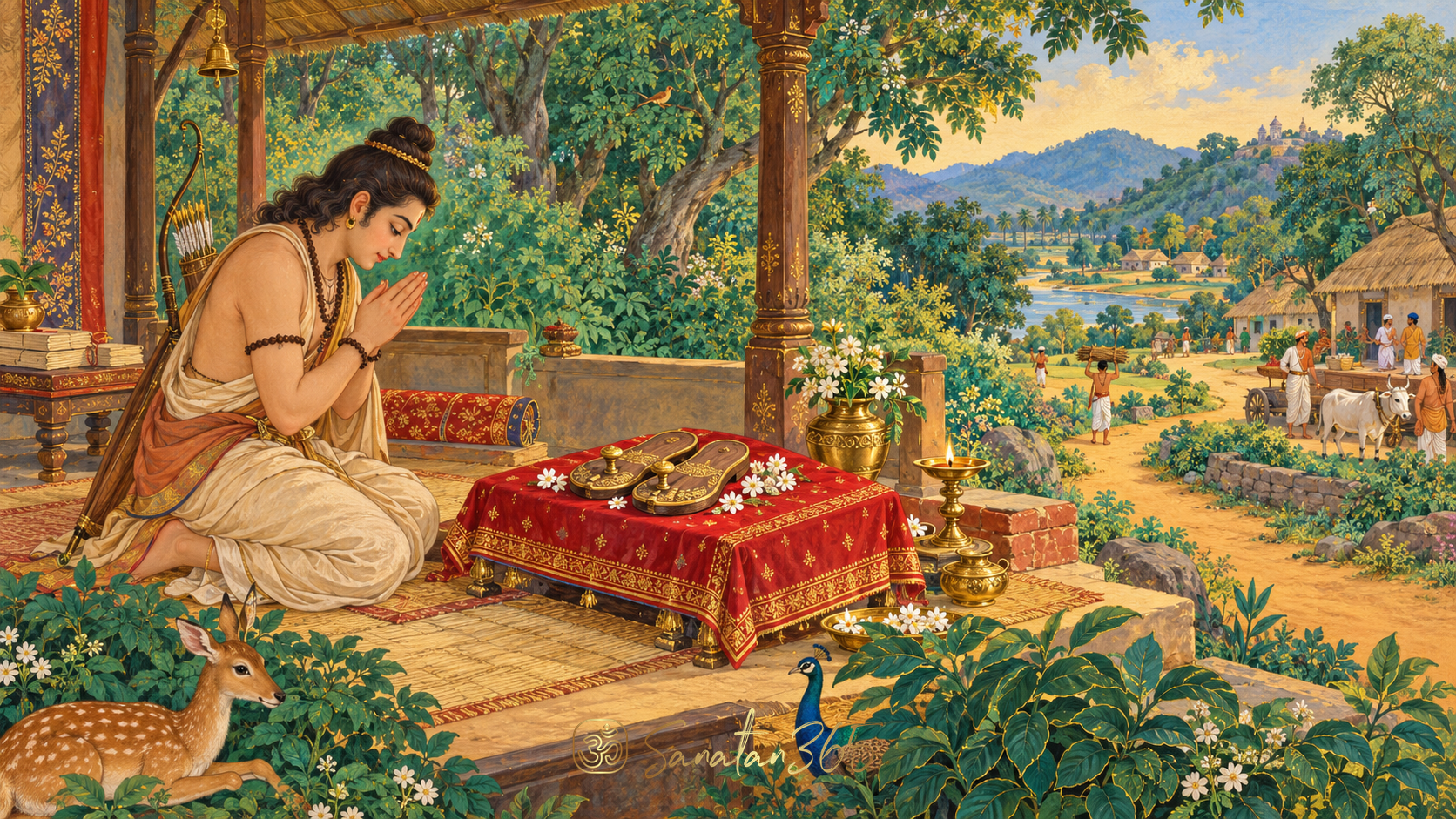
The Rama–Bharata encounter offers a powerful scriptural setting for this symbol. In the Vālmīki Rāmāyaṇa (वाल्मीकि रामायण, the Ramayana attributed to Valmiki), Ayodhya Kanda 2.112.21–25, Bharata asks Rama to place his feet upon gold-adorned sandals. Rama does so, removes them and gives them to Bharata. Bharata bows before the sandals and speaks of entrusting the kingdom’s administration to them while awaiting Rama’s return. The chapter’s text and translation provide the passage’s setting and sequence.
The action is moving because Bharata receives a sign of someone he refuses to replace in his own regard. The sandals make absence visible without making the relationship disappear. A devotional reading can therefore see remembrance as an active commitment: keeping faith with an entrusted responsibility while the beloved person is elsewhere.
There is a valuable detail immediately before the gift. Rama recognises Bharata’s capacity and advises consultation with capable counsellors in verses 16–17. Read alongside the sandal episode, this prevents a thin interpretation in which reverence removes the need to think or act. Bharata’s regard for Rama belongs beside the work that remains to be done.
For a household reader, the reflective question is modest: what has been entrusted to someone’s care? It might be a shared task, a promise to a family member or the responsibility to treat another person fairly. These examples are contemporary reflections, not new instructions attributed to the epic.
A remembrance object can make such a question easier to return to. Looking at it may interrupt the wish to take all the credit, avoid a difficult duty or forget the person who taught a useful discipline. The act becomes meaningful when it leads back into attention rather than remaining an attractive pause outside ordinary life.
This episode also deserves space to retain its devotional depth. Rama’s sandals are not interchangeable with a generic motivational token. Their meaning in the narrative comes from Rama and Bharata’s relationship. A reader can draw a practical reflection while preserving that sacred specificity.
Key takeaway: Bharata’s reverence invites a reading of remembrance joined with responsibility, rather than remembrance separated from action.
How do guru padukas express remembrance across traditions?
Guru padukas belong to a related but distinct relationship: that between a teacher and those who receive the teaching. Pūjā (पूजा, reverential worship) directed toward them honours the teacher through a tangible focal point. The particular prayers, materials and interpretation belong to the community practising it.
An explanation from Shri Chitrapur Math makes the connection between teaching and example especially clear. Its publication From Pāda Prakshālana to Phalamantrākshata describes an ācārya (आचार्य, teacher) as one who understands scriptural teaching, shows how it is practised and embodies it in conduct. It also explains that, in the situation described in that publication, worship is offered to the holy sandals of the institution’s Parama Guru (परमगुरु, the teacher’s teacher) rather than as foot worship of the reigning teacher. See the Math’s explanation of pada and paduka puja.
That example matters because it resists a one-size-fits-all account. A local institution’s custom should be described as that institution’s custom. A family learning elsewhere need not assume that the same arrangement, sequence or interpretation applies unchanged.
The relationship also explains why a symbol can remain meaningful beyond a teacher’s immediate physical presence. A student can return to what was taught, revisit a difficult passage or remember an example of patience. The object gives that return a visible place. The work of learning still needs to happen.
This is where paduka remembrance differs from collecting devotional objects. A collection asks how many things have been acquired. A practice asks whether attention has deepened. A carefully kept pair may be beautiful, but understanding does not increase simply because a display grows more elaborate.
Readers wishing to explore the wider relationship can turn to guru tattva (गुरुतत्त्व, the principle of the spiritual teacher), explained in our guide to the teacher’s role. The present question remains more specific: how does honouring the sandals keep the remembered teaching close enough to shape a day?
For someone encountering the custom in a temple, monastery or diaspora centre, respectful curiosity is a good beginning. Asking whose padukas are present and how that community honours them is more useful than supplying an explanation from an unrelated setting. Listening allows local meaning to remain visible.
Key takeaway: Guru padukas connect a particular teacher, a remembered teaching and a community’s own way of expressing reverence.
How can a household honour padukas with understanding?
A household beginning this practice benefits from clarity before elaboration. It can first establish whom the padukas represent, how the family received them and whether a teacher or institution has given particular guidance. These questions are more useful than copying an impressive ceremony without knowing its context.
The following is a framework for understanding and care, not a substitute for a lineage’s ritual instructions:
- Identify the devotional focal point. Say clearly whether these are Rama’s padukas, a teacher’s padukas or another established representation.
- Learn the relevant custom. Ask the responsible teacher or institution about placement, recitation and offerings where these apply.
- Care for the actual object. Do not assume that an inherited wooden or decorated pair should be treated like a newly made metal representation. Obtain appropriate guidance before applying liquids or other substances.
- Connect remembrance with one action. A quiet intention to listen carefully, keep a promise or complete an entrusted task can accompany reflection.
- Return to the meaning. The question at the end of a day is what was remembered and practised, not how impressive the arrangement appeared.
The distinction between sacred padukas and ordinary footwear should also be explained to children or visitors without embarrassment. A simple explanation can name the person honoured and the reason the object has a special place. There is no need to turn unfamiliarity into a fault.
Nor does someone need to imitate every external form immediately. A reader can first learn, observe respectfully and understand the relationship. Participation in a particular ceremony should follow the host community’s guidance. This is especially useful when a family’s inherited custom differs from the practice at a nearby centre.
The broader meaning of praṇāma (प्रणाम, reverential bowing), explored in why bowing expresses respect, can help explain the bodily gesture without reducing the entire practice to posture. Likewise, smaraṇa (स्मरण, remembrance), explored in remembering the Divine between daily tasks, offers a way to consider continuity after leaving the worship space. These related practices add context; none makes every household observance identical.
Key takeaway: Begin with identity, understanding and appropriate guidance, then let reverence continue through a concrete act of care.
What does following the footsteps ask of daily conduct?
The phrase “following the footsteps” is easy to admire and harder to make specific. A useful reflection begins with a teaching small enough to practise and clear enough to recognise. “Be a better person” is difficult to examine. “Listen without interrupting this conversation” gives attention somewhere to rest.
For a student, remembrance might mean returning to a lesson instead of seeking a new explanation each time practice becomes demanding. For someone caring for a shared home, it might mean completing an unglamorous task without needing an audience. For a person entrusted with an object or responsibility, it might mean treating that trust carefully even when nobody is watching.
These examples do not establish a universal paduka discipline. They show how a devotional symbol can invite an honest connection between what receives honour and what receives time. A reader can choose a different action that better expresses the teaching being remembered.
One helpful evening reflection has three parts: what was remembered, where it shaped conduct and where attention was lost. The purpose is accuracy, not an elaborate score. If a promise was forgotten, the next step is to acknowledge it and repair what can be repaired. A second bow does not complete an unfinished responsibility on someone’s behalf.
There is room here for both tenderness and rigour. The padukas can be approached with affection, gratitude and prayer. They can also call a devotee back to the demanding part of a teaching. Those qualities need not compete. Love gives the practice warmth; attention keeps it connected with the life it is meant to inform.
The strongest understanding of the symbol therefore keeps returning to a relationship. Whose footsteps are honoured? What has that presence taught? What would it mean to take one faithful step today? The answers may develop slowly, but the questions can remain close.
Key takeaway: The daily value of remembrance appears when reverence becomes attentive, responsible action.
FAQ
What is the simple meaning of paduka?
Paduka means a sandal. In a devotional setting, sacred padukas honour the feet and remembered presence of a deity or spiritual teacher. Their particular meaning depends on whose padukas they are and the tradition in which they are honoured.
Why did Bharata receive Rama’s sandals?
In Ayodhya Kanda 2.112, Bharata receives sandals that Rama has put on and removed. He bows before them and speaks of entrusting the administration to them while awaiting Rama’s return. The episode gives devotional remembrance a strong connection with entrusted responsibility.
Are guru padukas the same as ordinary footwear?
Ordinary footwear has a practical use. Guru padukas have a devotional relationship with a particular spiritual teacher and represent the teacher’s revered feet. Similar appearance does not give every sandal the same history, status or purpose.
Is there one paduka puja method for every household?
Different communities have their own guidance. A household should learn the custom relevant to its padukas and seek instructions from the responsible teacher or institution, especially before undertaking a formal ceremony or applying offerings to an inherited object.
About the author
Sanatan365 Editorial
Bringing Sanatan Dharma to modern seekers through authentic, scripture-grounded content.
Related in Practices
 Practices
Brahmarpanam Meaning: A Gita Verse Before the First Bite
Read Bhagavad Gita 4.24 as a verse about offering and see how a pre-meal recitation brings its imagery into an ordinary meal.
 Practices
Pratipaksha Bhavana Meaning: Choosing an Ethical Response in Yoga
Read Yoga Sutras 2.33–2.34 as a practice of examining harmful reasoning and choosing a concrete ethical response in ordinary life.
 Practices
Parayana Meaning: Giving Sacred Reading a Steady Place
Understand parayana as sustained devotional reading or recitation, with distinctions from study and mantra repetition and a respectful way…

