Chandan Offering in Hindu Puja: The Meaning of Gandha
Why devotees offer sandalwood paste in Hindu worship, what gandha signifies, how the custom varies, and how to practise with care.
A tiny streak of fragrant paste can change the pace of a whole puja. In puja (पूजा, ritual worship), before the lamp is lifted or food is presented, the devotee pauses to offer something cool, prepared, and personal.
A chandan offering in Hindu puja is the presentation of sandalwood paste to the deity, often called gandha (गन्ध, fragrance or scented paste) in a sequence of offerings. The gesture expresses welcome and reverence. It is not a promise that a particular result will follow, and it is not a test of whether a devotee can afford an elaborate ritual. Its meaning lies in attentive giving: fragrance, care, and a moment of inward steadiness.
What is a chandan offering in Hindu puja?
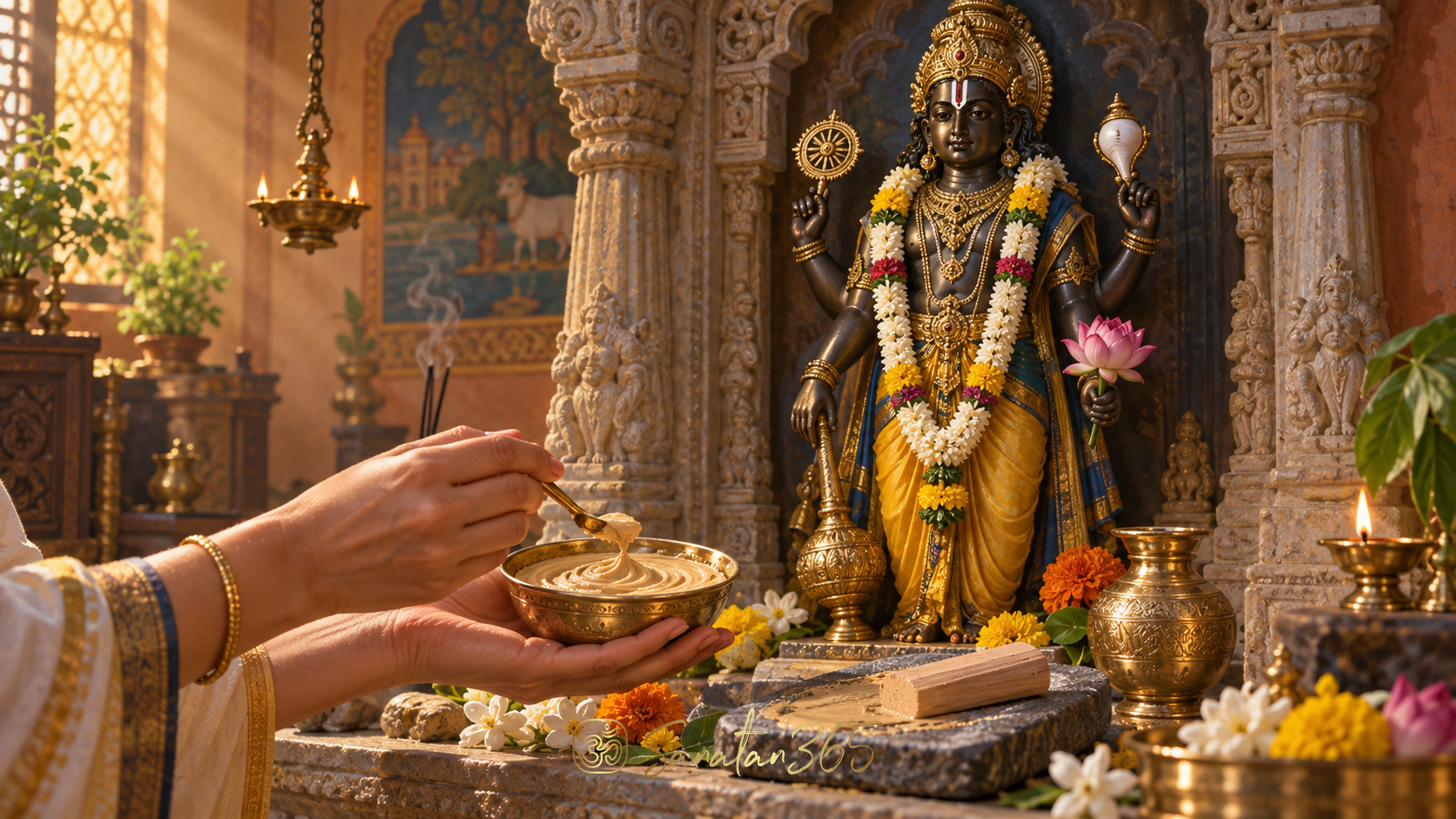
Chandan (चन्दन, sandalwood) usually refers in this setting to fragrant sandalwood paste, traditionally made by rubbing sandalwood with a little clean water on a stone, as described in the Swaminarayan tradition's chandan preparation guide. Gandha has a broader meaning of fragrance or scented substance; in many puja instructions, the word denotes the paste offered to the deity, as the Concise Encyclopedia of Hinduism entry reproduced by Hindupedia notes. The terms overlap in practice, but they are not identical: chandan names the material, while gandha names the fragrant offering or its quality. A family may use a prepared paste, and a temple may follow its own established method.
The distinction matters because a search for “gandha meaning” can produce the misleading impression that every Hindu worship service must use the same powder, the same vessel, or the same point of application. Hindu practice is diverse. A home altar is not required to imitate a temple's full service, and a visitor should never place paste on a murti (मूर्ति, a sacred image or form, which may be consecrated in a temple) without permission. The act of offering can be as simple as presenting a small amount respectfully before the image and following the custom of that shrine.
In many manuals, gandha appears among upachara (उपचार, acts of service or hospitality) offered in puja. The published five-offering guide describes one familiar arrangement, panchopachara (पञ्चोपचार, five acts of worship), includes gandha, flowers, incense, lamp, and food. The five are not a claim that all worship everywhere has exactly five steps. They are a compact teaching pattern; longer shodashopachara (षोडशोपचार, sixteen acts of worship) forms add further gestures of welcome. For the broader sequence, see the guide to five simple puja offerings.
Key takeaway: Chandan is the fragrant material; gandha is its place as a scented offering of hospitality in worship.
Why is gandha offered to the deity?
A guest is received with attention, not only with words. In a traditional puja, the deity is approached with the care one would give an honoured presence: a place, water, fragrance, light, and food according to the chosen form of worship. Gandha belongs to that language of welcome. Its sensory quality is important. Fragrance is noticed even when the eyes are closed; it can draw the worshipper's attention back from distraction to the offering at hand.
That does not mean sandalwood has a guaranteed spiritual, medical, or psychological effect. A person may experience its scent as calming, but the ritual meaning should not be converted into a health claim. The gesture invites a question: with what quality of mind is the offering made? A rushed, expensive arrangement is not necessarily more reverent than a modest, careful one.
The Bhagavad Gita, verse 9.26 names a leaf, a flower, fruit, and water offered with devotion. Sandalwood is not in that verse, so the verse should not be cited as an instruction specifically requiring chandan. Its relevance is the wider devotional principle: sincere offering is not measured by cost. The text gives ordinary materials a place in the relationship between devotee and the Divine. Chandan, when used, can be understood in that spirit rather than as a purchase of favour.
A second meaning is preparation. Grinding a small amount of paste, setting out a clean bowl, and offering it without waste make the hands participate in remembrance. This is a practical interpretation of ritual care, not a universal theological doctrine. The value of the gesture is partly that it asks the worshipper to slow down enough to notice what is being done. In a household where generations learned the practice together, that deliberate preparation can also carry memory and affection.
Some devotees later receive a sandalwood tilaka (तिलक, a mark placed on the forehead) as a sign of devotion or blessing. That mark is related to, but not identical with, the offering to the deity. Its shape and meaning vary by tradition. No single design should be presented as the standard for all Hindu communities; the appropriate practice is to follow one's family or temple custom.
Key takeaway: Gandha expresses attentive welcome; the substance matters less than the care and devotion with which it is offered.
Where does sandalwood paste fit in a puja sequence?
In the five-offering pattern, gandha is often named before pushpa (पुष्प, flowers), dhupa (धूप, incense), dipa (दीप, lamp), and naivedya (नैवेद्य, food offered to the deity). The sequence moves through fragrance and visible beauty toward light and nourishment. A useful way to understand it is not as a mechanical checklist but as a series of ways to honour the Divine through ordinary senses and materials. The five-offering guide explains the complete pattern; the present article stays with the distinct meaning of sandalwood paste.
A fuller puja may begin with cleaning the space, inward preparation, an invocation, and water offerings before gandha is presented. In other settings, the family may begin with a short prayer and present the paste without a formal Sanskrit formula. Both can be sincere. When a worshipper uses a mantra learned from a teacher, priest, or family elder, accuracy and lineage matter more than copying a phrase from a search snippet. If unsure, a simple respectful dedication in one's own language is safer than an invented liturgical line.
The paste may be placed on an appropriate part of a murti or sacred object by someone authorised to do so, or merely offered before it. Temple rules protect consecrated images and can differ sharply from home custom. Many temples do not permit visitors to touch an image at all. Ask an attendant before bringing any material to a shrine, and do not assume an offering bought outside is accepted inside. If a temple provides sandalwood paste to devotees, receive and use it according to local guidance.
The material also sits among other fragrant offerings without being interchangeable with them. Incense in Hindu puja introduces fragrance through smoke; chandan is a prepared paste, often applied or presented without flame. Flowers add another sensory language. Each has its own handling, symbolism, and practical constraints. One can learn their relation without collapsing them into a single generic “scent ritual.”
Key takeaway: Chandan often begins the familiar five-offering pattern, but the surrounding sequence and method belong to the custom of the particular home or shrine.
How do customs vary across homes and temples?
There is no one pan-Indian chandan rule. The material, amount, placement, and liturgical order can vary by region, deity, lineage, and the practical rules of a shrine. A family in one place may prepare a small paste before the morning puja; another may use paste supplied by a temple; another may not use sandalwood in its ordinary daily worship. A diversity of form does not make one devotee's prayer deficient.
For a concrete Vaishnava example, ISKCON Bangalore describes chandan adornment of its deity during a summer observance. A Shaiva shrine may follow different rules for what may be applied to a Shiva linga; the appropriate temple authority, not this example, determines those rules. These are examples of living practice, not instructions to cross-apply one community's procedure to another's sacred object. The person responsible for the altar or temple sets the boundaries. Where a particular murti is made of delicate material, even a seemingly harmless paste may be unsuitable; care for the image is part of reverence.
Availability matters too. Genuine sandalwood can be costly, and commercial products may contain perfume or dyes. A devotee should not assume that a heavily scented cosmetic paste is ritually appropriate, safe for a murti, or environmentally responsible. If the chosen tradition permits a substitute, follow its guidance. If not, a modest puja without chandan is preferable to a false or unsuitable offering. The Gita's emphasis on devotion in 9.26 offers a reason not to confuse expense with sincerity, although it does not prescribe a substitute for every specific ritual.
For diaspora households, the question is often practical: how to preserve a meaningful custom when the exact materials of a childhood shrine are unavailable. The most honest answer is to keep the intention and ask a knowledgeable community source about acceptable local practice. Do not import a plant product in violation of local rules, and do not place unfamiliar substances on shared temple property. A small home practice can be dignified without pretending that the household is reproducing a temple ceremony in full.
Some families mark the forehead with sandalwood after worship; others use different marks or none. Even within a single region, a family's observance may differ. A visitor can watch, ask politely, and follow the host's lead. Ritual fluency grows from respectful participation, not from declaring one universal rule after reading one article.
Key takeaway: Local custom and care for the sacred image determine how chandan is offered; variation is normal, not a defect.
How can a beginner offer chandan respectfully?
A beginner needs neither a large collection of vessels nor a memorised performance. The following is a modest home-practice outline, not a substitute for instructions from a family elder, priest, or tradition. Adapt it to the altar and materials actually used in the household.
- Prepare a clean place. Wash hands, tidy the altar, and use a small clean vessel reserved for the offering if possible. Place the image or symbol being worshipped in a stable, respectful setting.
- Check the material. Use a tiny amount of appropriate sandalwood paste only if it suits the household custom and the surface involved. Do not apply commercial fragrances or dyes to a murti without knowing they are acceptable.
- Pause before presenting it. Take a moment to remember whom the worship honours. An intention of reverence is more important than perfect choreography.
- Offer without assuming touch is required. Present the paste before the image, or apply it only where the household's practice permits. In a temple, leave application to authorised attendants unless explicitly invited.
- Continue simply. A flower, a lamp, or a prayer may follow according to the chosen form of puja. For context, the guide to flower offerings describes a distinct, related gesture.
- Handle remains carefully. Keep the space clean and follow the family's practice for the offered material. Do not discard ritual substances into a public waterway or apply leftover paste to someone else's skin without consent.
This is a framework for attention, not a guarantee of merit or an instruction to combine incompatible traditions. If there is no suitable sandalwood available, a simple prayer still has dignity. If a visitor is uncertain at a temple, asking quietly is itself an act of respect. The point is not to perform confidence; it is to participate honestly.
A useful reflection after the offering is: did the gesture make room for gratitude, or was it merely hurried? That question keeps the ritual connected to conduct outside the altar. Fragrance fades. The practice invites the worshipper to carry a little of the same care into ordinary speech, hospitality, and responsibility. This is an ethical reflection drawn from the act, not a claim that the paste automatically transforms character.
Key takeaway: Offer a small amount with clean hands, appropriate materials, and respect for local boundaries; when uncertain, ask rather than improvise on a sacred image.
Conclusion
The chandan offering in Hindu puja is a small act with a precise texture: fragrant paste, prepared and presented as gandha, becomes a gesture of welcome. Its place in worship is shaped by tradition, but its deepest lesson remains accessible. A devotee can honour the Divine without treating materials as a transaction or ritual complexity as a measure of worth. Care, restraint, and attention make the simple gesture meaningful.
Key takeaway: Gandha is an offering of reverent hospitality; let its fragrance point back to the quality of the heart and hands that offer it.
FAQ
Is gandha the same as chandan?
Not exactly. Chandan names sandalwood or its paste. Gandha means fragrance or a fragrant offering and often refers to sandalwood paste in puja instructions. Other scented materials may be used in some traditions, so follow the particular practice rather than assuming the words are universally interchangeable.
Is sandalwood paste compulsory for Hindu puja?
No universal rule makes it compulsory for every Hindu household or worship form. Some prescribed ceremonies have their own requirements, but a simple home prayer can be sincere without chandan. Bhagavad Gita 9.26 emphasises devotion in offering simple materials; it does not name sandalwood as a requirement.
Can a visitor apply chandan to a temple murti?
Only if the temple explicitly permits it. Many shrines reserve contact with the consecrated image for authorised attendants. A visitor can present an approved offering, receive paste distributed by the temple, or ask for guidance without touching the murti.
Why is chandan sometimes placed on a devotee's forehead?
In some communities, a sandalwood tilaka marks devotion or is received as part of a blessing after worship. Forms and meanings differ by lineage and region. This practice is related to, but distinct from, presenting gandha to the deity.
About the author
Sanatan365 Editorial
Bringing Sanatan Dharma to modern seekers through authentic, scripture-grounded content.
Related in Rituals
 Rituals
Deepa Dana Meaning: Why Devotees Offer Lamps
Deepa Dana is the devotional offering or giving of a lamp. Learn how it differs from aarti, what shared light signifies, and how to observe…
 Rituals
Kanya Puja Meaning: Honouring the Divine Feminine During Navratri
Kanya Puja honours young girls as living symbols of Devi during Navratri. Learn its meaning, timing, regional forms, offerings, and a respe…
 Rituals
Archana Puja Meaning: Names, Flowers, and Personal Temple Worship
Archana Puja is focused Hindu worship through sacred names, mantra, and offerings, often performed on behalf of a devotee or family.

