Kanya Puja Meaning: Honouring the Divine Feminine During Navratri
Kanya Puja honours young girls as living symbols of Devi during Navratri. Learn its meaning, timing, regional forms, offerings, and a respectful consent-first approach.
A Navrātri (नवरात्रि, the nine-night festival of the Divine Feminine) altar may glow with lamps, flowers, and red cloth, yet Kanya Puja asks devotees to look beyond the altar: can the presence of Devī (देवी, the Goddess) also be honoured in a child who arrives as a guest?
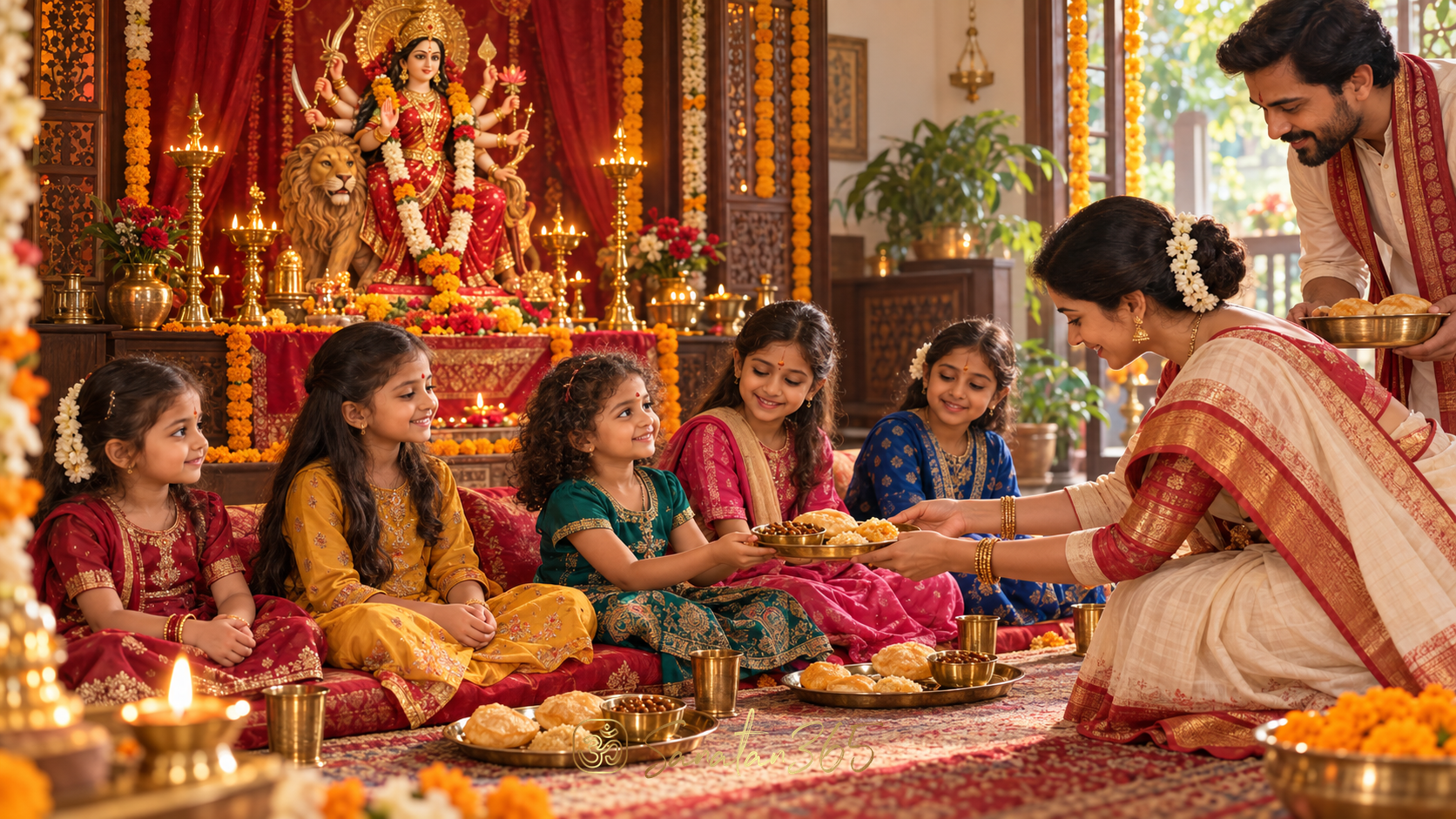
Kanya Puja meaning begins with this recognition. Kanyā (कन्या, a young girl) and pūjā (पूजा, reverential worship) describe a Navratri observance in which girls are welcomed and honoured as living symbols of the Divine Feminine. Often called Kanya Pujan, Kanjak, or Kumari Puja, the practice is commonly observed on Aṣṭamī (अष्टमी, the eighth lunar day) or Navamī (नवमी, the ninth lunar day). Its heart is not a transaction for blessings. It is sacred hospitality expressed through attention, food, gifts, dignity, and genuine care.
What is Kanya Puja meaning in Navratri?
Kanya Puja is a ritual of seeing. During Navratri, when Devi is worshipped through forms such as Durga, Lakshmi, and Saraswati, devotees may invite young girls to represent the living presence of Śakti (शक्ति, divine power or energy). Encyclopaedia Britannica describes Kanya Puja or Kanjak as an eighth- or ninth-day Navratri practice in which girls are honoured as forms of Durga and offered food and gifts (Britannica, “Kanya Puja”).
The ritual does not mean that a child is expected to perform holiness, grant wishes, or accept uncomfortable attention. Nor does it mean that divinity belongs only to girls of a particular family, community, appearance, or background. The symbol points outward: the Divine Mother is not confined to an image, and reverence must shape how people treat living beings.
Several ideas meet in the observance:
- Darśana (दर्शन, sacred seeing): the devotee practises recognising sacred presence rather than merely looking at a ritual object.
- Atithi-sevā (अतिथि-सेवा, service to a guest): welcome is expressed through a clean seat, kind words, food, and attentiveness.
- Śakti: feminine power is honoured as wisdom, courage, nourishment, protection, and creative life.
- Dāna (दान, generous giving): a gift is offered freely, without demanding gratitude or a promised result.
This meaning becomes especially clear beside the Devi Mahatmya’s vision of the Goddess acting through many powers and the widely recited recognition of Devi dwelling in all beings. The meaning of Ya Devi Sarva Bhuteshu offers a related theological lens: reverence is deepest when it changes perception and conduct.
Key takeaway: Kanya Puja is the practice of honouring Devi through respectful hospitality toward living children, not a bargain for spiritual reward.
Why are young girls honoured as forms of Devi?
Navratri celebrates the Divine Feminine as power that protects, nourishes, teaches, and restores order. In Kanya Puja, a young girl becomes a temporary ritual focus for this truth. Some households invite nine girls in association with the Navadurga, the nine revered forms of Durga. Other families invite a smaller number according to capacity and custom. The number is meaningful, but it should never become more important than the comfort of the guests.
The symbolism of childhood is often explained through qualities such as openness, possibility, and life not yet narrowed by adult status. Such language needs care. Children are not props for an adult ideal of “purity,” and no child should be judged against it. A more responsible understanding is that the ritual trains adults to meet young people without condescension: to listen, protect, feed, welcome, and respect them.
This makes the ceremony ethically demanding. If a family bows before a girl during puja but ignores her voice afterward, the ritual has not reached daily life. If society praises Śakti in a hymn while denying safety, education, nutrition, or dignity to girls, devotion remains incomplete. Kanya Puja therefore invites an honest question: does reverence at the altar become respect in the home, school, street, and workplace?
The practice also belongs to a wider Hindu language of worshipping the Divine through embodied presence. A murti is approached with sacred hospitality; a guest may be received with food and water; a river, tree, cow, teacher, or child may become a focus of gratitude according to context and tradition. These are not identical forms of worship, but they share a discipline of attention.
Key takeaway: Honouring a girl as Devi is meaningful only when symbolic reverence supports her real dignity, agency, safety, and flourishing.
When is Kanya Puja observed during Navratri?
Many North Indian households perform Kanya Puja on Durga Ashtami, the eighth tithi (lunar day), or Maha Navami, the ninth. Family lineage, regional calendar, temple tradition, and the local ending time of a tithi can affect the chosen day. Britannica notes both the eighth and ninth days as customary (Britannica, “Navratri”).
For Sharad Navratri 2026, commonly published New Delhi calendars place the festival from 11 to 19 October, with Durga Ashtami on 18 October and Maha Navami on 19 October. Panchang timings are location-dependent, however. Drik Panchang explicitly calculates festival timings for the selected city and notes that Hindu days and tithis do not always align with midnight-to-midnight civil dates (Drik Panchang, Shardiya Navratri 2026). Families should therefore check a trusted local panchang or temple rather than copying a time published for another city.
Kanya worship also appears outside one household pattern. In parts of eastern India, Kumari Puja may be conducted in a temple or Durga Puja setting with more formal liturgy. Sahapedia documents the worship of a prepubescent girl as a temporary manifestation of Adi Shakti within Durga Puja traditions (Sahapedia, “Kumari Puja”). Nepal has distinct living-Kumari institutions and festival customs; these should not be collapsed into the simpler household Kanjak observance. Shared vocabulary does not erase historical and regional difference.
Families may hear several names:
- Kanya Puja or Kanya Pujan: a broad Hindi and Sanskrit-derived name.
- Kanjak or Kanjake: common in parts of North India, especially for the household meal offered on Ashtami or Navami.
- Kumari Puja: used in several Shakta and eastern traditions, sometimes with formal temple procedures.
- Kumari worship in Nepal: connected to particular Newar and royal-city traditions that deserve their own context.
Key takeaway: Ashtami and Navami are both established occasions, but the correct day and form depend on local tithi, lineage, and regional custom.
How can families perform Kanya Puja respectfully?
There is no single universal household procedure. A family may follow instructions received from elders, a temple, or a trusted priest. What follows is a simple hospitality-centred outline, not a substitute for lineage-specific vidhi (विधि, prescribed ritual method).
1. Invite, do not summon
Ask the child and her parent or guardian well in advance. Explain what will happen, how long it may take, what food will be served, and whether photographs are planned. A clear “no” must be accepted warmly. Participation is an invitation, never a spiritual obligation.
2. Prepare a welcoming space
Keep the area clean, calm, and safe. Arrange comfortable seating at the child’s height. If there is an altar, identify the worship focal point clearly, such as a Durga mūrti (मूर्ति, sacred image) or another family form of Devi. Avoid smoke, loud sound, crowded rooms, or open flames within a child’s reach.
3. Receive each guest with consent
Traditional forms may include washing the feet, applying tilaka (तिलक, a sacred forehead mark), tying a sacred thread, offering flowers, performing āratī (आरती, the offering of light), or bowing. Ask before every form of touch. A child may prefer symbolic foot-washing, a flower placed nearby, or no physical contact. Reverence does not require overriding boundaries.
The red powder used in many pujas carries its own regional meanings; readers can explore the meaning of kumkum in Hindu worship. Use skin-safe materials and avoid applying anything if allergies or discomfort are possible.
4. Offer food with care
A common North Indian meal includes puri, kala chana, and halwa. Elsewhere, menus differ. Ask about allergies, dietary restrictions, spice tolerance, and portion size. Serve fresh food hygienically and allow children to eat without being watched as though they are completing a ritual test.
5. Give a simple, thoughtful offering
Fruit, clothing, stationery, a book, a useful object, or dakṣiṇā (दक्षिणा, a respectful offering) may be given according to custom and means. Expensive display is unnecessary. The gift should be freely offered and suitable for the child, with the guardian’s knowledge.
6. Conclude without expectation
Thank the guests and help them leave comfortably. Families may respectfully receive blessings, but children should not be pressured to recite words, touch adults, pose for images, or promise good fortune. The offering is complete in the act of reverence itself.
Key takeaway: A respectful Kanya Puja is measured by consent, safety, warmth, and care, not by how elaborate the ceremony appears.
How do Kanjak and Kumari Puja traditions vary by region?
Hindu practice grows through many local languages and lineages. Variation is not a defect to be corrected; it is part of the tradition’s lived depth.
In Punjab, Haryana, Delhi, Himachal Pradesh, Uttar Pradesh, and neighbouring regions, families may use the name Kanjak and invite girls for a meal on Ashtami or Navami. Details differ between households, and no one local sequence is a universal requirement.
In Bengal and some Ramakrishna-influenced settings, Kumari Puja can be more formal, with the selected girl seated before worshippers and honoured through a structured sequence. The ritual emphasis is explicitly Shakta: the Kumari is revered as a manifestation of the Mother. Such public ceremonies require careful institutional safeguarding as well as ritual discipline.
Nepal also has a distinct living-Kumari institution with its own history and ceremonial framework. A household Kanya Puja article should not pretend to explain that institution fully. Responsible readers can recognise both relationship and difference.
Across the diaspora, families often adapt the practice to smaller homes, mixed schedules, and local safeguarding norms. A family might host a shared community meal, make a donation supporting girls’ education, or combine a brief puja with service. These adaptations are strongest when they preserve the central movement from worship to dignity rather than treating charity as a replacement for relationship.
No family should feel compelled to imitate another region’s menu, number of guests, dress, or ritual sequence. A modest ceremony performed attentively can be more faithful than an elaborate event shaped by comparison.
Key takeaway: Kanjak, household Kanya Pujan, formal Kumari Puja, and Nepal’s living-Kumari traditions are related but distinct expressions of reverence for the Divine Feminine.
What should modern families remember about consent and dignity?
Consent is not a modern interruption of sacred practice. It is a practical expression of ahiṃsā (अहिंसा, non-harm) and respect. Adults hold more social power than children, especially inside a religious setting where refusal may feel difficult. That makes gentle explanation and genuine choice essential.
A consent-first approach includes:
- asking both the child and guardian before participation;
- avoiding touch unless the child agrees;
- never insisting on foot-washing, tilak, photographs, or social-media posting;
- protecting names, images, and locations online;
- providing food suitable for allergies and dietary needs;
- allowing rest, play, conversation, and an early departure;
- never ranking girls by appearance, caste, community, economic background, or perceived “purity”;
- ensuring that gifts do not create obligation.
Photography deserves special care. A child may agree in the moment without understanding where an image could travel. The safest default is not to post. If a photograph is necessary for a family record, obtain guardian permission and the child’s assent, avoid vulnerable ritual moments, and keep it private.
The ethical meaning also extends beyond one morning. Families can support girls’ nutrition, education, healthcare, safety, and equal opportunity throughout the year. These actions are not a way to purchase merit. They are ways of allowing a ritual insight to become conduct.
Kanya Puja should never suggest that girls deserve respect only while they fit an idealised image of childhood. The same dignity belongs to adolescents, adult women, elders, and every person. The ritual’s particular symbol should widen respect, not narrow it.
Key takeaway: The most devotional form of Kanya Puja is one in which every child feels safe, heard, unpressured, and genuinely honoured.
A simple reflection after the ritual
When the lamps are extinguished and the plates are cleared, a family can sit for one minute and ask:
- Did each guest appear comfortable and free to choose?
- Did we listen as carefully as we performed the ritual?
- What habit of respect can continue after Navratri?
- How will our home honour feminine wisdom, strength, and dignity throughout the year?
This reflection protects Kanya Puja from becoming a seasonal performance. Navratri celebrates the power that confronts disorder and restores balance. In domestic life, that restoration may begin through very ordinary actions: making space, serving food, listening without interruption, respecting a boundary, and keeping a child safe.
Kanya Puja does not ask devotees to confuse a person with a symbol. It asks them to let a sacred symbol transform how a person is treated.
Key takeaway: The ceremony reaches fulfilment when reverence continues as everyday respect after Navratri ends.
FAQ
What is the meaning of Kanya Puja?
Kanya Puja means reverentially honouring young girls as living symbols of Devi or Shakti. During Navratri, families may welcome them as sacred guests, perform a simple puja, serve food, and offer gifts. Its deeper purpose is to connect worship of the Divine Feminine with real dignity and care.
Is Kanya Puja performed on Ashtami or Navami?
Both are established. Many families observe it on Durga Ashtami, while others choose Maha Navami according to lineage, region, and local tithi timings. A trusted local panchang or temple can confirm the appropriate day.
Must nine girls be invited for Kanya Pujan?
Nine girls are often invited in association with the Navadurga, but practices vary. A family should not pressure children or overextend its capacity merely to reach a number. The dignity of each guest matters more than display.
What food is served during Kanjak?
Puri, kala chana, and halwa are common in several North Indian Kanjak traditions. Regional menus vary. Hosts should ask about allergies and dietary needs, prepare food hygienically, and serve portions suitable for children.
Can Kanya Puja be performed without washing a child’s feet?
Yes. Ritual forms vary, and consent comes first. A family can offer flowers, food, a lamp, or a respectful greeting instead. No physical gesture should be forced or treated as necessary when a child is uncomfortable.
The single enduring lesson of Kanya Puja is simple: to honour Devi in ritual is to honour the dignity, safety, voice, and flourishing of living girls in everyday life.
About the author
Sanatan365 Editorial
Bringing Sanatan Dharma to modern seekers through authentic, scripture-grounded content.
Related in Rituals
 Rituals
Vastra Offering Meaning: Why Clothing Is Offered in Puja
The offering of cloth turns ordinary care into sacred hospitality. Understand vastra in Hindu worship without confusing expense with devoti…
 Rituals
Madhuparka Meaning: Sweetness and Sacred Hospitality
Read madhuparka as a ceremonial honey mixture of welcome, exploring textual recipes, guest reception and its distinction from panchamrita.
 Rituals
Samavartana Meaning: Returning Home After Sacred Study
Samavartana marks the completion of traditional study through a ceremonial bath and return. Its lasting question is how learning becomes re…

