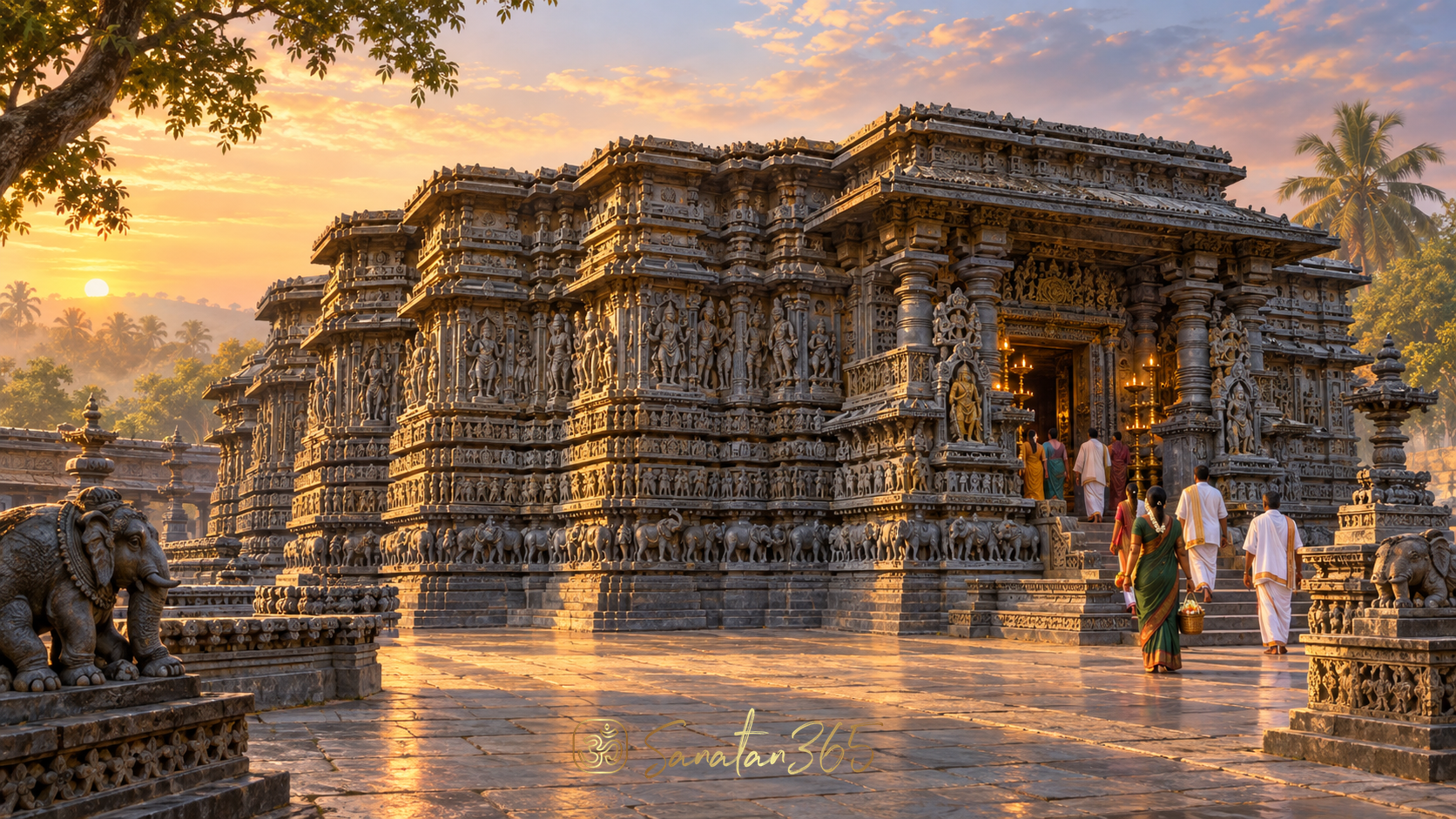
Chennakeshava Temple Belur: Vishnu, Hoysala Art, and Living Worship
Chennakeshava Temple in Belur is both a living Vishnu shrine and a landmark of Hoysala sacred architecture. Its sculpted surfaces show how devotion, craftsmanship, and community memory meet in stone.
Stone does not usually appear to move. At Chennakeshava Temple Belur, however, dancers seem to turn, elephants advance in procession, sacred stories unfold, and the whole sanctuary draws the eye toward Vishnu.
The temple is important because it remains two things at once: an active place of darshana (दर्शन, reverent seeing of the Divine) and one of the finest surviving expressions of Hoysala sacred architecture. Commissioned in 1117 CE at Belur in present-day Karnataka, the temple is dedicated to Chennakeshava, “Beautiful Keshava,” a form of Lord Vishnu. Its plan, carvings, inscriptions, and continuing rituals make it more than a monument to technical brilliance. They reveal how beauty can become an offering and how a community can carry worship across centuries.
Why is Chennakeshava Temple Belur important?
Chennakeshava Temple stands in Belur, an early capital of the Hoysala kingdom, on the banks of the Yagachi River in Karnataka’s Hassan district. King Vishnuvardhana commissioned the temple in 1117 CE. Historical interpretations differ on the precise combination of royal, military, and devotional motives behind that commission, so a careful reader should resist reducing the temple to one simple origin story.
What is certain is that the sanctuary became a major work of Hoysala patronage and a living centre of Vaishnava worship. UNESCO includes it with the Hoysalesvara Temple at Halebidu and the Keshava Temple at Somanathapura in the Sacred Ensembles of the Hoysalas, inscribed on the World Heritage List in 2023. UNESCO’s account emphasizes both the exceptional architectural language of these temples and the continuity of ritual life at Belur.
That continuity matters. A protected historic building may preserve material evidence, but a living temple also preserves rhythms: lamps are lit, offerings are made, names of the Divine are recited, festivals gather families, and worshippers continue to seek darshana. Architecture here is not merely observed. It is inhabited through devotion.
Belur also offers a useful counter to the idea that sacred seriousness must look austere. Its sculptural richness does not distract from worship when approached with attention. It can train the eye to recognize order, relationship, skill, movement, and story. The visitor passes through a world made intricate before standing before the centred presence of Vishnu.
Key takeaway: Chennakeshava Temple matters not only because it is old or ornate, but because art, memory, and worship still meet there.
Who is Chennakeshava, the presiding form of Vishnu?
The name Chennakeshava joins a Kannada word commonly understood as “beautiful” or “handsome” with Keshava, a revered name of Vishnu. The presiding deity is therefore approached as Vishnu in a form whose beauty is not superficial decoration. In Hindu temple thought, divine beauty can point toward harmony, auspiciousness, protection, and the ordered wholeness that sustains life.
Vishnu is widely revered as the preserver, the one whose sustaining presence protects dharma (धर्म, the order and responsibility that uphold life). At Belur, that theological idea appears in a setting where hundreds of crafted details remain coordinated around the sanctuary. The visual abundance has a centre. This relationship between multiplicity and focus is part of the temple’s devotional intelligence.
The temple is also known in historical records by names connected with Vijayanarayana or Keshava. Such naming should not be treated as evidence of different unrelated deities; it reflects the layered history of the site and the many ways Vishnu is praised. As with the reclining Lord Ranganatha at Srirangam, a particular temple form allows worshippers to meet a distinct devotional mood without claiming that one form of Vishnu exhausts the Divine.
The central act remains darshana: the devotee sees the sacred image and is understood, within devotional experience, to be seen in return. The sculpted exterior prepares attention, but the encounter in the garbhagriha (गर्भगृह, the innermost sanctum or “womb chamber”) gathers that attention into stillness.
Key takeaway: Chennakeshava’s beauty expresses the sustaining harmony associated with Vishnu and leads the devotee from visual abundance toward centred presence.
How does Hoysala architecture shape a devotee’s experience?
Hoysala temples are recognized for a distinctive architectural vocabulary developed in southern India between the eleventh and fourteenth centuries. Belur’s temple is often discussed through features such as its raised platform, complex projections, carefully worked stone, richly carved pillars, and sculptural bands. Yet those features become more meaningful when we ask what they do to a moving human body.
The platform turns walking into attentive seeing
The raised jagati (जगती, a temple platform) gives the building visual dignity and creates space for movement around it. Circumambulation, or pradakshina (प्रदक्षिणा, clockwise movement around a sacred centre), is not simply a way to inspect an exterior wall. It places the sacred centre on the devotee’s right while the body moves through changing views.
Because the walls project and recede, the temple never presents only one flat facade. Light catches different surfaces as the visitor walks. Detail arrives gradually rather than all at once. Attention becomes rhythmic: step, pause, look, continue.
The star-like geometry creates movement without disorder
The varied wall planes generate a powerful play of light and shadow. From a distance, the temple appears composed and grounded. At close range, its surfaces unfold into successive fields of ornament, figures, narrative panels, and architectural forms. This combination of stable centre and changing perception suits a devotional space. The Divine remains the centre while the seeker’s understanding deepens through repeated approach.
Pillars make craftsmanship visible
Inside, polished and carved pillars demonstrate extraordinary control of material and proportion. Some are associated with lathe-turned forms, while others carry intricate sculptural work. The purpose is not to turn anonymous labour into spectacle. Rather, it reveals shilpa (शिल्प, skilled art or craft) as disciplined knowledge.
The Metropolitan Museum of Art’s overview of Hoysala-period art places such temple production within a broader culture of sophisticated sculpture and patronage. At Belur, that sophistication serves a ritual destination. Technical mastery and sacred intention are not competing explanations; they meet in the completed work.
Key takeaway: Hoysala design guides the body through movement, changing light, and concentrated detail so that seeing itself becomes more attentive.
What stories and sacred ideas appear in the temple carvings?
The carvings at Belur reward slow looking. Processional animals, foliage, guardians, dancers, musicians, deities, and narrative episodes appear across the complex. Friezes include scenes associated with the Ramayana, Mahabharata, and Puranic traditions, while other figures preserve details of dress, movement, ornament, and courtly life.
These images should not be treated as a single illustrated book with one fixed reading order. Temples accumulate meanings through patronage, workshop practice, ritual use, regional aesthetics, and generations of interpretation. A knowledgeable local guide or scholarly source can help distinguish a specific episode from a decorative or protective motif.
Narrative bands create a sacred field of memory
When epic and Puranic scenes appear on temple walls, they bring remembered acts of courage, devotion, duty, and divine protection into the worshipper’s path. A visitor may recognize only a few scenes, but even partial recognition can awaken smarana (स्मरण, sacred remembrance). The story is no longer confined to a manuscript or recitation; it accompanies movement toward the sanctum.
Madanikas hold movement in stone
Belur is celebrated for bracket figures often called madanikas (मदनिका, idealized female figures in sculptural art) or shilabalikas. Many are shown dancing, making music, looking into a mirror, or holding a poised gesture. They testify to close observation of movement, ornament, and human expression.
These figures deserve more than a hurried label such as “decorative dancers.” They participate in a larger sacred aesthetic where music, dance, beauty, and skilled performance can belong near worship. Their presence does not make the temple less spiritual. It reflects a tradition in which disciplined art can honour the sacred.
Repetition teaches without becoming monotonous
Elephants may suggest strength and stability; lions and composite creatures can signal power and protection; vegetal scrolls evoke generative abundance. Interpretations vary, and not every motif has one universally agreed meaning. The safer insight is structural: repeated bands create order. Each detail is distinct, yet each belongs to a larger whole.
Key takeaway: Belur’s carvings turn sacred story, disciplined art, and social memory into a visual environment for worship.
How can a visitor approach Belur as a living temple, not only a monument?
UNESCO heritage status can attract visitors who first encounter Belur through architecture. That is welcome, but the site’s living identity asks for a different quality of attention. A visitor enters a place where people pray, priests conduct ritual, and the presiding deity is not an exhibit.
A respectful approach includes a few simple practices:
- Dress modestly and follow current temple instructions. Local rules about access, photography, queues, and restricted areas can change. On-site guidance should take priority over old travel pages.
- Remove footwear where directed. This is a practical sign that one is crossing into sacred space.
- Do not obstruct worship. A photograph can wait when a family is receiving darshana or a ritual is underway.
- Ask before photographing people or ceremonies. Permission protects both dignity and concentration.
- Walk slowly. The temple’s details cannot be received through haste. Allow time for the outer walls, interior pillars, and sanctum.
- Distinguish explanation from participation. A guide may explain history and iconography; a priest guides ritual matters. Visitors can learn without pretending expertise.
- Verify timings locally. Temple opening hours and ritual schedules may change on festival days or for administrative reasons.
It also helps to avoid treating Belur, Halebidu, and Somanathapura as interchangeable stops on an architecture checklist. Each has a different presiding tradition, history, spatial character, and present ritual life. At Belur, continuous worship is central to the site’s identity. This distinguishes its experience from sacred monuments where regular worship has ceased.
Readers interested in another example of heritage and active worship may compare Belur with Virupaksha Temple at Hampi. The comparison is valuable not because the temples are the same, but because both ask visitors to hold historical appreciation and devotional respect together.
Key takeaway: The most responsible visitor sees Belur as a temple first and a heritage destination through that living sacred context.
What does Belur teach about craftsmanship as seva?
The temple’s countless details invite a final question: what kind of attention does such work require? Major sacred buildings emerge from many hands, skills, decisions, revisions, and generations. Royal patronage may initiate a project, but artisans translate intention into measured form.
In this context, seva (सेवा, selfless or sacred service) offers a useful interpretive lens when applied carefully. It should not romanticize labour conditions we cannot fully reconstruct, nor erase the individuality of artists. Belur preserves signatures associated with some sculptors, reminding viewers that sacred craftsmanship can carry both communal purpose and personal mastery.
Craft becomes seva when excellence is offered toward something larger than self-display. That principle can speak to modern work without turning the temple into a productivity slogan. The lesson is not that every task must be ornate. It is that attention has ethical and spiritual weight.
Three aspects of Belur’s craftsmanship are especially instructive:
- Discipline: complex work depends on learned methods, patient repetition, and correction.
- Relationship: architecture, sculpture, ritual function, patronage, and community use must cooperate.
- Continuity: later generations protect, repair, interpret, and worship within what earlier generations made.
This is why the temple’s beauty feels different from decoration added at the end. Beauty is built into structure, movement, story, and purpose. The whole site suggests that sacred work is not only about the object produced. It also forms the quality of attention through which the work is done.
For a modern visitor, that insight may become practical. A craftsperson can honour tools through care. A designer can respect function as well as appearance. A teacher can prepare with patience. A family can maintain a prayer space without excess. The scale changes, but the discipline of careful offering remains.
Key takeaway: Belur presents craftsmanship as knowledge, patience, relationship, and service gathered into enduring form.
Conclusion
Chennakeshava Temple Belur cannot be understood by choosing between devotion and architecture. Its deepest significance appears when those dimensions are seen together. The temple’s geometry directs movement, its carvings preserve sacred and social memory, its craftsmanship embodies disciplined knowledge, and its sanctum keeps Vishnu worship at the centre.
The site therefore asks for two kinds of reverence: care for an irreplaceable work of human skill and humility before a living sacred tradition. When a visitor holds both, stone no longer appears silent. It becomes a record of attention offered across generations.
Key takeaway: Belur shows that sacred beauty becomes enduring when craftsmanship serves worship and living communities continue to care for both.
FAQ
What is Chennakeshava Temple Belur famous for?
It is famous as a living temple dedicated to Lord Vishnu in the form of Chennakeshava and as a major example of Hoysala architecture. Its complex wall geometry, sculptural bands, carved pillars, bracket figures, narrative reliefs, and long continuity of worship are especially significant.
Who built Chennakeshava Temple at Belur?
Hoysala king Vishnuvardhana commissioned the temple in 1117 CE. Its construction and artistic development involved generations of patrons, architects, sculptors, and craftspeople rather than one individual maker.
What does the name Chennakeshava mean?
Chennakeshava is commonly understood as “Beautiful Keshava.” Keshava is a revered name of Lord Vishnu. The name points to divine beauty as harmony, auspiciousness, and sustaining presence.
Is Chennakeshava Temple still used for worship?
Yes. UNESCO identifies the Belur complex as a living temple with continuity of worship, rituals, and festivals. Visitors should therefore approach it as an active sacred space, not only as an archaeological or architectural attraction.
Why is Chennakeshava Temple part of a UNESCO World Heritage Site?
It forms part of the Sacred Ensembles of the Hoysalas with the temples at Halebidu and Somanathapura. UNESCO recognizes these ensembles for their exceptional Hoysala architectural and sculptural language, authenticity, and cultural significance; Belur also retains active ritual continuity.
About the author
Sanatan365 Editorial
Bringing Sanatan Dharma to modern seekers through authentic, scripture-grounded content.
Related in Temples
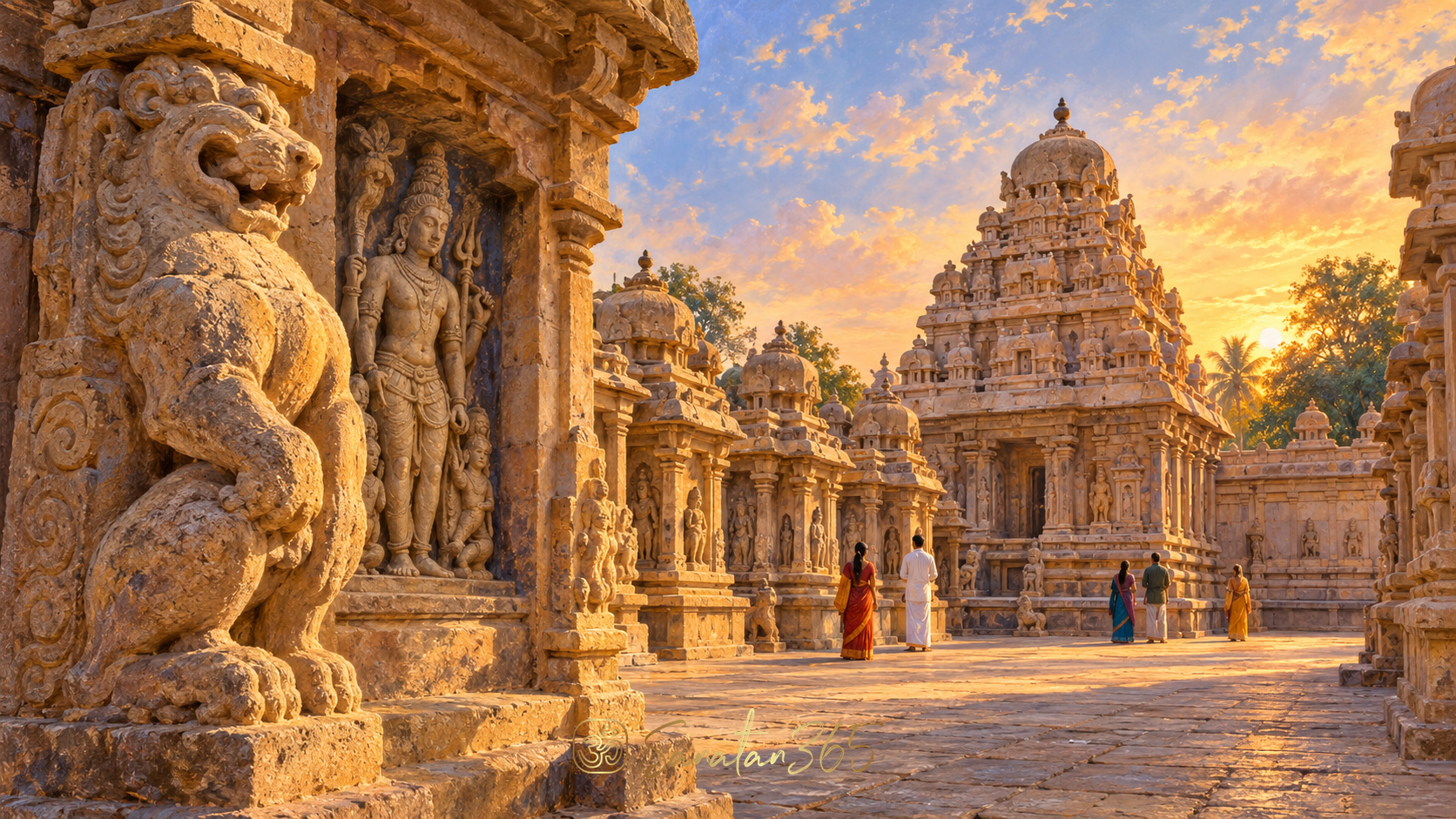 Temples
Kailasanathar Temple Kanchipuram: Learning to Read Shiva in Stone
Read Kanchipuram’s Pallava Shiva temple through its sandstone, sanctum tower, sculpted shrines and the care that sacred heritage asks of vi…
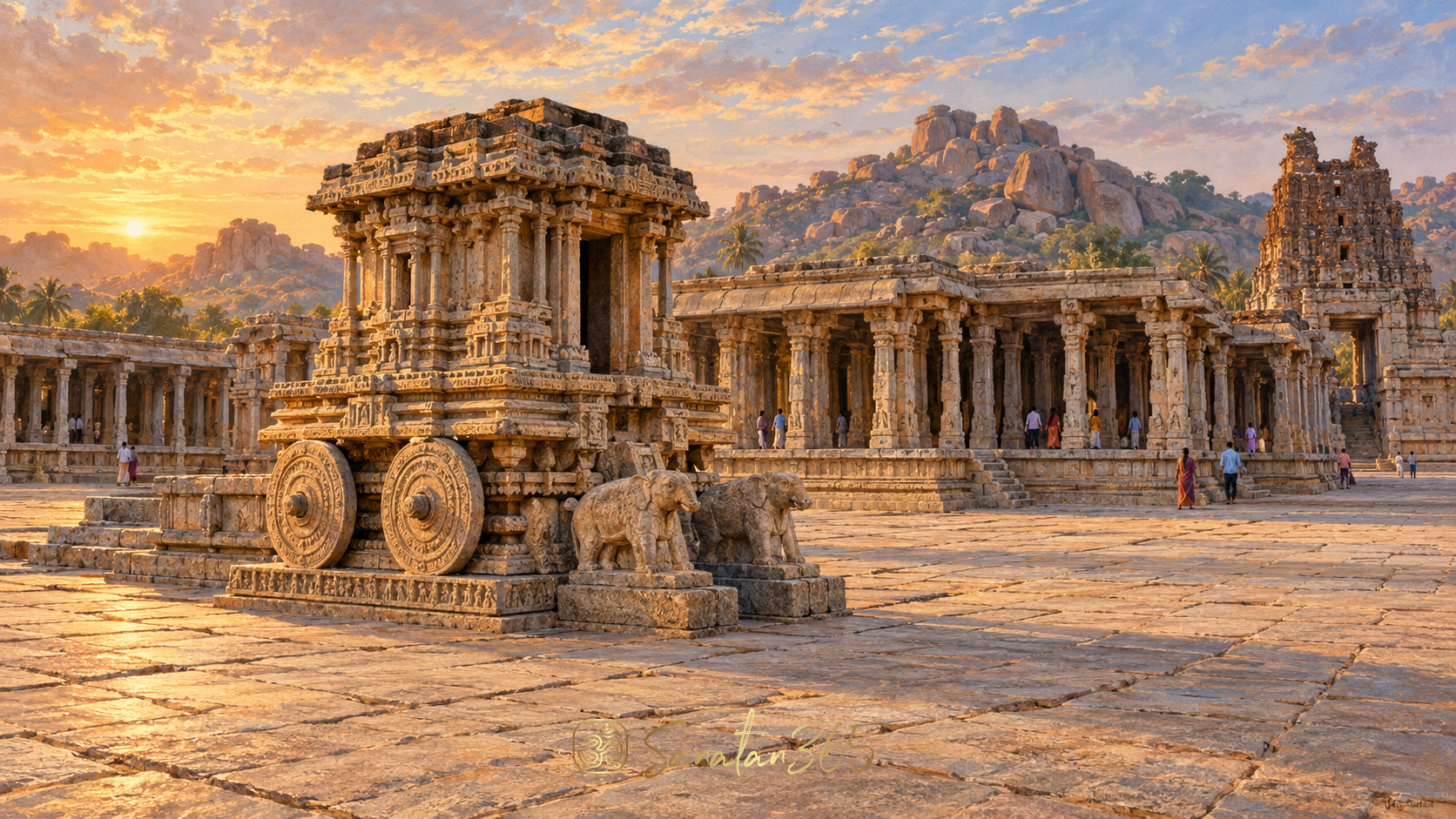 Temples
Vittala Temple Hampi: Reading the Stone Chariot and Sacred Courtyard
Understand Hampi’s Vittala Temple through its Garuda stone chariot, pillared halls, Vishnu devotion, and careful heritage visiting.
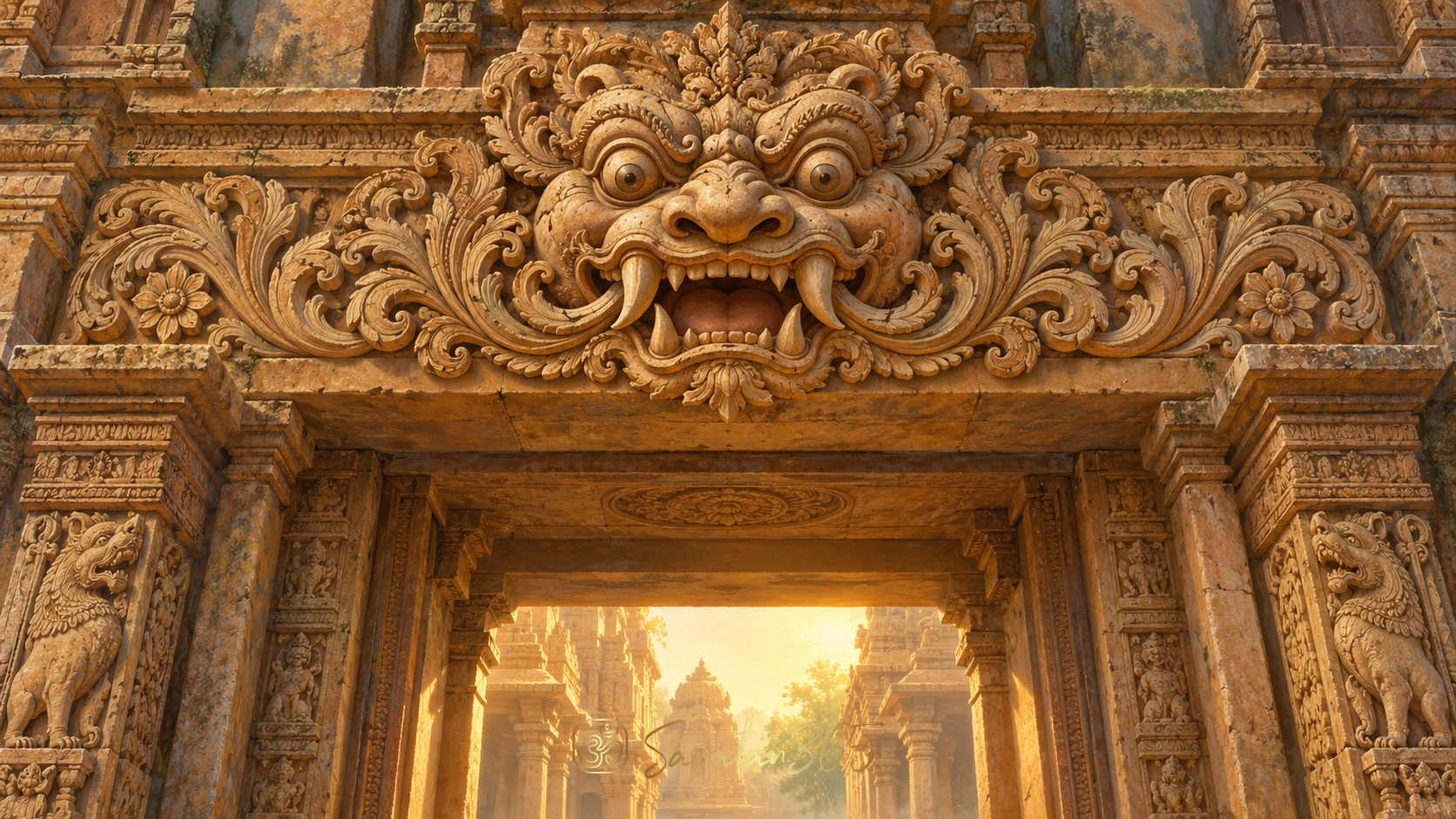 Temples
Kirtimukha Meaning: The Face of Glory Above the Temple Door
The fierce face above a temple doorway is not a warning to turn away. Learn to recognize Kirtimukha, read its sacred story, and notice how…

