Srirangam Ranganathaswamy Temple: Vishnu, Sacred Rest, and a Living Temple-Town
Srirangam's Ranganathaswamy Temple reveals Lord Vishnu in sacred rest, a temple-town shaped by seven enclosures, Sri Vaishnava devotion, and the Kaveri.
A city moves around a deity who appears perfectly still.
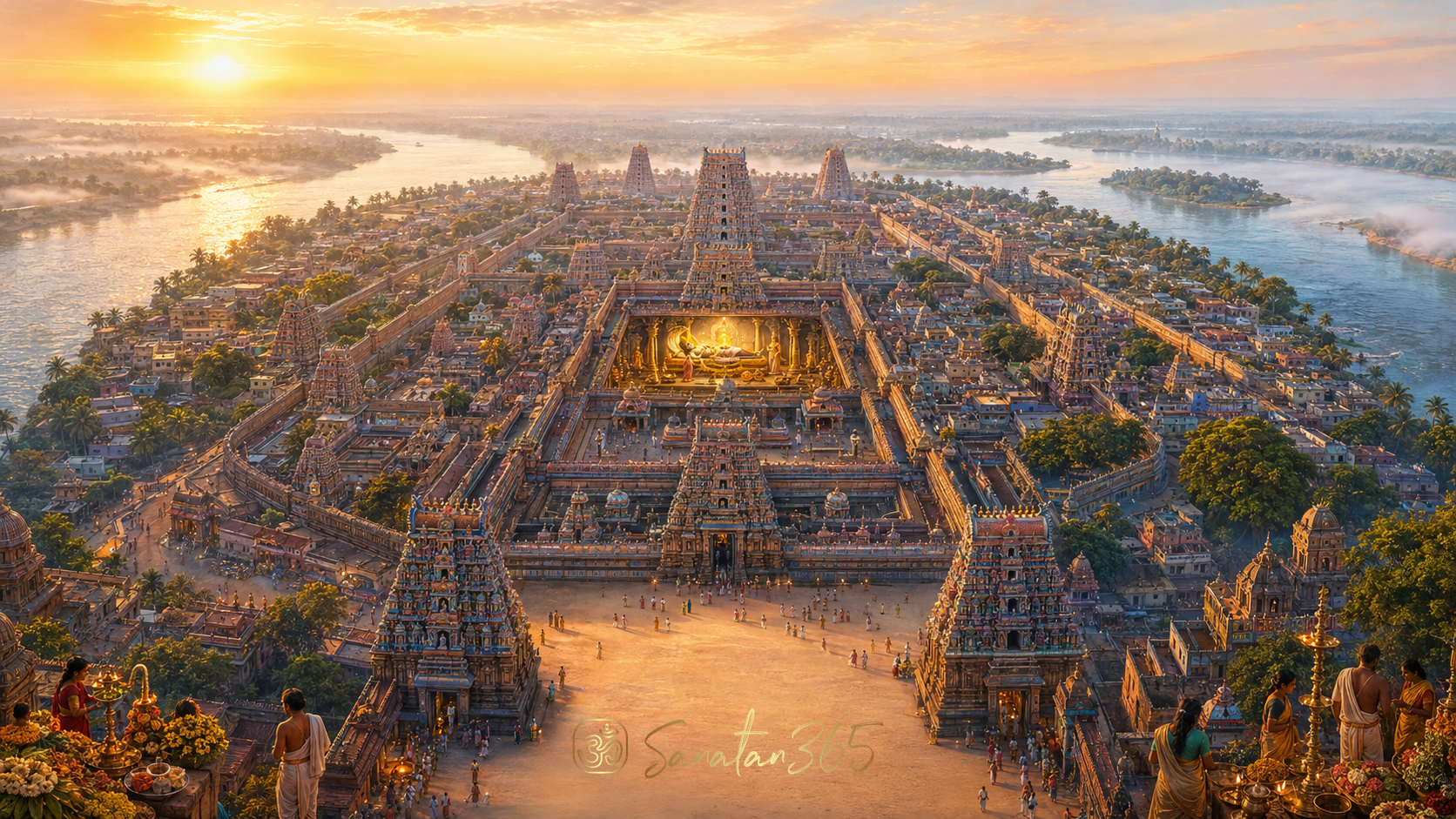
The Srirangam Ranganathaswamy Temple is a living Sri Vaishnava sacred centre on an island formed by the Kaveri and Kollidam rivers in Tamil Nadu. At its heart, Lord Vishnu is worshipped as Sri Ranganatha, reclining upon Adishesha, the cosmic serpent. The temple's seven concentric prakaras (प्राकार, enclosures) gather streets, gateways, shrines, homes, and worship around that calm centre. Srirangam therefore expresses more than monumental architecture: it shows ordinary life gradually orienting itself toward divine presence.
What Is the Spiritual Meaning of Srirangam Ranganathaswamy Temple?
Srirangam joins three realities that are often separated: temple, town, and sacred landscape. The complex stands on Srirangam island near Tiruchirappalli, held between branches of the Kaveri river system. Its outer enclosures include lived urban space, while successive gateways lead toward the sanctum. UNESCO's tentative-list description calls it a temple-town distinguished by a sapta-prakaram (सप्त प्राकार, seven-enclosure) plan developed over centuries (UNESCO World Heritage Centre).
At the centre is Ranganatha (रङ्गनाथ, “Lord of the sacred stage”), a reclining form of Lord Vishnu. He rests upon Adishesha while Goddess Sri, worshipped locally as Ranganayaki Thayar, holds an essential place in the devotional life of the temple. In Sri Vaishnava understanding, approaching Narayana is inseparable from divine grace, and Thayar embodies compassion and intercession without being reduced to a decorative presence.
The temple is traditionally honoured as the foremost among the 108 Divya Desams (दिव्य देशम्, sacred Vishnu sites praised by the Alvars). For devotees, this distinction is not a ranking meant to diminish other temples. It names Srirangam's special place within a living network of Tamil Vishnu devotion, sacred poetry, pilgrimage, and teaching.
Its spiritual meaning can be stated simply: life does not need to be abandoned before it can become sacred. Markets, households, festival streets, scholarship, service, and worship can all turn around a divine centre. The journey inward is architectural, but it is also ethical. Each threshold asks what noise, haste, pride, or distraction a pilgrim is willing to loosen.
Key takeaway: Srirangam is a temple-town in which sacred geography, community life, and worship converge around Lord Ranganatha.
Why Does Lord Ranganatha Recline on Adishesha?
The reclining image can surprise visitors accustomed to seeing divine power represented through standing strength or dramatic action. Ranganatha's posture presents another form of sovereignty: effortless order.
Lord Vishnu reclines upon Adishesha, whose name means the primal or enduring remainder. In Hindu cosmological imagery, Vishnu's rest is not laziness, withdrawal, or sleep caused by exhaustion. It is yoga-nidra (योगनिद्रा, divine yogic repose), the stillness from which cosmic preservation remains possible. The world may change continuously, yet the sustaining ground is not agitated by every movement.
The image teaches through contrasts:
- The deity rests, while pilgrims move through long corridors.
- The serpent, commonly feared, becomes a sheltering couch.
- Vast architecture gathers around an intimate vision of repose.
- Divine power appears as stability rather than strain.
This does not encourage passivity. Vishnu's preserving role is closely tied to dharma (धर्म, sustaining moral and cosmic order). Sacred rest supports right action because it is not driven by panic. The Bhagavad Gita describes the Divine as the Self seated in the hearts of all beings and as the beginning, middle, and end of beings (Bhagavad Gita 10.20, IIT Kanpur Gita Supersite). Ranganatha gives that sustaining presence a visual form: quiet, encompassing, and awake.
Adishesha's multiple hoods rise protectively above Vishnu. The serpent's endlessness suggests continuity through cycles of creation and dissolution. At Srirangam, the image invites the devotee to place restless thought within a larger order. One need not control the whole universe to fulfil today's duty; one needs a steadier centre from which to act.
The posture also connects Srirangam with other expressions of Vishnu devotion. A pilgrim who has reflected on the sacred form of Shaligram or the kingship of Dwarkadhish in Dwarka meets the same Divine through a different devotional language. Sanatan Dharma allows form, place, poetry, and practice to reveal complementary dimensions without demanding that one expression erase another.
Key takeaway: Reclining Ranganatha represents sustaining awareness: divine stillness that supports, rather than escapes, responsible action.
How Did Srirangam Become a Temple-Town with Seven Enclosures?
Srirangam cannot be understood by looking only at its central shrine. Its scale unfolds through seven concentric enclosures, traditionally called prakaras. A historical overview preserved by the Sri Vaishnava community describes a vast complex of seven walled circuits and notes the temple's central role in the tradition (Ramanuja.org).
The enclosures do not all function in the same way. Inner circuits intensify the ritual approach to the sanctum. Outer circuits have long supported processions and the social life of the temple-town. Gopurams (गोपुरम्, monumental gateway towers) mark crossings between spaces, while mandapams (मण्डपम्, pillared halls) hold gatherings, recitation, festival movement, and service.
It is tempting to assign a fixed mystical meaning to every wall. Tradition does support contemplative readings of moving from outward multiplicity toward an inward centre, but architecture also has practical, historical, civic, and defensive dimensions. A respectful reading holds both. The enclosures organize human movement and, at the same time, make inwardness bodily: the pilgrim walks, waits, sees, hears, and gradually approaches.
This design offers four spiritual insights.
- Approach takes time. Darshan is not merely a visual transaction at the end of a queue. The approach itself can prepare attention.
- The sacred includes community. Streets and shared spaces remind visitors that devotion is sustained by cooks, priests, flower sellers, cleaners, musicians, scholars, donors, and countless unnamed acts of service.
- Thresholds matter. Passing through a gateway can become a pause for recollection rather than a race toward the innermost point.
- Stillness can organize movement. The deity remains at the centre while processions, seasons, and generations circulate around the sanctum.
The Kaveri setting strengthens this meaning. Rivers support agriculture, settlement, ritual memory, and pilgrimage, but they are living ecosystems rather than scenery. Reverence for Srirangam therefore includes care for water, waste, and the dignity of the surrounding community.
Key takeaway: Srirangam's seven enclosures turn pilgrimage into a gradual reorientation of body, attention, and community toward the sanctum.
Why Are the Alvars and Ramanuja Central to Srirangam?
Stone alone does not make a temple alive. Srirangam's identity has been shaped by sung Tamil devotion, Sanskrit learning, ritual practice, teaching lineages, and community stewardship.
The Alvars were Tamil poet-saints whose hymns praise Vishnu in particular sacred places. Their collected verses are known as the Nalayira Divya Prabandham (நாலாயிர திவ்ய பிரபந்தம், the Four-Thousand Divine Hymns). Through this poetry, a temple becomes more than coordinates and architecture. The deity is addressed with love, longing, surrender, wonder, and sometimes the emotional immediacy of separation. Srirangam is not merely described; it is experienced through devotional language.
Sri Vaishnavism brings Sanskrit Vedic learning and Tamil devotional revelation into a shared theological life. Prapatti (प्रपत्ति, wholehearted surrender or refuge) is central: liberation is not treated as an achievement of ego but as dependence upon divine grace, joined to ethical conduct and loving service.
Ramanuja, the great teacher associated with Vishishtadvaita (विशिष्टाद्वैत, qualified non-dualism), is deeply connected with Srirangam. His teaching affirms one ultimate Brahman while preserving the reality and value of individual souls and the world as dependent upon the Divine. Devotion therefore does not require dismissing embodied life as meaningless. Relationship, service, and surrender matter.
Srirangam became a major centre for this teaching and for organized temple life. Historical claims about individual reforms should be stated carefully because devotional memory and documentary history do not always answer the same questions. What remains clear is that Ramanuja's presence profoundly shaped the temple's religious identity, institutional memory, and continuing role in Sri Vaishnava life.
Visitors may also encounter the tradition of kainkaryam (कैङ्कर्यम्, loving service offered to the Divine). This service can take visible ritual form, but its deeper discipline is humility. A temple depends upon many kinds of labour, and reverence includes treating every person performing that labour with dignity.
Those interested in how another Sri Vaishnava centre joins darshan, lineage, and service can also read about Udupi Sri Krishna Matha, while remembering that Udupi belongs to a distinct Madhva tradition with its own theology and practice.
Key takeaway: Alvar poetry gave Srirangam an intimate devotional voice, while Ramanuja's legacy helped make it a major centre of Sri Vaishnava theology and service.
How Can a Pilgrim Approach Srirangam with Reverence?
A pilgrimage becomes meaningful through preparation, not entitlement. Temple rules, darshan arrangements, festival schedules, photography restrictions, and opening times can change. Visitors should check current official or locally verified guidance before travel rather than treating an old itinerary as permanent.
A respectful approach includes:
- Dress and move modestly. Follow posted rules and local custom without turning observance into judgment of other visitors.
- Leave time for the approach. The complex is large. Rushing can reduce every corridor to an obstacle.
- Learn the basic names. Ranganatha is the reclining Vishnu; Ranganayaki Thayar is the Goddess. Knowing whom one approaches deepens attention.
- Respect access boundaries. Some temple areas may have entry restrictions determined by the institution. Follow them calmly; do not photograph, argue, or cross a boundary for a private “experience.”
- Keep offerings responsible. Use authorized counters and customary materials. Avoid litter, excessive plastic, and purchases that exploit wildlife or sacred symbols.
- Make space for local worshippers. A temple is not only a heritage attraction. Many people are there for daily prayer, vows, family rites, and service.
- Receive darshan without demanding a sensation. Darshan (दर्शन, sacred seeing and being seen) may feel powerful, quiet, crowded, or emotionally ordinary. Devotion does not need performance.
Festival days can offer extraordinary processional and liturgical experiences, but they also bring dense crowds and complex logistics. Families travelling with children, elders, or anyone with mobility or health needs should plan conservatively. Water, heat, medication, footwear arrangements, and meeting points matter. Practical care is part of pilgrimage, not a distraction from it.
Those unable to travel can still contemplate Ranganatha through authenticated temple imagery, Alvar poetry, Vishnu nama-japa, or a simple period of quiet rest before prayer. Physical pilgrimage has irreplaceable dimensions, yet divine remembrance is not limited to geographic access.
Key takeaway: Reverent pilgrimage combines devotion with patience, current local guidance, ecological care, and respect for a living worshipping community.
What Does Srirangam Teach Beyond Pilgrimage?
Srirangam offers a practical question for everyday life: what sits at the centre while everything else moves?
Most days develop their own concentric enclosures. Messages, work, money, family responsibilities, news, appetite, and anxiety create outer circuits. None is automatically impure; many are necessary. The difficulty begins when there is no remembered centre and every demand claims ultimate importance.
Ranganatha's sacred rest suggests a different pattern. Stillness need not wait until every responsibility disappears. It can become the inner posture from which responsibilities are met. A brief morning prayer, one verse held before a difficult conversation, a meal received with gratitude, or a weekly act of service can function like a gateway: not an escape from life, but a return to proportion.
The temple-town also corrects an overly private spirituality. Inner peace that ignores cleaners, rivers, queues, elders, workers, and neighbours remains incomplete. The sacred centre radiates outward through conduct. If darshan produces greater impatience with people, something essential has been missed.
Three questions can carry Srirangam home:
- What is the quiet centre of this day?
- Which threshold deserves a pause rather than an automatic reaction?
- How can remembrance become service to someone beyond the self?
The aim is not to imitate a temple's grandeur in domestic life. It is to learn its ordering wisdom: let action circle something worthy, let thresholds restore attention, and let stillness deepen responsibility.
Key takeaway: Srirangam teaches that a stable sacred centre can bring proportion, patience, and service to a life full of movement.
Conclusion
Srirangam Ranganathaswamy Temple is both a monumental temple-town and an intimate theology in stone, song, river, and ritual. Lord Ranganatha's repose on Adishesha reveals power without agitation. The seven enclosures turn approach into practice. Alvar hymns and Ramanuja's legacy keep architecture connected to devotion, teaching, surrender, and service.
The temple's deepest invitation is not simply to admire its scale. It is to discover what happens when the many movements of life are gathered around a sustaining centre.
Key takeaway: Srirangam transforms sacred rest into a living order where devotion, community, learning, and responsible action meet.
FAQ
Where is Srirangam Ranganathaswamy Temple?
The temple is in Srirangam, an island locality in Tiruchirappalli, Tamil Nadu, between the Kaveri and Kollidam rivers. Visitors should check current temple and travel guidance before arriving.
Who is Lord Ranganatha?
Lord Ranganatha is a reclining form of Lord Vishnu, shown resting upon Adishesha. The posture represents divine yogic repose and sustaining presence, not ordinary sleep or inactivity.
Why does Srirangam have seven enclosures?
The temple-town is organized through seven concentric prakaras, or walled enclosures. They structure ritual approach, processions, civic life, and movement toward the central sanctum. Devotees may also contemplate them as a gradual inward journey.
Why is Srirangam important to Sri Vaishnavism?
Srirangam is praised by the Alvars, honoured as the foremost Divya Desam, and closely associated with Ramanuja and later Sri Vaishnava teachers. It remains a major centre of Vishnu worship, sacred poetry, theology, ritual, and service.
What is the best way to prepare for darshan at Srirangam?
Check current timings and rules, dress modestly, allow sufficient time, respect access and photography restrictions, plan carefully for heat and crowds, and approach darshan as participation in a living temple rather than only sightseeing.
About the author
Sanatan365 Editorial
Bringing Sanatan Dharma to modern seekers through authentic, scripture-grounded content.
Related in Temples
 Temples
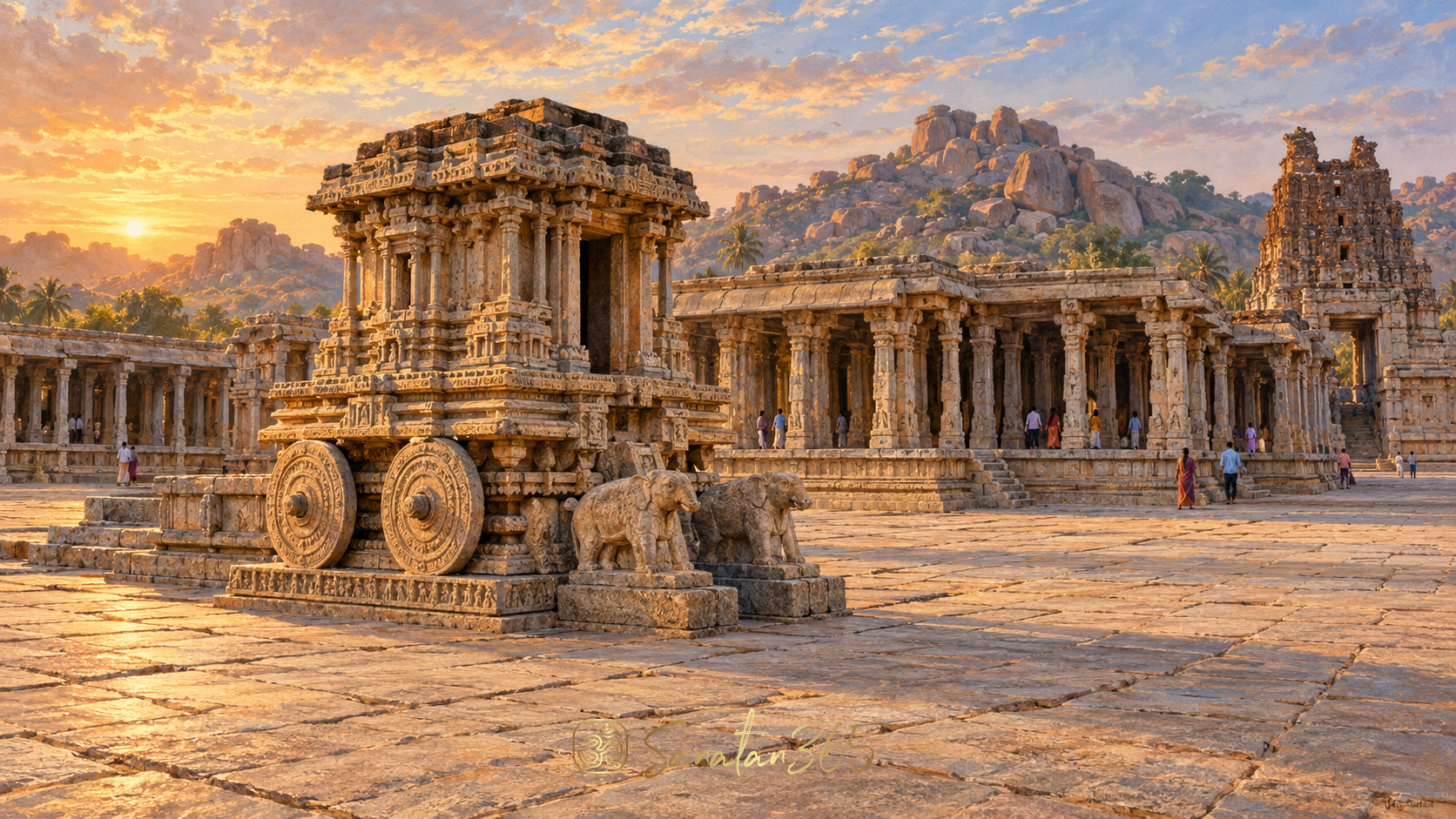
Vittala Temple Hampi: Reading the Stone Chariot and Sacred Courtyard
Understand Hampi’s Vittala Temple through its Garuda stone chariot, pillared halls, Vishnu devotion, and careful heritage visiting.
 Temples
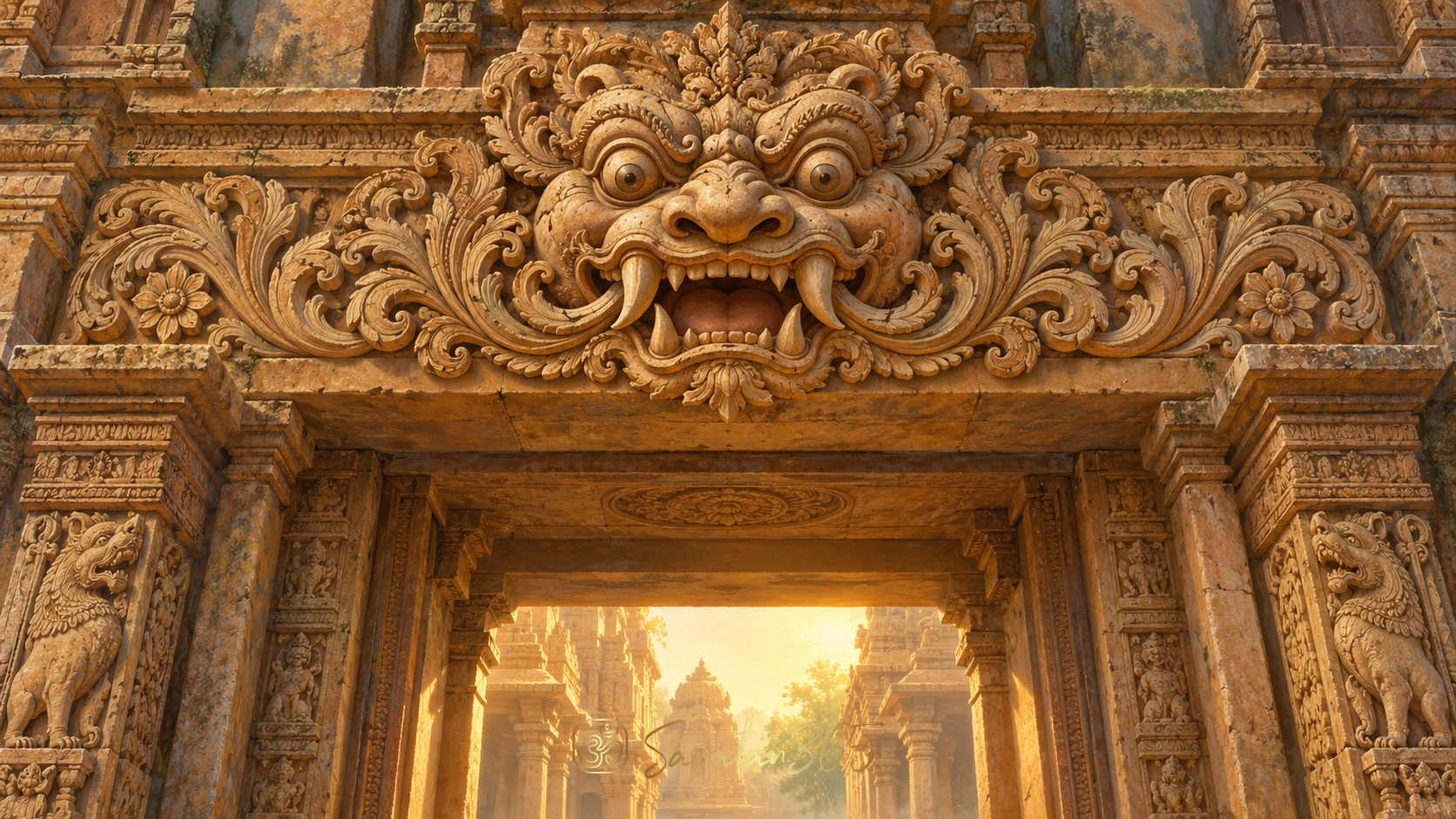
Kirtimukha Meaning: The Face of Glory Above the Temple Door
The fierce face above a temple doorway is not a warning to turn away. Learn to recognize Kirtimukha, read its sacred story, and notice how…
 Temples
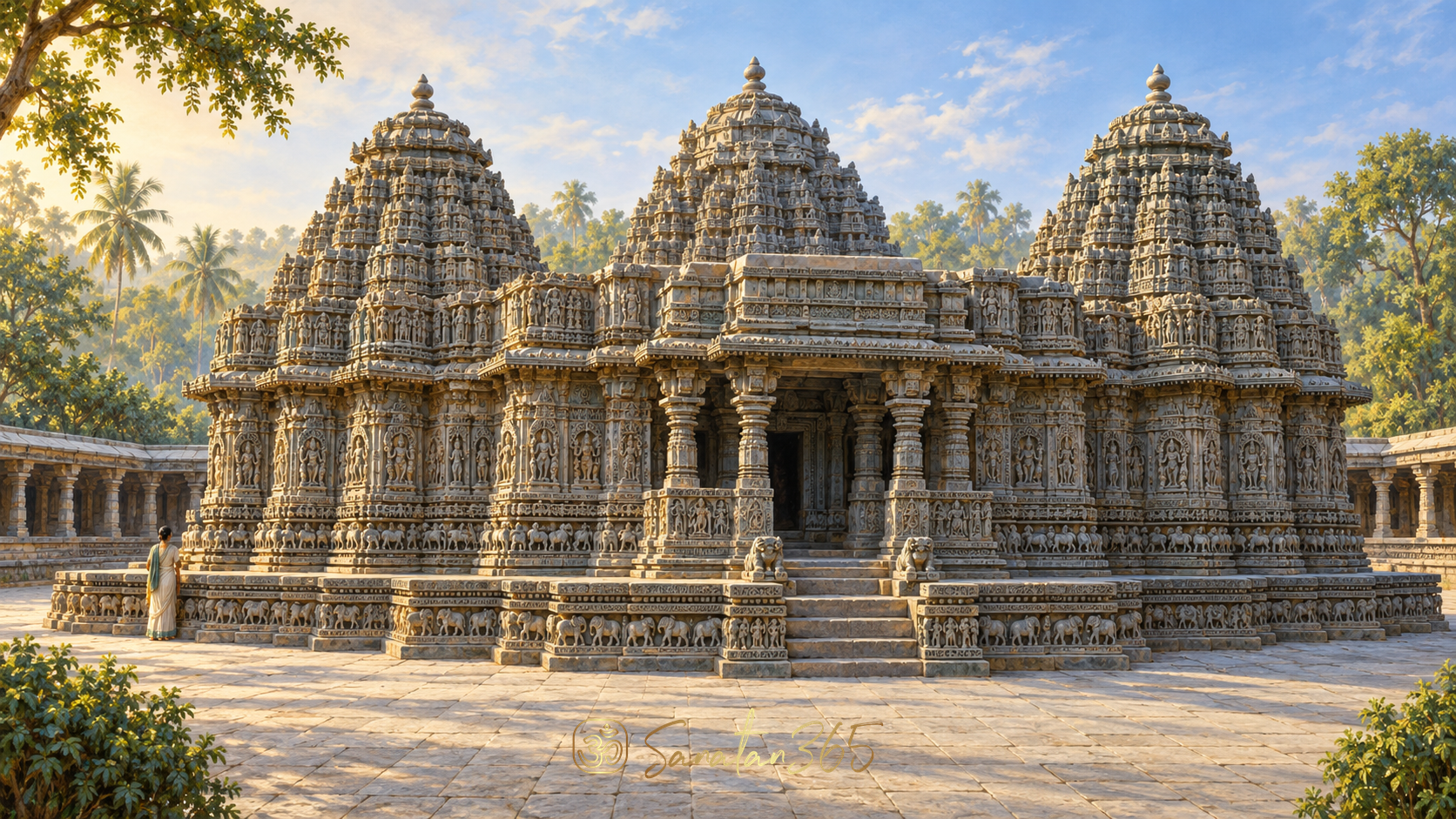
Somanathapura Keshava Temple: Three Shrines and the Art of Looking
Read the star-shaped plan, three Vishnu shrines and carved narratives of Somanathapura, with a respectful guide to a protected Hoysala monu…

