Virupaksha Temple, Hampi: Pampa, Stone, and Living Worship
Explore Virupaksha Temple through Pampa devotion, its monumental gateway, the Tungabhadra landscape, and the care a living sanctuary deserves.
A temple can belong to a ruined city without becoming a ruin in the lives of its worshippers.
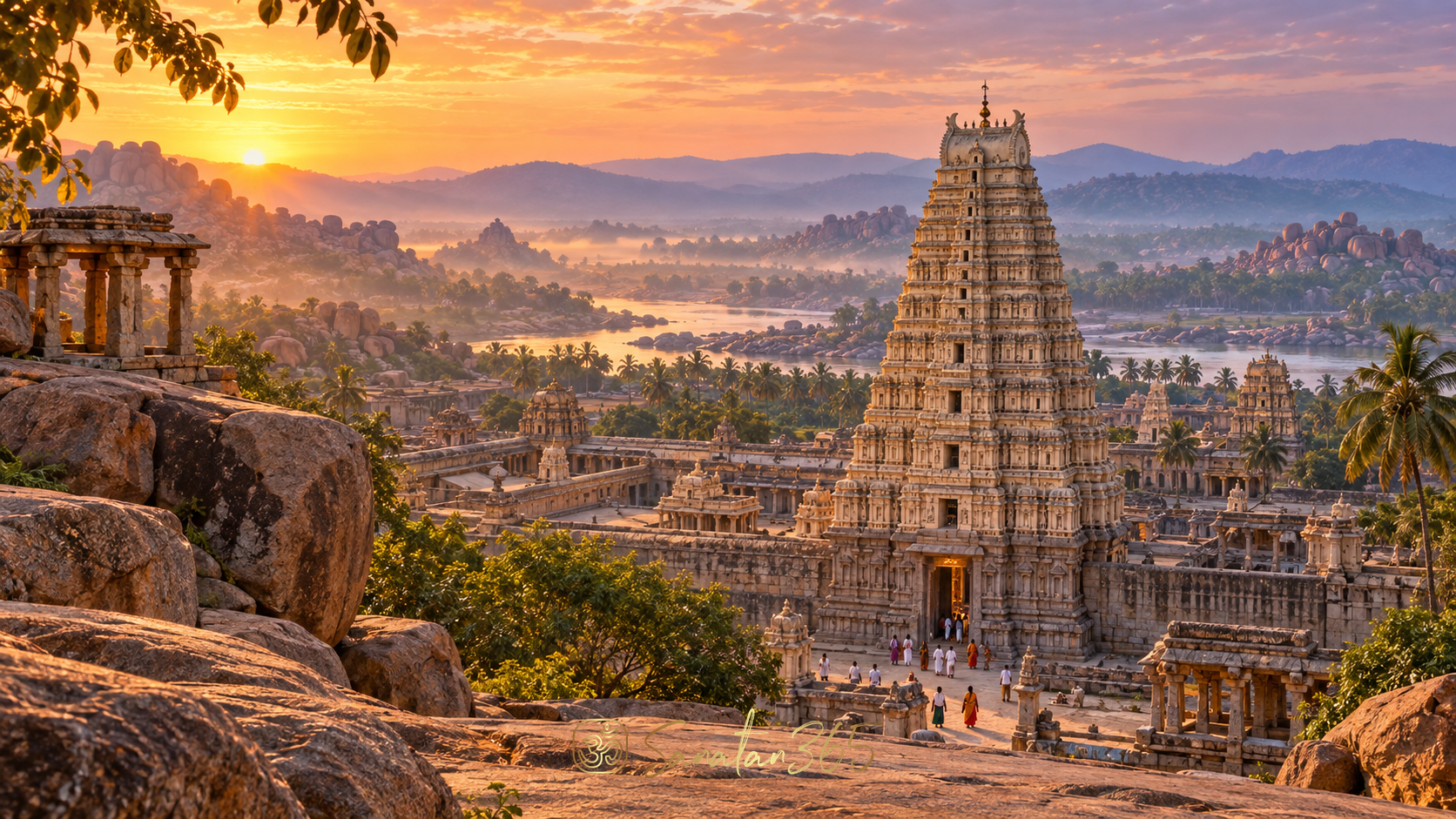
Virupaksha Temple in Hampi, Karnataka, is a living sanctuary of Shiva associated with the goddess Pampa. Its gateways, pillared spaces, and continuing worship stand within the UNESCO-listed Group of Monuments at Hampi, beside the Tungabhadra River. Understanding it requires two kinds of attention: the eye that studies architecture and the patience that recognises a place where devotion still orders the day.
A visitor may arrive looking for a famous skyline. The more revealing question is what continues beneath that skyline. Stone preserves a city's artistic achievement; worship gives the sanctuary a present tense. Neither perspective needs to displace the other.
What does Virupaksha Temple mean within Hampi?
Virupaksha is the name under which Shiva is worshipped here. Hampi is not a single monument, and the temple is not interchangeable with every celebrated structure in the archaeological landscape. It belongs to a much larger setting of sacred buildings, streets, royal remains, water systems, and granite hills.
The distinction matters because photographs often compress the site into a handful of recognisable images. The famous stone chariot belongs to the Vitthala temple complex, not the Virupaksha courtyard. A visitor who expects every Hampi landmark at one sanctuary misses the scale and variety of the place.
UNESCO's account of the Group of Monuments at Hampi describes the integration of the historic city, temple architecture, and natural setting. It also explicitly identifies Virupaksha as a temple in continuing worship. That is stronger and more useful than treating the entire landscape simply as a collection of abandoned buildings.
A sanctuary with more than one historical layer
The temple developed through additions rather than appearing in its present form in one moment. The Vijayanagara period was important to its architectural expansion, but a claim that one ruler created every part would flatten its history. Gateways, halls, and smaller structures can carry different histories even when they now form one visitor experience.
For a non-specialist, the most honest starting point is modest: notice differences, read site interpretation, and distinguish a documented attribution from a guide's memorable anecdote. Appreciation does not require attaching a confident date to every pillar.
There is also a difference between continuity and immobility. Continuing worship does not mean that every ceremony, building detail, or management arrangement has remained unchanged. A living sanctuary can preserve devotion while its material surroundings change. UNESCO notes additions and alterations associated with the temple's continuing use.
This way of reading Hampi avoids two mistakes. The first is to see only an archaeological object. The second is to assume that reverence removes the need for historical care. A working temple can invite devotion and careful scholarship at the same time.
Key takeaway: Virupaksha is a living sanctuary within a wider heritage landscape, not a shorthand for every monument at Hampi.
How does Pampa give the sanctuary its local identity?
Pampa is the goddess whose relationship with Shiva anchors the temple's local sacred identity. The name Pampapati refers to Shiva as Pampa's consort. It points to a relationship and a place, not merely another label on a list of divine names.
In the local sacred narrative, Pampa's devotion and her union with Shiva connect the landscape with divine love. Such an account belongs to religious tradition. It should be introduced as a sacred narrative, not presented as an event with an archaeologically established date.
That distinction need not diminish its meaning. A community can encounter a hill, a river, or a shrine through a remembered divine relationship. Sacred geography is not only a map of distances. It is also a map of associations: where devotion is remembered, where a festival gathers people, and where names carry inherited affection.
For readers unfamiliar with the language, kshetra (क्षेत्र, kṣetra) means a field or region and, in a pilgrimage context, a sacred place. Pampa's presence helps explain why the locality is approached as a sacred region rather than merely a convenient site for an impressive building.
Local does not mean lesser
A globally familiar description such as “a Shiva temple” is correct but incomplete. It gives the broad devotional identity while leaving out the local relationship that makes this sanctuary particular. The name Pampa restores that particularity.
This is a useful habit when learning about Hindu temples elsewhere. A deity's local name, associated goddess, festival narrative, and landscape may reveal more than a generic category. Recognising those differences does not require ranking temples or claiming one form of worship is superior.
Marriage celebrations associated with Virupaksha and Pampa express this relational identity publicly. The Incredible India introduction to Virupaksha Temple highlights these celebrations alongside the temple's architecture. Exact festival dates and arrangements should be confirmed locally for the intended year, rather than inferred from an undated travel summary.
A visitor who learns Pampa's name before arriving has already changed the quality of the visit. The gateway is no longer only an architectural silhouette. It marks entry into a place with its own devotional relationships and vocabulary.
Key takeaway: Pampa gives the sanctuary a specific local identity; sacred narrative and architectural history should be understood without confusing their kinds of evidence.
What do the gateway and pillared spaces reveal?
The great entrance tower is the temple's most recognisable public face. A gopuram (गोपुरम्, gopuram) is a monumental temple gateway tower. It announces an entrance, but the tower should not be mistaken for the sanctuary's innermost devotional focus.
Its height draws the eye upward. Movement through the entrance then changes the visitor's scale of attention: from skyline to courtyard, from a distant mass of architecture to individual surfaces, passages, and people. This shift is one reason an actual visit offers something a photograph cannot.
A mandapa (मण्डप, maṇḍapa) is a pillared hall or pavilion. Rather than looking at columns as isolated ornaments, consider how a hall holds space. Where does light enter? How do pillars frame a view? Where must people move, wait, or pass one another?
These are observational questions, not claims that every architectural feature has one hidden spiritual code. A reader should be cautious of accounts that assign a universal meaning to every dimension or announce spectacular mathematical discoveries without clear evidence.
An attentive sequence for looking
A simple sequence can make architectural observation more rewarding:
- Begin with the whole: notice the gateway in relation to the surrounding landscape.
- Follow the route: observe how entrances and passages organise movement.
- Study one detail: give a carving or a pillar more than a passing glance, where access permits.
- Return to the activity: notice that the space also serves worshippers and temple staff.
This approach does not require specialist terminology beyond what is useful. It replaces the pressure to identify everything with the discipline of seeing a few things accurately.
The inner sanctuary is a different kind of space from the public skyline. Darshan (दर्शन, darśana) means sacred seeing or beholding the deity. For a worshipper, the purpose of entering may be this encounter rather than the inspection of architectural detail.
A person studying the building should therefore make room for someone approaching it devotionally. Neither blocking a passage for a photograph nor treating a queue as background scenery is attentive looking. Good observation includes recognising another person's purpose.
Readers exploring temple architecture can compare this experience with the distinct sacred emphasis of Ekambareswarar Temple in Kanchipuram. The comparison is useful when it reveals differences, not when it turns every Shiva sanctuary into the same story.
Key takeaway: The gateway announces the temple, but its halls, routes, and devotional use explain how the place is experienced.
How do river and granite shape the sacred landscape?
Hampi's granite formations and the Tungabhadra are not decorative surroundings added to a temple itinerary. They shape the experience of distance, approach, light, and enclosure. UNESCO recognises the integration of the monumental city with this natural setting as part of the site's significance.
The temple tower seen against granite hills makes a different impression from the same tower cropped tightly in a photograph. A wider view shows how built form enters an existing landscape. The contrast between carefully organised architecture and irregular stone invites attention without requiring a speculative symbolic explanation for every boulder.
The river adds another dimension. Its presence makes the locality more than a dry collection of stone structures. Yet reverence for a river must not be confused with an assumption that every bank, crossing, or bathing point is safe or accessible at all times.
A practical visit should respect current conditions. Follow local access instructions, use designated routes, and check with responsible local operators before considering any river activity. Sacred significance does not cancel the realities of water levels, weather, or uneven ground.
Why an unhurried visit matters
A rushed itinerary tends to produce a list: gateway seen, photograph taken, next monument. An unhurried visit allows relationships to become visible. The visitor can notice how a street leads towards a tower, how shade changes the experience of a courtyard, and how the surrounding hills remain present even within the built setting.
This is not a claim that slower travel is always possible. Families, older visitors, and people with limited mobility may need to prioritise a small part of the site. A brief, thoughtful visit is more valuable than an exhausting attempt to cover everything.
The wider idea is explored in the meaning of tirtha as a sacred crossing. At Hampi, that reflection can stay concrete: a place is encountered through a route, a landscape, and the quality of attention brought to both.
Key takeaway: River, granite, and architecture belong in the same field of attention, while practical access and safety still require present-day information.
How can visitors respect a working sanctuary?
The first responsibility is to remember that the temple is not operating solely for visitors. Worship, maintenance, local livelihoods, and heritage care share the setting. A respectful approach does not demand expertise; it requires willingness to follow guidance.
Before entering, check the instructions actually displayed or given by authorised staff. Rules about footwear, clothing, photography, access, and offerings may differ between areas. An old travel article should not overrule current temple instructions.
Keep the distinction between a general cultural explanation and operational advice clear. This article does not provide a guaranteed opening timetable, ritual booking schedule, or list of areas accessible on every day. Those details need confirmation close to the visit.
Small decisions that change the visit
- Keep entrances and worship routes clear, including while waiting for companions.
- Ask before photographing people, and obey restrictions on photography inside.
- Avoid touching carvings or climbing structures for a better view.
- Use designated waste facilities and keep packaging away from the river and temple grounds.
- Choose a manageable route and allow time for rest, water, and local conditions.
- Treat an instruction to wait or move as part of visiting a working place, not an interruption to sightseeing.
For families, one useful question is better than a lecture: “What shows that this place is still used?” A child might notice a queue, a carefully maintained threshold, or people arriving with a purpose different from taking photographs. Adults can then explain only what they know, without inventing the meaning of an unfamiliar action.
For diaspora readers or first-time visitors, uncertainty is not disrespect. A quiet question to an appropriate person is usually more helpful than confidently imitating a practice without understanding local expectations.
The same consideration underlies the meaning of pradakshina, or reverential circumambulation. General knowledge can prepare a visitor, but the actual route and permitted practice should follow the sanctuary's own guidance.
Key takeaway: Respect is expressed in ordinary conduct: keeping space for worship, following current instructions, and caring for both people and place.
FAQ
Is Virupaksha Temple still used for worship?
Yes. UNESCO explicitly describes Virupaksha as a temple in continuing worship. Its place within a World Heritage property does not turn it into a museum-only building. Visitors should approach it as both a heritage site and a working sanctuary.
Which deity is worshipped at Virupaksha Temple in Hampi?
The principal deity is Shiva in the form known as Virupaksha. Pampa, the goddess associated with the locality and Shiva's consort in its sacred tradition, is central to understanding the temple's specific identity.
Is Hampi's stone chariot inside Virupaksha Temple?
No. The famous stone chariot belongs to the Vitthala temple complex elsewhere within Hampi's wider monumental landscape. Separating the two helps visitors plan realistically and understand each temple on its own terms.
Must visitors know the rituals before entering?
Detailed ritual knowledge is not necessary for learning respectfully about the sanctuary. Visitors should follow current access rules, observe without obstructing worship, and ask authorised staff when uncertain. Participation and access should never be assumed from a generic guide.
Where should current opening and festival information be checked?
Confirm arrangements through current temple information and reliable local visitor services before travelling. Festival calendars, access arrangements, and worship schedules can vary. An article explaining the temple's meaning should not be treated as a live operational timetable.
Virupaksha Temple asks for a double act of attention: to the stone that records artistic achievement and to the worship that makes the place more than its surviving architecture. Pampa's name, the gateway, the river, and the people using the sanctuary all belong to that understanding.
Key takeaway: Hampi's living temple is best encountered when historical curiosity leaves room for present devotion.
About the author
Sanatan365 Editorial
Bringing Sanatan Dharma to modern seekers through authentic, scripture-grounded content.
Related in Temples
 Temples
Kailasanathar Temple Kanchipuram: Learning to Read Shiva in Stone
Read Kanchipuram’s Pallava Shiva temple through its sandstone, sanctum tower, sculpted shrines and the care that sacred heritage asks of vi…
 Temples
Vittala Temple Hampi: Reading the Stone Chariot and Sacred Courtyard
Understand Hampi’s Vittala Temple through its Garuda stone chariot, pillared halls, Vishnu devotion, and careful heritage visiting.
 Temples
Kirtimukha Meaning: The Face of Glory Above the Temple Door
The fierce face above a temple doorway is not a warning to turn away. Learn to recognize Kirtimukha, read its sacred story, and notice how…

