Vibhishana's Story: Why Rama Welcomed Him
Why did Vibhishana leave Lanka, and why did Rama welcome him? Read the Ramayana's debate about refuge, trust, and dharma with nuance.
A stranger arrives above an army preparing for war. He is the enemy king's brother. Should the army welcome him or fear a trap?
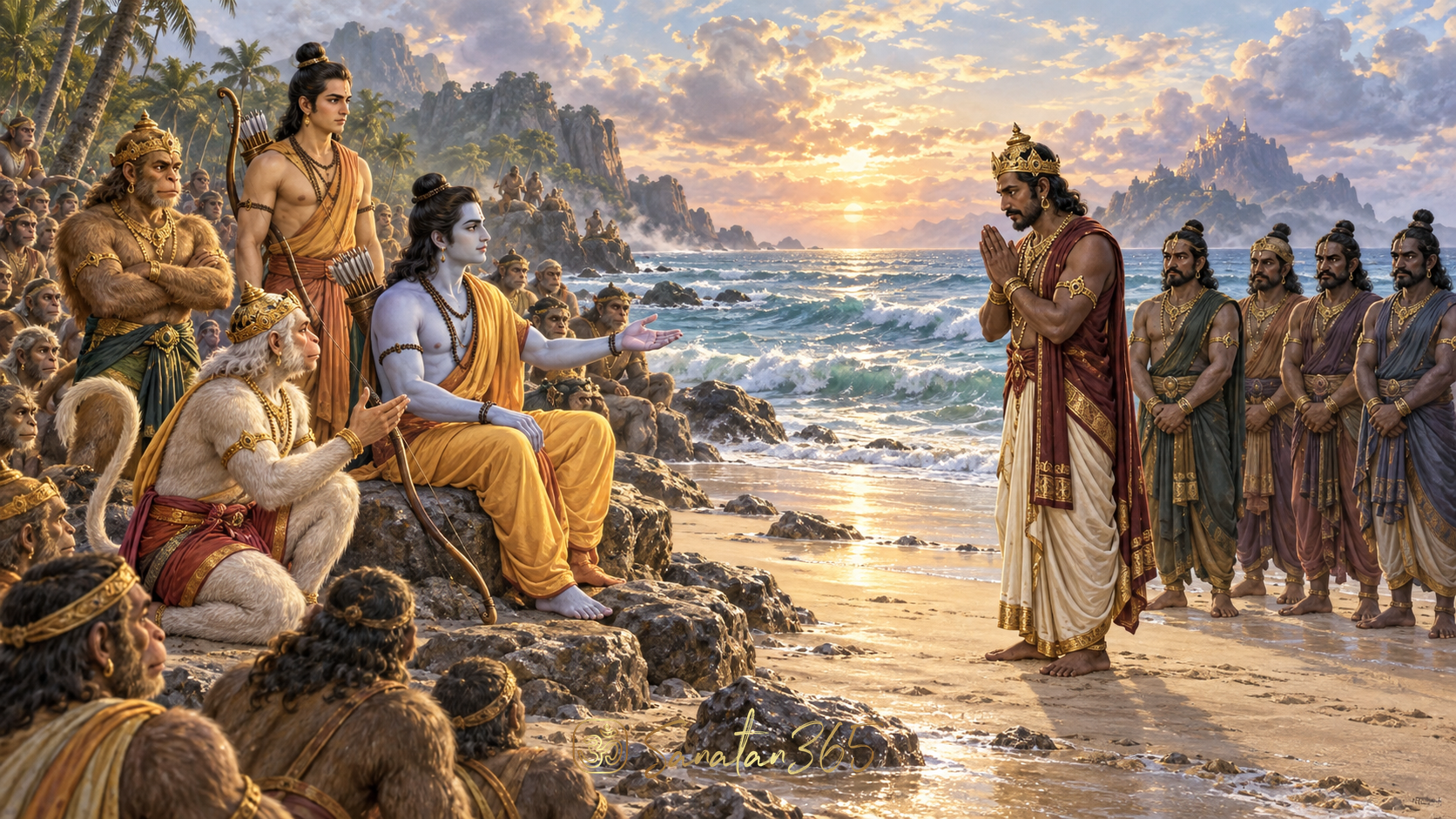
The Vibhishana story in the Valmiki Ramayana answers that question through a debate, not an instant gesture. Vibhishana leaves Ravana's court after his counsel is rejected and seeks Rama's protection. Sugriva urges caution; Hanuman argues for a more discerning hearing. Rama finally accepts the seeker of refuge. The episode joins two duties that are often pulled apart: taking a possible threat seriously and refusing to abandon someone who genuinely asks for shelter. The relevant narrative runs through the Yuddha Kanda (युद्धकाण्ड, the Book of War), especially chapters 16–19 (Valmiki Ramayana, Yuddha Kanda 16–19).
This is a story about dharma (धर्म, right conduct or sustaining duty) in an uncertain situation. It is not a command to trust every stranger without judgment, nor a license to call every disagreement with family a moral victory.
Vibhishana's Story: Why Did He Leave Ravana's Court?
Vibhishana is Ravana's younger brother. In the Yuddha Kanda, he advises Ravana to return Sita and avoid a ruinous war. His warning does not succeed. The court's response makes the cost of honest counsel unmistakable: Ravana rejects the advice and rebukes the adviser (Valmiki Ramayana, Yuddha Kanda 16). Vibhishana then departs with four companions and comes to Rama's camp.
The choice is more exacting than the shorthand “he switched sides.” The story asks what loyalty means when loyalty to a relative would require continuing to support conduct one believes is wrong. Vibhishana does not simply abandon an imperfect person at the first argument. In the narrative, he speaks inside the court first. He tries counsel before departure. That order matters: moral disagreement is not presented as an excuse to avoid the difficulty of speaking honestly.
Nor does the text invite readers to erase Vibhishana's own interests. Lanka and its future are part of the story. A refugee may have mixed motives; a leader must still decide how to respond. Rama's deliberation does not depend on proving that the newcomer has no self-interest. The question is whether protection can be offered responsibly, despite uncertainty.
Vibhishana's later words make the act of seeking refuge plain. He identifies himself as Ravana's younger brother, says he has been dishonoured, and asks Rama for protection as one who has come for shelter (Yuddha Kanda 6.19.4). Sharanagata (शरणागत, one who has come for refuge) is not merely a decorative title here. It names the relationship being requested: the vulnerable person asks a protector to receive him.
Key takeaway: Vibhishana's departure follows failed counsel and an explicit request for refuge; the narrative is more demanding than a simple tale of changing camps.
How Did Rama's Allies Respond to Vibhishana's Request?
The sea stands between Rama's allies and Lanka when Vibhishana appears. The timing makes suspicion reasonable. Sugriva sees the danger of admitting the brother of the enemy king. Other allies offer views as well, and Hanuman urges a more careful assessment of the visitor's speech and bearing. These responses are set out in the Yuddha Kanda before Rama declares his decision (Valmiki Ramayana, Yuddha Kanda 17).
There is a useful difference between caution and contempt. Sugriva's objection is not caricatured as heartlessness. An army at war has a duty to protect its members. If the visitor were a spy, a careless welcome could endanger many people. Good intentions do not dissolve that responsibility. Hanuman's argument, meanwhile, resists making family origin the only evidence that matters. A person related to Ravana can still speak and act differently from Ravana. The debate is a model of hearing relevant concerns before exercising authority.
Modern retellings sometimes jump from Vibhishana's arrival to Rama's welcome. That shortcut loses the most instructive part of the episode. Rama does not ask his companions to be quiet because his answer is predetermined. He invites counsel, hears objection, and then articulates why he will act. The moral weight of the final decision becomes clearer because the risk has been named.
A useful reader's question is not “Which adviser was right about everything?” It is “What did each adviser see?” Sugriva sees the possibility of deception and the safety of the group. Hanuman sees that identity by association is not a complete judgment. Rama holds the responsibility to decide how protection and prudence can coexist. The text gives each perspective a place in the deliberation.
This is also why the story should not be used to shame people who need practical safeguards. In ordinary life, offering help may involve boundaries, trusted intermediaries, or time to verify facts. The Ramayana's scene is a sacred narrative about a sovereign moral decision in a particular conflict, not a universal instruction to remove all safeguards in every situation.
Key takeaway: The welcome is preceded by real debate; prudence is heard rather than dismissed.
Why Did Rama Grant Refuge to Vibhishana?
After hearing Hanuman, Rama sets out his position. He says he will not reject one who comes in a friendly spirit, even if that person has faults. Sugriva continues to voice concern. Rama then speaks of the duty to protect the person who has sought refuge, and his promise becomes the moral center of the scene (Valmiki Ramayana, Yuddha Kanda 18).
The Sanskrit idea of sharanagati (शरणागति, seeking refuge or surrender) often carries devotional depth in later traditions. In this passage, it first has a concrete narrative shape: someone approaches and asks to be received; the one with power must choose whether to turn him away. Rama's response is not merely kind feeling. It commits him to protection when protection has a cost.
That promise has a striking scope. Rama's reasoning is not that Vibhishana is a convenient ally, although an ally may indeed be useful. He frames the decision through the responsibility toward a seeker of shelter. Utility does not become the only measure of a person's claim. This distinction matters because a policy of welcoming only those who can help us is not the same as compassion.
At the same time, the narrative does not require pretending the war has vanished. Rama can protect Vibhishana while continuing to prepare for the conflict with Ravana. Compassion is not passive approval of harmful action. The person who asks for refuge is not identical with the wrongs of the household from which he came.
In chapter 19, Vibhishana descends, speaks his request, and is received. Rama asks him what he knows of Ravana's forces. The story thus moves from ethical declaration to practical relationship. Vibhishana is neither left as an abstract symbol nor reduced to an intelligence source. He is addressed, accepted, and given a role (Valmiki Ramayana, Yuddha Kanda 19).
Later Vaishnava (वैष्णव, Vishnu-centered) devotional readings give Rama's promise a larger theological significance. Those readings can be meaningful without flattening the scene itself. A reader beginning with the epic can first notice the visible sequence: counsel, concern, promise, reception. Interpretive traditions build on that narrative rather than replacing it.
Key takeaway: Rama's decision is grounded in a duty toward one who asks for shelter, not only in the strategic value of a new ally.
What Does the Story Say About Loyalty and Dharma?
The Vibhishana story is often introduced as “dharma over family.” That phrase captures one part of the conflict but can be misleading if used too quickly. The narrative does not teach that family bonds are disposable. Vibhishana tries to persuade Ravana before leaving; his decision comes after counsel fails. The deeper question is whether loyalty can require silence when a family member's action harms others.
There are several loyalties in tension:
- Loyalty to a brother and a home.
- Loyalty to truthful counsel, even when it is unwelcome.
- Loyalty to those harmed by Ravana's refusal to return Sita.
- Loyalty to the duty of a leader to protect people who ask for refuge.
No slogan resolves all four. The epic dramatizes their collision. Vibhishana must decide what to do when his advice is rejected. Sugriva must consider the safety of his allies. Rama must decide what kind of protector he will be. Each faces a different aspect of dharma.
The episode also cautions against an easy morality of labels. Calling Vibhishana “traitor” settles the question before hearing why he left. Calling him “pure hero” can erase the difficult uncertainties Rama's allies actually considered. A more faithful reading keeps both: leaving a harmful course can require courage, and newcomers to a conflict may still need to be assessed carefully.
This nuance matters beyond the epic. People sometimes stay silent because they fear being called disloyal. Others may invoke conscience to avoid accountability for their own decisions. The scene suggests a disciplined order: speak honestly where one can, acknowledge consequences, listen to those whose safety is affected, and then act on a principle one can explain. That is an interpretation for reflection, not a claim that the Ramayana supplies a simple decision rule for every family dispute.
Related Sanatan365 readings can deepen the contrast: King Harishchandra's costly commitment to truth explores a different test of integrity, while the story of Jatayu's courage asks what duty means when victory is uncertain. These narratives are distinct; none reduces dharma to a single easy gesture.
Key takeaway: The episode treats loyalty as serious, but not as an excuse to silence truthful counsel or abandon a person asking for protection.
How Can Readers Reflect on the Episode Today?
A careful reflection begins by resisting two extremes. One is blind trust: “Rama welcomed Vibhishana, so every claim of good faith must be accepted immediately.” The other is guilt by association: “Vibhishana was Ravana's brother, so nothing he said could matter.” Neither fits the deliberation the epic actually presents.
Three questions can make the story useful without turning it into a formula:
- Has honest counsel been attempted? Vibhishana's departure is preceded by speaking against Ravana's course. Where it is safe and appropriate, responsible disagreement deserves a real attempt at dialogue.
- Whose safety is at stake? Sugriva's concern belongs in the conversation. Compassion for one person need not erase responsibility to others.
- What principle guides the final choice? Rama gives a reason rooted in protection. A consequential decision should be explainable by more than convenience or resentment.
These questions are relevant to families, communities, and institutions, but analogies have limits. Someone facing coercion or danger should not use an epic episode as a substitute for qualified legal or safety advice. The Ramayana offers a moral imagination, not a case-management protocol.
A devotional reader may also dwell on Rama's willingness to hear the person who arrives with no guarantee of acceptance. A literary reader may focus on the scene's dramatic structure: the feared outsider, the council, the declaration, and the welcome. Both readings can begin with the same source and respect the fact that the text stages an argument rather than merely printing a moral.
The best question to carry away may be: Can caution make compassion more responsible, instead of canceling it? In this episode, Rama's allies do not have to pretend risk is absent, and Rama does not let risk become a permanent reason to refuse shelter. That tension gives the story its enduring force.
Key takeaway: Reflect on counsel, safety, and the duty to protect together; avoid turning a complex sacred narrative into an automatic modern rule.
FAQ
Why did Vibhishana leave Ravana?
In the Valmiki Ramayana, Vibhishana urges Ravana to return Sita and avoid war. After Ravana rejects and rebukes him, Vibhishana leaves Lanka and seeks Rama's refuge (Yuddha Kanda 16–17).
Did Rama accept Vibhishana immediately?
The acceptance follows discussion. Sugriva raises the risk that Ravana's brother may be dangerous; Hanuman and others offer counsel. Rama then explains his commitment to protect one who comes seeking refuge (Yuddha Kanda 17–18).
What does sharanagati mean in this story?
Sharanagati (शरणागति) means seeking refuge or surrender. Here it describes Vibhishana's approach to Rama and Rama's decision to receive and protect him. Later devotional traditions read the scene with additional theological depth.
Does the story teach that family loyalty is wrong?
No. It portrays a conflict between several duties. Vibhishana first offers counsel to Ravana; he leaves after that counsel is rejected. The story asks what to do when loyalty to a relative conflicts with conduct one judges harmful.
Is Vibhishana welcomed only because he can help Rama win?
The narrative does show Vibhishana offering information and assistance. But Rama's stated reason for accepting him centers on the duty toward a seeker of refuge, not only on strategic gain (Yuddha Kanda 18–19).
In one line: Vibhishana's story holds prudent counsel and generous protection in the same frame—and asks what kind of person we become when someone comes seeking shelter.
About the author
Sanatan365 Editorial
Bringing Sanatan Dharma to modern seekers through authentic, scripture-grounded content.
Related in Stories
 Stories
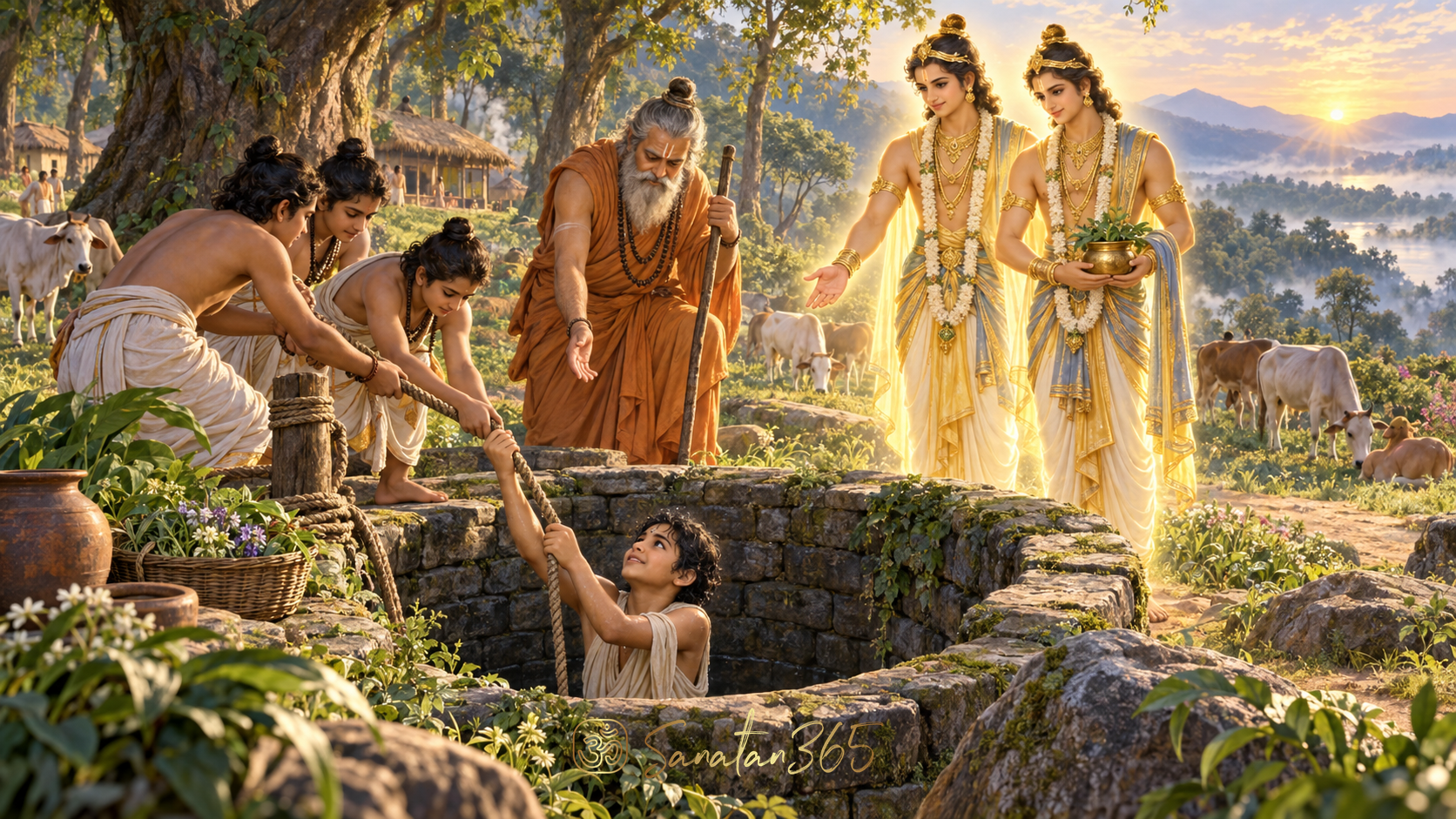
Upamanyu’s Story: Discipline, Discernment, and the Ashvins’ Grace
Upamanyu’s early Mahabharata story follows a hungry student tested by his teacher, blinded after eating harmful leaves, and restored by the…
 Stories
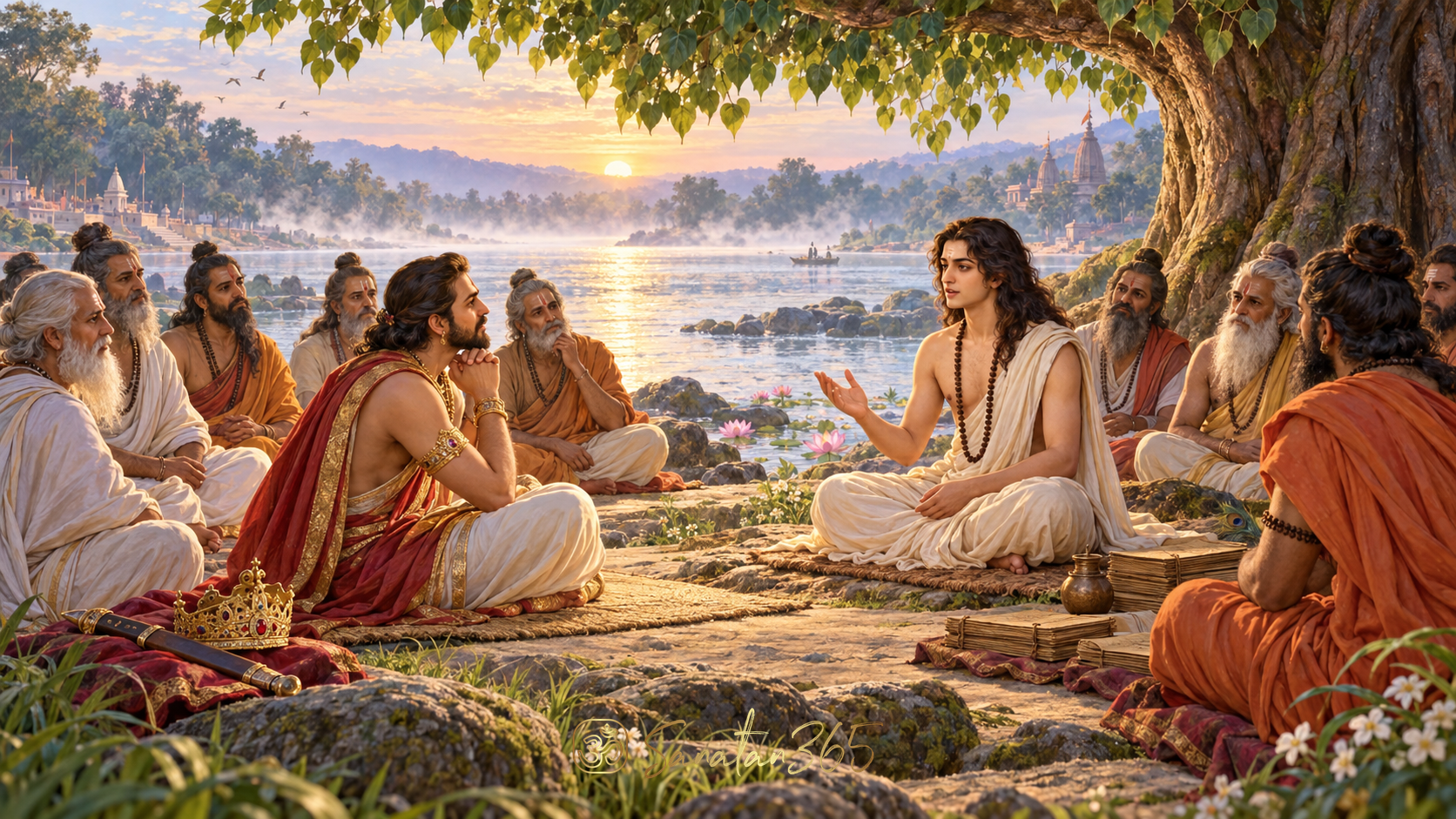
King Parikshit and Shukadeva: Seven Days of Sacred Listening
When King Parikshit learned that only seven days remained, the Bhagavata Purana says he turned from power toward one urgent question: what…
 Stories
Arundhati Vashistha Star Meaning: A Hindu Wedding Guide
The Arundhati–Vashistha star pair joins an ancient story of companionship with a living Hindu wedding custom. Learn who they are, why the s…

