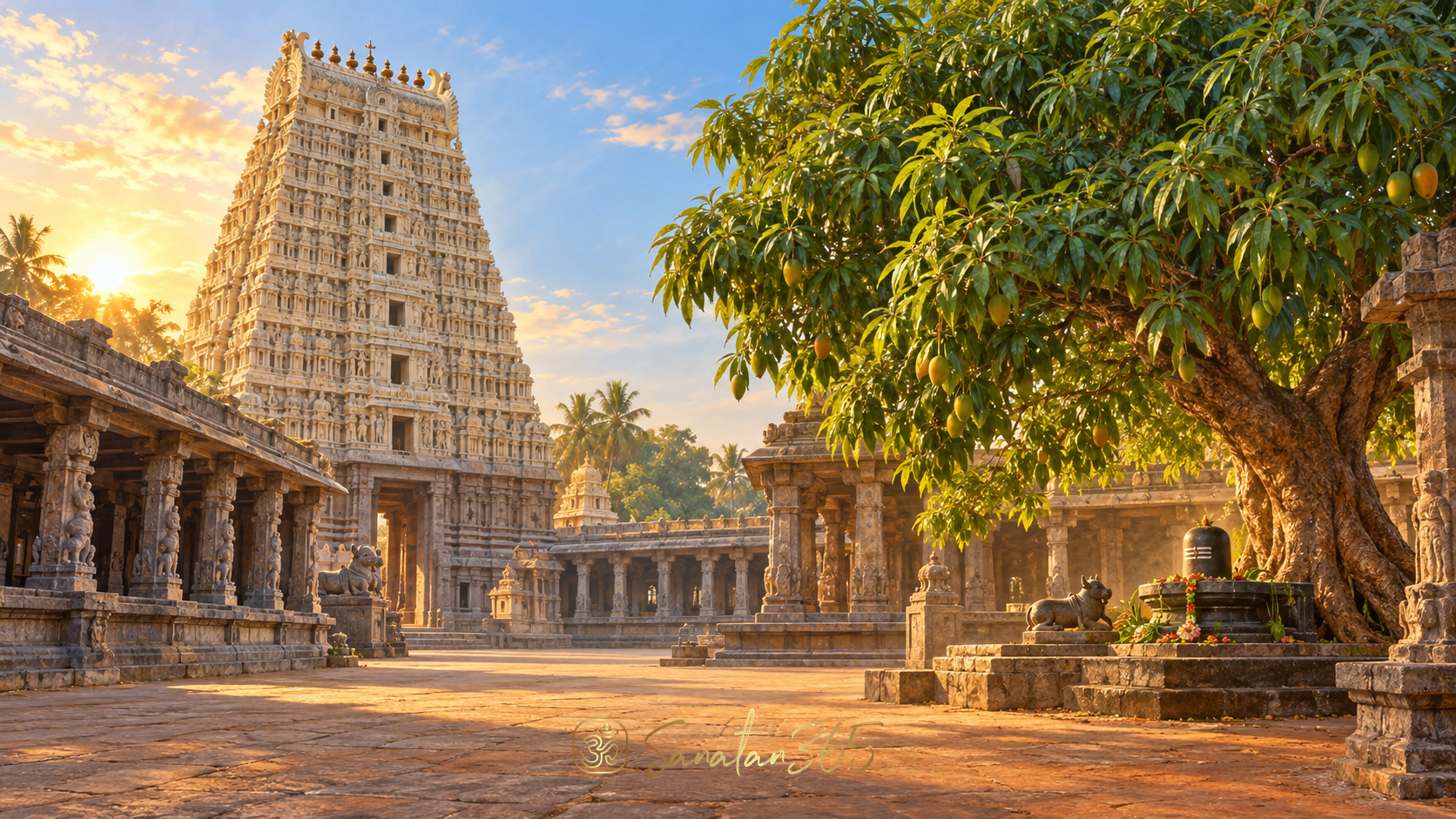
Ekambareswarar Temple: Shiva, Earth, and Kanchipuram’s Sacred Mango Tree
Kanchipuram’s earth-element Shiva shrine brings a sand linga, Parvati’s devotion, a sacred mango tree, and monumental temple architecture into one living tradition.
A temple can announce itself with a towering gateway and still place its deepest meaning in a handful of earth.
Ekambareswarar Temple in Kanchipuram, Tamil Nadu, is dedicated to Shiva and represents earth among the five elemental Shiva shrines. Its sacred identity brings together a sand linga, a mango tree, and the traditional account of Parvati protecting the form she worshipped. Linga (लिङ्ग, liṅga) means a sign or mark and, here, the sacred form through which Shiva is worshipped. The temple invites attention not only to monumental stonework but also to the relationship between devotion, place, and care.
That contrast is the most useful starting point for understanding the shrine. Visitors may first notice the height of its entrance tower. The story remembered within it turns toward something vulnerable: earth shaped for worship, held close when water threatens it. Grandeur and tenderness belong to the same sacred place.
Why does Ekambareswarar Temple represent earth?
The Kancheepuram district administration’s temple guide identifies Ekambareswarar as the earth shrine among the Pancha Bhoota Sthalams. The Sanskrit-derived expression pañca bhūta sthala means a sacred place associated with one of five elements: earth, water, fire, air, and space. These are traditional categories through which embodied existence and the sacred world are understood, not a replacement for modern chemistry.
Prithvi (पृथ्वी, pṛthvī) means earth. At this temple, the association is specific, not merely the general observation that all temples stand on land. The worshipped form is remembered as a linga of sand, and the sacred narrative places Parvati’s devotion beside a mango tree. Earth is therefore present both as an element and as a material capable of receiving loving attention.
For a reader approaching the tradition for the first time, it helps to resist reducing the five shrines to a checklist. Their elemental associations give each place a distinctive devotional language. An earth shrine and a space shrine do not compete to represent a more important Shiva. They make different aspects of the same sacred relationship available to thought and worship.
The earth association also offers room for reflection. Earth bears weight, receives footsteps, and supports ordinary life without demanding attention. Reading the temple through these qualities can encourage gratitude for what sustains daily existence. This is an interpretive reflection, not a claim that every visitor must draw an identical lesson or that temple worship promises a particular result.
A useful companion is the account of Shiva’s dance and sacred space at Chidambaram. Read together, the two places show how a shared devotional tradition can give distinct forms to the experience of presence.
Key takeaway: Ekambareswarar’s earth identity belongs to a specific sacred landscape, not a ranking of elements or temples.
What does the mango-tree story say about Parvati’s devotion?
The temple’s widely recorded sacred narrative places Parvati beneath a mango tree, worshipping Shiva through a linga made of sand. In one version, the Vegavati River rises and threatens the form she has fashioned. Parvati embraces the linga to protect it; Shiva responds to her devotion and their divine union is remembered. A reference account of the temple and its legends preserves this version alongside other tellings.
The distinction between a sacred narrative and a dated historical event matters. This story is presented as temple tradition, not as an archaeological report of a documented flood. Different retellings develop the testing of Parvati’s devotion differently. Keeping that variation visible allows the narrative to retain its devotional meaning without forcing every detail into a single supposedly verified sequence.
Its central image is unusually tender. Parvati does not protect an object because it is financially valuable or materially indestructible. The sand linga is precious because it is the focus of her worship. Her response is closeness, attention, and care. The story makes devotion visible through an action rather than leaving it as an abstract feeling.
This does not make Parvati a passive figure. Within the narrative, she worships, responds, and protects. Her agency is part of the scene’s meaning. A careful retelling can honour that activity without turning the story into a universal instruction about how people should endure difficulties in their own relationships.
Why does a tree become a sacred landmark?
The mango tree anchors the story in a living form. A temple’s sacred tree is often called its sthala-vriksha: sthala means place and vṛkṣa (वृक्ष) means tree. The expression names a tree connected with the shrine’s identity, not simply any tree growing inside a compound.
The district guide explicitly records the mango tree’s sacred status. Popular accounts also repeat claims about extraordinary age and fruit. Such claims are best distinguished from independently established botanical measurements. Reverence does not depend on presenting a traditional number as a laboratory-certified fact.
For families sharing the story, three questions keep its meaning concrete: What did Parvati create? Why did she protect it? How does the tree help people remember the place? Those questions leave room for curiosity without requiring children to choose between respectful listening and thoughtful inquiry.
Key takeaway: The mango-tree narrative expresses active, protective devotion; its sacred meaning should not be confused with a verified historical chronology.
How does the architecture frame the sacred centre?
Ekambareswarar is not an intimate village shrine expanded only in a visitor’s imagination. Its gateways, halls, and enclosure spaces make it a monumental temple complex. The district administration attributes the great entrance tower to the Vijayanagara ruler Krishnadevaraya and identifies the celebrated thousand-pillared hall with Vijayanagara patronage. These are useful, bounded historical points from the official guide.
Gopuram is the Tamil term commonly used for a monumental temple gateway tower. A mandapam is a pillared hall or pavilion. Knowing these words helps a visitor describe what is visible: an entrance that frames arrival, and a hall that creates space for movement, gathering, and attention. Neither needs to become an unexplained architectural label.
The building should not be treated as the work of a single moment. Temple reference accounts describe successive contributions under different ruling houses, including the Pallavas, Cholas, and Vijayanagara rulers. This layered character is more informative than attaching one ancient date to everything now standing. A shrine’s devotional history, surviving masonry, and later expansion are related but distinct questions.
Published summaries disagree on some tower measurements and the total size of the complex. A visitor does not need those disputed figures to appreciate the scale. Looking carefully at the relationship between the gateway, open space, and pillared passages offers a firmer understanding than collecting uncertain superlatives.
What can a visitor look for without rushing?
A simple sequence can make architectural attention more purposeful:
- Notice how the gateway changes the sense of arrival from the surrounding streets.
- Observe how a pillared hall alternates shadow, light, and repeated forms.
- Let smaller details become visible after taking in the larger scale.
- Remember that people using these spaces for worship are not part of a staged display.
These are suggestions for attentive looking, not an official route through every enclosure. Access can vary, and instructions at the temple take precedence. Where a passage is restricted or a ritual is underway, the respectful response is to pause or follow the indicated path.
The architecture and the sand-linga narrative also create a striking contrast. Large-scale building surrounds a sacred story about protecting something fragile. One can appreciate this contrast without assuming that every builder intended precisely the same philosophical reading. Good interpretation begins with what the place actually presents and remains modest about what it cannot prove.
Key takeaway: Read the temple as a layered living complex, with monumental architecture surrounding a distinct devotional centre.
How does this shrine belong to Kanchipuram’s living landscape?
Kanchipuram is not a city with only one sacred address. Its temples preserve different forms of devotion, architectural histories, and local memories. Ekambareswarar belongs within that wider landscape while retaining its own identity as the earth-element Shiva shrine.
The Kamakshi Amman Temple in Kanchipuram offers related context for the city’s worship of the Goddess. Recognising the relationship does not mean treating the two temples as interchangeable or assuming that visiting one automatically explains the other. The mango-tree narrative is specific to Ekambareswarar’s devotional identity.
The wider complex also contains the Nilathingal Thundam Perumal shrine dedicated to Vishnu, noted in the reference account cited above. This detail is a useful reminder that lived temple geography can be more intricate than a single category label suggests. It should encourage careful observation, not a sweeping claim about every temple in Tamil Nadu.
Language adds another layer. Ekambareswarar and Ekambaranathar are names visitors may encounter for Shiva at this shrine. Kanchipuram and Kancheepuram are common English spellings of the city. Recognising these variants can help when comparing signs, transport information, and official pages without mistaking a spelling difference for a different destination.
For diaspora families, these local details are especially valuable. A general introduction to Shiva worship may already be familiar, but a place becomes memorable through a particular tree, a particular narrative, and the sound of its local name. Sharing those details preserves texture that disappears when every temple is described only as ancient, powerful, and beautiful.
There is no need to turn a visit into a contest of how many shrines can be completed in one day. The broader idea of pilgrimage as a sacred crossing offers a different measure: how attentively a person encounters a place and the people who sustain it.
Key takeaway: Ekambareswarar becomes clearer within Kanchipuram’s varied sacred geography, without losing its own local character.
How can a visitor prepare for attentive worship?
A meaningful visit begins with ordinary preparation. Check current opening hours and local access arrangements before travelling. The district guide provides visitor information, but schedules may change for festivals, maintenance, or temple observances. A published schedule is a planning aid, not a guarantee for every date.
Darshan (दर्शन, darśana) means seeing or beholding; in temple practice it describes the devotional encounter with the deity. Preparation for darshan is not only a matter of reaching the right queue. It includes making room for the fact that the temple operates as a place of worship, with rhythms that may differ from a sightseeing timetable.
Practical attention can be simple:
- Confirm the correct Kanchipuram destination and allow time for local travel.
- Follow posted dress, footwear, photography, and access guidance.
- Ask before bringing or placing offerings; do not improvise rituals at the shrine.
- Keep routes clear for other worshippers and follow staff directions.
- Plan rest and mobility needs for the people travelling together.
The sacred tree deserves particular care. Admiration is not permission to pluck leaves, break twigs, tie objects, or enter a protected area. Follow the arrangements actually provided. Protecting the living landmark is a fitting response to a story in which devotion itself takes the form of protection.
A family might finish the visit by recalling one architectural detail, one part of the narrative, and one question that remains. This keeps curiosity alive without pretending that a short visit produces complete knowledge. The same approach works for someone learning from afar: start with verified place information, understand the traditional story, and recognise the limits of second-hand description.
The temple’s most lasting contrast may be its simplest. A great gateway draws the eye upward; the earth association returns attention to what supports life. Between them stands a story of care that does not need exaggeration to remain compelling.
Key takeaway: Prepare carefully, follow the temple’s living rules, and let attention matter more than collecting sights.
FAQ
Where is Ekambareswarar Temple?
It is in Kanchipuram, Tamil Nadu. Official sources also use the spelling Kancheepuram, and the deity’s name may appear as Ekambaranathar. Check that travel directions refer to the Kanchipuram shrine.
Why is Ekambareswarar called the earth temple?
It represents earth among the five elemental Shiva shrines. Its sacred identity centres on a sand linga and the traditional account of Parvati worshipping and protecting that form.
What is the significance of the mango tree?
The mango tree is the temple’s sacred tree and anchors the narrative of Parvati’s worship. Its religious significance should be distinguished from popular claims about its exact biological age.
Is the Parvati and sand-linga story a historical event?
It is a sacred narrative preserved in temple tradition, with different versions. It can be respectfully understood as devotional storytelling without presenting its details as independently verified history.
What should visitors check before arriving?
Confirm current opening hours, access arrangements, and any festival-related changes. Follow local guidance on dress, photography, offerings, and protected areas, including the sacred tree.
About the author
Sanatan365 Editorial
Bringing Sanatan Dharma to modern seekers through authentic, scripture-grounded content.
Related in Temples
 Temples
Vittala Temple Hampi: Reading the Stone Chariot and Sacred Courtyard
Understand Hampi’s Vittala Temple through its Garuda stone chariot, pillared halls, Vishnu devotion, and careful heritage visiting.
 Temples
Kirtimukha Meaning: The Face of Glory Above the Temple Door
The fierce face above a temple doorway is not a warning to turn away. Learn to recognize Kirtimukha, read its sacred story, and notice how…
 Temples
Somanathapura Keshava Temple: Three Shrines and the Art of Looking
Read the star-shaped plan, three Vishnu shrines and carved narratives of Somanathapura, with a respectful guide to a protected Hoysala monu…

