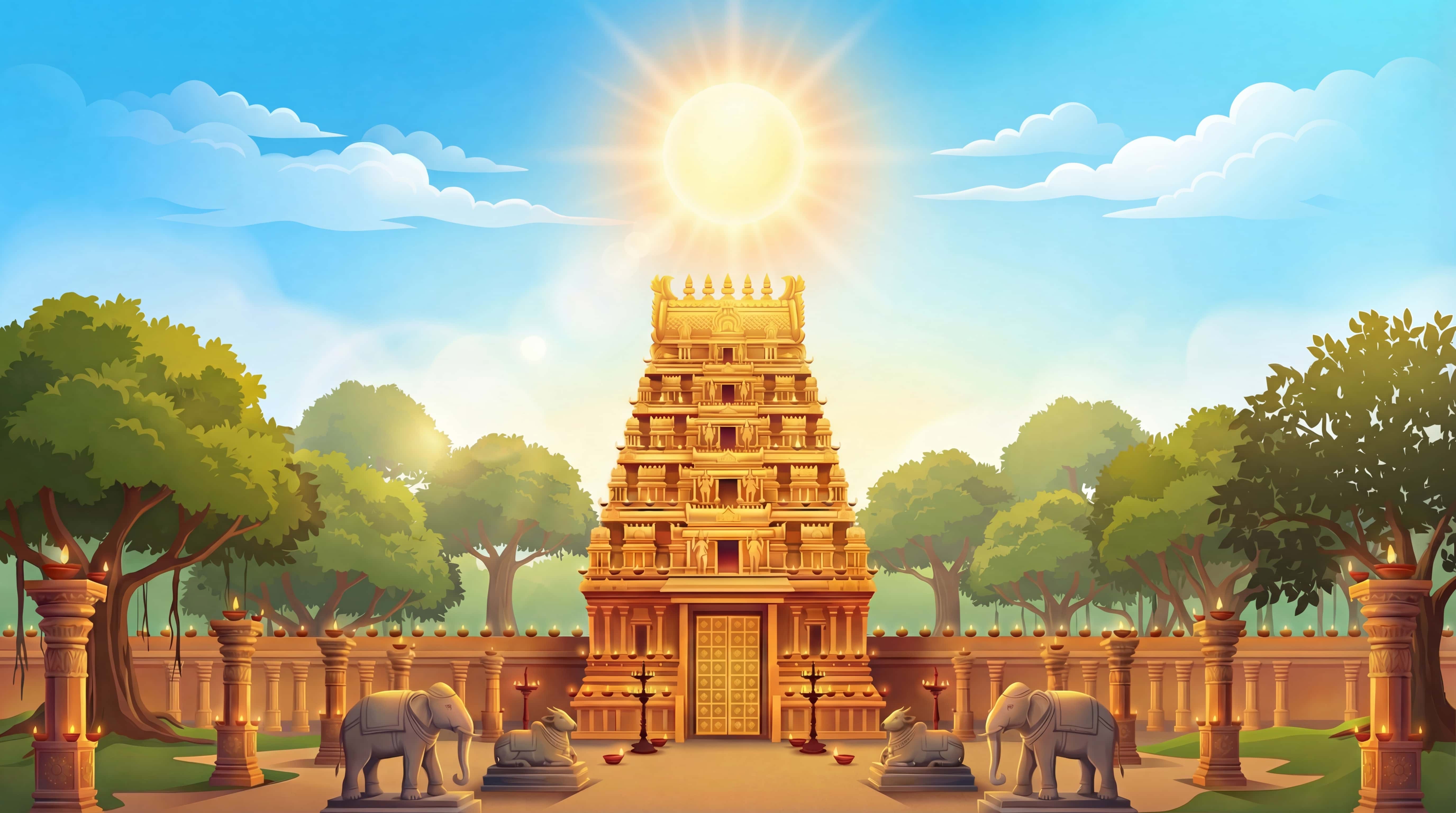
Tirtha Meaning: Why Hindu Pilgrimage Is a Sacred Crossing
Tirtha means a sacred crossing place: a riverbank, temple, mountain, or landscape where pilgrimage invites devotion, humility, remembrance, and responsible return.
A tirtha begins with the image of water shallow enough to cross.
That image carries the heart of tirtha meaning in Hinduism. Tirtha (तीर्थ, a ford or sacred crossing place) can be a riverbank, temple, mountain, city, forest, or other holy place where ordinary geography becomes a setting for devotion and inner reorientation. A tirtha-yatra (तीर्थयात्रा, pilgrimage to a sacred crossing) is therefore more than reaching a destination. It is the disciplined act of leaving familiar routines, approaching sacred presence with humility, and returning with responsibility.
What Is the Tirtha Meaning in Hinduism?
The Sanskrit word tirtha first evokes a ford: a place where one can pass from one bank to another. Hindu traditions extend that concrete image into sacred geography. A tirtha is a place where a crossing becomes possible between distraction and remembrance, isolation and community, habit and renewed attention.
Encyclopaedia Britannica defines a tirtha as a holy river, mountain, or other place made sacred through association with a deity or saint. It also notes that pilgrimage may involve bathing, circumambulation, offering, ancestral rites, and listening to sacred narratives (Britannica). The definition matters because it keeps place, story, and practice together. A river is not merely scenery; a temple is not merely architecture; a mountain is not merely a physical challenge.
Sacredness may be remembered through several kinds of association:
- a deity's presence, manifestation, or sacred story;
- the life, teaching, or samadhi (समाधि, spiritually absorbed passing or memorial shrine) of a saint;
- a river confluence, spring, mountain, cave, grove, or coastline;
- a temple tradition sustained by worship across generations;
- a scriptural narrative or local sthala-purana (स्थलपुराण, sacred account associated with a place);
- repeated acts of prayer, service, hospitality, and remembrance.
Scholar Diana L. Eck describes India through a network of sacred places and stories rather than through one isolated center. Her study of sacred geography shows how pilgrimage links rivers, mountains, temples, and regional traditions into a lived map of memory (Harvard University Press overview). A devotee may know one local shrine intimately while also recognizing Kashi, Rameswaram, Puri, Tirupati, the Himalayas, the Narmada, or the Ganga within a larger sacred imagination.
This does not mean every Hindu must visit the same places. Hindu pilgrimage is plural. A family shrine, a village deity's temple, a riverbank honored locally, and a renowned pan-Indian center can each carry genuine devotional meaning. Physical scale and public fame do not measure spiritual sincerity.
Key takeaway: A tirtha is a sacred crossing where place, story, worship, and disciplined attention meet.
Why Is Hindu Pilgrimage Called a Sacred Crossing?
Crossing is both physical and inward. The pilgrim crosses distance, weather, crowds, uncertainty, and personal comfort. At the same time, the pilgrim is invited to cross beyond self-importance.
Traditional pilgrimage often interrupts the structures that make a person feel fully in control. Meals become simpler. Sleep may be unfamiliar. The body tires. Plans change with weather, temple hours, river conditions, or the needs of fellow travelers. None of these difficulties automatically produces wisdom, but they can reveal impatience, entitlement, fear, generosity, and resilience with unusual clarity.
The Mahabharata contains extensive pilgrimage traditions, especially within the forest-book setting where journeys to sacred places are woven together with teachings and remembered narratives. The significance lies not in collecting locations like trophies but in hearing why a place matters and how one should conduct oneself there. Purana literature likewise preserves tirtha-mahatmya (तीर्थमाहात्म्य, accounts praising and explaining a sacred place), joining geography to story and ritual.
The crossing metaphor helps avoid two misunderstandings.
First, pilgrimage is not spiritual tourism with religious decoration. Tourism may appreciate beauty, history, food, and architecture; those are not wrong. Tirtha-yatra adds a devotional discipline: reverence, restraint, worship, listening, service, and ethical conduct.
Second, pilgrimage is not a transaction that guarantees a desired outcome. Traditional accounts may speak of punya (पुण्य, spiritual merit or wholesome sacred fruit), purification, blessing, or liberation. These should not be reduced to a commercial promise. No journey forces the Divine, erases accountability, or replaces sincere repair after harm. The quality of conduct before, during, and after the visit remains essential.
A person can bathe in sacred water while carrying the same cruelty home. Another can return from a modest local pilgrimage more patient, truthful, and generous. The outer crossing finds its completion in an inner and ethical one.
Key takeaway: Tirtha-yatra becomes a sacred crossing when physical movement supports humility, remembrance, and changed conduct.
How Does Sacred Geography Shape a Tirtha Yatra?
Hindu sacred geography is not one uniform landscape. Water, mountains, forests, coastlines, caves, and cities each shape the pilgrim differently.
Rivers and confluences
Rivers suggest movement, renewal, nourishment, and continuity. Places such as Prayagraj are revered for sangama (संगम, confluence), where waters meet. Varanasi's ghats bring worship, learning, cremation, memory, and daily life into close proximity. A ritual bath, where locally permitted and physically safe, is not simply washing; it expresses prayerful entry into a living sacred relationship.
That relationship requires ecological responsibility. Soap, plastic, cloth, food packaging, synthetic offerings, and other waste should not be left in rivers. Reverence for sacred water is contradicted by pollution.
Mountains, caves, and difficult paths
Mountain tirthas can make human smallness visible. Altitude, cold, distance, and changing weather demand preparation and respect. Himalayan pilgrimage traditions connected with Kedarnath, Badrinath, Gangotri, Yamunotri, Amarnath, and other sites carry distinct histories and rules; they should not be collapsed into one generic adventure.
Difficulty is not a competition. Older adults, children, people with disabilities, and those managing health conditions may require adapted routes, assistance, or a different form of devotion. Using transport or accessibility support does not make devotion inferior.
Temple cities and ritual landscapes
Some tirthas are whole ritual ecosystems. Temple, tank, river, procession route, market, monastery, feeding hall, shrine network, and neighborhood together form the sacred place. In Puri, Rameswaram, Madurai, Ujjain, Tirupati, and many other centers, the pilgrim enters a living community rather than an empty monument.
Local instructions matter. Dress rules, photography restrictions, queue systems, ritual permissions, and temple-specific etiquette should be followed without argument. Not every sacred space is designed around a visitor's convenience.
For a related view of interconnected sacred cities, the Sapta Puri tradition explains seven revered pilgrimage centers. Kedarnath's sacred endurance shows how Himalayan landscape, Shiva devotion, and responsible preparation meet in one specific tirtha.
Local and diaspora tirthas
Sacred geography travels through memory without becoming a copy. Diaspora temples, river ceremonies, procession routes, and community pilgrimage days may help families sustain practice far from ancestral regions. A local temple visited with regular service and devotion can shape a life more deeply than an expensive journey made for display.
Key takeaway: Every tirtha has its own ecology, story, community, and discipline; respectful pilgrimage learns the place rather than consuming it.
How Should Someone Prepare for a Tirtha Yatra?
Preparation joins devotion with practical care. A beautiful intention does not replace transport planning, medication, weather awareness, or respect for local rules.
1. Learn why the place is sacred
Read a reliable account of the deity, saint, river, event, or teaching connected with the tirtha. Learn the temple's official timings and current requirements. Distinguish a widely held tradition from a modern rumor or viral claim.
2. Form a clear sankalpa
Sankalpa (संकल्प, sacred intention) answers a simple question: why is this pilgrimage being undertaken? The answer might be gratitude, remembrance, prayer, learning, service, or marking a life transition. It should not promise a guaranteed miracle.
3. Prepare the body honestly
Check distance, altitude, heat, cold, stairs, crowd density, and sanitation. Carry prescribed medicine, water where allowed, identification, simple food if needed, and suitable clothing. Seek medical advice when health conditions, pregnancy, age, or altitude risk make that appropriate. Pilgrimage is spiritual practice, not a substitute for healthcare.
4. Travel lightly and ethically
Reduce unnecessary luggage, single-use plastic, noise, and waste. Use authorized guides and services. Do not pressure vulnerable people for photographs. Ask before photographing priests, ascetics, worshippers, or private rituals. Avoid feeding wildlife unless local conservation guidance explicitly permits it.
5. Make room for seva
Seva (सेवा, selfless service) may include helping an elder, supporting an authentic feeding program, contributing to verified conservation work, cleaning responsibly, or simply refusing to push ahead of others. Charity should preserve dignity; it is not content for self-promotion.
6. Know the core ritual sequence
Practices vary, but many pilgrimages include respectful arrival, bathing or symbolic purification where appropriate, darshana (दर्शन, reverential seeing and being seen by the Divine), pradakshina (प्रदक्षिणा, clockwise circumambulation), offering, prayer, listening, and receiving prasada (प्रसाद, blessed offering). Follow the local tradition rather than inventing a universal checklist.
7. Plan the return
Ask what one practice will continue at home. Without a return discipline, pilgrimage can become an intense memory that fades. A weekly lamp, more careful speech, river stewardship, study, charity, or patient family care can carry the crossing into daily life.
Key takeaway: Responsible tirtha-yatra combines sacred intention, local knowledge, health preparation, ecological care, and a concrete practice after returning.
Can a Person Experience Tirtha Without Travelling Far?
Not everyone can undertake a distant pilgrimage. Money, disability, caregiving, illness, immigration status, work, age, conflict, or environmental conditions may limit travel. Hindu devotional life has never depended on turning physical access into a test of worth.
A person can honor a distant tirtha by studying its story, reciting associated prayers, supporting its ecology or service institutions responsibly, visiting a nearby temple, or observing a sacred day at home. Some households keep water remembered from a pilgrimage; others listen to temple worship or gather as a community. These are not identical to physical presence, and they need not pretend to be. They are sincere forms of connection shaped by circumstance.
The deeper principle is attention. A famous temple visited carelessly may remain only a location. A nearby riverbank approached with gratitude, cleanliness, and prayer may become a profound teacher. Sacred geography does not erase the distinct importance of established tirthas, but it can awaken reverence for the places that sustain everyday life.
This insight also corrects the idea that holiness is somewhere else. Pilgrimage creates distance so that a person can see home differently. After bowing before a river, can one waste water casually? After receiving food as prasada, can one ignore hunger nearby? After waiting in a long queue for darshana, can one practice patience with family?
The single key takeaway is this: a tirtha is fulfilled not when the pilgrim reaches the sacred place, but when the crossing reshapes how the pilgrim returns.
FAQ
What is the simplest tirtha meaning?
Tirtha means a ford or crossing place. In Hinduism, it commonly refers to a sacred river, temple, mountain, city, or landscape where pilgrimage supports devotion, remembrance, and inner transformation.
What is the difference between tirtha and tirtha yatra?
A tirtha is the sacred crossing place. Tirtha-yatra is the pilgrimage or disciplined journey to that place.
Is every Hindu temple a tirtha?
Many temples function as sacred pilgrimage places, but traditions use the word with different scope. A tirtha may also be a river, confluence, mountain, cave, forest, city, saint-associated place, or another revered landscape.
Does visiting a tirtha guarantee punya or liberation?
Hindu traditions often associate pilgrimage with punya, purification, blessing, and spiritual growth, but these should not be treated as guaranteed transactions. Intention, conduct, accountability, devotion, and the life lived after returning all matter.
How can someone prepare for a first Hindu pilgrimage?
Learn the place's sacred story and official rules, form a modest intention, check health and weather needs, travel with minimal waste, follow local etiquette, and choose one responsible practice to continue after returning home.
About the author
Sanatan365 Editorial
Bringing Sanatan Dharma to modern seekers through authentic, scripture-grounded content.
Related in Pilgrimage
 Pilgrimage
Panch Prayag: Five Sacred Confluences of the Alaknanda
Learn the five Panch Prayag river pairs, their downstream order, the naming of the Ganga at Devprayag, and a respectful way to visit.
 Pilgrimage
Tiruvannamalai Girivalam: Meaning of the Sacred Arunachala Walk
A grounded guide to the meaning, route, traditions, and respectful practice of Girivalam around Arunachala in Tiruvannamalai.
 Pilgrimage
Narmada Parikrama Meaning: Walking with a Sacred River
Narmada Parikrama is the devotional circumambulation of the Narmada, traditionally following one bank to the river mouth and returning alon…