Kamakshi Amman Temple: Kanchipuram's Shrine of Sacred Stillness
Kamakshi Amman Temple places the Divine Mother at the spiritual heart of Kanchipuram. Its seated goddess, Sri Chakra tradition, and sacred-city setting reveal a vision of power held in stillness.
In a city celebrated for soaring temple towers, Kamakshi Amman Temple gathers attention toward a seated Goddess. The shrine is the devotional heart of Kanchipuram, Tamil Nadu: a major center of Shakti worship where Kamakshi is revered as the Divine Mother whose power is expressed through composure, attention, and grace. Its meaning lies not in one legend alone, but in the relationship among the Goddess, the Sri Chakra tradition, the temple's living worship, and Kanchipuram's sacred geography.
The name Kamakshi is commonly understood through kāma (काम, desire or love) and akṣi (अक्षि, eye): “she whose eyes awaken or fulfill worthy desire.” This is not a promise that every wish will be granted. It is a devotional image of the Mother's compassionate gaze, inviting desire to be refined by wisdom and dharma.
What makes Kamakshi Amman Temple central to Kanchipuram?
Kanchipuram is one of India's most enduring sacred cities. It developed as a major religious and political center under several South Indian dynasties and remains known for Hindu temples, learning, and silk weaving. Encyclopaedia Britannica identifies Kanchipuram as an ancient city with important Shaiva and Vaishnava shrines, while the city's sacred landscape also gives the Goddess a defining place (Encyclopaedia Britannica).
Kamakshi Amman Temple is distinctive because it is not simply another shrine among many. In the devotional imagination of Kanchi, Kamakshi is the city's presiding maternal presence. Shaiva, Vaishnava, and Shakta currents meet without needing to erase their differences. The temple thus offers a useful way to understand a Hindu sacred city: holiness is distributed across many shrines, yet particular deities may give the whole city its emotional and theological center.
This is also why Kanchipuram is remembered among the Sapta Puri, the seven sacred cities. A pilgrim does not encounter sacred geography as a checklist of monuments. Streets, tanks, processional routes, temple bells, flowers, food offerings, and inherited stories together form a landscape of remembrance.
The temple's historical development is layered. Popular accounts connect it with Pallava foundations and later Chola and Vijayanagara patronage, but precise claims about a single founding date vary. A careful reading therefore distinguishes documented architectural history from sthala purāṇa (स्थलपुराण, a shrine's sacred place-story). Both matter, but they answer different questions: history asks how a structure changed; sacred narrative asks how devotees understand the place.
Key takeaway: Kamakshi Amman Temple is central because it makes the Divine Mother the spiritual focus of Kanchipuram's diverse sacred landscape.
Who is Goddess Kamakshi and what does her name mean?
Goddess Kamakshi is revered as a form of Parvati and, in Shakta traditions, as the sovereign Divine Mother. Devotees also relate her to Lalita Tripurasundari, the beautiful and gracious form of supreme Shakti honored in Sri Vidya. These identifications belong to living theological traditions; they should not be flattened into the claim that one form of the Goddess is “higher” than another.
Her name offers a profound devotional teaching. Desire can scatter attention toward endless objects, status, or control. Under Kamakshi's gaze, desire is not merely condemned. It is examined and educated. What do we seek? Will obtaining it deepen responsibility? Can longing become devotion, service, learning, or courage?
That reframing is especially important when approaching stories that call Kamakshi a giver of boons. A vara (वर, boon or blessing) is not a commercial transaction with the Divine. Temple prayer may include hopes for family, livelihood, healing support, or clarity, but devotion does not guarantee a particular outcome. Kamakshi's compassionate gaze can instead be understood as the space in which a seeker learns to hold hope without entitlement.
Her iconography strengthens this lesson. Kamakshi is often described as holding a sugarcane bow and flower arrows, a noose and a goad. Within Sri Vidya symbolism, these objects can speak to the mind, the senses, attraction, restraint, and direction. They are not weapons of fear. They portray consciousness learning how to gather its own energies.
Key takeaway: Kamakshi's name turns the language of desire into an inquiry about love, attention, and dharmic purpose.
Why is Kamakshi seated in yogic stillness?
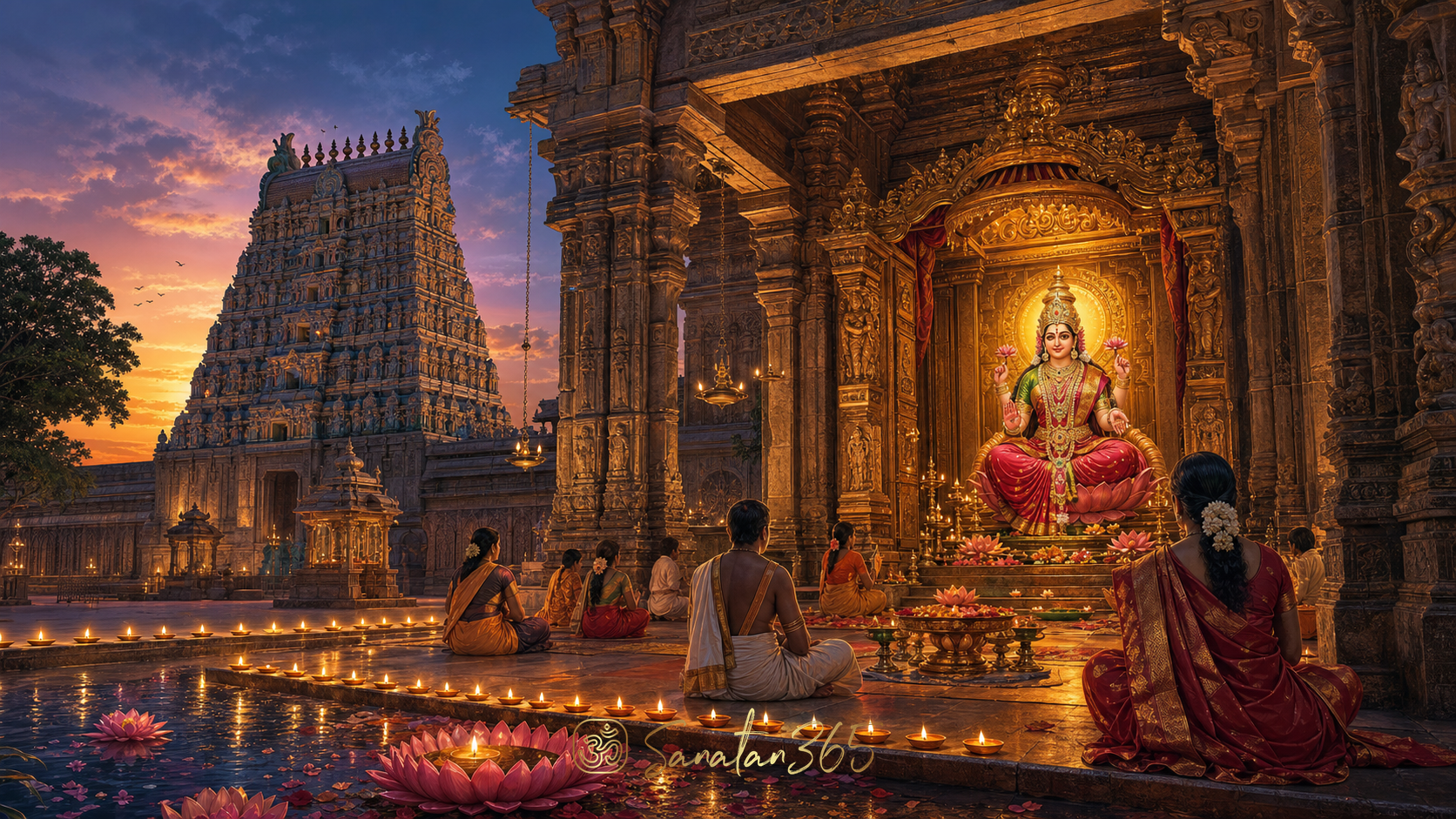
The principal Goddess is revered in a seated posture rather than shown in dramatic combat. Padmāsana (पद्मासन, lotus seat) evokes steadiness, centered awareness, and sovereign composure. The visual teaching is subtle: divine power need not always appear as movement. Power can also be the capacity to remain completely present.
This stillness does not make the Goddess passive. In Hindu thought, Shakti (शक्ति, divine power or creative energy) is the force through which existence unfolds. A composed form of Shakti suggests energy that is integrated rather than suppressed. It resembles a lamp whose flame remains steady because it is protected, not because the fire has disappeared.
Temple legends often describe a movement from fierce intensity toward benevolent calm, sometimes in connection with Adi Shankaracharya and the consecration of the Sri Chakra. Such accounts belong to the temple's sacred memory. They can be received reverently without converting them into provable chronology. Their spiritual point is clear: power becomes most beneficent when joined to order, awareness, and compassion.
The seated Kamakshi also changes the devotee's posture inwardly. Darshan, from darśana (दर्शन, sacred seeing or beholding), is reciprocal. The devotee sees the deity and understands that the deity sees the devotee. Before this calm gaze, hurried prayer may slow down. A wish may become a question; anxiety may become attention; gratitude may become offering.
The same visual grammar appears differently at other Goddess temples. The Meenakshi Amman Temple in Madurai centers the Goddess within the life of an entire city and a sacred marriage tradition. Kanchipuram's Kamakshi offers another emphasis: the majesty of concentrated stillness. Neither vision is superior; each reveals a distinct devotional mood.
Key takeaway: Kamakshi's seated form presents stillness as gathered power—the strength to see clearly before acting.
What does the Sri Chakra tradition signify at the temple?
The Sri Chakra, also called Sri Yantra, is a sacred geometric form central to Sri Vidya worship. Interlocking triangles, lotus petals, circles, and enclosing lines are contemplated as an ordered map of manifestation and return: from the apparent multiplicity of experience toward the indivisible center, or bindu (बिन्दु, point or concentrated source).
At Kamakshi Amman Temple, tradition closely associates the Sri Chakra with Adi Shankaracharya. Devotional accounts say that its consecration established or revealed the Goddess's peaceful, gracious presence. Because historical details are narrated differently across sources, it is more responsible to state the tradition than to insist on a modern documentary claim.
The Sri Chakra should not be treated as decorative “sacred geometry” detached from practice. In established traditions it belongs to disciplined worship, mantra, ritual knowledge, and guidance. A casual visitor need not attempt advanced Sri Vidya rites. The accessible teaching is enough: life has layers, attention can move inward, and the center is not separate from the whole.
This symbolism also explains why the temple's stillness feels dynamic. The Goddess is the center, while worship, procession, sound, fragrance, architecture, and community unfold around her. The center does not compete with movement; it gives movement coherence.
Visitors may encounter popular claims that the Sri Chakra mechanically grants wealth, marriage, children, or success. Such guarantees reduce a profound tradition to spiritual consumerism. A more faithful approach is to pray honestly, act responsibly, and leave results without demanding certainty.
Key takeaway: The Sri Chakra expresses ordered wholeness and inward attention, not a machine for guaranteed outcomes.
How does the temple shape Kanchipuram as a sacred city?
A sacred city is made by relationships. Kamakshi's shrine relates to nearby Shaiva and Vaishnava temples, monastic and teaching traditions, processional paths, markets, artisans, musicians, and families who maintain daily worship. Kanchipuram's famous silk is not merely a tourist product in this setting; textiles also participate in temple culture through offerings, festival dress, and the visual language of honor.
Tamil temple practice brings the senses into devotion. A gopuram (கோபுரம், monumental entrance tower) marks passage from ordinary movement toward sacred attention. A maṇḍapa (मण्डप, pillared hall) gathers bodies and voices. Lamps reveal bronze, stone, silk, and flowers in changing light. Bells and recitation order time. Prasada, from prasāda (प्रसाद, grace received through a blessed offering), carries the encounter back into daily life.
The temple's regional identity matters. Kamakshi is not an abstract “goddess energy” floating free of Tamil history. She is addressed through particular names, songs, festivals, ritual lineages, foods, flowers, and languages. Global seekers honor the tradition best by learning from that specificity rather than replacing it with generic spiritual vocabulary.
At the same time, the temple communicates beyond one region. Every seeker knows the challenge of undisciplined desire and the need for a compassionate gaze. Kanchipuram offers these universal questions through a distinctly Tamil sacred form. Universality grows from rootedness, not from erasing it.
Key takeaway: Kamakshi Amman Temple makes Kanchipuram sacred through living relationships among deity, place, ritual, art, and community.
How can visitors approach Kamakshi Amman Temple respectfully?
Respectful darshan begins before entering the sanctum. Temple schedules, photography rules, festival access, and dress expectations can change, so visitors should confirm current guidance through official or locally reliable channels rather than depending on an old travel post.
The following approach is useful for first-time visitors:
- Arrive without rushing. Leave room for queues, security, and the rhythm of worship.
- Dress modestly and follow local instructions. Remove footwear where directed and keep phones silent.
- Observe before imitating. If a ritual is unfamiliar, watch respectfully or ask temple staff rather than guessing.
- Hold one clear intention. A simple prayer for wisdom, gratitude, or the welfare of others is enough.
- Do not treat darshan as a transaction. Offerings express reverence; they do not purchase guaranteed results.
- Respect restricted spaces and images. Never photograph the sanctum unless permission is explicit.
- Receive prasada carefully. Use the right hand or both hands according to local custom, and avoid waste.
Those unable to travel can still learn from Kamakshi's form. Sit quietly for a few minutes, notice what the mind is chasing, and ask whether that desire serves love and responsibility. This is reflection inspired by the temple, not a substitute for its initiatory traditions or living priests.
When combining a Kanchipuram visit with other temples, avoid turning the day into a race for maximum shrine counts. Sacred geography becomes meaningful through attention. One unhurried darshan may leave a deeper impression than many hurried entrances.
Key takeaway: Respectful pilgrimage joins practical courtesy with inward honesty: arrive attentive, follow the temple's living customs, and release transactional expectations.
Kamakshi Amman Temple offers a striking theology in visual form. At the center of a city of temples, divine power sits still. The Mother's gaze does not encourage endless wanting; it asks desire to become worthy of what it seeks. The Sri Chakra does not promise control; it gives multiplicity a center. Architecture does not merely impress; it trains the body to approach with care.
The temple's deepest invitation is therefore simple: let attention become an offering.
Key takeaway: Kamakshi's sacred stillness teaches that the most transformative power is centered, compassionate, and guided by dharma.
FAQ
Where is Kamakshi Amman Temple located?
Kamakshi Amman Temple is in Kanchipuram, Tamil Nadu, southwest of Chennai. Kanchipuram is an ancient sacred city known for major Shaiva, Vaishnava, and Shakta temples as well as its silk-weaving heritage.
What does the name Kamakshi mean?
Kamakshi is commonly explained through kāma, meaning desire or love, and akṣi, meaning eye. Devotion interprets the name as the compassionate gaze of the Divine Mother, under which desire can be refined by wisdom and dharma.
Is Goddess Kamakshi a form of Parvati?
Yes. Kamakshi is widely revered as a form of Parvati and as the Divine Mother. Sri Vidya traditions also relate her to Lalita Tripurasundari. These are devotional identifications, not grounds for ranking one form of the Goddess above another.
Why is the Sri Chakra important at Kamakshi Amman Temple?
Temple tradition associates the Sri Chakra with the ordered, peaceful presence of the Goddess and with Adi Shankaracharya. In Sri Vidya, the sacred geometry represents the relationship between the many layers of manifestation and the indivisible center.
What should a first-time visitor know before darshan?
Visitors should check current opening times and rules, dress modestly, follow temple instructions, avoid unauthorized photography, and approach offerings without expecting guaranteed results. Quiet observation is always more respectful than imitating an unfamiliar ritual carelessly.
About the author
Sanatan365 Editorial
Bringing Sanatan Dharma to modern seekers through authentic, scripture-grounded content.
Related in Temples
 Temples
Lepakshi Veerabhadra Temple: Sacred Art, Architecture, and Devotion
Lepakshi's Veerabhadra Temple brings Vijayanagara architecture, Shaiva devotion, painted ceilings, carved pillars, and living sacred memory…
 Temples
Chennakeshava Temple Belur: Vishnu, Hoysala Art, and Living Worship
Chennakeshava Temple in Belur is both a living Vishnu shrine and a landmark of Hoysala sacred architecture. Its sculpted surfaces show how…
 Temples
Dhwaja Stambha Meaning: The Sacred Flagstaff Before a Hindu Temple
Dhwaja Stambha meaning explained through the sacred flagstaff's place in Hindu temple architecture, festival ritual, deity emblems, and the…