Havan Meaning: Why Hindus Offer Into Sacred Fire
A clear guide to havan meaning in Hindu practice, how homa and yajna relate, why Agni matters, and how families can approach sacred fire rituals with reverence.
A small flame can change the mood of an entire room.
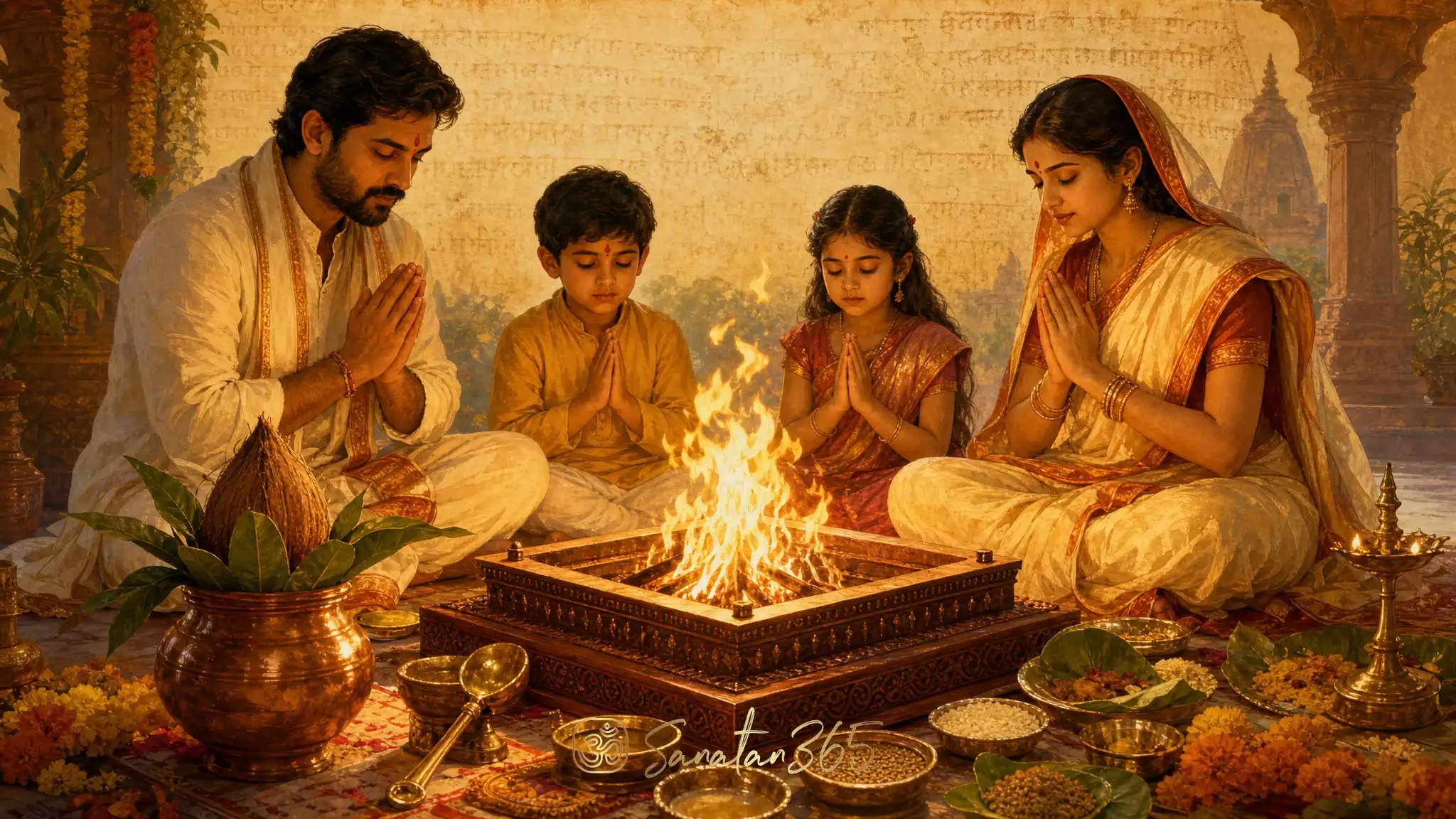
Havan meaning begins with offering: havan, also called homa (होम, fire offering), is a Hindu fire ritual in which ghee, grains, herbs, and mantras are offered into consecrated fire. The fire is not treated as ordinary heat. In Vedic and household ritual imagination, Agni (अग्नि, sacred fire and fire deity) carries offerings between human prayer and divine presence. Britannica describes Agni as the fire of the domestic and sacrificial hearth, the carrier of oblations, and a messenger between human and divine orders Britannica.
This is why a havan is both simple and profound. A family may see a small square kund, a priest, a spoon of ghee, and the sound of "svaha." The deeper movement is surrender, purification, intention, and participation in sacred order.
What is Havan Meaning in Hindu Practice?
Havan meaning is the devotional act of making offerings into sacred fire while mantras are recited. The word is commonly used across North Indian and diaspora Hindu communities. Homa or homam is a closely related Sanskrit-derived term used in many traditions, especially in South Indian contexts. Yajna (यज्ञ, sacred offering or sacrifice) is the broader Vedic idea of ritual offering, duty, and sacred reciprocity.
These terms overlap, but they are not always identical in usage:
- Havan: commonly used for household or community fire ritual.
- Homa or homam: formal Sanskritic term for fire offering.
- Yajna: wider Vedic idea of sacred offering, sometimes including large public rituals and the deeper principle of offering itself.
In living Hindu practice, families may use the words naturally rather than technically. A wedding fire ceremony, a griha pravesh (गृह प्रवेश, home-entry ritual), a Satyanarayan puja with fire offering, a Navagraha homa, or a simple family havan may all carry the same central gesture: what is valuable is offered into flame with mantra and reverence.
The visible act is material. The inward act is subtle. Ghee becomes devotion. Grains become gratitude. Herbs become prayer. Sound becomes intention. Fire becomes a witness.
Key takeaway: Havan meaning is not only "fire ritual"; it is the disciplined offering of intention, substance, and prayer into sacred Agni.
Why is Agni Central to a Hindu Fire Ritual?
Agni is central because fire transforms what it receives.
In ordinary life, fire cooks food, gives warmth, and gives light. In ritual life, those same qualities become sacred symbols. Fire transforms offerings, illumines the altar, marks presence, and gathers attention. The Vedic imagination honors Agni as both element and deity: visible flame, divine force, and ritual messenger.
Britannica notes that Agni is one of the major Vedic deities and is connected with the domestic hearth and sacrificial fire Britannica. This matters because havan is not a random performance around flame. It comes from a long memory in which fire stands at the meeting point of home, cosmos, and worship.
The fire is also a witness. In many Hindu weddings, the couple takes vows in the presence of Agni. The point is not superstition. It is accountability before sacred presence. A vow made before fire says: let this commitment be clear, visible, and purified of casualness.
Agni also teaches transformation. The offering does not remain as it was. It is changed. That is the ritual's quiet lesson for the devotee: pride, anxiety, selfishness, and confusion can also be offered inwardly. The flame asks the worshipper to become more transparent.
Key takeaway: Agni matters because sacred fire receives, transforms, witnesses, and carries the devotee's offering into a larger spiritual frame.
What Happens During a Havan?
A havan usually follows a careful sequence, though details vary by region, sampradaya (सम्प्रदाय, lineage or tradition), family custom, and ritual purpose.
A simple household havan may include:
- Preparing the ritual space and havan kund.
- Invoking Ganesha and other deities according to tradition.
- Lighting the sacred fire.
- Reciting mantras with attention.
- Offering ghee, grains, herbs, or havan samagri.
- Saying "svaha" at the completion of offerings.
- Praying for peace, clarity, gratitude, and welfare.
- Closing with aarti, prasad, and respectful dispersal.
The word svaha (स्वाहा, "well offered" or "may it be offered") is important because it seals the act of offering. In many rituals, the offering is placed into the fire as the mantra reaches svaha. The sound teaches timing. It also teaches surrender: the offering is no longer held back.
Offerings differ. Some rituals use ghee, sesame, rice, barley, herbs, sandalwood powder, coconut, flowers, or specific samagri mixtures. A priest or knowledgeable elder may guide the exact materials. The safest approach is not to improvise intensely symbolic rituals from internet fragments. A family can participate reverently without pretending to master every technical detail.
The ritual is also sensory: flame, fragrance, mantra, bell, conch, warmth, and silence. This helps even children understand that worship is not only an idea. It is embodied attention.
Key takeaway: A havan moves through preparation, invocation, mantra, offering, svaha, prayer, and closure, with regional variation guided by tradition.
How is Havan Different from Puja or Aarti?
Havan, puja, and aarti are related forms of worship, but each has a distinct center.
Puja (पूजा, worship) is the broad act of honoring the Divine through offerings such as flowers, water, incense, food, lamp, mantra, and prayer. Aarti (आरती, offering of light) is the waving of a flame before the deity as an act of reverence and receiving sacred light. Havan places sacred fire at the center and makes offerings into that fire.
The difference can be understood like this:
- Puja honors the deity through direct offerings at an altar or murti.
- Aarti offers and receives light as a devotional climax.
- Havan offers into consecrated fire through mantra and svaha.
Many ceremonies include all three. A family may perform puja first, then havan, then aarti. In a wedding, fire may become the ritual witness. In a home blessing, havan may mark purification and auspicious beginning. During Navratri, Durga puja and havan may come together. In temple life, large homas may be performed for specific devatas or community welfare.
It is helpful to avoid ranking these practices. Sanatan Dharma has many ritual forms because human devotion has many needs. Sometimes the heart needs image. Sometimes it needs light. Sometimes it needs sound. Sometimes it needs fire.
Key takeaway: Havan is the fire-offering form of worship, while puja is broader altar worship and aarti is the offering of light.
What Does Havan Teach Beyond the Ritual?
Havan teaches that spiritual life becomes real when something is offered.
The offering may be small: a spoon of ghee, a few grains, a flower petal. Yet the ritual asks a larger question: what is the devotee willing to release? Anger can be offered. Careless speech can be offered. A selfish habit can be offered. A new commitment can be offered. In this sense, the outer fire points toward inner yajna.
The Bhagavad Gita uses the language of yajna to describe more than ritual. It teaches that action aligned with sacred offering sustains life. A careful translation of Bhagavad Gita 3.14 describes a chain in which beings depend on food, food on rain, rain on yajna, and yajna on action Holy Bhagavad Gita. The verse should not be reduced to a mechanical promise. Its deeper point is reciprocity: life is sustained by disciplined giving, not isolated consumption.
This gives havan practical meaning for modern families:
- Speak with more care after a ritual of sacred speech.
- Eat with gratitude after offering grains into fire.
- Treat the home as a place of dharma, not only comfort.
- Let children see adults pray with humility.
- Remember that devotion is not complete without conduct.
The smoke may fade quickly, but the discipline should remain. A havan that ends in the same harshness, wastefulness, or carelessness has not been fully understood.
Key takeaway: Havan points beyond ritual technique toward inner offering, ethical action, and grateful participation in the web of life.
How Can Families Approach Havan Respectfully?
Families can approach havan with reverence, simplicity, and safety.
First, learn from a reliable source: a family elder, temple priest, lineage teacher, or trusted community guide. Ritual details vary, so humility matters. A Bengali household, Tamil homam, Maharashtrian griha ritual, Gujarati community havan, and diaspora temple ceremony may not sound or look identical. That diversity is part of Hindu life.
Second, do not turn sacred fire into performance. Phones, photos, and social sharing should not dominate the ritual. If a picture is taken, it should never interrupt mantra, priestly instruction, or the dignity of participants.
Third, keep safety practical. Fire rituals require ventilation, stable placement, respectful distance for children, appropriate materials, and responsible extinguishing after completion. Reverence includes care.
Fourth, explain the meaning to children in simple language:
"We offer into the fire because fire transforms. We are praying that our thoughts, speech, and actions also become cleaner and brighter."
That explanation is enough. Children do not need every technical layer at once. They need to see sincerity.
Finally, participate with attention. Fold hands. Listen to the mantra. Offer when guided. Sit quietly when silence comes. A person who does not know Sanskrit can still be present with respect.
Key takeaway: A family havan is strongest when it combines tradition, safety, humility, and sincere attention rather than display.
What Are Reliable Sources for Understanding Havan?
For basic orientation, start with sources that explain Agni, Vedic ritual, and Hindu worship carefully. Britannica's Agni entry is useful for understanding why sacred fire has such a central place in Vedic religion. Translations and commentaries on the Bhagavad Gita help explain yajna as a wider principle of offering. Temple priests and family traditions remain important because lived ritual cannot be learned fully from text alone.
Useful starting points include:
- Britannica: Agni
- Bhagavad Gita 3.14 translation
- Local temple guidance for region-specific homa or havan procedures
Readers should be careful with articles that promise guaranteed material results from havan. Hindu ritual is not a vending machine. It is a sacred discipline of devotion, purification, gratitude, and alignment. Blessings may be sought, but outcomes are not controlled by the worshipper.
Key takeaway: Learn havan through reliable references and living guidance, while avoiding exaggerated claims about guaranteed results.
FAQ
What is the simple meaning of havan?
Havan means a Hindu fire ritual in which offerings such as ghee, grains, herbs, and mantras are offered into sacred fire with devotion. It is also closely related to homa and the wider Vedic idea of yajna.
Is havan the same as homa?
In many everyday contexts, havan and homa refer to the same fire-offering practice. Usage varies by region and tradition. Havan is common in North Indian speech, while homa or homam is often used in Sanskritic and South Indian contexts.
Why do people say svaha during havan?
Svaha is said as the offering is placed into the fire. It marks the completion of the mantra-offering gesture and expresses the devotional sense that the substance, prayer, and intention are being offered fully.
Can beginners perform havan at home?
Beginners should learn from a priest, family elder, or trusted temple source before performing havan independently. A simple guided household havan can be meaningful, but fire safety, mantra accuracy, and ritual context deserve care.
What does Agni represent in havan?
Agni represents sacred fire, transformation, witness, and the messenger between human offering and divine presence. In havan, Agni is not only a physical flame but the ritual center through which offerings are transformed.
Havan's single key takeaway is this: sacred fire teaches the devotee to offer with clarity, receive transformation with humility, and carry the discipline of yajna into daily life.
About the author
Sanatan365 Editorial
Bringing Sanatan Dharma to modern seekers through authentic, scripture-grounded content.
Related in Rituals
 Rituals
Kanya Puja Meaning: Honouring the Divine Feminine During Navratri
Kanya Puja honours young girls as living symbols of Devi during Navratri. Learn its meaning, timing, regional forms, offerings, and a respe…
 Rituals
Archana Puja Meaning: Names, Flowers, and Personal Temple Worship
Archana Puja is focused Hindu worship through sacred names, mantra, and offerings, often performed on behalf of a devotee or family.
 Rituals
Pind Daan Meaning: An Offering of Memory, Gratitude, and Duty
Pind Daan is a Hindu ancestral rite in which pindas, usually shaped offerings of food, are offered with remembrance and sacred intention. I…