International Yoga Day 2026: Meaning, Theme, and Simple Practice
International Yoga Day 2026 falls on June 21 with the theme Yoga for Healthy Ageing. Learn its Hindu roots, global meaning, and a simple home practice.
One day in June has made a Sanskrit word part of the world's common language.
International Yoga Day 2026 is observed on June 21, 2026, with the United Nations theme "Yoga for Healthy Ageing." The day honors yoga as a discipline from India's spiritual civilization: a way of training body, breath, senses, mind, and conduct toward steadiness. For Hindu families and global seekers, its meaning is deeper than a public group exercise session. Yoga (योग, union or disciplined integration) is a reminder that long life becomes sacred when it is joined with self-knowledge, restraint, compassion, and daily practice.
What Is International Yoga Day 2026?
International Yoga Day 2026 is the twelfth annual United Nations observance of the International Day of Yoga, marked globally on June 21. The UN page for the observance names the 2026 theme as "Yoga for Healthy Ageing" and presents yoga as a practice that supports health, balance, and human well-being across the life span (United Nations).
The date is fixed, not lunar: June 21 every year. That makes it different from many Hindu festivals, which follow tithi (तिथि, lunar day) and regional panchang calculation. Yet the date still carries seasonal meaning. June 21 is near the summer solstice in the Northern Hemisphere, a turning point of light. In many parts of India, it also arrives around the monsoon transition, when heat begins to soften and daily rhythm changes.
The Ministry of Ayush has supported large public participation through Yoga Sangam and related International Day of Yoga activities, bringing schools, communities, institutions, and families into shared practice (Ministry of Ayush). For the diaspora, this is often the one day when yoga becomes visible in parks, temples, studios, universities, offices, and city squares.
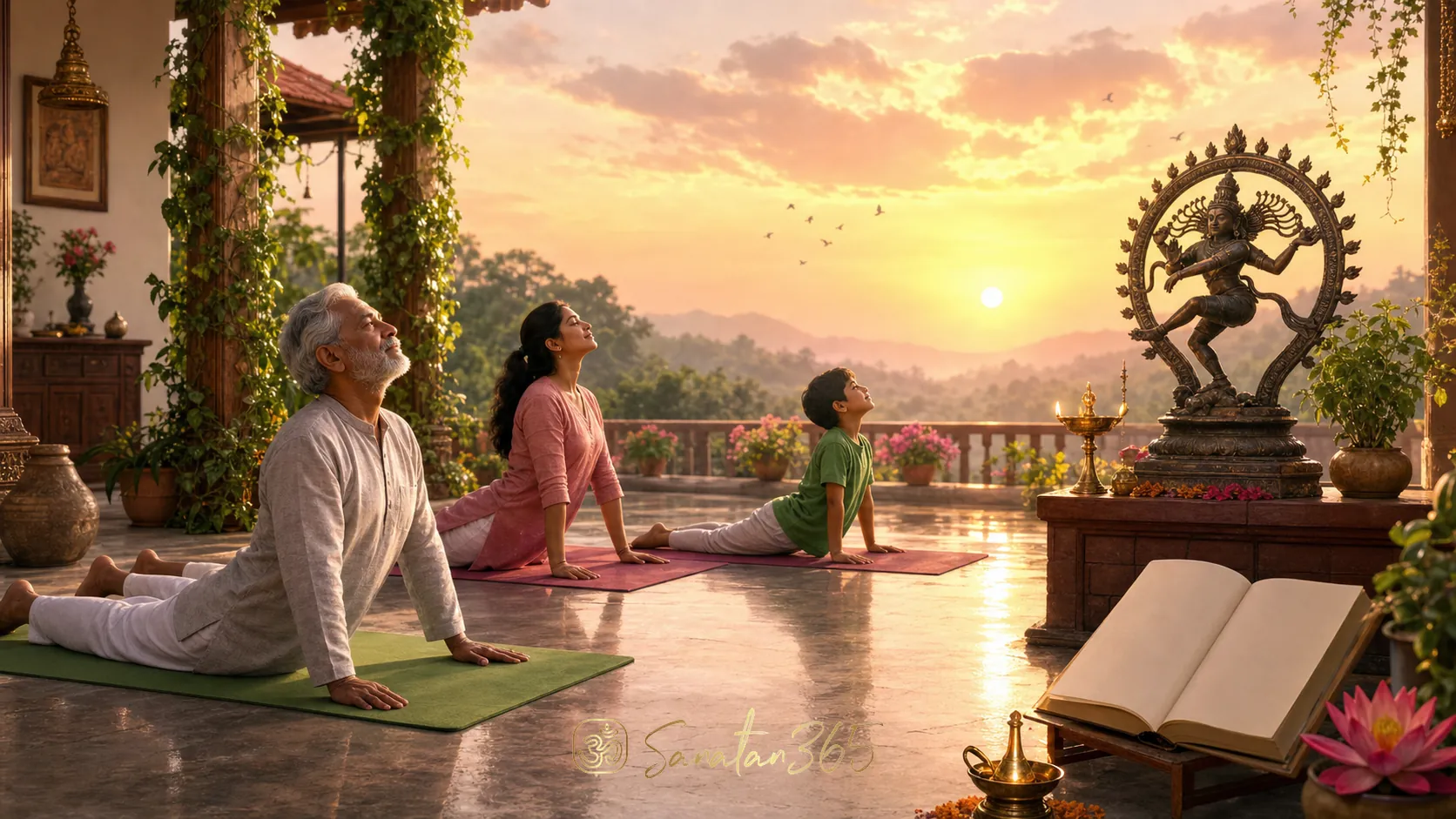
This shared visibility has value when it is handled with reverence. A child who sees grandparents, parents, teachers, and neighbors practicing together learns that yoga is not an imported lifestyle trend but a living inheritance. A young professional may first arrive for flexibility or stress relief, then slowly discover that breath, speech, food, sleep, service, and prayer are all connected. That gradual widening is part of yoga's grace.
But visibility should not reduce the meaning. A public asana session can be beautiful, yet yoga is not only posture. In Hindu thought, yoga includes yama (यम, ethical restraints), niyama (नियम, observances), asana (आसन, steady posture), pranayama (प्राणायाम, regulation of life-breath), pratyahara (प्रत्याहार, withdrawal of the senses), dharana (धारणा, concentration), dhyana (ध्यान, meditation), and samadhi (समाधि, deep absorption). Patanjali's Yoga Sutra 2.29 lists these eight limbs as a full discipline of inner training.
Key takeaway: International Yoga Day 2026 is a global observance, but its heart remains the older Hindu understanding of yoga as disciplined integration of life.
Why Is the 2026 Theme "Yoga for Healthy Ageing" Important?
The 2026 theme, Yoga for Healthy Ageing, matters because it moves the conversation away from youth, flexibility, and performance. It asks a quieter question: how can human beings age with steadiness, dignity, breath, memory, and inner balance?
This framing is especially useful for Hindu households. Many families already carry a living model of practice through elders who rise early, light a diya, chant a mantra, walk slowly, remember the Gita, or sit in japa even when the body is no longer young. Healthy ageing is not only a medical phrase. In the dharmic view, it includes right conduct, clean food, mental moderation, gratitude to teachers, and the slow refinement of attention.
Yoga does not promise immunity from illness, old age, grief, or change. Hindu wisdom is honest about the body. The Bhagavad Gita describes the embodied person passing through childhood, youth, and old age, teaching that change is natural and should be met with steadiness rather than panic (Bhagavad Gita 2.13). Yoga helps cultivate that steadiness.
A healthy-ageing approach can include gentle asana, breath awareness, mantra, balance practice, simple joint movement, restful meditation, and family support. It should be adapted to age, ability, health conditions, and professional guidance where needed. The spiritual point is not to force the body into an impressive shape. The point is to make the body a respectful instrument for dharma, devotion, and awareness.
This theme also corrects a common misunderstanding. Yoga is often marketed as personal fitness. The Hindu roots are broader. The Hindu American Foundation's overview of yoga emphasizes yoga as a spiritual practice with roots in Hindu traditions, not merely a modern stretching routine (Hindu American Foundation).
Key takeaway: "Yoga for Healthy Ageing" reminds seekers that yoga is not a contest of youth; it is a lifelong discipline for steadier living.
What Are the Hindu Roots of International Yoga Day 2026?
International Yoga Day 2026 is a modern global event, but yoga itself is rooted in India's spiritual and philosophical traditions. The word appears across many streams: the Upanishads, the Bhagavad Gita, Patanjali's Yoga Sutras, Shaiva and Shakta traditions, Vedanta, Tantra, Hatha Yoga, bhakti practice, and living guru lineages.
In the Bhagavad Gita, yoga is not one single technique. Krishna speaks of karma yoga, the yoga of selfless action; bhakti yoga, the yoga of devotion; jnana yoga, the yoga of wisdom; and dhyana yoga, the yoga of meditation. The famous teaching "yogah karmasu kaushalam" says yoga is skill in action (Bhagavad Gita 2.50). That line is often quoted because it brings yoga into daily life: work, choice, speech, duty, and surrender.
Patanjali gives another precise definition: "yogah chitta vritti nirodhah," yoga is the stilling or restraint of the movements of the mind (Yoga Sutra 1.2). Chitta (चित्त, mind-stuff or consciousness-field) and vritti (वृत्ति, fluctuation or pattern) are not abstract words for scholars only. Anyone who has sat quietly and watched thoughts rush from memory to worry to desire understands them.
In Shaiva memory, Lord Shiva is often revered as Adiyogi, the first yogi and primordial teacher of yoga. This does not mean every yoga practitioner must worship Shiva in the same way. It means that within Hindu sacred imagination, yoga is not a casual wellness invention. It is a path carried by divine, rishi, guru, and practitioner lineages.
Modern International Yoga Day has helped the world recognize this gift from India. The healthiest way to honor that recognition is to practice with humility: acknowledge the roots, avoid turning yoga into mere aesthetics, and let ethical self-discipline sit beside physical movement.
Key takeaway: Yoga's Hindu roots are philosophical, devotional, ethical, and meditative; asana is one doorway, not the whole house.
How Can Families Practice International Yoga Day 2026 at Home?
International Yoga Day 2026 can be observed at home with a short, gentle practice that respects different ages and abilities. A family does not need a perfect studio, special clothing, or a long routine. A clean floor, quiet intention, and consistency are enough.
A simple 30-minute home rhythm may look like this:
- Begin with sankalpa (संकल्प, sacred intention): "May this practice bring steadiness, gratitude, and clarity."
- Light a diya or sit near a clean altar, if this fits family tradition.
- Sit quietly for three minutes and observe natural breath.
- Practice gentle neck, shoulder, wrist, spine, hip, knee, and ankle movements.
- Add simple asanas such as Tadasana, seated forward folding, gentle twists, supported Vajrasana, or wall-supported balance.
- Practice five minutes of slow breathing without strain.
- Chant "Om" or a family mantra softly, or sit in silence.
- Close with gratitude to parents, teachers, gurus, and the body itself.
For elders, the practice can be chair-based. For children, keep it playful but respectful. For adults, avoid turning the morning into correction and instruction. A shared family practice should feel like care, not a performance review.
If a person has injury, pregnancy considerations, serious illness, dizziness, high blood pressure, or other medical concerns, practice should be adapted with professional guidance. Yoga has depth, but it should not be used to make guaranteed medical claims or replace needed care.
The best family observance is often very small: one month of ten-minute morning breath, one weekly scripture reflection, one evening of device-free silence, or one commitment to kinder speech. When yoga enters speech and food and attention, International Yoga Day becomes more than a calendar event.
Key takeaway: The most meaningful Yoga Day practice is simple, safe, age-aware, and repeatable beyond June 21.
What Should Seekers Avoid on Yoga Day?
International Yoga Day can become shallow when the outer form receives all the attention. A few mistakes are worth avoiding.
First, do not treat yoga as only fitness. Strong bodies are good, but yoga is not complete without self-restraint, truthful speech, moderation, compassion, and inward attention.
Second, do not force the body. Pain is not proof of devotion. The yogic path values steadiness and clarity, not aggressive display.
Third, do not erase the roots. It is generous to share yoga globally, but respectful sharing includes remembering its Sanskrit vocabulary, Hindu philosophical sources, and teacher lineages.
Fourth, do not use yoga to feel superior. A person who can hold a difficult posture but speaks harshly, mocks others, or feeds pride has missed the deeper training. The Gita's yoga is joined to equanimity, humility, and offering.
Fifth, do not make the day only symbolic. A photo from a public event can inspire, but the real question comes the next morning: did the practice continue?
Key takeaway: Yoga Day is best honored when public celebration becomes private discipline.
FAQ
When is International Yoga Day 2026?
International Yoga Day 2026 is on June 21, 2026. The International Day of Yoga is observed every year on June 21, following the United Nations observance calendar.
What is the theme of International Yoga Day 2026?
The United Nations lists the 2026 theme as "Yoga for Healthy Ageing." The theme emphasizes yoga as a lifelong practice that can support steadiness, balance, and well-being across age groups.
Is International Yoga Day a Hindu festival?
International Yoga Day is a modern UN observance, not a traditional lunar Hindu festival. Still, yoga has deep Hindu roots through the Upanishads, Bhagavad Gita, Patanjali Yoga Sutras, Shaiva traditions, Vedanta, and living guru lineages.
What is a simple way to observe Yoga Day at home?
Begin with a short sankalpa, sit quietly, practice gentle movement, breathe slowly, chant Om or a family mantra, and close with gratitude. Keep the practice safe, age-aware, and simple enough to repeat.
Why is June 21 chosen for International Yoga Day?
June 21 is near the summer solstice in the Northern Hemisphere and carries symbolic meaning as a turning point of light. The UN observes the International Day of Yoga on this fixed date every year.
International Yoga Day 2026 should leave behind more than a photograph of one morning's practice. Its deeper invitation is to age with steadiness, move with gratitude, breathe with awareness, speak with restraint, and let yoga return to its real home: daily life.
About the author
Sanatan365 Editorial
Bringing Sanatan Dharma to modern seekers through authentic, scripture-grounded content.
Related in Festivals
 Festivals
Sharad Purnima 2026: Date, Moonlight Traditions, and Kojagara Puja
Sharad Purnima falls on 25 October 2026. Understand the two-date calendar question, moonlight and kheer customs, and regional Kojagara Laks…
 Festivals
Dussehra 2026: Date, Vijayadashami Meaning, and Living Traditions
Understand the 2026 Dussehra date, the meanings of Rama and Durga’s victories, regional celebrations, and a thoughtful way to observe Vijay…
 Festivals
Garba Meaning: The Lamp at the Heart of Navratri
Garba is a Gujarati devotional dance associated with Navratri. Its central lamp, shared circular rhythm and reverence for Goddess Amba expl…