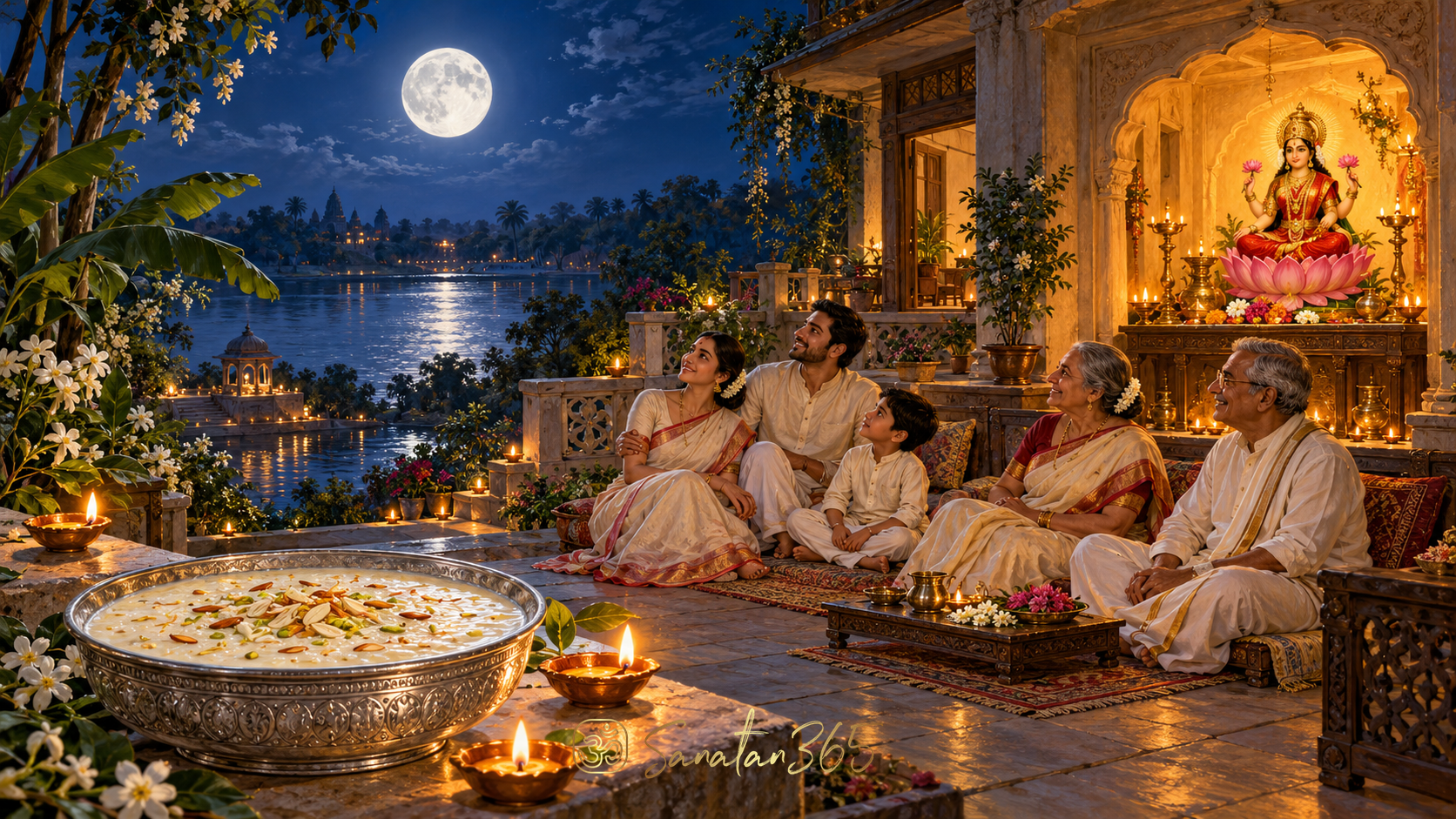
Sharad Purnima 2026: Date, Moonlight Traditions, and Kojagara Puja
Sharad Purnima falls on 25 October 2026. Understand the two-date calendar question, moonlight and kheer customs, and regional Kojagara Lakshmi worship.
A festival night and a calendar date do not always begin together. Sharad Purnima makes that distinction especially visible: the moonlit evening can fall on one civil date while the full-moon observance at sunrise falls on the next.
Sharad Purnima 2026 is observed on Sunday evening, 25 October, according to Drik Panchang’s New Delhi calendar. Purnima (पूर्णिमा, pūrṇimā, the full-moon lunar date) begins at 11:55 AM on 25 October and ends at 9:41 AM on 26 October, in Indian Standard Time. The celebration brings together autumn moonlight, devotional remembrance, rice pudding and, in several eastern traditions, worship of Goddess Lakshmi. Local calendars and family practice determine the details.
The useful question is therefore not simply which date appears in a search result. It is which observance that date describes, where the household is located, and what its own tradition actually asks it to do.
When is Sharad Purnima 2026, and why do calendars show two dates?
The Drik Panchang Sharad Purnima calendar places the festival on 25 October 2026 for New Delhi. Its published full-moon interval extends into the following morning. That interval explains why an evening celebration and a sunrise-based Purnima listing need not carry the same date.
A tithi (तिथि, lunar day) is not identical to a midnight-to-midnight civil day. A household looking for the moonlit celebration is asking a different calendar question from someone looking for a morning observance. Neither question should be answered by copying a date without its label.
For the New Delhi reference used here:
- Sharad Purnima evening: Sunday, 25 October 2026.
- Purnima begins: 11:55 AM, 25 October.
- Purnima ends: 9:41 AM, 26 October.
- Listed moonrise: 5:00 PM, 25 October.
These are a dated, location-specific reference, not a universal timetable. Moonrise differs by location, and households outside India should use a calendar set to their own city. An Indian date screenshot is not automatically the right instruction for a family in London, Toronto or Sydney.
The same care applies to the midnight portion of the festival. A time written as 12:31 AM on 26 October belongs to the night that began on 25 October. Losing the next-day label can move a household’s plan to the wrong evening.
Readers who want the broader calendar framework can begin with how the five limbs of the Panchang are read. Panchang (पञ्चाङ्ग, pañcāṅga, the traditional five-part calendar reckoning) provides context; it does not remove the need to check the city and the particular observance.
Key takeaway: For the New Delhi reference, plan the Sharad Purnima evening for 25 October, and retain the 26 October label wherever a time crosses midnight.
What do moonlight and kheer express in this observance?
Sharad (शरद्, śarad, the autumn season) gives the festival its seasonal setting. The full moon becomes a focus for gratitude, beauty and devotional attention. Rather than treating the night as an ordinary meal followed by an extra ritual, many households allow its light and quiet to shape the evening itself.
Kheer (खीर, sweet rice pudding traditionally prepared with milk and sugar) is one of the festival’s most familiar offerings. Drik Panchang describes the custom of placing it in moonlight and later sharing it within the family. The practice gives a small household dish a larger setting: sky, season, prayer and hospitality meet around something people can prepare and offer together.
The symbolism need not be flattened into a technical explanation. Devotional descriptions of nectar and fullness belong to a language of sacred celebration. An article about the custom should not turn those descriptions into promises about what moonlight will do to someone’s body. The festival’s meaning does not depend on making such promises.
Nor should tradition be used to justify careless food handling. Milk-based food requires ordinary care. Families can preserve the intention of a moonlight offering while keeping the dish covered and following appropriate storage practices. There is no need to leave a large batch unattended simply because an online summary describes an overnight custom.
The distinction between preparation, offering and sharing is also worth preserving. Prasad (प्रसाद, prasāda, a blessed offering received and shared) is not merely a more impressive name for a sweet dish. In devotional life, offering changes the relationship to the food: it is approached with gratitude and received without making the meal a display of personal achievement. See the meaning of prasad in Hindu worship for that wider context.
A modest bowl can therefore serve the occasion well. An elaborate recipe, expensive vessel or photograph-ready terrace is not the measure of sincerity. The important questions are whether the offering is treated with care and whether the sharing remains generous and considerate.
Key takeaway: Moonlight and kheer make gratitude tangible; their devotional significance should be preserved without unsupported promises or careless handling.
How do Sharad Poonam, Braj remembrance, and Kojagara differ?
One autumn full moon can carry several regional devotional emphases. Recognizing them allows a family to understand its own observance without treating another household’s practice as a mistake.
In Gujarat, Drik Panchang notes the name Sharad Poonam, a regional form of the festival name. The shared full-moon setting does not mean that every Gujarati household follows one identical sequence. A regional label is useful context, not a complete set of instructions.
In Braj, the region associated with Krishna devotion around Mathura and Vrindavan, the night is remembered as Raas Purnima. Raas (रास, rāsa, the devotional dance associated with Krishna and the cowherd devotees) gives the moonlit celebration a particular emotional language: divine love, remembrance and the wish to remain attentive to the beloved Divine. Drik Panchang presents this as a devotional tradition connected with Krishna’s great dance.
It is best to name that account as sacred remembrance. Its purpose in this article is not to assign a modern historical date to an ancient narrative, or to turn poetic descriptions of an extraordinary night into astronomical calculations.
In West Bengal, Odisha and Assam, Kojagara or Kojagari observances give special prominence to Goddess Lakshmi. The Drik Panchang Kojagara Puja page describes Lakshmi worship and the tradition of a night vigil. Puja (पूजा, pūjā, reverential worship) here belongs to a regional festival setting that should not simply be merged with every other Lakshmi observance.
For New Delhi, that page lists Kojagara Puja’s Nishita interval from 11:40 PM on 25 October to 12:31 AM on 26 October. Nishita (निशीथ, niśītha, the midnight period used in ritual timing) is a specific calendar reference, not a command that every family must remain awake until that hour. A local calendar and trusted family guidance remain important.
Kojagara Lakshmi worship is also distinct from Lakshmi Puja during Diwali, which occurs in a different lunar setting. Similar devotional language does not make the two occasions interchangeable. Households that sing a familiar prayer can explore the meaning of Om Jai Lakshmi Mata without assuming that a song alone specifies the festival procedure.
Key takeaway: Sharad Poonam, Braj remembrance and Kojagara share a full-moon occasion while retaining meaningful regional differences.
How can a household prepare a simple, respectful evening?
The following outline is a practical planning aid, not a prescribed ritual manual. It helps a household make room for its existing custom rather than assemble a new ceremony from unrelated online instructions.
First, identify the observance. Ask whether the family normally emphasizes moon viewing, a food offering, Krishna remembrance, Lakshmi worship, a vigil, or some combination. A short conversation with an elder or trusted teacher can prevent a great deal of unnecessary shopping and confusion.
Second, confirm the local calendar. Write down the city, evening date and any next-day time labels. If a community gathering is planned, use its organizer’s confirmed schedule rather than assuming that the home-calendar interval is also the event’s opening time.
Third, prepare only what can be handled thoughtfully. A clean worship space, the customary offering and a safe place to sit may be enough. Where a lamp is used, keep it away from loose fabric and leave it attended. A balcony or terrace is not essential; a household can observe with dignity without recreating someone else’s setting.
Fourth, make the devotional focus clear. If Lakshmi worship is the family’s practice, arrange the appropriate image or murti with care. Murti (मूर्ति, mūrti, a sacred embodied form used in worship) should not become a decorative object added merely for a photograph. If Krishna remembrance is central, choose a reading or song the family already understands rather than borrowing an elaborate performance it cannot explain.
Fifth, allow participation without pressure. Children can help set out a vessel, listen to a short account, ask why two dates appear, or assist with clearing up. Elders may prefer an earlier gathering. Guests can be welcomed without being expected to know every gesture. The practical aim is a shared, attentive evening, not a test of endurance or ritual memory.
Finally, conclude deliberately. Put offerings away with care, attend to food storage, extinguish lamps safely and thank those who prepared the gathering. These ordinary finishing actions help keep devotion connected with responsibility rather than leaving the work to an unnoticed family member.
None of these suggestions establishes a single correct regional procedure. They are ways to make preparation calmer and more considerate while leaving the actual ritual sequence to the household’s tradition.
Key takeaway: A clear local date, a familiar devotional focus and thoughtful preparation are more useful than an elaborate borrowed checklist.
What should families check before sharing timings or traditions?
Festival information often travels faster than its qualifications. A useful message should retain the details that allow another person to judge whether it applies to them.
Before forwarding a timing, check four things:
- Year: An older festival graphic may look entirely current.
- Location: A New Delhi moonrise or midnight interval is not a universal local time.
- Observance: Evening celebration, midnight worship and sunrise Purnima are different labels.
- Source: A named calendar page is more useful than an unexplained screenshot.
The same discipline helps with custom. “Our family does this” is often more accurate and welcoming than “Everyone must do this.” A note that says “Kojagara Lakshmi worship in our household” carries a different claim from a universal instruction for Sharad Purnima.
Preparation also becomes easier when devotion is separated from display. A family does not need to reproduce every regional observance on the same night. Understanding a neighbour’s tradition can deepen appreciation without requiring imitation. The festival’s shared beauty lies partly in that variety.
For 2026, the central practical point remains simple: the New Delhi Sharad Purnima evening is 25 October, with Purnima continuing into the morning of 26 October. Beyond that shared reference, local timing and inherited practice deserve to remain visible.
Key takeaway: Share the date with its city and observance, and share a custom with its regional or family context.
FAQ
Is Sharad Purnima 2026 on 25 or 26 October?
Drik Panchang lists the Sharad Purnima evening on 25 October for New Delhi. The Purnima tithi continues until 9:41 AM on 26 October, so sunrise-based Purnima listings can show the following day. Check which observance a calendar entry names.
What is the Purnima tithi timing in New Delhi?
The cited 2026 calendar gives 11:55 AM on 25 October to 9:41 AM on 26 October, in Indian Standard Time. Keep the city and both dates with the timing when sharing it.
Is Kojagara Puja the same as Diwali Lakshmi Puja?
No. Kojagara Lakshmi worship belongs to this full-moon occasion in several eastern regional traditions. Diwali Lakshmi Puja has a different lunar setting. Shared devotion to Lakshmi does not make the calendar dates or procedures identical.
Must every family leave kheer outside all night?
Drik Panchang describes an overnight moonlight custom, but households differ. Follow trusted family guidance while treating milk-based food with ordinary care. A respectful offering does not require leaving food unattended or ignoring appropriate storage.
Can a household observe without an elaborate ceremony?
Yes. A familiar prayer, attentive remembrance and a modest customary offering can form a thoughtful evening. The aim is not to combine every regional practice, but to understand and honour the tradition being followed.
About the author
Sanatan365 Editorial
Bringing Sanatan Dharma to modern seekers through authentic, scripture-grounded content.
Related in Festivals
 Festivals
Dussehra 2026: Date, Vijayadashami Meaning, and Living Traditions
Understand the 2026 Dussehra date, the meanings of Rama and Durga’s victories, regional celebrations, and a thoughtful way to observe Vijay…
 Festivals
Garba Meaning: The Lamp at the Heart of Navratri
Garba is a Gujarati devotional dance associated with Navratri. Its central lamp, shared circular rhythm and reverence for Goddess Amba expl…
 Festivals
Golu Meaning: Navratri Dolls, Living Stories, and Hospitality
Understand Navratri Golu through its handmade dolls, regional names, family stories and welcoming home visits, with thoughtful preparation…

