Jagannath Rath Yatra 2026: Date, Chariots, Rituals, and Spiritual Meaning
A careful guide to Jagannath Rath Yatra 2026, the Puri chariot festival of Lord Jagannath, Balabhadra, and Subhadra, with date notes, rituals, and inner meaning.
Three chariots, three sibling deities, and one road in Puri turn a temple festival into a public act of grace.
Jagannath Rath Yatra 2026 is the annual chariot festival of Lord Jagannath, Lord Balabhadra, and Devi Subhadra in Puri, Odisha. Rath Yatra means "chariot procession": ratha (रथ, chariot) and yatra (यात्रा, sacred journey). In 2026, most current festival calendars place the main Puri Rath Yatra in mid-July, with many listing Thursday, July 16, 2026; devotees should confirm final local timings through the Shri Jagannath Temple Administration or a trusted panchang before travel, because lunar-festival observance depends on tithi and local practice.
Rath Yatra is not only a spectacle of wheels, ropes, music, and crowds. It is a theological statement: the Lord leaves the sanctum and comes into the street. For a few charged days, darshan (दर्शन, sacred seeing) becomes public, mobile, and open to those who may not enter the inner temple.
Why does Jagannath Rath Yatra 2026 matter?
Jagannath Rath Yatra 2026 matters because it shows devotion as movement. Lord Jagannath, understood in many Vaishnava traditions as a form of Krishna or Vishnu, travels with Balabhadra and Subhadra from the Jagannath Temple toward Gundicha Temple, carried on towering wooden chariots. Britannica describes the Chariot Festival at Puri as a major Hindu festival honoring Jagannath with Balarama and Subhadra Britannica.
The central image is simple and profound: the Divine does not remain distant. Jagannath's name is often understood as "Lord of the Universe," from jagat (जगत्, world) and natha (नाथ, lord). In Rath Yatra, that universal lordship is not expressed through abstraction. It is expressed through wood, cloth, rope, drums, flowers, and the labor of thousands of hands.
For devotees, the chariot is not a parade float. It is a moving altar. The street is not merely a route. It becomes a sacred path. The act of pulling the ropes is not only crowd participation; it is seva (सेवा, service), a physical way of saying that the human life should help carry dharma forward.
Key takeaway: Rath Yatra turns temple devotion outward, making darshan visible in the public square.
What is the date of Jagannath Rath Yatra 2026?
Most published 2026 festival references place Puri Rath Yatra around Thursday, July 16, 2026. Rath Yatra is traditionally observed on Ashadha Shukla Dwitiya, the second lunar day of the bright fortnight of Ashadha. Because Hindu festival dates follow the lunar calendar and local sunrise rules, a careful devotee should confirm the exact observance for Puri, Odisha, before making travel or vrata plans.
This date also sits within a wider ritual season. Before Rath Yatra comes Snana Yatra, the ceremonial bathing festival of the deities. After that, the deities are traditionally understood to withdraw from public view for a period before reappearing in youthful form. The main chariot procession then begins the journey toward Gundicha Temple, followed by the return journey, often called Bahuda Yatra.
For readers outside Odisha, the date may be adapted by local temples. ISKCON centers and Jagannath temples around the world often hold Rath Yatra processions on nearby weekends so families can attend. That does not reduce the devotion; it reflects how a Puri-centered festival has become part of global Hindu life.
Key takeaway: Use July 16, 2026 as the planning anchor, but verify local tithi-based timings before worship or travel.
What happens during Puri Rath Yatra?
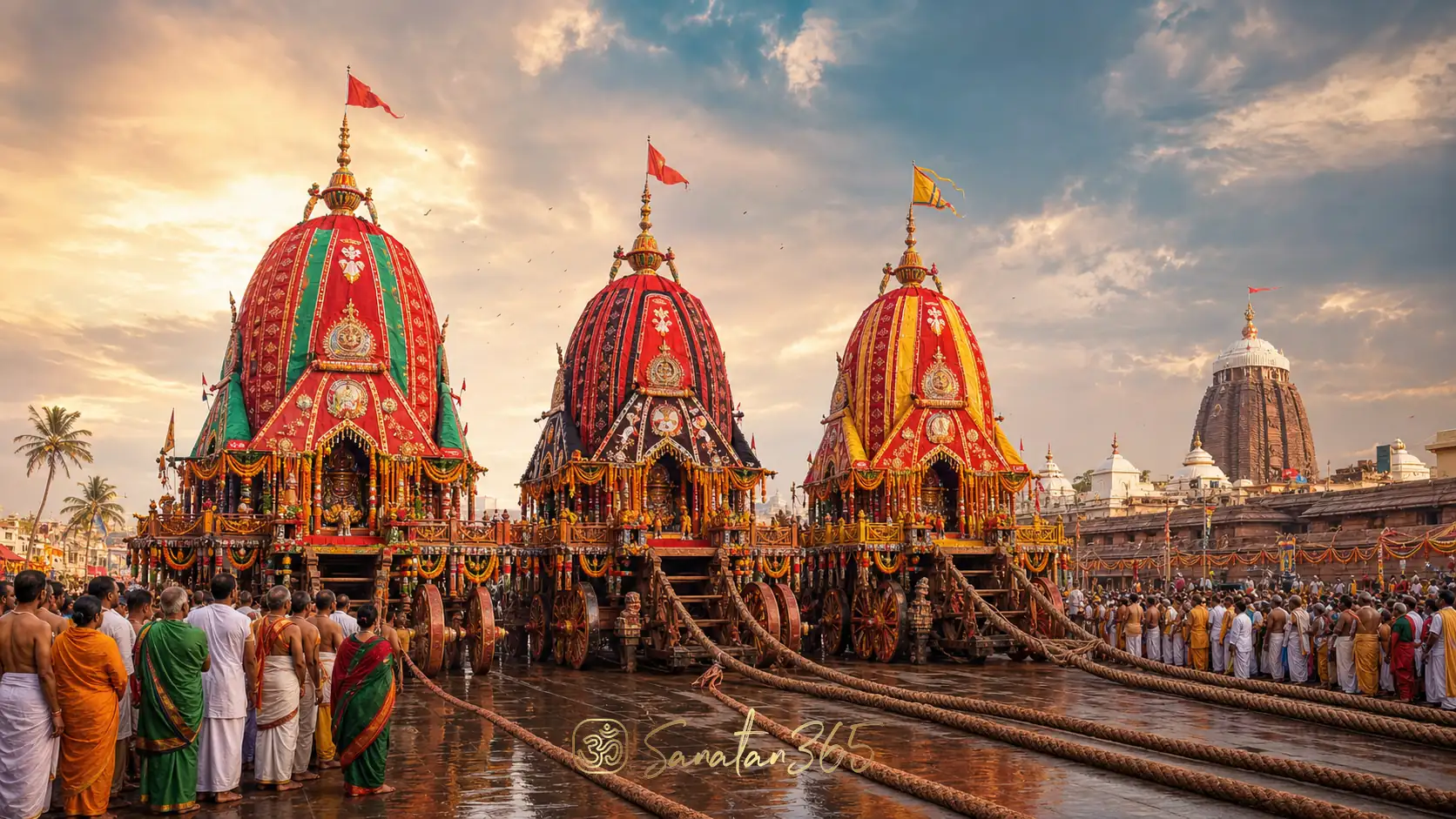
The most recognizable ritual is the pulling of three chariots along Puri's Grand Road, traditionally called Bada Danda. The deities of Jagannath, Balabhadra, and Subhadra are brought from the temple and seated on their separate chariots. Devotees then pull the chariots toward Gundicha Temple, where the deities remain for a period before returning.
Each chariot has its own name and identity:
- Lord Jagannath's chariot is called Nandighosha.
- Lord Balabhadra's chariot is called Taladhwaja.
- Devi Subhadra's chariot is called Darpadalana, also known in some traditions as Devadalana.
The chariots are built anew each year, which is one reason Rath Yatra feels alive rather than museum-like. Wood, measurement, color, and ritual craft all matter. Festival descriptions commonly note the three deities, the massive wooden chariots, and the procession from the main temple toward Gundicha Temple; travel and festival reports often describe the distance as about three kilometers along the main route Economic Times.
The procession includes music, chanting, temple servitors, pilgrims, security teams, and local families who have inherited specific forms of service. The festival belongs to the temple, but it is held by a whole ecosystem of devotion: carpenters, priests, cooks, singers, police, volunteers, and ordinary devotees who wait for one glimpse.
Key takeaway: The chariots are sacred bodies of ritual craft, not decorative vehicles.
What is the spiritual meaning of the chariot journey?
Rath Yatra can be read at several levels. At the public level, it is a festival of darshan. At the devotional level, it is the Lord's outing to meet devotees. At the inner level, it becomes an image of the human being.
The Katha Upanishad famously uses the chariot as a metaphor: the body is the chariot, the Self is the lord of the chariot, the intellect is the charioteer, and the mind is the reins. Rath Yatra does not need to be reduced to that metaphor, but the symbolism helps modern readers see why the image of a moving chariot has such power in Hindu thought. A life without reins is pulled by impulse. A life aligned with dharma becomes a sacred vehicle.
The ropes of Rath Yatra also carry meaning. Many devotees see the act of pulling as surrender: the individual does not control the Lord, but participates in divine movement. The crowd's force is collective, yet each hand matters. This is a beautiful model for Hindu community life. Bhakti (भक्ति, devotion) is personal, but it is rarely isolated.
There is also an inclusive dimension. Puri's Jagannath tradition has long carried a public, folk, royal, and temple-centered character at once. Rath Yatra brings together people across regions and languages. In the diaspora, that openness becomes even more visible, as children who may not understand every Sanskrit word can still understand the sound of kirtan, the sight of the chariot, and the joy of prasada.
Key takeaway: Rath Yatra teaches that spiritual life is not only stillness; it is guided movement toward the Divine.
How can devotees observe Rath Yatra respectfully?
Not every devotee can travel to Puri. Rath Yatra can still be observed with dignity at home, at a local temple, or through careful remembrance.
For a home observance, keep the practice simple:
- Offer a clean lamp, flowers, fruit, or homemade prasad to Lord Jagannath, Balabhadra, and Subhadra.
- Chant the names of Jagannath or a Krishna mantra with attention.
- Read or listen to a short account of the Puri Rath Yatra tradition.
- Feed someone, donate to a trusted temple or seva initiative, or share prasad with family.
- Avoid turning the day into entertainment alone; keep reverence at the center.
For those attending a public procession, humility matters. Follow temple and local authority instructions. Do not push into restricted areas for photos. Keep children close. Dress modestly for a devotional setting. If pulling the rope is permitted, treat it as seva, not as a competition for position.
For diaspora families, Rath Yatra can become a living classroom. Children can learn why Jagannath's eyes are large, why the chariots are pulled, why the siblings travel together, and why prasada is shared. The lesson should be warm and grounded: the Divine is not locked away from ordinary life.
Key takeaway: A respectful Rath Yatra observance is built from darshan, chanting, seva, and restraint.
What should first-time visitors to Puri know?
Puri during Rath Yatra is intense. The crowds can be immense, the weather humid, and movement restricted by security routes. In recent years, authorities have emphasized crowd control, medical readiness, and traffic planning around the festival. A first-time visitor should plan early, follow official advisories, and avoid last-minute assumptions. Readers who want deeper temple context can also read the Sanatan365 guide to Jagannath Temple Puri.
Practical preparation includes:
- Book accommodation well in advance and confirm distance from Bada Danda.
- Carry water, simple food if permitted, medicines, and sun or rain protection.
- Follow official crowd movement instructions even when the route feels slow.
- Decide a family meeting point in case phones fail.
- Keep devotion stronger than the urge to capture every moment.
There is a subtle spiritual discipline here. Pilgrimage (तीर्थयात्रा, tirtha-yatra, sacred travel) asks the body to cooperate with the soul's intention. Waiting, walking, sweating, and adjusting are part of the offering. In Puri, the goal is not perfect comfort. The goal is darshan with patience.
Sanatan365 users who cannot travel may use Daily Live Temple Darshan from Home as a supportive daily practice around festival season, while remembering that any digital darshan is a complement to devotion, not a replacement for temple tradition.
Key takeaway: Puri Rath Yatra rewards preparation, patience, and reverence more than urgency.
How does Rath Yatra connect Odisha and the wider Hindu world?
Rath Yatra is rooted in Puri, but its emotional reach is far wider. Odisha gives the festival its sacred geography: the Jagannath Temple, Bada Danda, Gundicha Temple, Mahaprasad, Odia devotional songs, and the distinctive visual language of Jagannath, Balabhadra, and Subhadra. Without Odisha, Rath Yatra loses its heart.
At the same time, the festival has traveled across India and the world. Cities such as Ahmedabad, Kolkata, Mumbai, London, New York, and many others host chariot processions. These events may differ in scale, date, and local custom, but they carry the same essential idea: the Lord comes out among the people.
This balance matters. Global celebration should not flatten the Puri tradition into a generic street festival. The most respectful approach is to honor the source while welcoming regional expression. A family in Odisha, a temple in Gujarat, a student group in California, and a devotee watching from Singapore may all meet Jagannath through different doors.
Key takeaway: Rath Yatra is globally loved because it remains locally rooted in Puri.
FAQ
When is Jagannath Rath Yatra 2026?
Most current references list Jagannath Rath Yatra 2026 in mid-July, commonly Thursday, July 16, 2026, for Puri. Devotees should confirm the final tithi and local observance through a trusted panchang or official temple advisory before travel.
Which deities are worshipped in Rath Yatra?
Rath Yatra centers on Lord Jagannath, Lord Balabhadra, and Devi Subhadra. They travel in three separate chariots from the Jagannath Temple toward Gundicha Temple in Puri.
What are the names of the three Rath Yatra chariots?
Lord Jagannath's chariot is Nandighosha, Lord Balabhadra's chariot is Taladhwaja, and Devi Subhadra's chariot is Darpadalana or Devadalana in some traditions.
Can Rath Yatra be observed at home?
Yes. A home observance may include a clean altar, lamp offering, flowers, fruit or prasad, chanting of Jagannath's name, reading about the festival, and an act of seva such as feeding someone or supporting a trusted devotional service.
Is Rath Yatra only celebrated in Puri?
Puri is the sacred center of Jagannath Rath Yatra, but chariot festivals are now held across India and the global Hindu diaspora. Local processions should still be understood with respect for the original Puri tradition.
Rath Yatra's final teaching is not hidden. The Lord of the Universe comes onto the road so that devotion can move from the sanctum into public life. Key takeaway: when the chariot moves, the devotee is invited to move too: from spectatorship to seva, from distance to darshan, and from habit to living bhakti.
About the author
Sanatan365 Editorial
Bringing Sanatan Dharma to modern seekers through authentic, scripture-grounded content.
Related in Festivals
 Festivals
Parivartini Ekadashi 2026: Date, Meaning, and Gentle Vrat Guide
Parivartini Ekadashi 2026 falls on September 22. Learn why it is called Parsva or Vamana Ekadashi, how it relates to Chaturmas, and how to…
 Festivals
Hartalika Teej 2026: Date, Meaning, Puja, and Parvati's Resolve
Hartalika Teej 2026 is observed on September 14 in honour of Goddess Parvati and Lord Shiva. Learn the festival's story, vrat meaning, regi…
 Festivals
Radha Ashtami 2026: Date, Meaning, and Devotion at Home
Radha Ashtami falls on 19 September 2026 in India. Explore its meaning, Braj traditions, local timing guidance, and a thoughtful home obser…