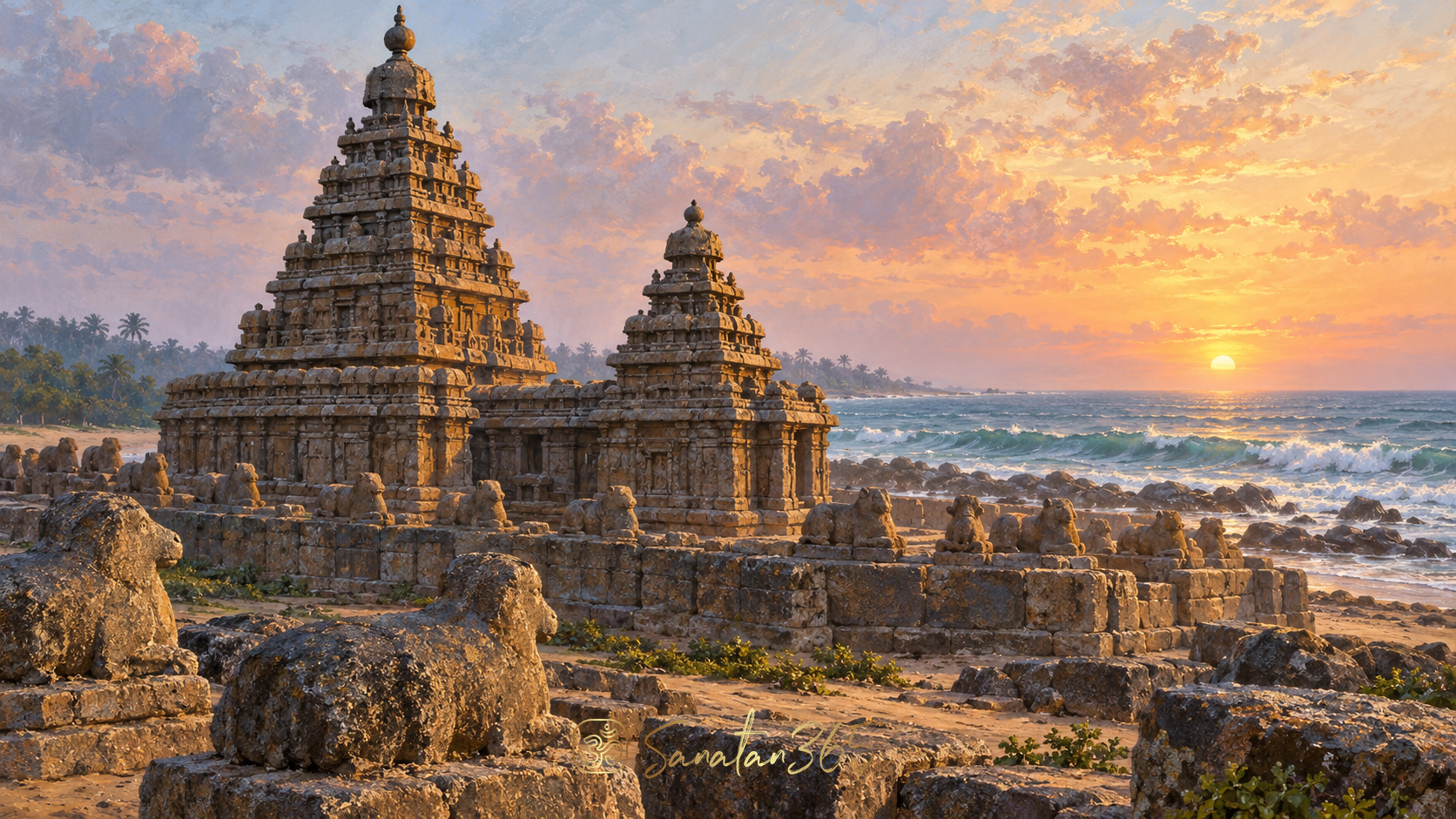
Shore Temple Mahabalipuram: Shiva, Vishnu, and the Pallava Sea
Why the Shore Temple matters: read its coastal setting, Shiva and Vishnu shrines, Pallava architecture, and fragile sculptural heritage with care.
The sea is not a backdrop to Mahabalipuram's Shore Temple. It is part of the encounter: stone towers rise from the Coromandel Coast while salt, wind, and waves remind visitors that even a monument built for the sacred needs human care.
Shore Temple Mahabalipuram is special because it brings together an early Pallava structural temple, shrines associated with Shiva and Vishnu, and a dramatic position beside the Bay of Bengal. It belongs to the UNESCO-listed Group of Monuments at Mahabalipuram. The temple is both a place shaped by devotion and an irreplaceable record of South Indian architectural experiment. Its meaning becomes clearer when the architecture, images, and vulnerable shoreline are read together, rather than as a single postcard view. UNESCO's site account and the Archaeological Survey of India's monument description provide the historical basis for this reading.
Why is Shore Temple Mahabalipuram important?
Mamallapuram, also called Mahabalipuram, is a coastal town in Tamil Nadu. Its Pallava monuments include rock-cut caves, monolithic rathas (रथ, chariot-shaped temple forms), large open-air reliefs, and built temples. UNESCO places these works chiefly in the seventh and eighth centuries and recognizes them as a group, not just as one photogenic shrine. The Shore Temple is memorable because its built stone form stands close to the sea, where the city's religious imagination and architectural ambition meet a very visible natural force. UNESCO
The distinction between a rock-cut shrine and a structural temple matters. A rock-cut shrine is carved by removing material from an existing rock mass. A structural temple is assembled from worked blocks. The Pallavas practiced both approaches at Mamallapuram. According to the ASI account, structural architecture grew on a grand scale under Rajasimha and culminated in the Shore Temple. That makes the site a useful place to see a transition in building language: forms explored in stone carving became part of a constructed sacred complex.
It would be too simple to call the temple merely a technical milestone. A vimana (विमान, the tower above a temple's sanctum) gives vertical emphasis to the sacred center. Walls, passages, sculptural programs, and approaches guide attention toward the shrines. The setting adds another rhythm: a temple approached on land while the open sea remains present at its edge. The architecture organizes a visitor's movement, yet the horizon prevents the experience from feeling enclosed.
Other South Indian temples can help clarify what is distinctive here. Virupaksha Temple at Pattadakal presents another early medieval architectural world, while Airavatesvara Temple at Darasuram belongs to a later Chola context. They should not be collapsed into a single "ancient temple" story. The Shore Temple's Pallava design and marine exposure deserve to be understood on their own terms.
Key takeaway: The Shore Temple matters as both sacred architecture and an unusually legible chapter in the development of South Indian built temples.
How did Pallava builders shape a temple beside the sea?
The Shore Temple is not a lone tower. ASI describes a complex of three temples, including Rajasimhesvara and Kshatriyasimhesvara shrines associated with Shiva, with a shrine linked to a reclining Vishnu between them. This arrangement complicates a quick label such as "the Shiva temple by the beach." Shiva is central to the surviving architectural impression, but Vishnu's presence is part of the site's material and devotional history. ASI
The Pallava builders used stone architecture to create recognizable sacred spaces in a place where wind and sea spray would always be felt. The towers' receding tiers make the silhouette visible from a distance, but a closer walk rewards smaller observations: sculpted surfaces, Nandi figures associated with Shiva, the relationship between the towers, and the way a perimeter frames the complex. A viewer does not need to claim that every detail has one fixed symbolic meaning. The careful question is what the surviving form actually shows, and how a worshipper or visitor might have experienced its sequence.
The nearby monuments widen the picture. A ratha is not the same as a modern festival chariot; here it names a monolithic architectural experiment. A mandapa (मण्डप, a pillared hall or pavilion) may be cut into rock elsewhere in the group. Large reliefs engage narrative at a different scale. Taken together, these forms show the Pallava court and artisans exploring how sacred images, built space, and public sightlines could work in stone. UNESCO explicitly lists rathas, mandapas, reliefs, temples, and excavated remains within the World Heritage property. UNESCO
This is why the site's chronology should be expressed with care. UNESCO gives the broader group a seventh- to eighth-century frame. ASI associates the Shore Temple's major structural phase with Rajasimha. Exact dates for individual components and later discoveries deserve scholarly qualification; a visitor gains little from a confident year assigned to every carving. Britannica's overview likewise treats the temple as an early medieval coastal complex, not as a monument whose entire story fits into one construction date.
The sea adds beauty, but also a practical constraint. Stone exposed to a coastal environment is vulnerable to weathering. It is tempting to romanticize this as timeless endurance; responsible appreciation notices the conservation work that allows future visitors to see the carvings at all. The temple's silhouette is a triumph of design, while its survival is a continuing human responsibility.
Key takeaway: The complex rewards a slow reading of multiple shrines, sculpted forms, and a shoreline that is both visually powerful and materially demanding.
What do the Shiva and Vishnu shrines show?
The presence of Shiva and Vishnu at the Shore Temple need not be presented as a competition between devotional paths. The evidence points to a complex sacred landscape in which different images and shrines occupy an architectural whole. ASI's description identifies a reclining Vishnu image among the remains and describes Shiva-associated shrines within the temple complex. UNESCO also notes a reclining Vishnu image found among excavated remains around the Shore Temple. These sources support a richer account than the shorthand of a single deity and a single tower. ASI; UNESCO
Shaiva (relating to Shiva worship) traditions give particular significance to the forms seen here. A linga (लिङ्ग, a sacred emblem through which Shiva is worshipped) is a significant form in Shaiva temple worship. Nandi, the bull associated with Shiva, can orient the eye toward a Shiva shrine even when the carved surfaces are weathered. A reclining Vishnu image calls attention to another divine form and another devotional register. Visitors should avoid turning this into a claim that one tradition superseded another unless a specific historical source supports it. What remains is enough to invite reverent attention without inventing a rivalry.
This is also a useful reminder that a temple is more than its exterior. Modern photographs favor the towers against the ocean, especially at sunrise. Sacred architecture, however, is organized around presence, orientation, and approach. A sanctum (garbhagriha, गर्भगृह, literally the "womb chamber") is not merely an interior room; it is the concentrated core of a temple plan. At a protected monument, access and worship practices may differ from those of an active neighborhood shrine. Describing the site as a historic sacred complex avoids assuming that every ancient ritual continues there in the same form today.
One can notice unity without erasing difference. Shiva and Vishnu have distinct iconographies and rich traditions of worship. The Shore Temple's surviving arrangement asks visitors to look carefully at both. It also asks writers to resist overconfident spiritual claims about what every ancient builder intended. The devotional meaning of a site can be respected while archaeological description remains precise.
For readers interested in another architectural encounter with Shiva, Mukteshvara Temple in Bhubaneswar offers a different regional language. It is a comparison for attentive looking, not evidence that two temples share the same plan or history.
Key takeaway: The Shore Temple's Shiva and Vishnu associations make its sacred setting more layered than a one-deity caption suggests.
How do sculptures and the shoreline change the visitor's view?
At first glance, weathered stone can appear mute. It is not. A repeated Nandi form, a tower profile, or the placement of a shrine tells the visitor where to look next. The passage of time has softened some detail, which makes slow observation more valuable than dramatic certainty. If an image is difficult to identify, it is better to consult an on-site sign or a reliable monument guide than to assign a name from a social-media caption.
Excavations have also changed the picture of what stands around the famous towers. ASI records rock-cut figures and remains to the north and south, including a Bhuvaraha (Bhūvarāha, Vishnu’s boar form associated with the Earth) image, a reclining Vishnu, and a stepped structure facing the sea. UNESCO notes additional structures revealed as sand was removed. These finds do not prove every popular legend about submerged temples. They do show that the familiar outline is part of a larger, partially recovered archaeological setting. ASI; UNESCO
The shoreline makes this distinction especially important. Stories about lost coastal cities can be compelling, but an evocative story is not the same as a documented excavation. A responsible account says what has been found, who reports it, and what remains uncertain. In doing so, it preserves wonder. The known remains already offer a powerful picture of builders working between sacred stone and a changing coast.
The monument also invites a different kind of patience. A quick view captures the sea-framed towers. A longer visit reveals how the temple belongs to Mamallapuram's broader group. Nearby caves, reliefs, and rathas are not supplementary photo stops; they form the context that helps explain the Shore Temple's architecture. Visitors can compare carved and constructed forms, notice the limits of their own knowledge, and leave room for further reading.
Even the weathering can teach a practical lesson in stewardship. A protected site is not an unlimited backdrop for climbing, touching, or placing objects against sculpture. The visible stone has carried centuries of exposure. Respecting barriers and local rules is not a minor administrative courtesy; it is part of protecting what makes the encounter possible.
Key takeaway: Read the sculptures and excavated remains carefully, and distinguish documented evidence from appealing coastal legends.
What should a respectful visitor know about conservation?
Begin with the site as a protected monument and a sacred inheritance, not an empty stage. Check current ASI visiting guidance, opening hours, tickets, and any photography or access restrictions before travel; these operational details can change. Plan time for the wider Mahabalipuram group so that the Shore Temple is not reduced to one hurried sunrise photograph. Bring water and sun protection appropriate for a coastal visit, while following site rules on food, waste, and restricted areas.
At the monument, give other visitors space to look and reflect. Do not climb stonework, rub carvings, or leave offerings unless staff explicitly permit them in a designated context. A centuries-old sculpture does not become more meaningful because someone touches it. Read signs and ask local guides what is verified, especially when a dramatic claim about a buried shrine or miraculous event circulates without a source. Reverence and historical care can reinforce one another.
For families, the site can become an exercise in observing before explaining. Ask children to notice the difference between a carved rock surface and assembled blocks, or to find the Nandi forms without crossing barriers. Then connect what they see to the larger question: how did people create a sacred place on an exposed coast? This makes heritage tangible without forcing a single interpretation on every image.
For devotees, quiet attention can be a form of respect even where ordinary temple worship is limited by heritage protections. For historians and curious travelers, precision is also respect: attribute major claims to the monument authorities and acknowledge uncertainty. These are not competing ways of valuing the temple. Both begin by treating the surviving stone as more than content for a camera.
The Shore Temple's beauty is inseparable from its vulnerability. Its setting gave the Pallava builders a remarkable horizon; the same setting gives each generation a reason to conserve the structure carefully. That is perhaps the most honest modern lesson of this ancient coastal shrine.
Key takeaway: A good visit joins attentiveness to Shiva and Vishnu imagery, historical curiosity, and care for a fragile coastal monument.
The Shore Temple asks for two kinds of attention at once: to the sacred architecture its builders shaped, and to the vulnerable coast on which it still stands. The single key takeaway is to see the Shiva and Vishnu complex as a carefully preserved whole, not merely a stone silhouette against the sea.
FAQ
What is special about Shore Temple Mahabalipuram?
It is an early Pallava structural temple complex beside the Bay of Bengal, with Shiva-associated shrines, a Vishnu-associated image and shrine history, and a place within UNESCO's Group of Monuments at Mahabalipuram. Its combination of architecture, sculpture, and exposed coast is distinctive. UNESCO; ASI
Is the Shore Temple dedicated only to Shiva?
No. Shiva is prominent in its surviving towers and iconography, but ASI describes a complex that also includes a shrine associated with a reclining Vishnu. The site is best understood through its full architectural and archaeological setting rather than a one-line deity label. ASI
Is the Shore Temple rock-cut or built from stone blocks?
The Shore Temple is a structural, built temple. This distinguishes it from several rock-cut and monolithic monuments elsewhere in the Mahabalipuram group. The contrast is one reason the wider site is so useful for understanding Pallava architectural development. ASI
Were other temples found near the Shore Temple?
Excavations have revealed additional remains around the site, including structures and sacred images reported by ASI and UNESCO. Those finds should not be stretched into proof of every legend about a submerged city. The documented remains are significant on their own. ASI; UNESCO
About the author
Sanatan365 Editorial
Bringing Sanatan Dharma to modern seekers through authentic, scripture-grounded content.

