Kumkum Meaning: Why Sacred Red Powder Matters in Hindu Worship
Kumkum is more than a red mark. Its place in Hindu worship connects blessing, sacred presence, household devotion, and regional traditions with careful attention to how it is prepared and offered.
A pinch of red powder can turn an ordinary welcome into a blessing.
Kumkum meaning in Hindu worship begins with auspicious presence. Kumkum, also called kumkuma (कुङ्कुम, sacred red powder), is offered in puja, placed on the forehead as a tilaka (तिलक, sacred mark), and shared after worship as a sign of blessing. Its red colour is often associated with life, sacred energy, dignity, and Devi, the Divine in feminine form. Yet its meaning is never only one thing: family, region, deity tradition, and occasion all shape how it is prepared and used.
What is kumkum meaning in Hindu worship?
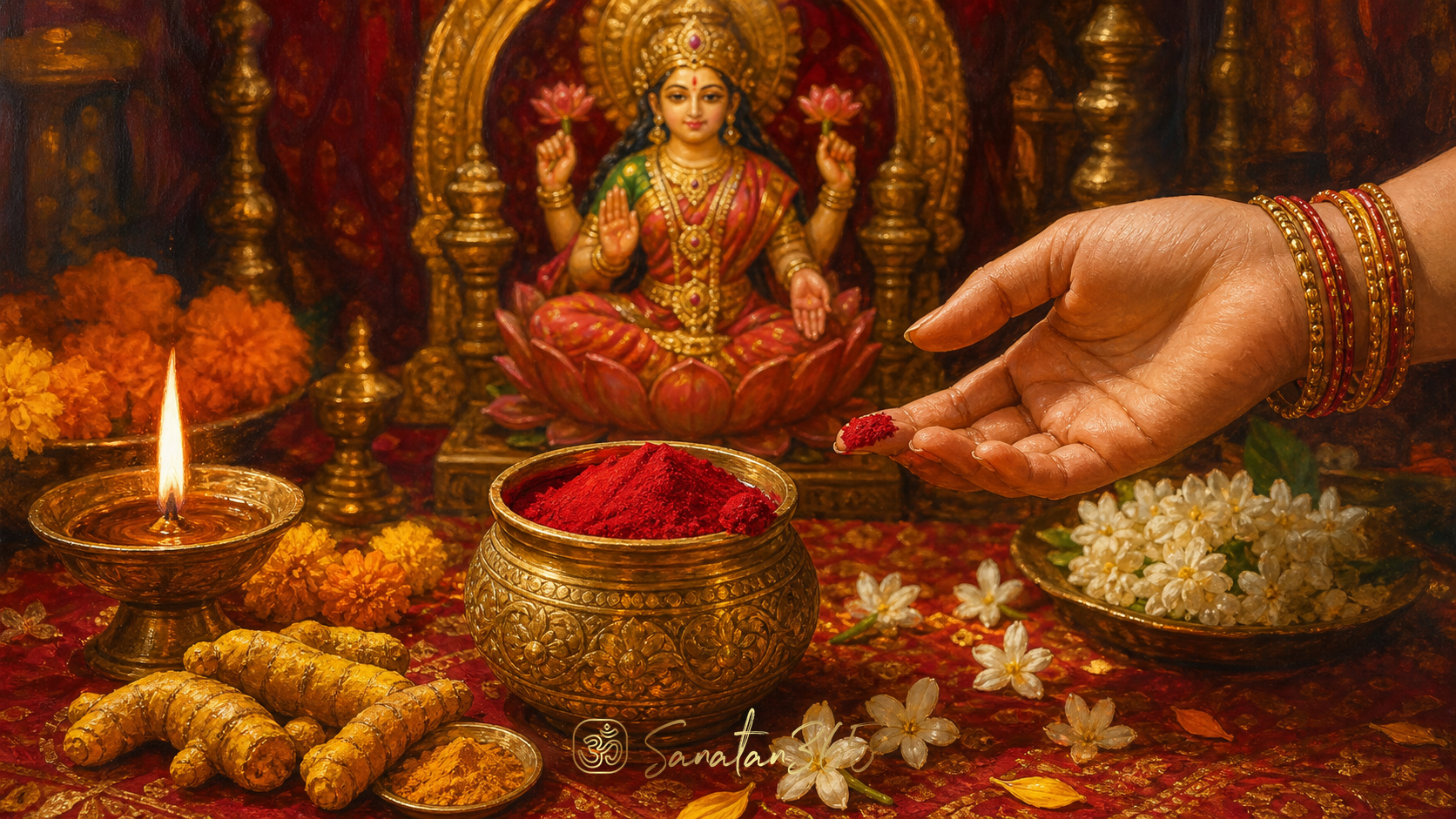
Kumkum meaning is best understood through what happens to it during worship. Before puja, it is a ritual substance kept in a clean container. During puja, it may be offered to a murti, placed beside flowers and light, or applied as a small mark. After puja, it may be received as prasada (प्रसाद, grace received through an offering). The material is the same, but relationship changes its significance.
The red mark does not claim that the wearer has achieved a particular spiritual state. It says something humbler: remember the Divine, carry the blessing, and let conduct reflect the sacred encounter. This is why kumkum appears in temples, household shrines, weddings, festival gatherings, and simple daily prayer.
Kumkum can express several connected ideas:
- Auspiciousness: Red is widely used in Hindu ceremonies connected with blessing, welcome, fertility, courage, and flourishing.
- Sacred presence: Offering colour to a murti is one way of making devotion visible and embodied.
- Shakti: In many Goddess traditions, red evokes shakti (शक्ति, divine power or sacred energy).
- Remembrance: A forehead mark can recall prayer after a person leaves the temple or altar.
- Hospitality: Offering kumkum to a guest can honour the person and the sacredness of the meeting.
These meanings overlap, but they should not be flattened into a single universal formula. A family may emphasize Devi's blessing, a Vaishnava temple may combine red kumkum with another tilak material, and a household ceremony may use it primarily as a sign of welcome. The Hindu American Foundation's guide to Hindu religious symbols likewise notes that bindi and tilak forms vary and may be made with kumkum, sandalwood, or sacred ash.
Key takeaway: Kumkum becomes meaningful through offering, blessing, remembrance, and the living tradition in which it is used.
How is traditional kumkum prepared, and how does it differ from sindoor?
Traditional accounts often describe kumkum as turmeric transformed into a red powder through an alkaline ingredient. Haridra (हरिद्रा, turmeric) begins yellow; careful processing changes its colour. Methods differ across regions and artisans, so it is wiser to say that many traditional preparations are turmeric-based than to insist that every authentic kumkum follows one recipe.
That distinction matters because modern commercial powders may use different pigments, fillers, fragrances, or bases. Colour alone cannot prove ritual quality or skin suitability. Families should choose kumkum from a trusted source, read available ingredient information, avoid products that cause irritation, and keep ritual powder away from the eyes and from children who may ingest it. Homemade preparation also requires care: slaked lime is alkaline and should not be handled casually or guessed by proportion.
Kumkum, sindoor, bindi, and tilak are related words, but they are not exact synonyms:
- Kumkum: the sacred powder or paste used in puja, blessing, and forehead marks.
- Sindoor: a red or orange-red material especially associated in many communities with a married woman's hair-parting, though customs vary.
- Bindi: a dot or decorative mark worn on the forehead; it may be made from kumkum or may be an adhesive ornament.
- Tilak or tilaka: the broader category of sacred forehead marks, made in many shapes and from materials such as kumkum, sandalwood paste, clay, or vibhuti.
These boundaries are not identical in every Indian language. In Tamil homes, kungumam may be the familiar word; Telugu speakers may say kumkuma; other communities use local terms and distinguish ceremonial materials in their own way. Good explanation respects this linguistic range rather than treating one Hindi-language convention as universal.
The difference between kumkum and sindoor is therefore partly material, partly location, and partly social use. Kumkum may be offered to anyone as a puja blessing in many settings. Sindoor in the hair-parting often carries a specific marital meaning in communities that follow that custom. Neither practice should be used to judge another person's devotion, marital life, or identity.
Key takeaway: Kumkum is a broad sacred puja substance, while sindoor, bindi, and tilak describe related but context-specific materials or marks.
Why is kumkum offered to deities and shared as a blessing?
Hindu puja engages the senses. Water is offered, a lamp is shown, fragrance is released, food is presented, and colour adorns the sacred presence. Kumkum belongs to this language of tangible devotion. It allows reverence to take form through a small act performed with attention.
When kumkum is offered to a Goddess murti, red may honour Devi as living power, protection, abundance, or compassionate strength. When it is offered to Lord Ganesha, Lord Vishnu, or another deity, its role may follow the temple's sampradaya (सम्प्रदाय, living religious tradition) and local practice. Some forms of worship use kumkum prominently; others emphasize sandalwood, sacred ash, clay, or a combination. Diversity here is not inconsistency. It is the natural expression of Hindu tradition through many lineages.
Receiving kumkum after worship is equally important. The devotee does not simply take cosmetic powder. The right hand is extended, the material is accepted respectfully, and a small amount may be placed on the forehead or carried home. Like prasada, sacred food received as grace, the act reverses the direction of offering: what was given with devotion returns as blessing.
The forehead placement can also become an ethical reminder. The mark sits where other people can see it, but its deepest work is inward. It can quietly ask:
- Is thought becoming clearer rather than harsher?
- Is speech carrying dignity?
- Is sacred energy becoming service rather than pride?
- Is the blessing visible in patience, honesty, and care?
This prevents symbolism from becoming superstition. Kumkum is not a guarantee of wealth, marriage, protection, or success. It does not force a deity to grant a request. The ritual gains depth when it supports devotion and dharmic conduct.
Key takeaway: Offering and receiving kumkum turns colour into relationship: devotion moves toward the Divine, and blessing returns to the devotee.
How do kumkum traditions vary across Indian regions?
There is no single pan-Indian kumkum ceremony. Regional practice changes vocabulary, gesture, shape, and social setting while preserving the broad themes of blessing and auspiciousness.
In parts of Maharashtra, haldi-kumkum gatherings bring women together to exchange turmeric and kumkum with hospitality and good wishes. The gathering can accompany festivals or household observances, but details differ by family. Its social beauty lies in reciprocal honour: host and guest both give and receive.
Across Tamil Nadu and other South Indian settings, kungumam is commonly offered at temples and kept in home shrines. A devotee may receive it after darshan, apply a small mark, and take some home for family members. Goddess temples often give red kumkum particular prominence, while Vishnu temples may offer it alongside or within a distinct tilak convention.
In Gujarati households, kumkum may appear in chandlo marks of welcome and blessing. In Bengali Shakta settings, red ritual substances have their own strong associations with Devi worship and festival culture, but local terms and materials should not be casually collapsed into one category. North Indian puja may use roli, a term that sometimes overlaps with kumkum in everyday speech but can refer to a specific red ritual powder according to the household.
Diaspora practice adds another layer. Families may adapt to smaller homes, limited access to familiar materials, interregional temples, and children learning several Indian languages at once. A useful approach is to teach both the shared principle and the family-specific form: "This is how our home offers kumkum, and other Hindu families may do it differently."
That sentence protects tradition from two opposite errors. It avoids treating every variation as interchangeable, and it avoids claiming that one household custom is the only authentic Hindu practice.
Key takeaway: Regional variety does not weaken kumkum's meaning; it shows how a shared sacred substance lives through many Hindu communities.
How can families use kumkum respectfully and safely?
A respectful practice does not need to be elaborate. It needs cleanliness, suitable material, a clear worship focal point, and attention.
For a simple home puja:
- Keep kumkum in a clean, dedicated container near the altar.
- Begin with clean hands and a settled intention.
- Offer a small amount to the specific murti, Shiva linga, sacred symbol, or approved formless-Divine focus used in the household practice.
- Apply only the form customary in the family's tradition; when uncertain, ask a trusted elder or temple priest.
- Receive and share it gently rather than scattering or wasting it.
- Store it dry, covered, and separate from cosmetic powders or craft pigments.
If the powder will touch skin, use a trusted product with clear ingredients where possible. Stop using any material that causes discomfort. People with sensitive skin can receive the blessing without applying it, or use the alternative customary in their tradition. Reverence is not measured by enduring irritation.
Families can also explain kumkum to children without fear-based claims. A child can learn: "This red powder is used to honour the Divine and remember the blessing." That is enough. There is no need to say that refusing a mark brings bad luck or that one shape proves greater devotion.
When visiting a tradition different from one's own, observe before imitating. Receive temple offerings as directed, avoid correcting local devotees, and ask courteously when the procedure is unclear. A sacred mark carries lineage and context, not merely aesthetic appeal.
For readers exploring other puja materials, Panchamrita's five sacred ingredients and the meaning of Kalasha in Hindu puja show the same broader principle: ordinary materials become spiritually meaningful through offering, discipline, and relationship.
Key takeaway: Kumkum is used well when the material is suitable, the gesture is modest, and the blessing continues through respectful conduct.
The red mark and the life that follows
Kumkum lasts on the forehead for only a short time. Its real question lasts longer: what should a person carry from worship into the day?
The answer is not a superstition about colour. It is remembrance. The red mark can recall sacred energy without aggression, auspiciousness without entitlement, and tradition without judging those whose customs differ. In that sense, kumkum is both visible and inward. It adorns a moment of worship, then asks the devotee to make the rest of life worthy of the blessing.
Key takeaway: The deepest kumkum meaning is not the mark alone, but the devotional memory and dharmic conduct it awakens.
FAQ
What does kumkum symbolize in Hinduism?
Kumkum commonly symbolizes auspiciousness, sacred energy, blessing, and remembrance of the Divine. In many Goddess traditions, its red colour is associated with Shakti, while other temples and families use it according to their own lineage.
Is kumkum the same as sindoor?
Not exactly. Kumkum is broadly used in puja, temple blessings, and forehead marks. Sindoor is especially associated in many communities with a married woman's hair-parting. Materials and terminology vary by region, so local practice matters.
Can anyone receive kumkum at a temple?
In many temples, kumkum is shared with devotees as a blessing, but customs differ. Visitors should follow the temple's guidance and receive the offering respectfully without assuming every temple uses the same material or procedure.
How is kumkum different from a bindi or tilak?
Kumkum is a substance. A bindi is a forehead dot that may be made from kumkum or an adhesive ornament. Tilak is a broad term for sacred forehead marks made in different shapes and materials according to tradition.
What is the safest way to choose kumkum powder?
Choose a trusted ritual supplier, check ingredient information when available, and avoid powders that irritate the skin. Keep kumkum away from the eyes and do not improvise homemade alkaline mixtures without reliable knowledge.
About the author
Sanatan365 Editorial
Bringing Sanatan Dharma to modern seekers through authentic, scripture-grounded content.
Related in Rituals
 Rituals
Kanya Puja Meaning: Honouring the Divine Feminine During Navratri
Kanya Puja honours young girls as living symbols of Devi during Navratri. Learn its meaning, timing, regional forms, offerings, and a respe…
 Rituals
Archana Puja Meaning: Names, Flowers, and Personal Temple Worship
Archana Puja is focused Hindu worship through sacred names, mantra, and offerings, often performed on behalf of a devotee or family.
 Rituals
Pind Daan Meaning: An Offering of Memory, Gratitude, and Duty
Pind Daan is a Hindu ancestral rite in which pindas, usually shaped offerings of food, are offered with remembrance and sacred intention. I…

