King Harishchandra Story: When Truth Demands Everything
The story of King Harishchandra explores satya, dharma, sacrifice, and the hard question of what truthfulness costs when every comfort is taken away.
A king can lose a throne and remain royal. Harishchandra's story asks whether a person can lose wealth, freedom, family security, and public honour yet still refuse to sell the truth.
The King Harishchandra story is a Hindu narrative about a ruler renowned for satya (सत्य, truth) and dharma (धर्म, sustaining moral order and right conduct). Tested through a severe series of losses, Harishchandra gives up his kingdom, accepts servitude, and faces a final conflict between official duty and compassion for his own family. The story does not teach that suffering is automatically holy. It teaches that integrity becomes real when truth, responsibility, and mercy must be held together under pressure.
Key takeaway: Harishchandra's greatness lies not in royal power but in refusing to let hardship decide his character.
What Is the King Harishchandra Story?
Harishchandra is remembered in several layers of Hindu literature and later regional retellings. Details vary across the Markandeya Purana, the Devi Bhagavata tradition, older references associated with the Aitareya Brahmana, and centuries of theatre, poetry, oral storytelling, and cinema. The shared center is a king whose commitment to truth is subjected to an almost unbearable test.
In a widely told Puranic version, the sage Vishvamitra tests Harishchandra's celebrated truthfulness. Through a demanding sequence of vows and obligations, the king relinquishes his realm. Even after surrendering the kingdom, he must provide a promised dakshina (दक्षिणा, an offering or honorarium given with reverence). With no royal treasury left, Harishchandra, his wife Shaivya or Taramati, and their son Rohitashva leave the palace.
The demand is not satisfied by a grand speech. It moves into daily life. To honour what he has pledged, the former king sells himself into service. His wife and child enter another household. Harishchandra is assigned work at a cremation ground, where he must collect the required fee before funeral rites can proceed.
The reversal is complete:
- The ruler becomes a servant.
- The protector cannot shield his own household.
- The man praised for truth must discover whether truth survives humiliation.
- The father must face duty when it arrives wearing the face of grief.
This descent is why the story has remained unforgettable. The palace is not the true stage. The true stage is the moment when every external reason for virtue has disappeared.
Key takeaway: The story strips away Harishchandra's status so that the source of his integrity becomes visible.
Why Does Harishchandra Give Up His Kingdom?
Harishchandra gives up his kingdom because he has made a commitment that he will not deny when its cost becomes clear. In many retellings, Vishvamitra's test unfolds through a dream, a sacrificial request, or a direct claim. The narrative is intentionally extreme: it turns an admired principle into a lived crisis.
The Sanskrit word satya means more than avoiding a factual lie. It is connected to sat (सत्, that which is real, true, or enduring). To live by satya is to align speech, promise, intention, and conduct with what one recognizes as true. Harishchandra cannot keep the public identity of a truthful king while quietly creating a private exception for himself.
Yet the story should not be flattened into “always obey every demand.” Hindu discussions of dharma are more discerning than that. A promise made under coercion, an unjust command, and a duty that harms the vulnerable raise genuine moral questions. Harishchandra's narrative is not a legal manual for those situations. It is a moral epic that magnifies one question: what is a promise worth if it lasts only while convenient?
The loss of the kingdom also reveals a distinction between ownership and stewardship. Harishchandra rules, but the narrative refuses to let him treat power as the source of his worth. Rajadharma (राजधर्म, the duty of a ruler) includes truthfulness, accountability, and protection. When the symbols of rule disappear, the inward discipline remains.
For modern readers, the closest parallel may not be surrendering a kingdom. It may be admitting an error that costs a promotion, returning money received by mistake, refusing to manipulate a report, or keeping a difficult commitment without advertising the sacrifice.
Key takeaway: Harishchandra gives up the kingdom because his word cannot remain sacred only when obedience is easy.
How Is Truth Tested at the Cremation Ground?
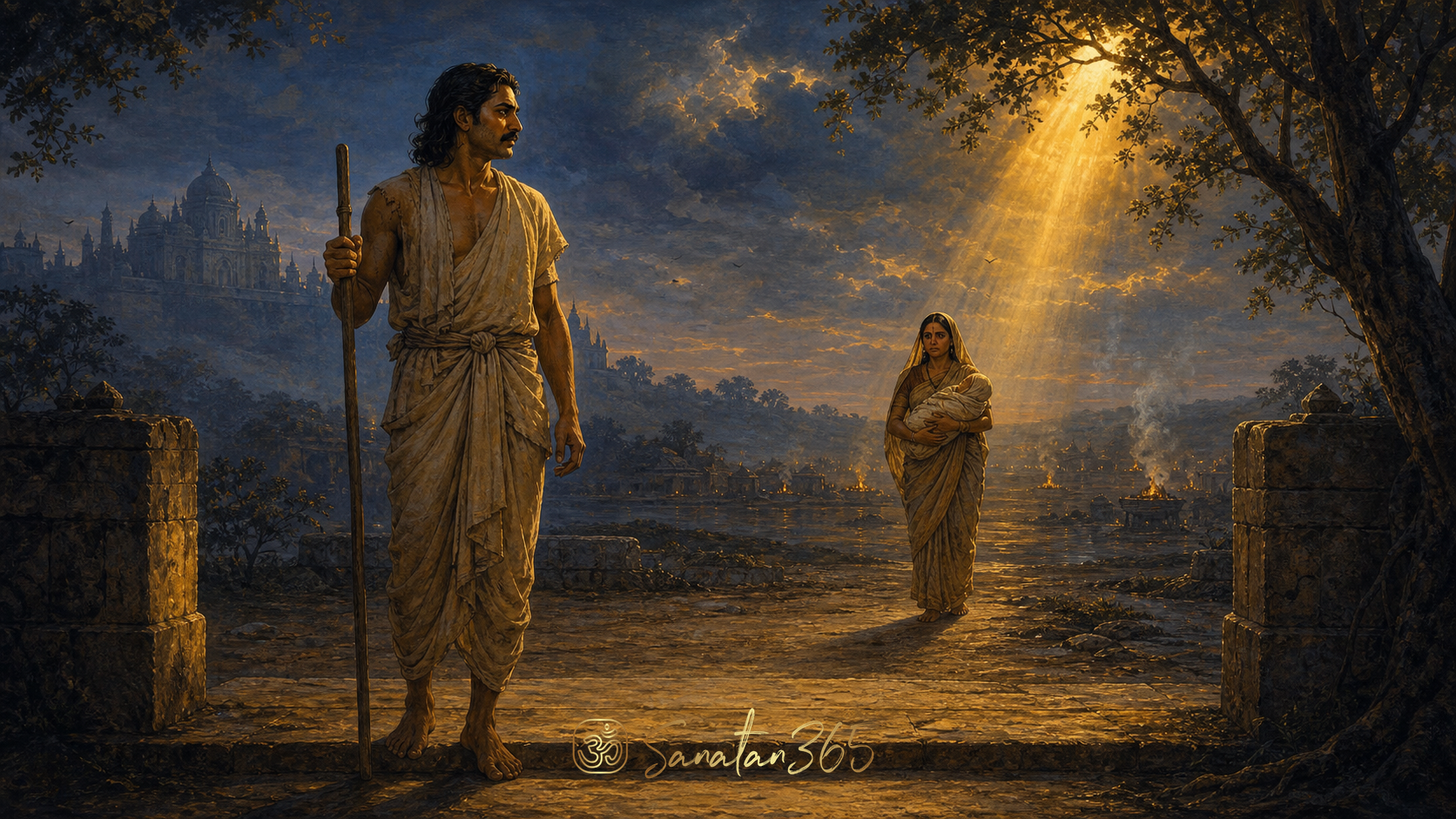
The cremation ground is the narrative's hardest setting because it removes social illusion. Rank, wealth, beauty, and reputation end at the same threshold. Harishchandra, once surrounded by courtiers, now serves under a keeper of the cremation ground and must enforce its rules.
Then his wife arrives carrying their dead son. In many popular retellings, the child has died from a snakebite. She has no money for the cremation fee. Harishchandra recognizes both wife and child, but his assigned duty still requires payment. The demand becomes unbearable: will he abandon the rule for his family, or will he wound compassion in the name of consistency?
This is not a simple victory of bureaucracy over love. The emotional force comes from the collision of dharmas. Harishchandra has a duty to his employer, a duty to truth, a duty to his wife, a duty to his child, and a duty not to exploit his position. Shaivya or Taramati also embodies courage; she is not merely a prop in the king's test. She bears dispossession, labour, bereavement, and moral resolve.
Some versions describe her offering part of her garment as the fee. At the decisive moment, the divine test is revealed. The child is restored, the family's honour is affirmed, and Harishchandra's kingdom is returned. The exact dramatic sequence varies, but the restoration matters less than what precedes it. His integrity is shown before rescue is guaranteed.
The cremation ground also carries a contemplative meaning. It is a place of anitya (अनित्य, impermanence). Harishchandra cannot preserve the fiction that possessions last forever. What remains available is the quality of the next action.
Key takeaway: The final test is difficult because truth and compassion appear to conflict, forcing integrity to become more than rigid rule-following.
What Is the Moral of the Harishchandra Story?
The usual moral is “always speak the truth,” but the narrative offers at least five deeper lessons.
1. Integrity is continuity
Integrity means the person in private is not secretly opposed to the person praised in public. Harishchandra's word continues across palace, exile, service, and grief.
2. Status cannot manufacture character
The throne makes authority visible; it does not create virtue. Once authority is removed, Harishchandra's conduct still carries moral weight. This is why Indian public memory often uses his name as shorthand for exceptional truthfulness.
3. A vow requires discernment before it is made
The story honours vow-keeping, but it also warns against casual promises. Sankalpa (संकल्प, solemn intention or resolve) should be made with awareness. A promise is not decoration for the moment; it creates a future claim upon one's conduct.
4. Suffering does not erase another person's dignity
Harishchandra suffers, but so do his wife and son. A mature reading refuses to celebrate one hero while ignoring the cost borne by others. Truth must remain attentive to relationship, consent, and compassion.
5. Dharma is proven through action
The Bhagavad Gita repeatedly places wisdom within action rather than escape from it. Its teaching that people learn from the conduct of those they regard as exemplary is especially relevant here (Bhagavad Gita 3.21). Harishchandra becomes exemplary because the principle enters work, loss, and responsibility.
Key takeaway: The story's moral is not truth as performance, but integrity maintained through changing circumstances and tempered by moral discernment.
How Has Raja Harishchandra Shaped Indian Culture?
The Raja Harishchandra story travelled far beyond Sanskrit texts. It became part of regional theatre, devotional narration, folk performance, schoolbooks, public speech, and modern media. Different communities emphasized different aspects: the king's vow, the queen's endurance, the cremation-ground test, divine justice, or the victory of satya.
Its best-known cinematic milestone is Raja Harishchandra, released in 1913 and directed by Dadasaheb Phalke, widely recognized as India's first full-length indigenous silent feature film. The National Film Archive of India preserves and interprets this early film heritage. The choice of Harishchandra for that landmark was fitting: audiences already knew the story, while cinema itself was asking viewers to trust a new form of storytelling.
The narrative also shaped moral vocabulary. To call someone “a Harishchandra” may be sincere praise for honesty or, in casual speech, a teasing comment about uncompromising truthfulness. That range shows how deeply the name has entered everyday culture.
Regional performance traditions keep the story alive by changing emphasis without abandoning its center. A stage retelling can dwell on Taramati's grief. A village performance may stress the fragility of wealth. A classroom version may focus on honesty. A contemplative reading may see the cremation ground as a lesson in impermanence.
Readers interested in another Mahabharata-linked examination of truth and discernment may also explore the Yaksha Prashna story. The situations differ, but both narratives refuse to separate knowledge from moral choice.
Key takeaway: Harishchandra endures because each generation can recognize its own conflict between convenience, responsibility, and truth.
How Can Harishchandra's Lesson Be Practised Today?
No one needs to imitate the story's extremity. Its value lies in making ordinary integrity more visible. A practical Harishchandra reflection can begin with small disciplines:
- Make fewer promises, then keep them carefully.
- Correct false impressions even when silence would benefit you.
- Distinguish confidentiality from deception.
- Admit uncertainty instead of inventing confidence.
- Return what is not yours.
- Record agreements clearly so memory does not become self-serving.
- When duties conflict, seek wise counsel rather than hiding behind a rule.
- Repair harm caused by truthful words delivered without compassion.
Truthfulness is not permission for cruelty. Saying “I am only being honest” can become a way to enjoy another person's pain. Satya is traditionally held alongside ahimsa (अहिंसा, non-harming). Speech should be true, useful, timely, and as gentle as the situation allows.
Nor does truthfulness require unsafe disclosure. A person facing abuse, coercion, or exploitation may need professional, legal, or community support and a safety plan. Harishchandra's voluntary moral test should never be used to pressure someone into remaining in danger.
A simple evening practice is to ask three questions:
- Where did my speech and action match today?
- Where did fear make me create a misleading impression?
- What repair can I make tomorrow without causing fresh harm?
This turns admiration into sadhana (साधना, disciplined spiritual practice). The goal is not to become famous for honesty. It is to become trustworthy.
Key takeaway: Practise the story through careful promises, truthful repair, compassionate speech, and wise handling of conflicting duties.
FAQ
Who was King Harishchandra?
King Harishchandra is a celebrated ruler in Hindu narrative traditions, remembered for unwavering commitment to satya and dharma. Accounts appear in several textual and regional traditions, with details varying across retellings.
What is the moral of the King Harishchandra story?
The central moral is that truthfulness and integrity matter most when they are costly. A fuller reading also emphasizes discernment, responsibility, compassion, and the dignity of family members who share the trial.
Why did Harishchandra work at a cremation ground?
After relinquishing his kingdom and entering servitude to fulfil his obligation, Harishchandra was assigned work collecting cremation fees. The setting creates the story's final test when his own grieving wife arrives without payment.
Did Harishchandra get his kingdom back?
In widely told Puranic versions, the divine test is ultimately revealed, his son is restored to life, and Harishchandra receives his kingdom again. The restoration confirms the test, but the moral force lies in his conduct before rescue was certain.
Is Raja Harishchandra a historical biography?
Harishchandra belongs to sacred, literary, and cultural memory rather than a modern evidence-based biography. The story should be read with reverence for its scriptural and ethical role without making unsupported chronological claims.
The King Harishchandra story leaves a demanding image: a person with no throne, no wealth, and no guarantee of relief still choosing not to become false. Its enduring power is not a command to seek suffering. It is an invitation to build a character that hardship cannot cheaply purchase.
Key takeaway: Truth becomes dharma when it remains responsible, compassionate, and steady even after comfort disappears.
About the author
Sanatan365 Editorial
Bringing Sanatan Dharma to modern seekers through authentic, scripture-grounded content.
Related in Stories
 Stories
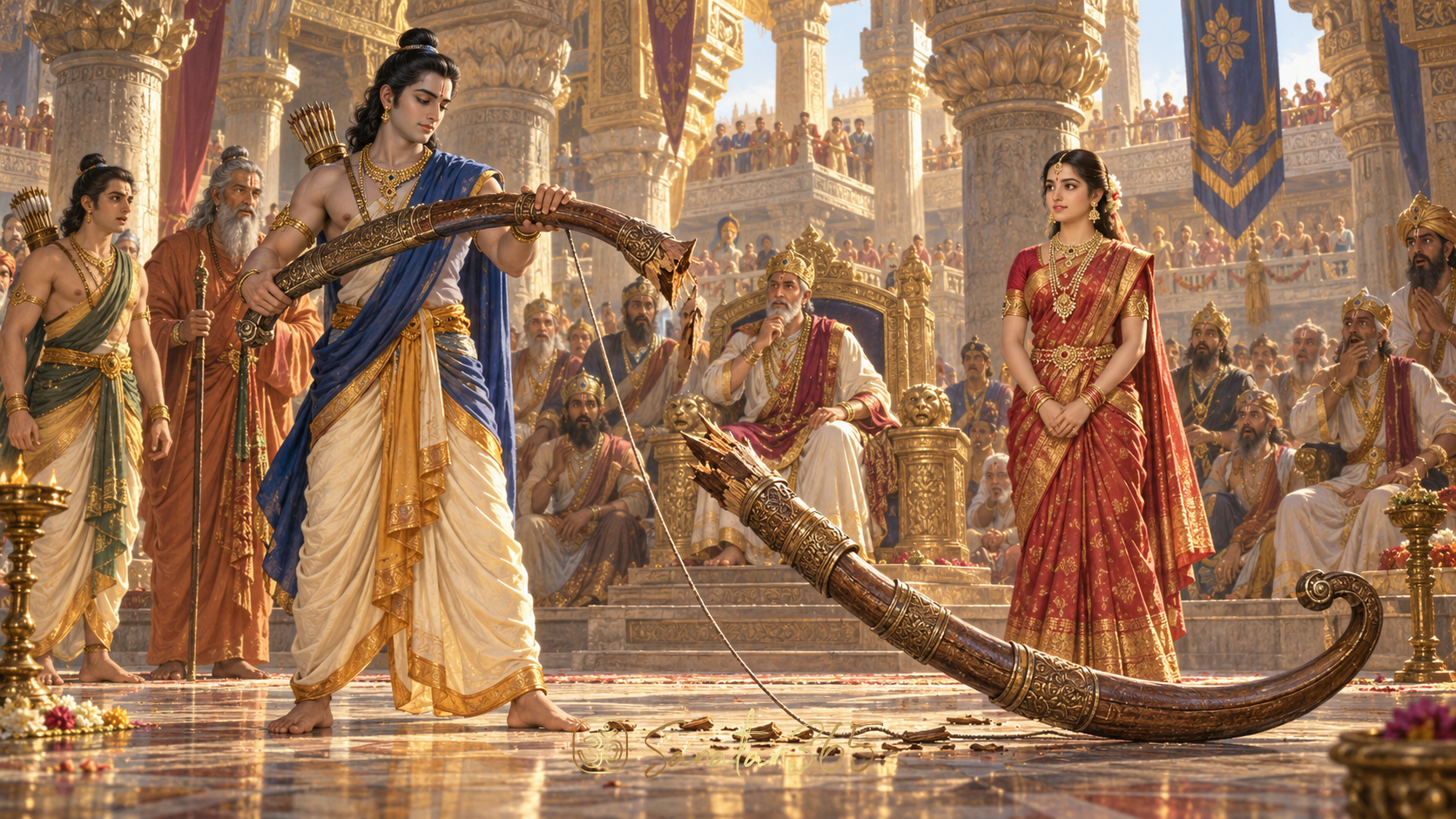
Sita Swayamvara in the Ramayana: Shiva's Bow and the Meaning of the Marriage
Read the Bala Kanda account of Rama, Sita, Janaka and Shiva's bow, and separate the text's sequence from later devotional retellings.
 Stories
King Chitraketu Story: Grief, Wisdom, and Humility in the Bhagavata
The Bhagavata Purana tells how King Chitraketu met devastating loss, listened to Narada and Angira, and learned a difficult humility. Read…
 Stories
King Ambarisha and Durvasa: A Story of Devotion and Humility
The Bhagavata Purana story of King Ambarisha and Sage Durvasa explores a difficult fast, an angry visitor, and the restraint behind devotio…