King Janaka Story: The Philosopher-King Who Acted Without Attachment
King Janaka shows that spiritual depth does not require abandoning responsibility. His example joins self-knowledge, public duty, and action without possessiveness.
A king surrounded by land, wealth, decisions, and public expectation became one of Hindu tradition's clearest examples of inner freedom. The King Janaka story matters because it rejects a false choice: a person need not abandon family, work, or leadership to live spiritually.
Janaka is remembered as a rājarṣi (राजर्षि, philosopher-king or royal sage), ruler of Mithila, father of Sita in the Ramayana tradition, and a serious seeker in the Upanishads. The Bhagavad Gita 3.20–21 names Janaka as one who reached perfection through action while continuing to work for the welfare and example of society. His lesson is not indifference. It is complete participation without making status, success, or possession the foundation of the self.
Who Was King Janaka in Hindu Tradition?
“Janaka” functions as a dynastic title in the ancient kingdom of Videha, whose capital was Mithila. Hindu narratives often use the name for Siradhvaja Janaka, the king associated with Sita. This helps explain why different texts place “Janaka” in more than one setting: the tradition remembers both a royal lineage and an exemplary ruler.
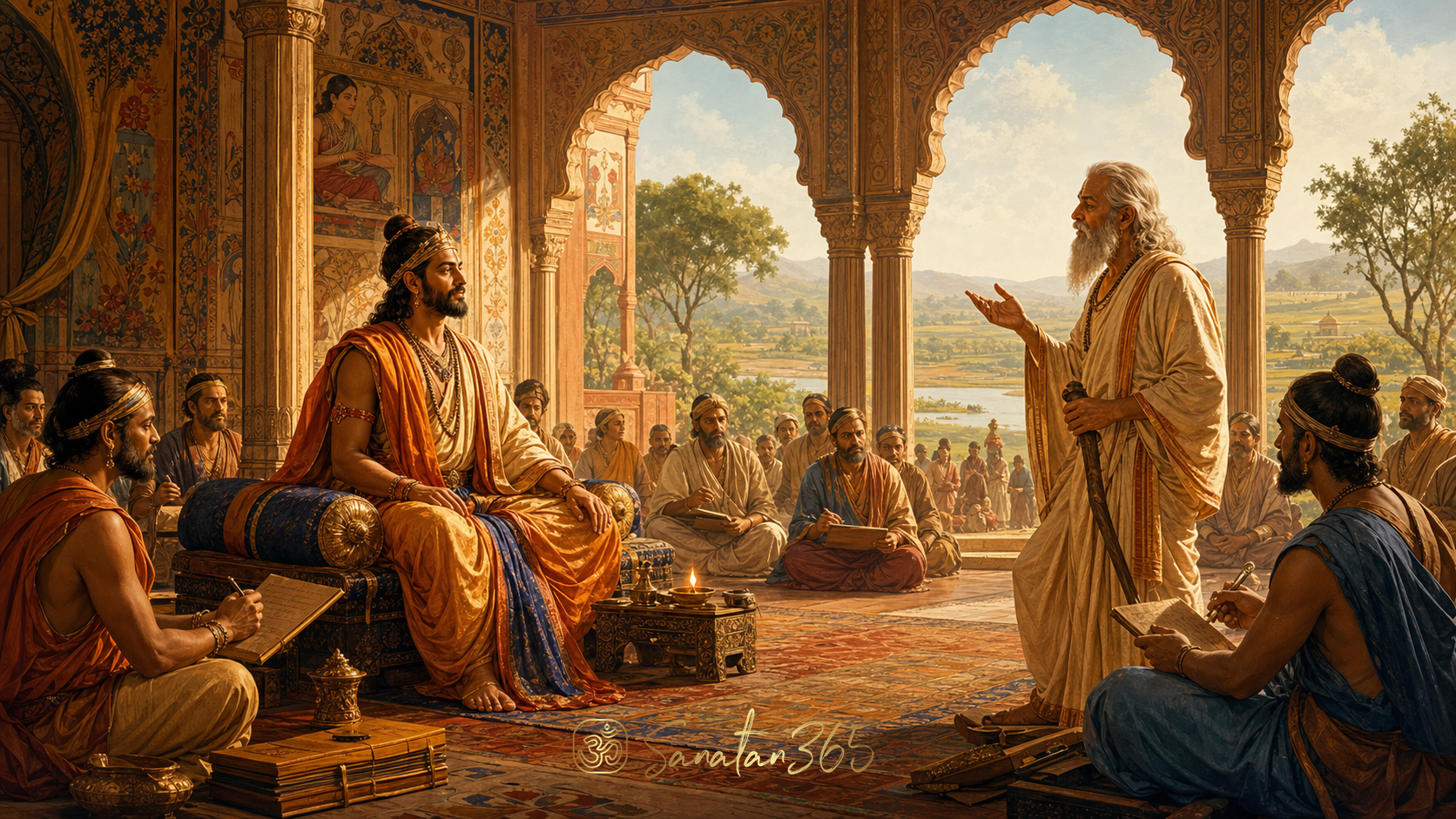
In the Valmiki Ramayana tradition, Janaka is the father who finds Sita while ploughing a ritual field and later establishes the condition for her svayaṃvara (स्वयंवर, a ceremony in which a bride chooses from qualified suitors). In the Upanishads, King Janaka appears less as a distant monarch and more as a demanding student of truth. He gathers learned teachers, asks exact questions, offers generous gifts, and refuses shallow answers.
These portraits belong together. Janaka is not presented as wise because he holds a throne. He is wise because responsibility does not end his inquiry into the Self.
The term rājarṣi combines rājan (राजन्, king) and ṛṣi (ऋषि, seer or sage). It names a rare ideal: outward authority disciplined by inward clarity. A rajarshi does not treat spiritual knowledge as decoration for power. Knowledge changes how power is held.
Key takeaway: King Janaka represents leadership in which learning, humility, and public responsibility support one another.
Why Does the Bhagavad Gita Name Janaka?
The Bhagavad Gita introduces Janaka during Krishna's teaching on karma yoga (कर्मयोग, the discipline of action without attachment to personal reward). Arjuna wonders whether spiritual wisdom should lead away from difficult action. Krishna answers that freedom is not reached merely by avoiding work.
“Janaka and others attained perfection through action. You should also act, keeping in view the welfare of the world.” — Bhagavad Gita 3.20, sense translation
The next verse explains why the conduct of a respected person matters: others tend to follow the standard that leader establishes. Janaka therefore illustrates two linked truths.
- Responsible action can become a path of spiritual maturation.
- A leader's private discipline produces public consequences.
This teaching is often misunderstood as a command to work endlessly. The Gita does not glorify exhaustion or exploitation. Its focus is attachment: the ego's insistence that “my result, my reputation, and my control” must determine inner peace. Janaka performs his duty, but he is not spiritually owned by the throne.
Detached action is also not careless action. A surgeon, parent, teacher, or public servant cannot use “detachment” as an excuse for poor preparation. In karma yoga, the action receives full attention while the actor releases the fantasy of absolute control over the result.
Janaka's example is especially demanding because kingship magnifies consequences. His freedom must coexist with judgment, protection, administration, and accountability. If spiritual life works only in isolation, it cannot guide the householder or leader. Janaka demonstrates that it can.
Key takeaway: The Gita names Janaka to show that wholehearted duty and inner non-attachment can exist in the same life.
What Do Janaka and Yajnavalkya Teach in the Upanishads?
The Bṛhadāraṇyaka Upaniṣad (बृहदारण्यक उपनिषद्, “Great Forest Upanishad”) preserves several dialogues involving King Janaka and the sage Yajnavalkya. The text portrays Janaka's court as a place where serious philosophical inquiry receives royal support. Scholars debate, questions sharpen, and knowledge is tested rather than merely praised.
One famous sequence asks what serves as a person's light. Sunlight guides activity during the day; moonlight, fire, and speech provide other forms of orientation. The questioning eventually turns inward. When external lights are absent, what makes experience knowable? The teaching points toward the ātman (आत्मन्, the innermost Self) as the light by which experience is known.
The significance is practical. Janaka possesses many external sources of authority: title, wealth, advisers, ritual status, and military power. Yet he asks about a light that cannot be conferred by office. The court becomes a classroom because the king does not pretend that political authority equals ultimate knowledge.
Another important feature of these dialogues is Janaka's willingness to reward learning. Material gifts appear in the text, but they are not presented as purchases of truth. They show that a healthy society values teachers and protects spaces for rigorous thought. Yajnavalkya, meanwhile, is not reduced to a flattering court intellectual. The exchanges retain tension, precision, and intellectual independence.
Modern readers should also resist blending every Janaka narrative into a single literal biography. The Upanishads, the Ramayana, later Vedantic accounts, and popular teaching stories have different literary purposes. Their shared ethical portrait is more secure than invented historical detail: Janaka is a ruler whose engagement with truth reshapes his relationship to power.
Key takeaway: Janaka's Upanishadic greatness lies in asking questions that his royal status cannot answer for him.
What Does Detached Action Really Mean?
Detached action is better understood as non-possessive action. It has four parts.
1. Identity is larger than the role
A role may be sacred and demanding, but it is not the whole self. Janaka serves as king without assuming that kingship defines his deepest being. Modern people can apply the same distinction: “I perform this role” is healthier than “I am nothing without this title.”
2. Effort is sincere, but control is limited
Karma yoga asks for disciplined effort while recognizing that outcomes emerge from many causes. Preparation belongs to the actor. Every consequence does not.
3. Success does not become ownership
Janaka's kingdom is entrusted to him; it is not an extension of his ego. The same principle can guide money, expertise, influence, or family authority. Stewardship asks, “What does this responsibility require?” Possessiveness asks, “How does this prove my importance?”
4. Failure becomes instruction, not annihilation
Non-attachment does not remove disappointment. It prevents disappointment from becoming a total verdict on personal worth. A clear mind can correct mistakes sooner because it spends less energy defending an image.
This vision resembles videha (विदेह, literally “bodiless”), a name associated with Janaka's kingdom and, in later interpretation, with freedom from body-bound identification. It should not be read as contempt for the body. Hindu household and royal duties require care for embodied life. The point is that bodily comfort, social label, and possession do not exhaust the truth of the Self.
Key takeaway: Detachment is not distance from responsibility; it is freedom from using responsibility to manufacture identity.
How Can the King Janaka Story Guide Modern Life?
Janaka's model can be translated into a simple practice without pretending that an office, home, or business is an ancient court.
Before action: name the duty
Ask, “What is actually mine to do here?” Separate duty from the desire to control another person's response. A manager may owe clarity and fairness, but cannot guarantee universal approval. A parent may offer guidance, but cannot live a child's life.
During action: give undivided attention
Detachment should improve attention. Put away the performance of being busy. Listen fully. Check facts. Make the difficult call without adding avoidable harshness. This is the active side of karma yoga.
After action: release the private courtroom
Review what happened, make amends where needed, and learn. Then stop retrying the event endlessly in imagination. Reflection is useful; self-punishment disguised as reflection is not.
When praised: return to stewardship
Praise can be received with gratitude without being converted into identity. Ask what the trust now requires. Janaka's example suggests that influence increases obligation rather than entitlement.
When uncertain: seek teachers who can disagree
Janaka invited inquiry into his court. Modern leadership also needs voices that are not rewarded merely for agreement. A spiritual mentor, experienced colleague, elder, or careful text can expose assumptions that power tends to hide.
A brief evening reflection can make the teaching concrete:
- Where did I act from duty today?
- Where did fear of reputation distort my judgment?
- What result am I trying to possess?
- What repair belongs to me tomorrow?
- What can I now release?
This is not a method for suppressing emotion. Grief, stress, and conflict may require rest, trusted support, or professional help. Spiritual reflection can complement such care; it does not replace medical or mental-health treatment.
Key takeaway: Janaka's discipline becomes practical when people define their duty, act attentively, review honestly, and release what they cannot own.
What Janaka Does Not Teach
Janaka's popularity makes several corrections necessary.
First, he does not teach passive acceptance of injustice. A ruler has protective duties. Non-attachment cannot mean indifference to harm.
Second, he does not prove that wealth automatically supports wisdom. His possessions create a sharper test: can power be held without being worshipped?
Third, he does not erase the value of renunciation. Sanatan Dharma preserves multiple valid paths and life orientations. Janaka's householder and royal example should not be used to declare one path superior to another.
Fourth, later stories sometimes depict Janaka remaining calm while Mithila burns. Their point is usually his freedom from possessiveness, not permission to neglect citizens or property. A responsible reading keeps inner non-attachment joined to outward duty.
Finally, Janaka does not offer a productivity slogan. “Work without attachment” should never be used by institutions to demand endless labor while avoiding fair conditions. Karma yoga is an ethical discipline of the actor, not a tool for exploiting workers.
Key takeaway: Janaka's freedom is measured by wiser responsibility, not by numbness, privilege, or neglect.
Conclusion
The King Janaka story preserves a demanding hope: contemplation and responsibility do not have to become enemies. The philosopher-king studies the Self, listens to teachers, governs a kingdom, and acts for loka-saṅgraha (लोकसंग्रह, the sustaining welfare and cohesion of the world).
Key takeaway: Inner freedom is not proved by escaping every role; it is revealed when a person can serve fully without turning the role, result, or praise into the self.
FAQ
Who was King Janaka?
King Janaka is remembered in Hindu tradition as a ruler of Mithila, father of Sita in the Ramayana, and a philosopher-king who studies self-knowledge in the Upanishads. “Janaka” was also a dynastic title, so textual references need not all describe one simple modern-style biography.
Why is King Janaka mentioned in the Bhagavad Gita?
Bhagavad Gita 3.20 names Janaka as an example of one who attained perfection through action. Krishna uses him to show Arjuna that spiritual wisdom can support responsible work performed for the welfare of society.
What is rajarshi meaning?
Rājarṣi means “royal sage” or “philosopher-king.” It combines the responsibilities of a ruler with the inquiry, discipline, and ethical clarity associated with a rishi.
What is detached action?
Detached action means performing one's duty carefully without making the desired result, praise, possession, or role the basis of identity. It is not indifference to quality or consequence.
What can leaders learn from King Janaka?
Leaders can learn to seek teachers who challenge them, distinguish stewardship from possession, act for collective welfare, review mistakes without defensiveness, and remember that authority does not equal ultimate knowledge.
About the author
Sanatan365 Editorial
Bringing Sanatan Dharma to modern seekers through authentic, scripture-grounded content.
Related in Stories
 Stories
Sita Swayamvara in the Ramayana: Shiva's Bow and the Meaning of the Marriage
Read the Bala Kanda account of Rama, Sita, Janaka and Shiva's bow, and separate the text's sequence from later devotional retellings.
 Stories
King Chitraketu Story: Grief, Wisdom, and Humility in the Bhagavata
The Bhagavata Purana tells how King Chitraketu met devastating loss, listened to Narada and Angira, and learned a difficult humility. Read…
 Stories
King Ambarisha and Durvasa: A Story of Devotion and Humility
The Bhagavata Purana story of King Ambarisha and Sage Durvasa explores a difficult fast, an angry visitor, and the restraint behind devotio…

