Lepakshi Veerabhadra Temple: Sacred Art, Architecture, and Devotion
Lepakshi's Veerabhadra Temple brings Vijayanagara architecture, Shaiva devotion, painted ceilings, carved pillars, and living sacred memory into one remarkable temple complex in Andhra Pradesh.
A temple ceiling can become a scripture in colour, and a granite hall can teach the body how to slow down.
The Lepakshi Veerabhadra Temple in Andhra Pradesh is important because it unites living Shaiva worship with some of the most remarkable surviving architecture, sculpture, and mural painting of the Vijayanagara period. Dedicated chiefly to Lord Veerabhadra, the complex invites visitors to read sacred stories not only through words, but through painted ceilings, carved pillars, ritual spaces, and the deliberate movement from outer court to sanctum.
Lepakshi is often introduced through its famous “hanging pillar.” That architectural curiosity deserves attention, but it is not the temple's deepest meaning. The greater wonder is the coherence of the whole place: fierce divine protection, disciplined craftsmanship, visual storytelling, and worship all belong to one sacred environment.
Why Is Lepakshi Veerabhadra Temple Important?
Lepakshi stands in the present-day Sri Sathya Sai district of Andhra Pradesh, close to the Karnataka border. The temple is generally associated with the sixteenth-century Vijayanagara world and with the brothers Virupanna and Viranna, who served under the reign of Achyuta Deva Raya. As with many historic temples, inscriptions, architectural evidence, later memory, and local sacred narratives should be read together without forcing every tradition into a single modern historical claim.
The UNESCO World Heritage Centre's tentative-list entry identifies the Sri Veerabhadra Temple and the nearby monolithic Nandi as outstanding expressions of the Vijayanagara sculpture and painting tradition. Its documentation highlights the temple's mural panels, narrative subjects, spatial planning, and relationship with earlier South Indian building traditions.
Yet Lepakshi is not simply an art museum. A Hindu temple is organized around darshana (दर्शन, sacred seeing or an encounter with the Divine). The visitor does not merely inspect an object from a distance. Architecture guides attention toward presence. Pillars regulate movement, thresholds mark inward progression, and images place sacred narratives within the devotee's field of vision.
This makes Lepakshi valuable in three connected ways:
- As a shrine: it remains centered on worship of Veerabhadra and related Shaiva forms.
- As a visual archive: its murals and sculptures preserve stories, clothing, ornament, gesture, and artistic conventions of the Vijayanagara period.
- As sacred architecture: its halls, enclosures, subsidiary shrines, and ritual spaces turn movement through stone into a devotional experience.
The temple therefore rewards more than a hurried photograph. It asks the visitor to notice how devotion becomes form.
Key takeaway: Lepakshi matters because worship, painting, sculpture, and architecture were conceived as one sacred language rather than separate attractions.
Who Is Lord Veerabhadra in the Lepakshi Temple Tradition?
Veerabhadra is a fierce form associated with Lord Shiva. The name joins vīra (वीर, heroic or courageous) with bhadra (भद्र, auspicious, gracious, or protective). His well-known Puranic narrative is connected with Daksha's sacrifice and the grief and righteous fury that follow Sati's death. Different texts and regional traditions tell the story with variations, so it is best understood as a broad Shaiva narrative rather than a single universally fixed script.
Fierceness in Hindu iconography does not automatically mean cruelty. A ugra (उग्र, intense or formidable) form can represent the force that confronts disorder, protects sacred responsibility, and refuses indifference when dharma (धर्म, sustaining moral and cosmic order) is violated. Veerabhadra's presence at Lepakshi gives the temple a spiritual center: power is placed in service of protection and restored order.
This theme becomes especially meaningful when the visitor sees it alongside the temple's careful artistic discipline. Fierce energy is not shown as chaos. It is contained within proportion, rhythm, ritual, and sacred space. The message is not that anger itself is holy; it is that strength requires direction, responsibility, and alignment with dharma.
The wider Shaiva context also helps. Lord Shiva appears across Hindu tradition in contemplative, cosmic, household, and fierce forms. Readers exploring this range may also appreciate the symbolism of Shiva as Dakshinamurti, the silent teacher and the sacred geography described in Ekambareswarar Temple at Kanchipuram. Lepakshi contributes another dimension: Shiva-related devotion expressed through heroic protection and monumental visual art.
Key takeaway: Veerabhadra's fierceness is best read as disciplined protective power, not as a celebration of uncontrolled rage.
How Does Vijayanagara Architecture Shape the Sacred Experience?
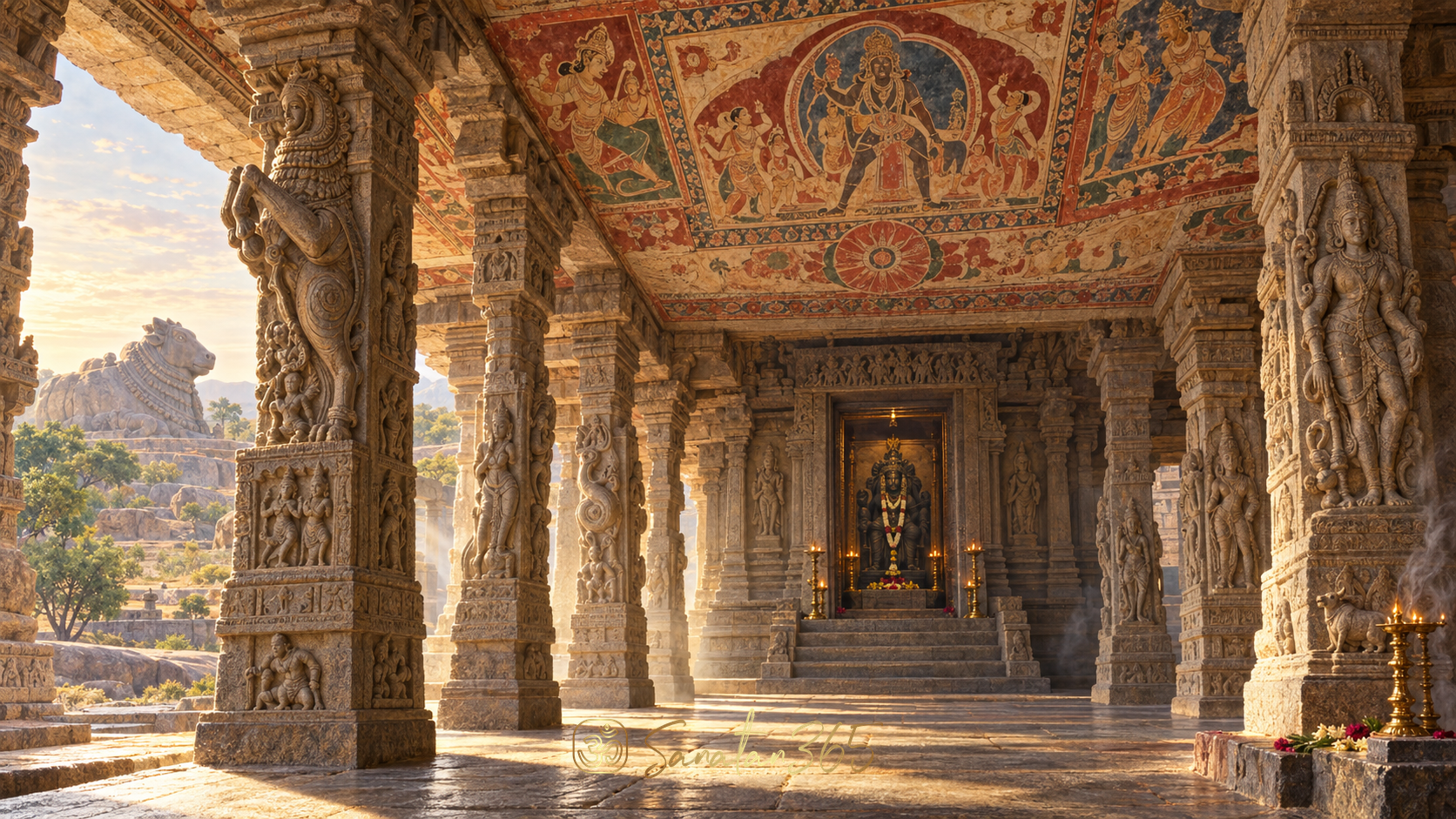
Vijayanagara architecture often creates an experience of abundance through repeated pillars, open and enclosed halls, sculpted surfaces, strong horizontal lines, and carefully staged approaches to the sanctum. At Lepakshi, these features are not decorative excess. They organize where the body pauses, turns, looks upward, and moves inward.
The temple complex includes multiple mandapas (मण्डप, pillared halls), enclosures, ritual structures, and subsidiary sacred spaces. The incomplete kalyana mandapa (कल्याण मण्डप, ceremonial marriage hall) is particularly evocative. Its sculpted pillars and unfinished condition reveal both artistic ambition and the vulnerability of historical projects. An unfinished structure can still teach: sacred work is transmitted across generations, but human plans remain subject to political, economic, and personal change.
Elsewhere, the Nagalinga sculpture gathers serpent canopy, Shiva linga, mass, and movement into a single commanding composition. The temple's granite can feel immovable, yet its carvings produce rhythm. Figures turn, ornaments flow, and architectural members lead the eye from one visual episode to another.
The relationship between structure and attention is central. A large hall allows community, procession, music, and shared ritual. A narrower passage draws attention inward. A raised platform establishes importance. A carved pillar can mark both physical support and narrative meaning. Similar principles can be seen in other regional masterpieces, though each site develops them differently, such as the living sculptural programme of Chennakeshava Temple at Belur.
Visitors should also remember that historic surfaces are finite. Touching, leaning on, or rubbing ancient carvings may seem harmless in one moment, but repeated contact can damage stone, pigment, and fragile detail. Reverence includes restraint.
Key takeaway: Lepakshi's architecture is a choreography of attention, guiding the visitor from spacious public encounter toward concentrated sacred presence.
What Do Lepakshi's Murals and Sculptures Communicate?
The painted ceilings are among Lepakshi's greatest treasures. UNESCO's documentation notes mural panels depicting episodes from the Mahabharata, the Ramayana, and Puranic narratives. These are not illustrations added after architecture was complete in spirit. They participate in the temple's teaching function.
To look upward at a painted ceiling is physically significant. The gesture lifts the head and changes ordinary posture. Stories surround the worshipper above the level of daily traffic, placing human life under a wider sacred memory. Colour, costume, procession, gesture, and scale help distinguish figures and moments even before every narrative detail is identified.
The murals also preserve evidence of artistic practice and social imagination. Garments, ornaments, courtly groupings, attendants, musicians, and compositional choices tell us how artists translated sacred narratives through the visual vocabulary available to them. They should not be treated as photographic records of ancient events. They are devotional interpretations made in a particular historical and regional world.
Sculptures work differently but in conversation with the paintings. Granite creates weight, shadow, and permanence. Painted surfaces offer line, colour, and expanded narrative sequence. Together they make the temple readable at several speeds:
- from a distance, through monumental forms;
- while walking, through repeating pillars and framed views;
- at close range, through ornament, expression, and gesture;
- in stillness, through the sacred focus of the shrine.
The nearby monolithic Nandi extends this sacred landscape beyond the main enclosure. Nandi is Shiva's bull and devoted attendant, conventionally oriented toward the Lord. At Lepakshi, the great sculpture has become an emblem of the site, but its devotional identity should not be reduced to its size. It represents steadfast attention, service, and the power of waiting before the Divine.
Photography rules and access conditions can change, especially around fragile paintings and active worship spaces. Visitors should follow current on-site instructions rather than assuming that every surface may be photographed or approached closely.
Key takeaway: Lepakshi's paintings and sculptures do more than display skill; they turn sacred narrative into an environment that can be entered, seen, and remembered.
What Is the Truth Behind the Famous Hanging Pillar?
One pillar at Lepakshi is widely called the “hanging pillar” because much of its base appears not to rest fully on the floor, allowing a thin cloth or sheet of paper to pass beneath part of it. Popular retellings often describe it as levitating or as a mystery beyond explanation. Such language is dramatic but unnecessary.
The more responsible account is also more interesting. The pillar belongs to an interconnected stone structure in which loads are distributed across beams, columns, joints, and the wider hall. Published descriptions note that the pillar is not uniformly suspended without contact; it is slightly displaced and touches at one side. Its condition has also been linked in modern accounts to a past attempt to investigate or move it. Without a current structural engineering report, claims about an exact mechanism should remain modest.
The pillar still demonstrates extraordinary planning and stone craftsmanship. But turning it into a supernatural proof can distract from the achievement that is visible: builders understood geometry, material behaviour, alignment, and structural relationships well enough to create a complex hall that has endured for centuries.
Visitors should never push objects under the pillar, strike it, or imitate viral demonstrations. A protected monument is not an experiment for each tourist to repeat. Wonder can remain wonder without physical interference or exaggerated claims.
Key takeaway: The hanging pillar is best appreciated as part of a sophisticated structural system, not marketed as a miracle that requires careless testing.
How Can Visitors Approach Lepakshi Respectfully?
A meaningful visit begins by remembering that Lepakshi is both a heritage monument and a sacred place. The needs of conservation and worship reinforce one another: both ask for attention, humility, and care.
Practical principles include:
- Dress and behave with temple awareness. Follow local guidance on footwear, entry, and photography.
- Do not touch murals or test pillars. Pigments and carved surfaces can be damaged by repeated contact.
- Allow worship to continue undisturbed. Do not block the sanctum approach, ritual movement, or devotees in prayer.
- Read legends and history carefully. Local sacred memory deserves respect, while historical claims should be distinguished from later storytelling.
- Give the site time. Look at the murals, spatial sequence, carvings, shrine, and Nandi as parts of one sacred ensemble.
- Plan for climate and current conditions. Andhra Pradesh heat can be intense; verify opening hours, local travel advice, and on-site rules before departure.
The deepest etiquette is not complicated: receive more than one consumes. A visitor can leave with photographs, but also with a renewed respect for artists, worshippers, conservators, and generations who kept the sacred place alive.
Lepakshi's enduring lesson is that devotion can take material form without becoming merely material. Stone bears weight, pigment bears story, ritual bears memory, and the visitor bears responsibility.
Key takeaway: Respectful pilgrimage protects both the living sanctity and the irreplaceable art of Lepakshi.
FAQ
Where is Lepakshi Veerabhadra Temple located?
It is in Lepakshi in Sri Sathya Sai district, Andhra Pradesh, near the Karnataka border. Travellers should verify current road, opening-hour, and local-access information before visiting.
Who is worshipped at Lepakshi Temple?
The principal dedication is to Lord Veerabhadra, a fierce and protective form associated with Lord Shiva. The complex also contains other Shaiva images, subsidiary sacred spaces, and the nearby monumental Nandi.
Why are the Lepakshi murals important?
They are major surviving examples of Vijayanagara painting. Their ceiling panels present sacred narratives, figures, costumes, gestures, and visual conventions that illuminate both devotion and sixteenth-century artistic culture.
Is the Lepakshi hanging pillar really floating?
Much of its base does not appear to rest evenly on the floor, but responsible descriptions note contact at one side and treat it as part of an interconnected structural system. It should not be described casually as supernatural levitation or physically tested by visitors.
Is Lepakshi only a heritage attraction?
No. It is both a protected historic monument and a living sacred place. Visitors should approach its architecture and art with the same respect they offer active worship.
Lepakshi Veerabhadra Temple shows what becomes possible when sacred imagination, skilled hands, and disciplined attention meet. Its most memorable feature is not one pillar, mural, or sculpture in isolation, but the way every element directs the mind toward presence, story, and responsibility.
Key takeaway: Lepakshi is best understood as a complete sacred environment where devotion gives architecture meaning and architecture gives devotion visible form.
About the author
Sanatan365 Editorial
Bringing Sanatan Dharma to modern seekers through authentic, scripture-grounded content.
Related in Temples
 Temples
Vittala Temple Hampi: Reading the Stone Chariot and Sacred Courtyard
Understand Hampi’s Vittala Temple through its Garuda stone chariot, pillared halls, Vishnu devotion, and careful heritage visiting.
 Temples
Kirtimukha Meaning: The Face of Glory Above the Temple Door
The fierce face above a temple doorway is not a warning to turn away. Learn to recognize Kirtimukha, read its sacred story, and notice how…
 Temples
Somanathapura Keshava Temple: Three Shrines and the Art of Looking
Read the star-shaped plan, three Vishnu shrines and carved narratives of Somanathapura, with a respectful guide to a protected Hoysala monu…

