Lingashtakam Meaning: How Every Verse Returns to Bowing
The hymn moves through fragrance, light and lotus imagery, yet repeatedly returns to bowing. Read that relationship without turning praise into promises.
The descriptions change; the act at the end does not.
Lingashtakam meaning centres on eight Sanskrit stanzas praising Shiva through the liṅga (लिङ्ग, his sacred emblem), each returning to a salutation. Aṣṭakam (अष्टकम्, a group of eight) describes the hymn's principal structure. Fragrance, brightness and lotus imagery give the praise richness, while the recurring bow keeps its direction clear. The reader is hearing different descriptions addressed to one sacred presence, rather than collecting eight separate techniques for obtaining results.
What is the central Lingashtakam meaning?
The Sanskrit text preserved by Sanskrit Documents provides the starting point: eight principal stanzas share a closing line, followed by a short statement of the fruit of recitation. A printed sheet or recording may therefore include a concluding verse beyond the eight that give the hymn its name.
A stotram (स्तोत्रम्, hymn of praise) works through description and address. Its language can be remembered, sung and contemplated. The familiar category of mantra (मन्त्र, sacred utterance) helps readers locate it among devotional recitations, but an eight-stanza hymn has a different literary shape from a short repeated invocation. Recognising the form helps a learner hear what its repetition is doing.
The useful question is therefore more precise than whether the hymn is powerful. What remains constant while the descriptions change? Someone listening for the first time may notice a flower in one line and an immense image of light in another. Listening for the ending reveals a second pattern: each set of images is brought back into the same relationship of reverence.
That relationship gives the reader a way through unfamiliar vocabulary. Every compound need not become familiar on the first reading. One can begin by distinguishing the descriptive part from the returning salutation, then learn how they belong together. A translation becomes more helpful when it reveals this structure instead of presenting an uninterrupted list of divine attributes.
There is no need to attach an unsupported composition date or biography to make the hymn valuable. This reading follows the named text and institutional study sheet. It does not establish an author from historical evidence. Questions about attribution should be kept separate from the words that can actually be read in the edition at hand.
Key takeaway: Lingashtakam is an eight-stanza act of praise whose repeated ending gives its changing imagery a common devotional direction.
Why does the Sadashiva refrain keep returning?
The recurring line can be followed as:
तत् प्रणमामि सदाशिवलिङ्गम् ।
Tat praṇamāmi Sadāśiva-liṅgam means, in a plain rendering, “To that linga of Sadashiva I bow.” Praṇamāmi (प्रणमामि, I bow) names the action; Sadāśiva (सदाशिव, ever-auspicious Shiva) identifies the one honoured. The first-person statement is especially important. After describing what is revered, the voice of the hymn states its own response.
A repeated line can become so familiar that it is heard as a pause between the interesting parts. Here it deserves attention in its own right. Each return asks the listener to bring the preceding description into an act of reverence. The refrain is a hinge: the imagery opens a field of meaning, and the bow gives the voice a place within it.
Consider the difference between describing a beautiful offering and offering it. The description can remain something observed at a distance. An act of offering involves a relationship. The hymn's repeated first person allows a reader to notice that movement without needing to invent an elaborate ceremony around every stanza.
This is an interpretive way of reading the structure, not a claim that the hymn prescribes a particular bodily movement after every line. A person may recite while standing, seated or following an established household arrangement. Someone with limited mobility can express reverence without attempting a posture that is unsuitable for them. The grammatical act of bowing should not become an unnecessary physical test.
The repetition also gives a group something to recognise together. One learner may understand more of a stanza than another, while both can hear its return. For a family reading the hymn, this offers a natural point of shared attention. It need not turn into a demonstration of who knows more Sanskrit.
The related Shiva Panchakshara Stotram organises its praise around five syllable-dedicated stanzas. That is a different textual design. Keeping the distinction clear helps prevent one familiar Shiva hymn from supplying explanations that belong to another.
Key takeaway: The Sadashiva refrain makes bowing the recurring response to praise; its familiarity should deepen attention rather than replace it.
How do fragrance and light shape this Shiva stotram?
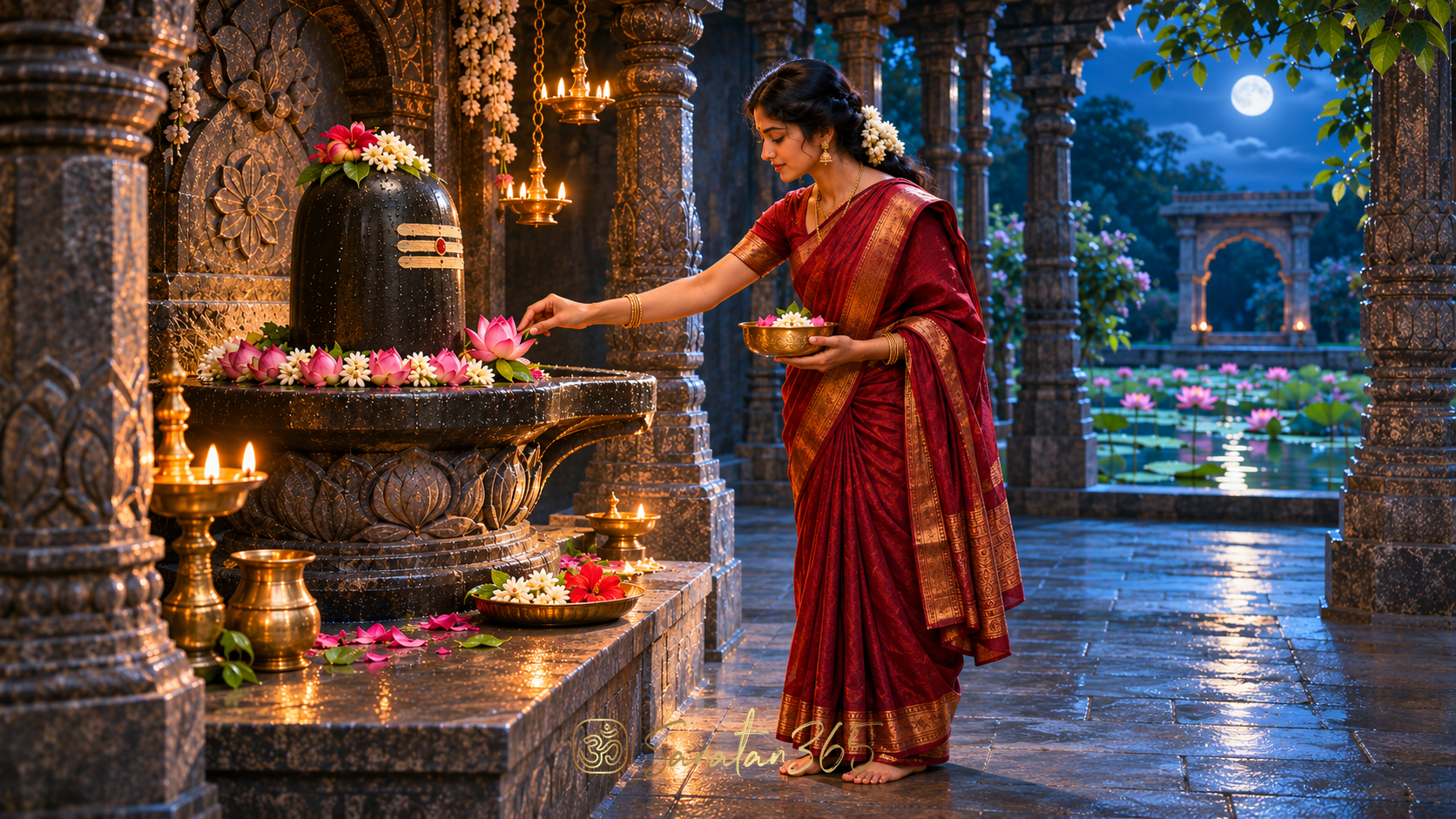
The hymn's sensory vocabulary is concrete. The Chinmaya Mission Orlando Lingashtakam study sheet translates references to fragrant anointing, sandal paste, lotus garlands and immense radiance. These details can be checked against the Sanskrit edition. They make praise something the reader can imagine through material, colour and light.
One can linger over the difference between fragrance and display. A scent is experienced through proximity; it does not demand that every person in a room look toward it. Read reflectively, that quality offers a useful question about devotion: how much attention is given to an offering when there is no audience to admire its preparation? This question is a contemporary reflection prompted by the image, not a hidden instruction in the Sanskrit.
Sandal paste provides another concrete point of attention. An English explanation can move too quickly from the named material to a broad statement about purity or peace. It is often more revealing to stay with what the line actually evokes: something carefully prepared and respectfully applied. The reader can recognise care before deciding what further personal meaning to draw from it.
Likewise, brightness in a hymn is more than an illumination diagram. An immense solar comparison expresses the scale of praise. It does not ask an illustrator to fill every surface with the same glow, or require a reader to imagine a physically measurable event. Poetic scale can remain magnificent without being converted into a claim about ordinary optics.
The contrast between nearby fragrance and vast light is worth hearing. One image draws attention close; another opens it outward. Their shared ending allows the hymn to move between these scales without losing its devotional centre. Richness comes from their relationship, rather than from treating every image as a separate symbol with a fixed modern explanation.
A useful reading exercise is to place a short note beside a stanza:
- What material or image is actually named?
- What quality does its description make noticeable?
- What belongs to the source, and what is a personal association?
- How does the ending direct that attention toward Shiva?
These questions are a study aid, not a required method of worship. They can make room for curiosity while protecting the hymn from explanations that sound traditional simply because they have been repeated online.
Key takeaway: The hymn's richness is sensory and devotional; careful reading keeps its concrete images distinct from later personal associations.
What do the lotus and Supreme Self bring together?
The Sanskrit edition's later verses place an eight-petalled lotus image alongside language concerning the origin of creation, and the final principal stanza invokes the Supreme Self. Paramātman (परमात्मन्, Supreme Self) is the philosophical term relevant to that closing register. These are different scales of language within the same praise.
A lotus is easy to picture. The Supreme Self cannot be treated as one more decorative object beside it. Reading the two registers together allows a familiar form to remain a point of attention without assuming that the form exhausts everything the hymn addresses. This is an observation about the text's movement, not an attempt to settle the differences among philosophical schools.
The image is especially useful when a reader feels a choice must be made between material beauty and spiritual depth. The hymn does not abandon flowers when its language becomes expansive. Nor does the presence of flowers require the philosophical language to be reduced to an attractive arrangement. A devotional reading can attend to both without forcing them into the same kind of statement.
A person studying the text might describe this distinction in ordinary terms: an offering can be visible and particular, while the reverence expressed through it reaches beyond what can be arranged on a surface. That sentence is an explanatory reflection. It should not be attributed to a verse as though it were a literal translation.
Numbers also require care. The presence of eight in the title and lotus imagery does not justify inventing eight compulsory life goals, eight financial outcomes or an eight-day deadline. A symbolic or poetic pattern should be explained from a source that actually teaches it. Where an edition does not supply an explanation, leaving the question open is more honest than filling it with a tidy chart.
The same care applies to reading the linga itself. It is the definite sacred focus of the hymn, not an empty stand awaiting something more important. Its presence allows the descriptions and the salutation to remain directed. A reader who wants the separate practical subject of water offering can consult the account of Jalabhishek; this hymn reading does not prescribe that ritual's sequence.
Key takeaway: Concrete lotus imagery and expansive philosophical language can belong to one act of devotion without becoming interchangeable explanations.
How can Lingashtakam chanting remain attentive rather than transactional?
An attentive reading begins with the difference between praise and a contract. Benefit language in a devotional text expresses a sacred understanding of grace and nearness to the Divine. It should not be converted into a promise of a particular income, examination result, cure or deadline. The person explaining the hymn has a responsibility to keep that distinction visible.
The question then becomes practical: what might attentive learning look like? A beginner can choose one consistent text, read a stanza's meaning and listen to a dependable pronunciation example. The closing line can be recognised before the entire verse is memorised. Returning to that line gives the learner a point of orientation while the rest becomes familiar.
A short sequence can support study:
- Locate the eight principal stanzas and identify any concluding verse separately.
- Read one stanza without trying to master the whole hymn immediately.
- Notice its concrete image or attribute.
- Recite its ending with the meaning of bowing in mind.
- Return later to a word or translation that remains uncertain.
This is an optional learning suggestion, not an initiation procedure, recitation quota or replacement for a teacher's instruction. A household, temple or community may preserve a particular pronunciation, melody or arrangement. Readers in India and the diaspora can follow that context respectfully while distinguishing its customary form from the text's principal structure.
The hymn can also be heard without turning the listener's experience into a test. Some days an image feels vivid; on others the words require patient effort. Neither experience supplies a reliable measure of another person's devotion. The modest task of learning the text carefully is enough for the occasion.
A final reflection can remain close to the refrain. After elaborate descriptions, the hymn repeatedly returns to a simple response. A reader might carry that proportion into ordinary conduct: prepare with care, appreciate beauty, and avoid making display the purpose of the act. This is a contemporary application, clearly separate from a literal translation.
Key takeaway: Let the hymn's return to bowing guide attentive study, with no compulsory quota or guaranteed worldly result attached to it.
FAQ
How many verses does Lingashtakam have?
Its name refers to eight principal stanzas. The linked Sanskrit edition also includes a short concluding statement about the fruit of recitation. Recordings may repeat lines or add invocations, so track length alone is not a reliable guide to the structure.
What does Tat pranamami Sadashiva lingam mean?
A plain rendering is “To that linga of Sadashiva I bow.” Sadashiva names ever-auspicious Shiva, while pranamami states the speaker's act of bowing. The recurring line connects each description with the same devotional response.
Does the hymn require every material it describes?
Descriptive praise should not automatically become a universal list of required purchases or offerings. Follow the practice of a knowledgeable teacher, household or temple where relevant. Reading the hymn's meaning is distinct from reconstructing a ritual from its imagery.
Does chanting guarantee wealth or another particular result?
No worldly outcome should be guaranteed by an explanatory article. The text's benefit language belongs to devotional faith. Its enduring invitation here is to understand the praise, recognise its images and return to the salutation with attention.
About the author
Sanatan365 Editorial
Bringing Sanatan Dharma to modern seekers through authentic, scripture-grounded content.
Related in Mantras
 Mantras
Saha Navavatu Meaning: A Prayer for Learning Together
Before the lesson begins, teacher and learner ask for something together. Follow the invocation from shared protection to study without ill…
 Mantras
Madhu Vata Ritayate Meaning: The Rigveda’s Prayer for Sweetness
Read the Rigveda’s three honeyed verses through wind, rivers, night, dawn, trees and cattle, and discover what sweetness means in the praye…
 Mantras
Shantakaram Bhujagashayanam Meaning: Reading Vishnu’s Peaceful Form
Read Shantakaram Bhujagashayanam through Vishnu’s peaceful form, serpent couch, cloud hue and lotus eyes, then follow the verse’s closing a…

