Lion and Rabbit Panchatantra Story: Why the Reflection Wins
The rabbit does not defeat the lion by strength. It supplies a story, then lets reflection and echo become convincing evidence. This fable rewards a closer look at how belief is formed.
The lion reaches the well expecting an enemy. By the time it sees a face in the water, the rabbit has already explained what that face is supposed to mean.
The lion and rabbit Panchatantra story tells how a threatened rabbit overcomes a destructive lion by leading it to mistake its own reflection and echo for a rival. The lesson concerns intelligence, but also the danger of treating an angry expectation as proof. The imagined opponent never needs to exist.
पञ्चतन्त्र (Pañcatantra, “five treatises”) is the collection in which this animal fable appears. Reading the tale closely reveals more than the familiar contrast between a small creature and a strong one: the rabbit changes how the lion interprets what it sees.
What happens in the lion and rabbit Panchatantra story?
In Arthur W. Ryder’s translation, “Numskull and the Rabbit” appears in Book One. A lion kills the forest animals so relentlessly that they negotiate a daily offering of one animal. When the rabbit’s turn comes, it arrives late and claims that another lion has challenged the ruler’s authority.
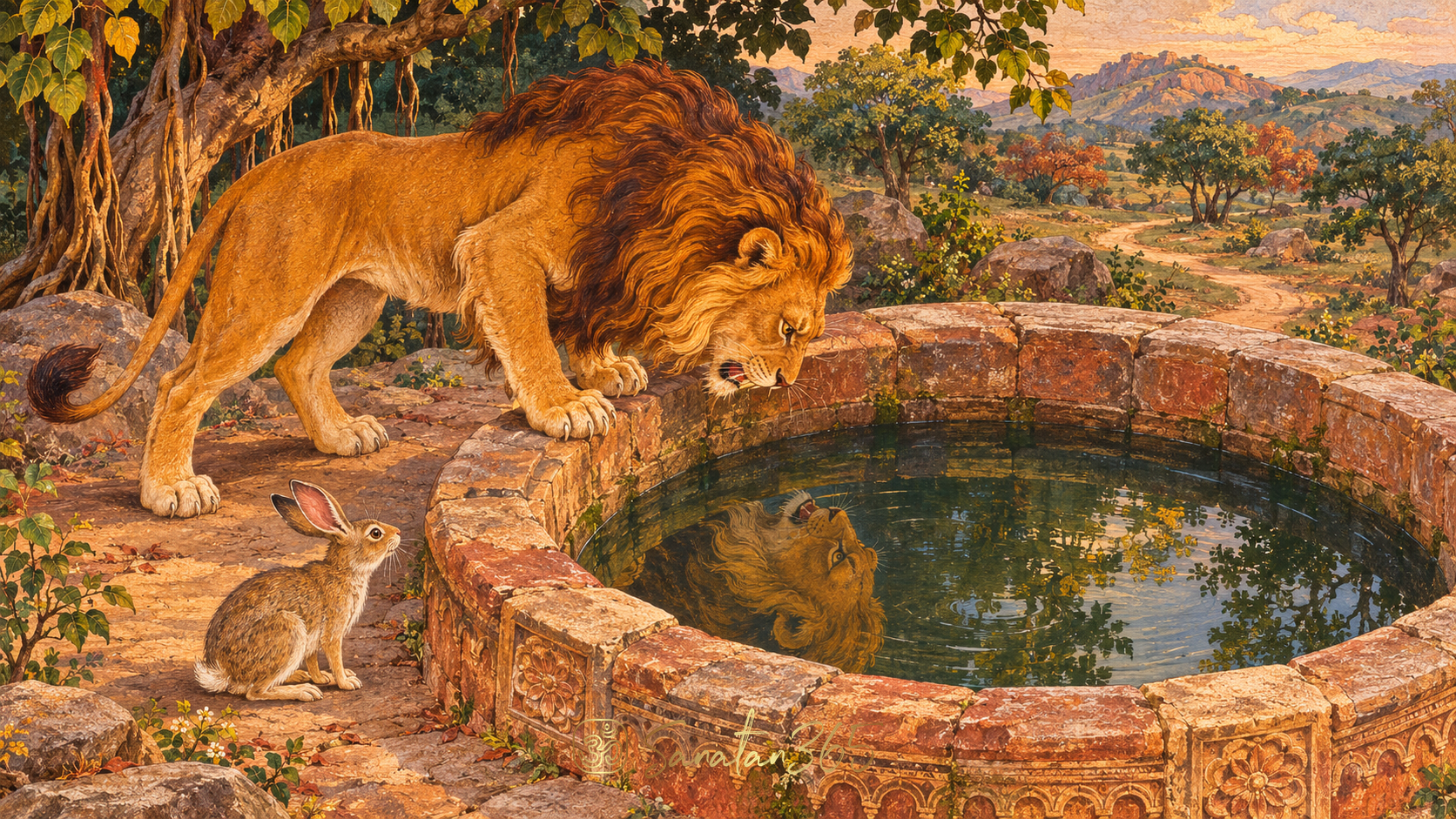
The rabbit leads the angry lion to a well. The lion sees its own reflection, roars, and hears the sound return. Believing a powerful rival is below, it leaps into the well and dies. The rabbit brings the news back to the other animals.
That brief outline contains the story’s main events without needing a graphic description of its ending. The threatened community matters as much as the rabbit’s personal escape. The danger is not simply that the lion might eat one creature; its unchecked violence has made ordinary life precarious for everyone.
The story is also told as “The Lion and the Hare.” Names and smaller details vary between versions. The University of Pittsburgh’s collected fable text preserves a related Panchatantra rendering in which the same well, reflected face and returning roar determine the outcome.
These variations are a reason to identify the version being discussed. A retelling need not combine every detail found in every edition. Here, Ryder supplies the principal narrative, while the university-hosted text confirms the familiar central mechanism.
The rabbit’s size gives the contrast immediate force. Direct physical confrontation would favour the lion. The rabbit survives by noticing something strength cannot settle: the difference between an appearance and an opponent.
A younger reader may first remember the small animal’s victory. An older reader can ask a second question: why was the powerful animal so willing to accept the explanation it was given? That question leads to the well before the lion ever looks inside it.
Key takeaway: The lion is overcome through a mistaken interpretation, not through a stronger attacker.
How does the rabbit prepare the lion to see a rival?
The rabbit does not begin by pointing at water. It first supplies a cause for delay and a threat to the lion’s standing. By the time the well appears, the lion has been encouraged to search for an insult and an enemy.
This sequence is important. The reflected face becomes convincing because it fits a story already accepted. The rabbit’s claim gives the lion a framework; the well seems to provide the missing confirmation.
In Ryder’s version, the exchange also includes warnings about the supposed enemy’s protected position and strength. These do not calm the lion. They draw it further into the confrontation it has decided it must pursue.
The following analysis is an interpretation of the fable’s construction. The lion’s central weakness is not an inability to see. It sees something real: a reflected image. Its weakness is the confidence with which it assigns the wrong cause to that image.
The same distinction can help a reader examine an ordinary misunderstanding. A delayed reply is real. The conclusion that it was intended as an insult is an additional judgment. A raised voice is audible. Its exact cause may still need to be understood.
These are contemporary examples, not incidents from the Panchatantra. They illustrate why separating an observation from its explanation can be useful. A conclusion does not become certain merely because it feels immediate.
The rabbit’s strategy depends on the lion failing to make that separation. The supposed challenge matters so much to the lion that the opportunity to verify it becomes secondary. The animal wants to answer the rival more urgently than it wants to establish whether the rival exists.
A thoughtful reading can therefore notice two kinds of movement. The characters walk toward the well, while the lion’s attention narrows toward one conclusion. The second movement prepares the first one’s disastrous result.
Key takeaway: The explanation arrives before the evidence, shaping what the lion expects to find.
Why do reflection and echo seem like evidence?
The well gives the lion two apparently connected experiences: a face that looks back and a roar that answers. To a reader, they expose the mistake. To the lion, they appear to confirm the rabbit’s account.
The reflection is especially effective because it resembles the very creature that feels challenged. The lion encounters its own appearance while expecting another lion. The returning sound then seems to give that apparent figure a voice.
This makes the well a strong narrative device. The rabbit does not have to invent a visible creature or produce a separate roar. The lion supplies both through its own presence and action. What appears to be independent confirmation is generated by the same source.
That observation offers a useful reading of the title’s reflection. The story is not merely warning against looking into water. It invites attention to the way an expectation can organize several experiences into one misleading account.
Consider a simple contemporary example. Someone reads a brief message as unfriendly, replies sharply, then receives a defensive response. The new response may seem to prove that the original message was hostile. Yet the person’s own sharp reply has helped shape what happened next.
The analogy has limits. Human conversations are more complicated than a fable, and another person’s intentions cannot be settled by one comparison. The example simply shows why a response produced by one’s own action is not always independent evidence for the first suspicion.
A pause creates room for a different question: what else could explain what is being seen or heard? In the well scene, that question has an obvious answer for the reader. In daily life, the answer may require more information and a willingness to remain uncertain.
The story’s dramatic clarity can make this habit memorable. Before answering the apparent rival, identify where the image and the sound actually come from. Strength cannot compensate for leaving that question unasked.
Key takeaway: A reflected image and returning sound can feel like separate confirmations while sharing a single source.
Does the rabbit’s victory make every deception wise?
The rabbit is not playing a harmless trick on an unsuspecting friend. It faces a creature whose violence threatens the whole forest. That setting matters when interpreting its conduct.
Admiring the rabbit’s resourcefulness does not require turning its method into a universal rule for ordinary relationships. The story’s survival setting should not disappear when its lesson is carried into a home, classroom or workplace.
Ryder’s surrounding dialogue also complicates a simple celebration of cleverness. After the tale, the speakers dispute what can safely be inferred from the rabbit’s success. The collection leaves room for discussion rather than supplying only a slogan about intelligence defeating strength.
A careful reader can therefore distinguish an outcome from a general principle. The rabbit’s plan works in the story. It does not follow that every act of deception is prudent, fair or harmless. The circumstances and the people affected still matter.
For everyday disagreement, a better extension of the fable is often the opposite of manipulation: make information clearer. Ask a direct question, describe what is known and leave space for correction. A lesson drawn from the lion’s failure need not reproduce the rabbit’s trick.
This distinction is particularly valuable when reading with children. The discussion can acknowledge both the rabbit’s danger and the limits of treating every clever success as permission. Intelligence is worth developing alongside responsibility for how it is used.
The monkey and crocodile story offers another situation in which a vulnerable character responds to danger through thought rather than force. Comparing the circumstances can be more useful than reducing both tales to an identical moral.
The point is not to remove the fable’s sharpness. Its unequal power and risky solution make it memorable. The point is to read its success with enough care that a specific survival strategy does not become careless advice about every human encounter.
Key takeaway: Appreciate the rabbit’s resourcefulness without making deception the default answer to ordinary problems.
How can this story teach a pause before reacting?
The most useful everyday question may be the one the lion fails to ask: “How do I know this explanation is correct?” It is a small question, but it changes the next step.
A practical reading exercise can separate three things:
- What happened: the observation that can be described without adding a motive.
- What is assumed: the explanation being attached to that observation.
- What could be checked: a respectful question or additional fact that might clarify matters.
For example, a task has not been finished when expected. That is an observation. “The other person wanted to embarrass someone” is an interpretation. Asking what delayed the work may reveal information that was not available at first.
The exercise is not a demand to ignore a real problem. Checking an explanation can lead to a firmer, more accurate response. Patience and decisiveness need not be opposites when the pause is used to understand what actually needs to be addressed.
Nor does the fable establish that every suspicion is mistaken. Sometimes a concern will be supported by evidence. The lesson is to avoid treating emotional force as a substitute for that evidence.
The three fishes Panchatantra story adds a useful companion question about timing: when should thought become action? Read together, the stories suggest that neither impulsive certainty nor endless delay deserves automatic praise.
A family discussion can begin with the well itself. Ask which part of the scene was real, which part was misidentified and which earlier claim made the mistake persuasive. These questions keep the lesson attached to the narrative rather than turning it into a vague instruction to “be wise.”
An adult reader can make the reflection more personal without treating every other person as a disguised rabbit. The useful task is to examine one’s own conclusion, not to become suspicious of everyone else’s motives.
The single lesson is to give an explanation a chance to be tested before reacting to it. In this fable, the lion never faces the rival it fears. It acts upon an account that has already made its own reflection look like an enemy.
Key takeaway: Pause long enough to distinguish what is observed from what is assumed, then respond to the facts that can be established.
FAQ
What is the moral of the lion and rabbit Panchatantra story?
The fable shows how intelligence can overcome greater physical strength. A closer reading also highlights the lion’s failure to test a claim before treating reflection and echo as evidence of a rival.
Was there really another lion in the well?
No. The lion sees its own reflection and hears its own roar return as an echo. The rival exists in the explanation the rabbit supplies, not as a second animal below the water.
Why is the animal called a rabbit in some versions and a hare in others?
English retellings use both terms, and names and smaller details differ between editions. The versions cited here retain the central sequence of delay, the claim of a rival and the mistake at the well.
Does the story advise people to deceive others?
That is too broad a conclusion. The rabbit’s strategy occurs under a serious threat in an animal fable. Everyday applications should consider context and responsibility; checking evidence is a useful lesson without making manipulation a normal habit.
About the author
Sanatan365 Editorial
Bringing Sanatan Dharma to modern seekers through authentic, scripture-grounded content.
Related in Lessons
 Lessons
The Heron and the Crab Story: When a Rescue Claim Needs Proof
In this Panchatantra tale, a heron promises to carry fish to safety. A crab discovers what the promise concealed by watching where the bird…
 Lessons
Four Friends Panchatantra Story: Why the Second Rescue Matters
The deer is free, but the story is not over. Follow the four friends as the tortoise needs a second rescue, and see how care becomes a coor…
 Lessons
Tortoise and Geese Story: Knowing When to Hold a Reply
A familiar Panchatantra fable asks a precise question: what happens when the wish to answer a crowd becomes stronger than the purpose frien…

