Mahamrityunjaya Mantra Meaning: Shiva, Fear, and the Prayer for Inner Freedom
A careful guide to the Mahamrityunjaya Mantra meaning, its Vedic source, word-by-word symbolism, and how devotees chant it with reverence.
The Mahamrityunjaya Mantra does not ask Shiva to make life painless. It asks for ripeness, release, and a fearless movement toward amritam, the deathless truth.
The Mahamrityunjaya Mantra meaning is a prayer to Tryambaka, the three-eyed Rudra-Shiva, for liberation from the bondage of mortality. Mahamrityunjaya (महामृत्युंजय, mahā-mṛtyuṃjaya) means "the great victory over death." In practice, devotees chant it for courage, healing of the heart, steadiness in fear, and remembrance that the Self is deeper than the body.
What is the Mahamrityunjaya Mantra meaning?
The mantra is widely known by its opening words, Om Tryambakam Yajamahe. It is associated with Rigveda 7.59.12 and also appears in Yajurveda recitation traditions, where it is addressed to Rudra, later worshipped by many devotees as Shiva. A careful summary of the Mahamrityunjaya Mantra meaning is: "We worship the three-eyed Lord, fragrant with grace and nourishing all life; may we be released from the bondage of death, like a ripe cucumber from its stem, but not from immortality."
Here is the commonly recited form:
Om tryambakam yajāmahe sugandhim puṣṭi-vardhanam urvārukam iva bandhanān mṛtyor mukṣīya mā'mṛtāt
This is not a slogan for escaping every difficulty. It is a Vedic prayer for mukti (मुक्ति, liberation), a softening of fear, and a mature relationship with impermanence. The image of a ripe fruit slipping naturally from the vine is central. Release is not violent. It is ripening.
Key takeaway: the mantra's deepest request is freedom from bondage, not a guarantee that ordinary human life will never face suffering.
Why is Shiva called Tryambaka in this mantra?
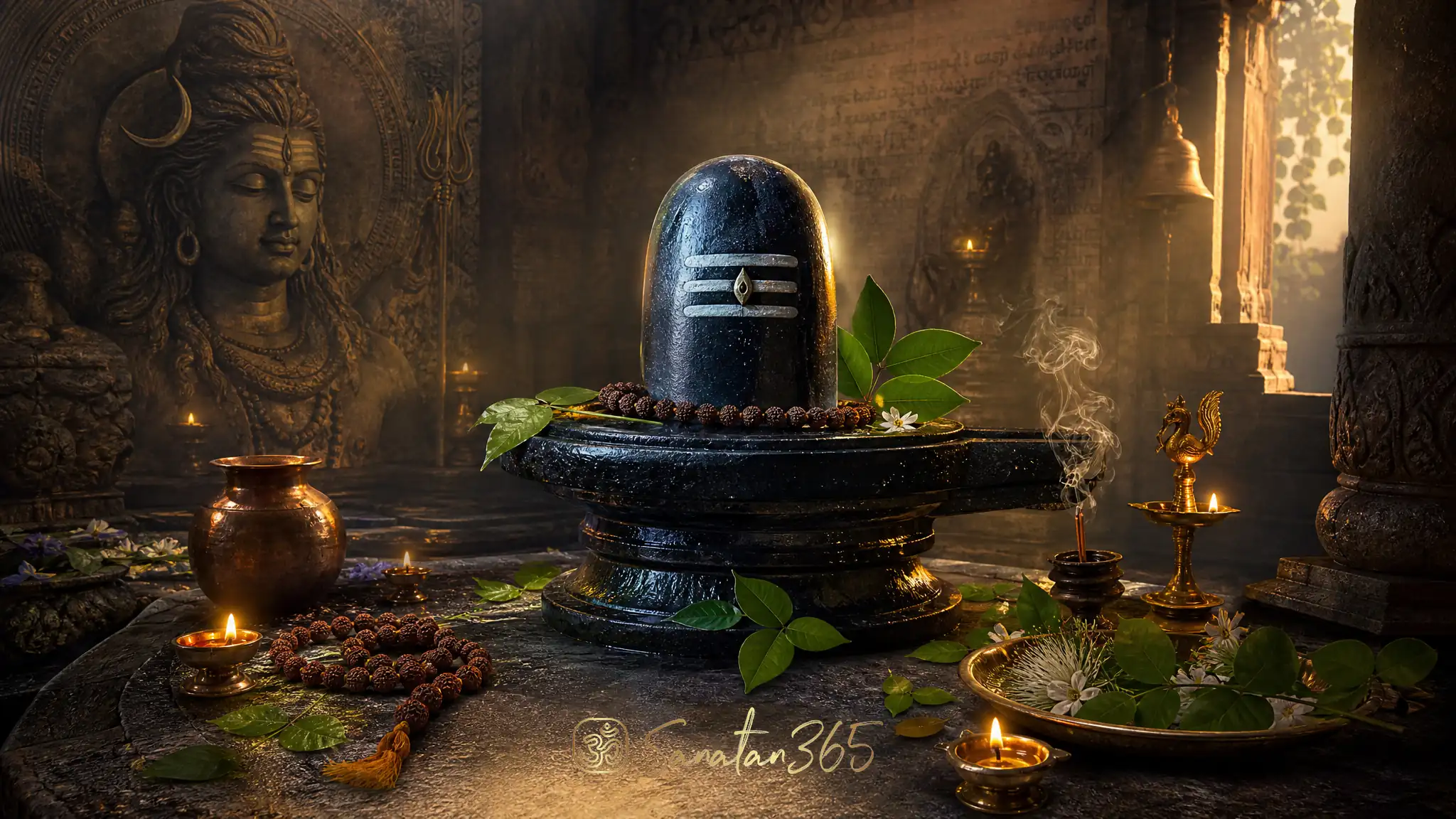
Tryambaka (त्र्यम्बक, tryambaka) is usually understood as "three-eyed one." In Shaiva devotion, the three eyes of Shiva point to more than physical iconography. They suggest a vision that sees the past, present, and future; the sun, moon, and fire; and the inner eye of jnana (ज्ञान, wisdom). Britannica's overview of Shiva notes the third eye as one of Shiva's defining features, linked to inward vision and transformative power. Britannica's entry on Rudra also identifies Rudra as one of the names of Shiva.
This matters because the mantra is not addressed to an abstract force alone. It is devotional, personal, and cosmic at once. The chanter turns toward Shiva as Rudra: fierce enough to dissolve fear, compassionate enough to nourish life, and subtle enough to reveal what the ordinary mind misses.
The word sugandhim (सुगन्धिम्, fragrant) is also important. Fragrance spreads without force. A flower does not argue for itself; its presence fills the air. In the same way, the mantra pictures the Divine as a life-giving presence that quietly strengthens the devotee from within.
Puṣṭi-vardhanam (पुष्टिवर्धनम्) means "the one who increases nourishment, fullness, or thriving." This is why the mantra is often loved in homes, temples, and moments of anxiety. It asks for strength without aggression, courage without hardness, and release without despair.
Key takeaway: Tryambaka is Shiva as the one whose inner sight cuts through fear and whose grace nourishes life.
What does each phrase of Om Tryambakam Yajamahe mean?
A word-by-word reading helps prevent vague or exaggerated interpretations. The following meanings are devotional and interpretive, not a replacement for learning Vedic chanting from a qualified teacher.
- Om: The sacred syllable used before many mantras, pointing toward the whole of reality.
- Tryambakam: The three-eyed one, Rudra-Shiva.
- Yajāmahe: We worship, revere, or offer ourselves toward.
- Sugandhim: The fragrant one, whose presence spreads quietly.
- Puṣṭi-vardhanam: The nourisher, the one who increases fullness and vitality.
- Urvārukam iva: Like a ripe cucumber, gourd, or fruit.
- Bandhanān: From bondage, attachment, or binding stem.
- Mṛtyor mukṣīya: May I be released from death.
- Mā amṛtāt: Not from immortality, or not from the deathless truth.
The phrase urvārukam iva bandhanān gives the mantra its emotional tenderness. It does not picture liberation as a dramatic escape. It pictures a natural separation when the fruit has ripened. That ripening can be read as spiritual maturity: fear loosens, clinging loosens, and the person becomes able to meet change without losing dharma.
The final phrase, mā amṛtāt, prevents a shallow reading. The prayer is not merely "save me from death." It is "release me from bondage to death, but keep me joined to amritam (अमृतम्, the deathless or immortal truth)." This makes the mantra a prayer for spiritual freedom, not a promise of physical invulnerability.
Key takeaway: the mantra moves from worship, to nourishment, to ripened release, to the remembrance of the deathless.
Where does the Mahamrityunjaya Mantra come from?
The mantra is traditionally linked to the Vedic world. It is commonly cited as Rigveda 7.59.12 and is also recited in Yajurveda contexts such as the Rudra tradition. Ved Mandir's reference page lists the mantra with Rigveda and Yajurveda references, while broader academic summaries connect Rudra with the later devotional form of Shiva.
For a general reader, the important point is simple: this is not a recent composition or a generic affirmation. It is rooted in the Vedic prayer tradition and carried forward through Shaiva worship, temple practice, household chanting, and guru-parampara (गुरु-परम्परा, teacher lineage).
Because Vedic mantras have sound, accent, and transmission disciplines, pronunciation deserves respect. Many families chant a familiar devotional form at home, while formal Vedic recitation may require learning from someone trained in that śākhā (शाखा, recensional tradition). Both reverence and humility matter.
This is also why the mantra should not be treated as a mechanical "benefit hack." In Hindu practice, mantra (मन्त्र, sacred sound formula) works with bhava (भाव, devotional feeling), shraddha (श्रद्धा, sincere faith), discipline, and ethical life. Sound is sacred, but the heart carrying it matters too.
There is also a useful distinction between reciting the mantra as prayer and studying it as text. Study asks: Where does this verse appear? What does each word mean? How has Rudra-Shiva been understood across time? Prayer asks a more intimate question: What fear am I carrying, and can I place it before Shiva with sincerity? A good devotional life allows both. The mind studies carefully so it does not invent meanings; the heart chants humbly so knowledge does not become dry.
Key takeaway: the mantra's authority comes from Vedic tradition, and its living power is preserved through reverent practice.
How do devotees chant the Mahamrityunjaya Mantra carefully?
Many devotees chant the Mahamrityunjaya Mantra during illness, grief, fear, transition, travel, or periods of inner heaviness. It is also recited in temples, during japa (जप, repeated mantra practice), and in Shaiva worship. But responsible practice avoids guaranteed claims. The mantra can support faith, steadiness, and devotion; it should not be presented as a substitute for medical care or practical responsibility.
A simple devotional approach:
- Sit cleanly and quietly, facing a home altar, Shiva linga, or peaceful direction.
- Begin with a short prayer to Shiva, asking for clarity and humility.
- Chant slowly, prioritizing steadiness over speed.
- If using a mala, a rudraksha mala is traditional in Shaiva practice. For deeper context, see Rudraksha Meaning: Shiva's Sacred Beads for Japa and Steady Practice.
- End with gratitude, silence, and a sankalpa (संकल्प, sacred intention) for courage and dharma.
Some chant 3, 11, 21, or 108 repetitions depending on family practice and time. The number is less important than sincerity, consistency, and correct spirit. For those unfamiliar with Sanskrit, listening to a reliable teacher and learning gradually is better than rushing.
The mantra also pairs naturally with other devotional practices. A person may offer light through Aarti Meaning: Why Hindus Offer Light in Worship, sit in quiet Dhyana Meaning: Hindu Meditation as Steady Awareness, Not Empty Escape, or simply repeat the mantra mentally during a difficult day.
For household practice, a gentle rhythm is often sustainable. A devotee might chant once after lighting a lamp in the morning, 11 times on Mondays, or 108 times during a chosen vrata (व्रत, sacred observance). Families may chant together for an elder, a child facing anxiety, or a loved one undergoing treatment, while still taking all practical steps needed in the world. In this balanced form, the mantra becomes a way of holding worry inside dharma rather than letting worry rule the home.
Key takeaway: chant with reverence, clarity, and humility; do not reduce the mantra to a superstition or guaranteed outcome.
Why does this mantra speak so strongly to modern life?
Modern life often hides death, aging, loss, and uncertainty behind constant distraction. The Mahamrityunjaya Mantra does the opposite. It brings mortality into sacred awareness without making it morbid. It teaches that fear can be met, not denied.
The mantra's psychology is subtle. It does not say, "Nothing bad will happen." It says, "May I ripen beyond bondage." This is a mature spiritual posture. The devotee is not asking to control every event. The devotee is asking to become inwardly free enough to meet life with courage.
This is why the mantra is meaningful for families, elders, seekers, and diaspora Hindus trying to preserve practice in busy environments. A few minutes of chanting can become a daily remembrance: the body is precious, life is temporary, and dharma must be lived now.
At the same time, the mantra keeps hope alive. Shiva as Mrityunjaya, the conqueror of death, does not merely stand at the end of life. He stands in every moment where fear begins to loosen. When the mind remembers the deathless, ordinary pressures lose some of their tyranny.
Key takeaway: the mantra is modern because fear is modern, but its answer is ancient: ripen, remember, and release.
FAQ
What is the simple Mahamrityunjaya Mantra meaning?
The simple Mahamrityunjaya Mantra meaning is a prayer to Shiva as Tryambaka, the three-eyed Lord, asking for nourishment, release from the bondage of death, and connection with amritam, the deathless truth.
Is the Mahamrityunjaya Mantra only for illness?
No. Many devotees chant it during illness or fear, but its meaning is wider. It is a prayer for inner freedom, courage, spiritual ripening, and release from clinging. It should not be used as a replacement for medical care.
Who is the deity of the Mahamrityunjaya Mantra?
The mantra is addressed to Tryambaka, commonly understood in Shaiva tradition as Rudra-Shiva. Rudra is a Vedic deity later closely identified with Shiva in Hindu worship.
How many times should the mantra be chanted?
Common devotional counts include 3, 11, 21, or 108 repetitions. The best count depends on one's tradition, capacity, and guidance. Correct attitude and steady practice matter more than display.
Can beginners chant Om Tryambakam Yajamahe?
Yes, beginners can chant with respect, especially in a simple devotional form. For formal Vedic recitation, accent, meter, and pronunciation are best learned from a qualified teacher.
Conclusion
The Mahamrityunjaya Mantra is not merely a famous Shiva mantra. It is a compact spiritual map: worship the three-eyed one, receive nourishment, ripen beyond fear, and remain joined to the deathless.
Key takeaway: to understand the Mahamrityunjaya Mantra is to see death not as a taboo, but as a doorway into deeper devotion, courage, and freedom.
About the author
Sanatan365 Editorial
Bringing Sanatan Dharma to modern seekers through authentic, scripture-grounded content.
Related in Mantras
 Mantras
Medha Suktam Meaning: A Vedic Prayer for Understanding
Explore the meaning of Medha Suktam, its prayer for clear understanding and memory, and ways to approach this Vedic hymn respectfully.
 Mantras
Bhaja Govindam Meaning: Devotion, Wisdom, and the Limits of Learning
Explore the meaning of Bhaja Govindam, its call to Govinda, and its reflection on learning, impermanence, and wise living.
 Mantras
Kanakadhara Stotram Meaning: Lakshmi, Compassion, and Prosperity
Kanakadhara Stotram praises Lakshmi through the image of her compassionate glance. Explore its Sanskrit meaning, traditional story, and res…

