Nachiketa Story: What the Katha Upanishad Teaches About Fear, Choice, and the Self
The Nachiketa story from the Katha Upanishad teaches courage before death, the difference between pleasant and truly good choices, and the search for Atman.
A child waiting at the door of Death may sound like a dark beginning, but the Nachiketa story is one of Hinduism's clearest teachings on courage.
The Nachiketa story comes from the Katha Upanishad, where young Nachiketa meets Yama, the lord of death, and asks what remains when the body falls away. The story teaches shreyas (श्रेयस्, the truly beneficial) over preyas (प्रेयस्, the merely pleasant), Atman (आत्मन्, the inner Self), and a steady way to face fear without denial. It is not a horror tale. It is a teaching story about truthfulness, patience, and spiritual discrimination.
Key takeaway: Nachiketa shows that the deepest questions should be met with steadiness, not avoidance.
Why does the Nachiketa story begin with a difficult question?
The Nachiketa story begins during a sacrifice performed by his father, Vajashravasa. In the Katha Upanishad, the father gives away cows that are old, weak, and no longer useful. Nachiketa sees the gap between the outer ritual and the inner spirit of dana (दान, sacred giving). A gift that looks generous but carries no living value troubles him.
So the child asks a sharp question: "To whom will you give me?" He asks again and again. In anger, his father says, in effect, "I give you to Death." The words are rash, but Nachiketa treats speech as sacred. If a vow has been spoken, he must honor it.
This first movement matters because the story is not only about death. It is about integrity before death becomes the subject. Nachiketa does not begin as a philosopher trying to win an argument. He begins as a child who notices that dharma (धर्म, sustaining right order) cannot be reduced to performance. Ritual must be joined with truth.
The Upanishads are concluding portions of the Vedas and became foundational for Vedanta traditions; Britannica notes their deep influence on later Hindu thought and their concern with the relation between the individual and the cosmos (Britannica, Upanishad). The Katha Upanishad uses a story, not an abstract lecture, because moral clarity is easier to remember when it has a face.
For a modern reader, Nachiketa's question is still uncomfortable: where are we performing goodness without offering anything real? It may be time, attention, charity, spiritual practice, family duty, or professional responsibility. The story asks whether the gift has life in it.
Key takeaway: Nachiketa's first teaching is that truthful attention matters before any spiritual claim is made.
What happens when Nachiketa meets Yama?
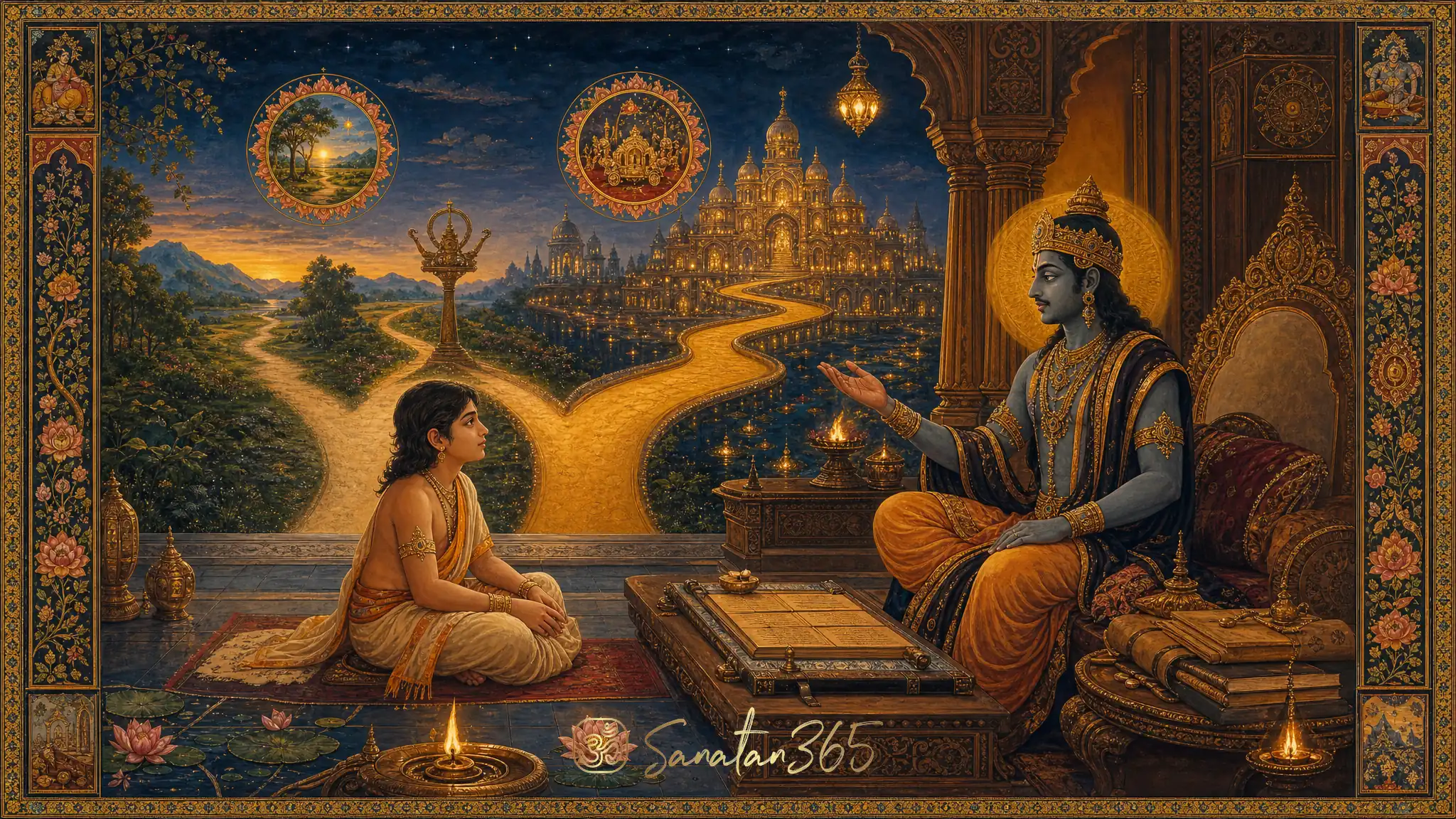
Nachiketa reaches the abode of Yama, but Yama is away. The boy waits for three nights without proper hospitality. In dharmic culture, a guest is not a small matter; the guest may be honored as atithi (अतिथि, one who arrives without a fixed date). When Yama returns, he recognizes the lapse and offers Nachiketa three boons.
The first boon is tender and practical. Nachiketa asks that his father be peaceful, free of anger, and able to welcome him back. Before asking cosmic questions, the child asks for family healing. This is important. Spiritual depth does not make ordinary relationships irrelevant. It should make them cleaner.
The second boon concerns a sacred fire ritual that leads to heavenly merit. Yama teaches it, and Nachiketa learns it with precision. In the Katha Upanishad tradition available through Wisdom Library's presentation of the text with Shankara's commentary, the work is organized as a dialogue between Nachiketa and Yama on Atman, Brahman, and moksha (मोक्ष, liberation) (Wisdom Library, Katha Upanishad).
The third boon is the heart of the story. Nachiketa asks: when a person dies, some say the person continues, others say not. What is the truth?
Yama does not answer immediately. He tests the boy. He offers long life, wealth, music, pleasure, chariots, power, and heavenly enjoyments. Nachiketa refuses. He sees that even the longest life ends, and pleasures lose their force. What he wants is not entertainment in front of the question. He wants knowledge that changes the way one lives.
This refusal is not hatred of life. It is clarity about proportion. Wealth has its place. Beauty has its place. Comfort has its place. But none of them can answer what the Self is. Nachiketa is not anti-world; he is anti-distraction.
Key takeaway: Nachiketa earns Yama's teaching by refusing to trade a real question for temporary comfort.
How does the Katha Upanishad explain Shreyas vs Preyas?
The Katha Upanishad's famous contrast is between shreyas and preyas. Shreyas means the good, the beneficial, the path that strengthens the soul even when it asks for discipline. Preyas means the pleasant, the immediately attractive, the path that may soothe or excite but does not necessarily free.
This is one reason the Nachiketa story stays relevant. Most modern dilemmas are not between obvious virtue and obvious harm. They are between something pleasant now and something better over time:
- Speaking sharply for relief, or speaking truthfully with restraint.
- Consuming endless noise, or sitting with a difficult feeling.
- Choosing status, or choosing inner steadiness.
- Performing devotion for appearance, or practicing with sincerity.
- Avoiding mortality, or letting mortality clarify what matters.
Yama's teaching does not require a person to reject ordinary life. It asks the seeker to rank things correctly. Preyas becomes dangerous when it pretends to be ultimate. Shreyas becomes possible when one can pause before desire and ask: will this make the mind clearer or more bound?
In Vedantic reading, this is viveka (विवेक, discernment). Viveka is not cold judgment. It is the warm intelligence that knows the difference between glitter and gold. For families, this can become a simple teaching for children: not everything wanted is worth choosing, and not everything difficult is bad.
The story also avoids fear-based spirituality. Yama is not shown as a monster hunting the living. He is a teacher of law, time, and consequence. Death, in this frame, is not merely an ending; it is also the boundary that reveals whether a life has been spent in wisdom or distraction.
Key takeaway: Shreyas vs Preyas is the daily practice of choosing what frees over what merely pleases.
What does Nachiketa learn about Atman?
Nachiketa's deepest question leads to Atman, the inner Self. In the Katha Upanishad, Atman is not the body, not the shifting mind, not social identity, and not a mood. It is the deeper principle of awareness that cannot be reduced to birth and death.
This teaching must be handled humbly. A blog article cannot compress the full depth of Upanishadic Vedanta into a slogan. Still, the story gives readers a doorway. If every pleasure changes, every fear changes, every role changes, and even the body changes, what is the witness of change? The Upanishadic seeker turns attention toward that witness.
This is why Yama's teaching is not a curiosity about the afterlife alone. It is practical while one is alive. A person who remembers Atman may still grieve, work, love, struggle, and make decisions. But the person is less likely to mistake every passing event for the whole truth of existence.
The Katha Upanishad also uses the chariot image. The body is compared to a chariot, the senses to horses, the mind to reins, the intellect to the charioteer, and the Self to the master of the chariot. This image gives a simple map of spiritual discipline. The senses are not enemies, but untrained horses can pull the traveler anywhere. The mind is necessary, but loose reins cannot guide. Buddhi (बुद्धि, discerning intelligence) must be awake.
For modern practice, this can become a daily reflection:
- What are my senses pulling toward today?
- Is my mind holding the reins, or dropping them?
- Is my intelligence choosing shreyas?
- Am I remembering the deeper Self, or only reacting as a role?
The Nachiketa story becomes powerful because it joins metaphysics with conduct. It says that the question "Who am I?" should change how one eats, speaks, spends, studies, prays, and loves.
Key takeaway: Atman is not an escape from life; it is the deeper center from which life can be lived more clearly.
How can modern families teach the Nachiketa story?
The Nachiketa story is especially useful for families because it respects young intelligence. Nachiketa is not treated as too small for a big question. He is young, but his sincerity is greater than the comfort of many adults around him.
For children, the story can be taught through three simple layers:
- Truthfulness: Nachiketa notices when a gift is not sincere.
- Patience: He waits for Yama for three nights without losing his purpose.
- Courage: He asks the hard question instead of accepting distractions.
For teenagers, the Shreyas vs Preyas frame is even stronger. It gives a Hindu vocabulary for choices around attention, peer pressure, digital habits, ambition, and self-respect. The teaching should not be used to shame pleasure. It should be used to build discrimination.
For adults, the story becomes a mirror. Many people postpone spiritual questions until crisis arrives. Nachiketa asks early. He does not wait until old age to wonder what cannot be bought, extended, or distracted away.
A home discussion can use five questions:
- What did Nachiketa see that others ignored?
- Why did Yama test him before teaching him?
- What are examples of preyas in our daily life?
- What are examples of shreyas that we avoid because they are harder?
- What does the chariot image say about our senses and mind?
This is also a good moment to connect the story with everyday sadhana (साधना, disciplined spiritual practice). A family might read a short passage, sit quietly for three minutes, chant a simple mantra, or share one shreyas choice each person will make that day. The point is not to turn the story into a school exam. The point is to let it enter the rhythm of life.
Key takeaway: Nachiketa gives families a language for courage, discernment, and sincere spiritual questioning.
Why does the Nachiketa story still matter?
The Nachiketa story matters because death is not only an event at the end of life. Small endings happen constantly: childhood ends, roles end, relationships change, certainty breaks, success fades, and the body keeps teaching impermanence. A culture that cannot speak about death becomes easily manipulated by distraction.
Nachiketa offers another way. He does not become gloomy. He becomes exact. He wants to know what is real enough to trust. Yama, as teacher, does not give him a cheap consolation. He teaches discrimination, discipline, and the Self.
That is why the story feels both ancient and modern. It belongs to the Katha Upanishad, but it also belongs wherever a person is tired of being entertained away from truth. The young seeker at Death's door is asking on behalf of everyone: What should I choose? What remains? What is worth a human life?
The answer begins simply. Choose shreyas when preyas tries to rule. Keep the mind trained. Let the senses serve, not govern. Honor relationships. Ask serious questions with humility. Remember that the Self is deeper than fear.
Key takeaway: Nachiketa matters because he turns mortality from a source of panic into a doorway for wisdom.
FAQ
What is the Nachiketa story about?
The Nachiketa story is about a young seeker in the Katha Upanishad who meets Yama, the lord of death, and asks what happens beyond death. The story teaches courage, truthfulness, Shreyas vs Preyas, and the search for Atman.
What does Shreyas vs Preyas mean?
Shreyas means the truly good or spiritually beneficial path. Preyas means the pleasant or immediately attractive path. Yama teaches Nachiketa that wise seekers choose Shreyas over Preyas when the two conflict.
Is Yama shown as frightening in the Katha Upanishad?
Yama is not mainly shown as frightening in this story. He appears as a dharmic teacher who tests Nachiketa and then teaches him about Atman, discipline, and liberation.
What is the main lesson of Nachiketa for daily life?
The main daily lesson is to choose what makes the mind clearer and the heart truer, even when distraction is easier. Nachiketa teaches sincere questioning, patience, and courage before life's deepest realities.
Can children learn the Nachiketa story?
Yes. The story is suitable for children when told gently. It can be framed around honesty, patience, courage, and making wise choices, without making death sound frightening or sensational.
The Nachiketa story leaves one clean instruction: do not waste the deepest questions on shallow answers.
About the author
Sanatan365 Editorial
Bringing Sanatan Dharma to modern seekers through authentic, scripture-grounded content.
Related in Stories
 Stories
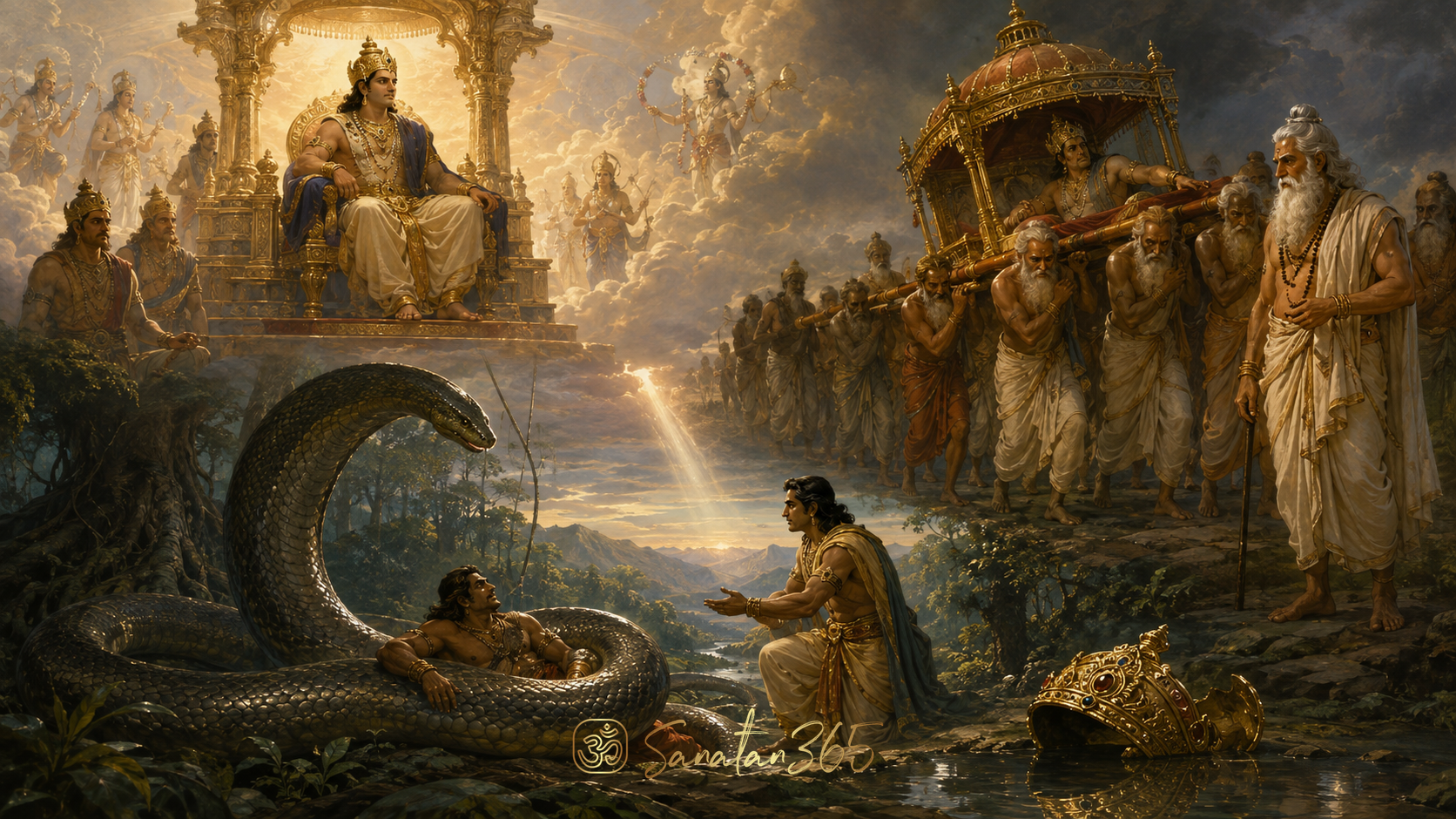
King Nahusha’s Story: Power, Pride, and the Return to Wisdom
King Nahusha rose from righteous earthly rule to the throne of heaven, then fell when power outran humility. His Mahabharata story explores…
 Stories
Trishanku Story: Ambition, Belonging, and the Wisdom of Limits
Explore the Ramayana story of Trishanku, Vishvamitra's extraordinary intervention, and what the image of a suspended heaven teaches about a…
 Stories
Mandodari in the Ramayana: Wise Counsel in Ravana's Court
Mandodari's story reveals the courage to speak dharma inside a powerful household, the limits of ignored counsel, and dignity amid grief.