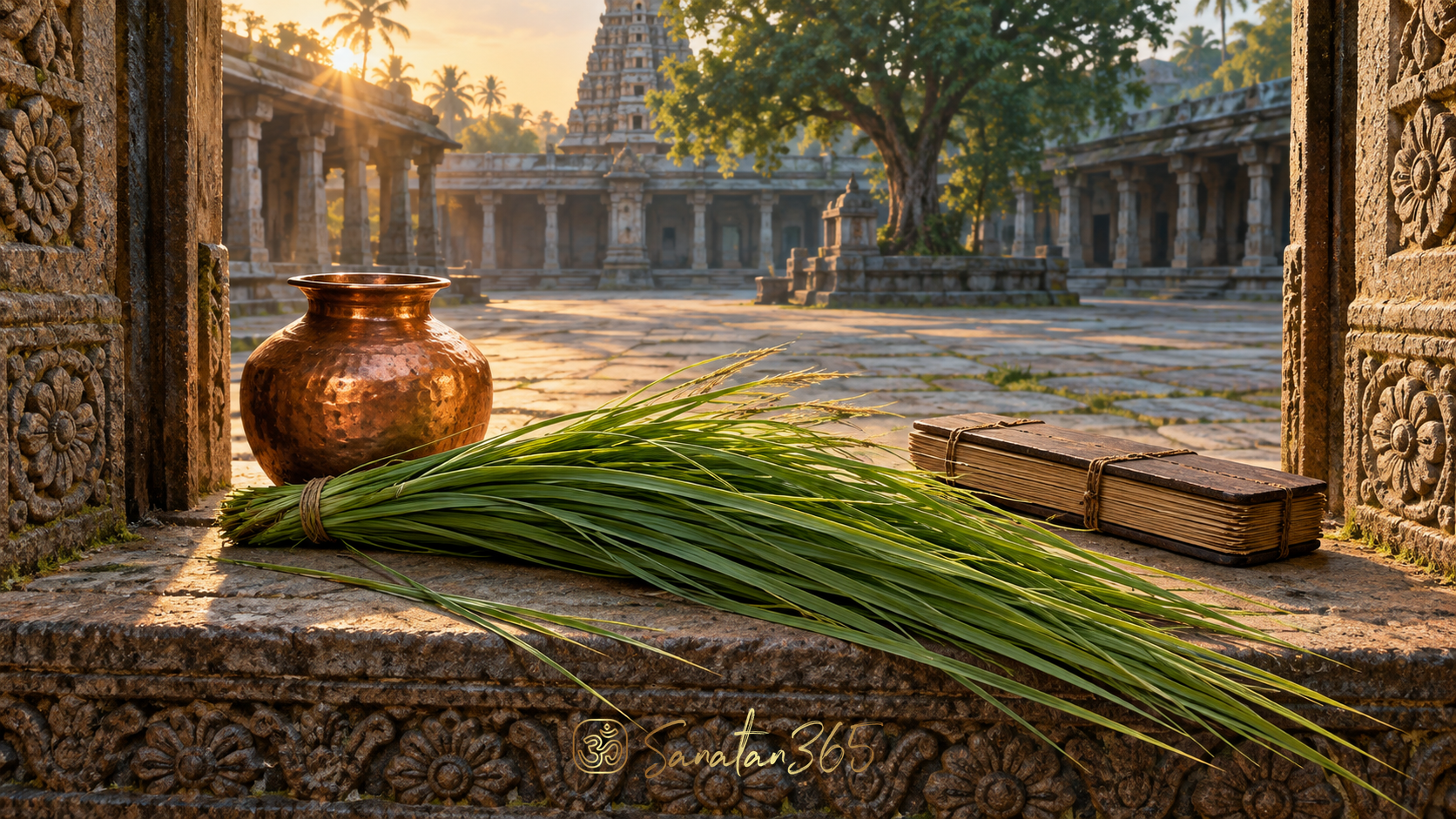
Kusha Grass Meaning: Why Darbha Has a Place in Hindu Rituals
Understand kusha or darbha grass, its traditional place in worship and ancestral rites, and how to approach varied customs with care.
A single blade of grass can mark a change in attention. In many Hindu rites, a small bundle of kuśa (कुश, sacred grass), also called darbha (दर्भ, ritual grass), makes an ordinary place ready for an intentional act.
The kusha grass meaning is not a promise that a plant has supernatural powers. Kusha is a traditional material used to prepare a seat, hold or offer water, and give physical form to ritual care. Ancient texts mention sacred grass in settings of meditation and ancestral remembrance; households and ritual lineages use it differently. The meaning lies as much in the discipline of preparing and handling it as in the material itself.
Kusha Grass Meaning in Hindu Tradition
Kusha is a name used in Sanskrit religious literature for a grass employed in ritual practice. Darbha is another familiar name, especially in South Indian usage. Modern botanical identification can be complex because vernacular names and local sourcing vary; a reader should not assume that every grass sold under either name has the same botanical identity. For a particular rite, the relevant family or officiating tradition is a better guide than a generic online photograph.
The Bhagavad Gita gives one of the most accessible textual references. In its teaching on meditation, Krishna describes preparing a firm seat with kuśa grass, a deerskin, and a cloth, in a clean place, neither too high nor too low (Bhagavad Gita 6.11). The verse is about establishing a stable setting for disciplined attention. It does not prescribe that every modern meditator must recreate every historical material in order to practice sincerely. A contemporary reader can understand the underlying care: choose a suitable, clean, steady place and sit with purpose.
Grass is modest. It is not the central deity, the prayer, or the inner aim. Its presence instead marks an ordered threshold between casual activity and a rite undertaken deliberately. That distinction helps explain why even a small piece may matter. Ritual objects do not have to be expensive to be meaningful; their value depends on how they are situated within a tradition of practice. The distinct custom of offering durva grass to Ganesha shows how another grass has its own context; the two should not be conflated.
The Sanskrit term pavitra (पवित्र, pure or purifying) is sometimes used for a ring or implement made of darbha in particular rites. The exact form and use of such an implement vary by region and lineage. Translating pavitra simply as a magical filter would distort its ritual meaning. In context, it is part of a disciplined pattern of preparation, not a substitute for the intention and prayers of the participant.
Key takeaway: Kusha is a modest but meaningful ritual material whose role comes from a particular practice and its inherited discipline, not from a universal claim about the grass itself.
Why Is Kusha Grass Used in Hindu Rituals?
Rituals often use natural materials to make an invisible intention visible. Water can signify offering or cleansing; a lamp can gather attention around light; grass can define a seat or help shape an offering. Kusha serves this material language in several settings. Its straight blades and simple form lend themselves to deliberate placement, but texts and communities, not physical appearance alone, give the act its meaning.
The Gita's meditation verse provides a good example of restraint in interpretation. Krishna's instruction addresses the construction of a seat as one element of sustained practice (Bhagavad Gita 6.11–12). The seat is not presented as a shortcut to insight. It supports the posture and focus of the practitioner. Reading the passage this way avoids two opposite mistakes: dismissing the grass as meaningless decoration, or claiming that possession of it guarantees a spiritual result.
A related idea is śauca (शौच, cleanliness or purity), an ethical and practical principle discussed in yoga traditions. In ritual settings, cleanliness includes the environment, materials, and conduct. It does not mean that a person's worth depends on access to a specific object. Some families may have access to properly prepared darbha; others may not. A lack of one material should never be used to shame a worshipper or to claim that devotion is invalid.
Sacred materials also help transmit memory. A child watching an elder carefully set out grass, water, and a vessel sees that worship is not a hurried performance. Preparation has a rhythm. When the elder explains what the material signifies, an apparently small action becomes a lesson in attention, humility, and continuity. That lesson is not limited to the species of plant; it is part of the human act of making time and space for worship. The broader rhythm of daily home worship offers another example of deliberate preparation.
These meanings should be held alongside the diversity of Hindu practice. Not every pūjā (पूजा, act of worship) includes kusa or darbha. Some rites rely on other leaves, flowers, water, or no plant material at all. A general article can explain the pattern, but it cannot replace the instructions for a particular ceremony.
Key takeaway: Kusha helps organize attention and preparation in some Hindu rites; its use is contextual, never a measure of a person's devotion.
How Is Kusha Grass Used in Worship and Ancestral Rites?
A meditation seat is the clearest scriptural example for many readers. The Gita's āsana (आसन, seat or posture) is set in a clean place and prepared to support a steady mind. A present-day meditation space might look very different, yet the passage still asks a practical question: have we made room for sustained attention? The text's physical detail should lead toward its spiritual purpose, rather than become an object of anxiety.
In worship, darbha may be arranged near vessels of water, held during a prescribed action, or fashioned into a ring in traditions that call for it. Those are examples, not a universal sequence. A household rite led by a family elder can differ from a temple ceremony; regional manuals can differ from one another. Even the direction in which blades are placed may have a specific meaning in one tradition and no prescribed role in another. Anyone performing a formal rite should follow the instructions of the tradition responsible for that rite, not improvise from a short article.
Ancestral remembrance is another setting in which ritual grass appears. The Rig Veda's ancestral hymns refer to the forebears seated upon the sacrificial grass, including the invocation at Rig Veda 10.15.3. The image links hospitality, offering, and remembrance in a Vedic ritual world. Later śrāddha (श्राद्ध, rites of reverent remembrance for ancestors) practices developed in varied ways, and many employ darbha. It would be inaccurate to claim that a single Vedic verse describes every later family custom. The safer connection is thematic: prepared sacred grass belongs to a long history of respectfully making a place for remembrance.
That history can be emotionally significant. For someone remembering a parent or grandparent, the grass is not the point of the rite; love, gratitude, and duty are. The material helps give these commitments a careful shape. It can make a fleeting intention visible through a deliberate action. It is also why sensational claims about what the grass supposedly does to the deceased miss the moral heart of remembrance.
A practical distinction helps: a text may mention a material, a manual may prescribe its handling, and a family may carry a custom. These are related but not identical kinds of authority. A reader can honor all three without flattening them into one rule. When uncertain, ask the family elder or officiant which action is intended and why. A good explanation should increase understanding, not fear.
Key takeaway: Kusha can shape meditation, offerings, and ancestral remembrance, but the precise procedure belongs to the rite and lineage in which it is used.
How Should a Beginner Approach Kusha Grass?
Start with the purpose of the rite. Is the grass being used to prepare a seat, to accompany a water offering, or for a formal ancestral ceremony? The answer changes what guidance is relevant. There is no responsible one-size-fits-all instruction to cut, tie, point, or place blades for every Hindu household. A beginner can learn the names and meanings first, then seek rite-specific instruction from a trustworthy elder or officiant.
If a practice calls for darbha, obtain it through a reputable local source rather than taking plants from a protected site or assuming that any roadside grass is suitable. Handle it cleanly and respectfully. Local customs may specify whether it should be fresh or dried, how it is stored, and how it is disposed of afterward. These details are part of living traditions and can differ. A thoughtful question to ask is: “What does our family or temple practice require, and what does this action signify?”
Distinguish spiritual meaning from medical or scientific claims. Online descriptions sometimes say that darbha absorbs radiation, sterilizes water, or cures illness. Such claims should not be repeated as facts without reliable evidence, and they are not needed to explain the grass's religious significance. A practice can be valuable because it cultivates attention, memory, and reverence. It does not need a laboratory-sounding justification to deserve respect.
There is also an ecological dimension. A sacred material should not be an excuse for wasteful harvesting. Communities can preserve the integrity of ritual while sourcing responsibly and using only what is needed. This is a practical expression of care, not a claim that every traditional text specifies a modern environmental policy. The point is simple: reverence for a material should include care for the living world from which it comes.
For a reader without access to darbha, the Gita's meditation passage still offers guidance: prepare a clean, stable place and bring the mind back to its purpose. For a formal rite, ask the person qualified to guide it about appropriate alternatives; do not assume one. In both cases, understanding begins with humility. The grass is a teacher of attentiveness only when we resist turning it into either a superstition or an empty prop.
Key takeaway: Learn the purpose and local rule before using kusha; practice respectfully, source responsibly, and avoid unsupported claims about its physical effects.
FAQ
What is the difference between kusha and darbha grass?
Kusha and darbha are names used for sacred ritual grass in Sanskrit and regional Hindu contexts. Usage and botanical identification can vary locally. For a formal rite, use the name and material specified by the relevant family or officiating tradition rather than assuming all labelled grasses are interchangeable.
Does the Bhagavad Gita require kusha grass for meditation today?
Bhagavad Gita 6.11 describes a meditation seat prepared with kusa grass as part of a clean, steady setting. The passage teaches disciplined preparation; it should not be turned into a claim that meditation is impossible without that historical material. Follow an appropriate teacher or tradition for a specific practice.
Why is darbha used in ancestral rites?
Some ancestral rites use darbha to help prepare and structure offerings made with reverence. Vedic ancestral hymns include an image of forebears seated on sacrificial grass (Rig Veda 10.15.3), while later rites differ by region and lineage. The material supports remembrance; it does not replace gratitude or duty.
Can any grass be substituted for kusha?
Not automatically. Names, materials, and ritual instructions vary. For a formal ceremony, ask a knowledgeable elder or officiant what is prescribed and whether an alternative is acceptable in that context.
Does kusha grass have proven healing powers?
This article makes no medical claim for kusha. Its established relevance here is religious and cultural. Claims that it cures illness or changes physical exposure should be evaluated independently against reliable evidence, not inferred from its ritual use.
The simplest way to read the tradition is also the most demanding: take preparation seriously without confusing a material with the goal of worship. Kusha grass is small, but the care with which it is placed can make a moment of prayer, meditation, or remembrance more deliberate. Its meaning is neither spectacle nor guarantee. It is an invitation to give attention a form.
Key takeaway: Kusha matters where a tradition uses it to make reverence tangible; the enduring practice is thoughtful attention.
About the author
Sanatan365 Editorial
Bringing Sanatan Dharma to modern seekers through authentic, scripture-grounded content.
Related in Practices
 Practices
Bhuta Shuddhi Meaning: Purifying the Five Elements Within
Bhuta Shuddhi means the purification of the five elements: earth, water, fire, air, and space. In Hindu yogic and Tantric traditions, it is…
 Practices
Likhita Japa: Meaning and Practice of Writing a Mantra
Likhita japa turns mantra repetition into a written devotional discipline. Learn its meaning, how it differs from spoken and mental japa, a…
 Practices
Surya Arghya Meaning: Why Water Is Offered to the Rising Sun
Learn the meaning of Surya Arghya, why devotees offer water to the rising sun, and how to approach this daily Hindu practice with gratitude…

