Likhita Japa: Meaning and Practice of Writing a Mantra
Likhita japa turns mantra repetition into a written devotional discipline. Learn its meaning, how it differs from spoken and mental japa, and how to begin with attention and respect.
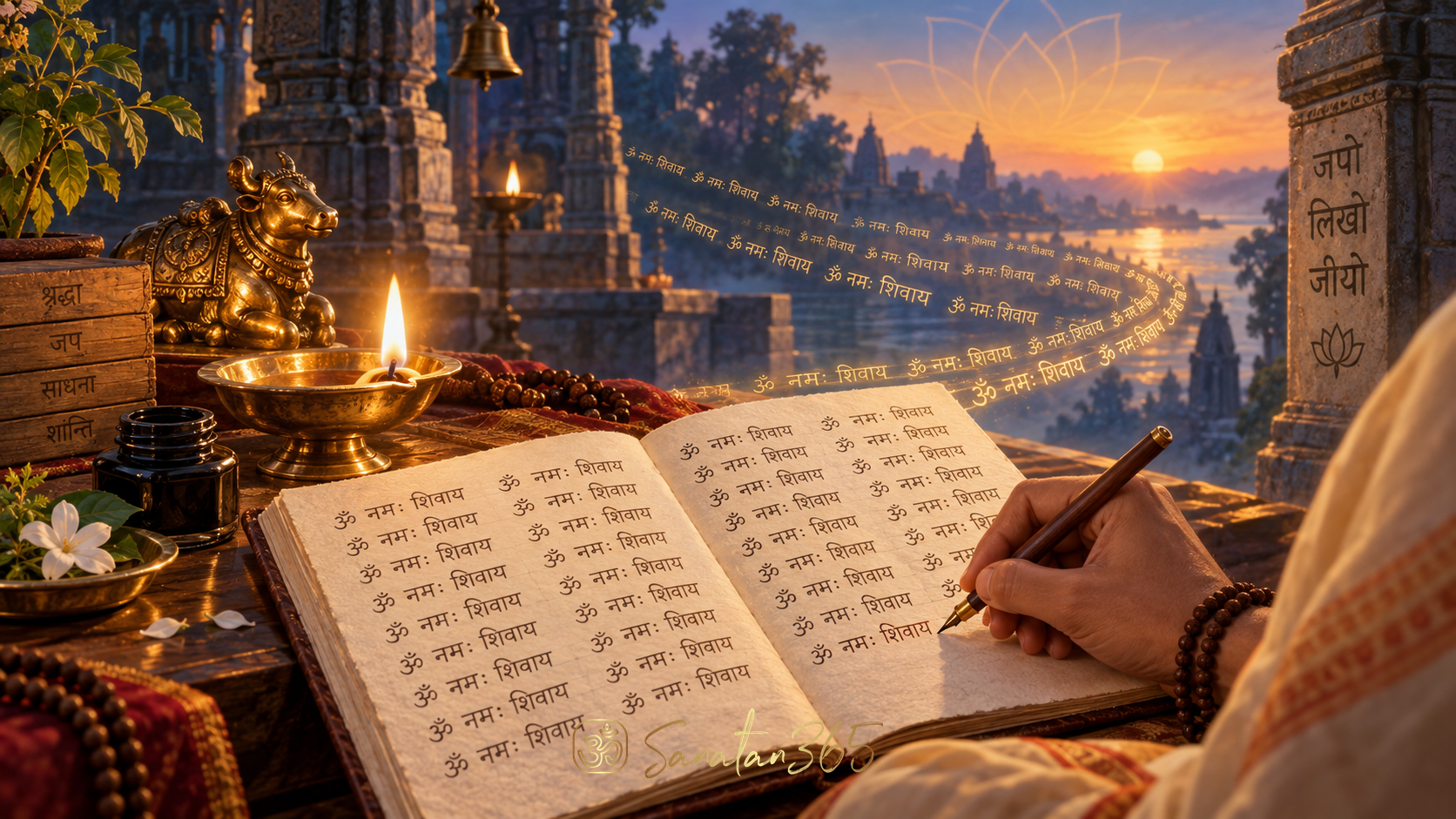
A mantra can be heard, whispered, remembered—and written. Likhita japa is the devotional practice of repeatedly writing a mantra or the Divine Name while keeping its meaning and sacred presence in awareness. The Sanskrit-derived phrase joins likhita (लिखित, written) with japa (जप, repeated remembrance or recitation). Instead of treating handwriting as clerical work, the practice gathers the eyes, hand, posture, and mind around one act of remembrance.
This makes likhita japa both simple and demanding. Anyone can fill a page with repeated words; the spiritual discipline begins when each line is written with attention, reverence, and bhava (भाव, devotional feeling or inner attitude). It is not a contest to accumulate the largest number of pages. Its purpose is to make remembrance steadier and less divided.
What is likhita japa?
Likhita japa, also written as likhita japam or likita japa in different transliterations, means repeating a mantra in writing. A practitioner chooses one mantra or Divine Name and writes it carefully, usually in a dedicated notebook. The hand forms the letters, the eyes follow them, and the mind returns to the mantra's meaning.
The practice belongs to the wider discipline of japa meditation, in which a sacred formula is repeated with regularity. Japa may be spoken aloud, whispered, repeated mentally, or supported by a japa mala. Likhita japa adds writing as its distinctive instrument.
Swami Sivananda's Divine Life Society teaching on Japa Yoga describes mantra writing as a means of concentrating the mind. A Sivananda Yoga Vedanta Centre explanation similarly presents it as a practical form of meditation in which repeated writing directs attention toward the mantra. These are teachings within particular modern yoga lineages, not claims that every Hindu community follows one identical method.
The written line matters because it leaves a visible trace of attention. If the mind drifts, irregular letters and skipped words often reveal that drift. The page does not condemn the practitioner; it quietly invites a return.
Key takeaway: Likhita japa is not ordinary copying. It is mantra remembrance expressed through deliberate handwriting.
How is written mantra repetition different from spoken or mental japa?
All forms of japa share a centre: repeated remembrance. Their practical textures differ.
- Vaikhari japa uses an audible voice. Sound, pronunciation, and hearing support attention.
- Upamshu japa is softly whispered or murmured, often with minimal lip movement.
- Manasika japa takes place mentally, without audible speech.
- Likhita japa forms the mantra in writing, coordinating sight, movement, and thought.
These forms need not compete. A person may find audible repetition helpful at one time and written repetition helpful at another. Some lineages combine quiet recitation with writing; others recommend silence so that the written form receives full attention. If a mantra has been received through diksha (दीक्षा, formal initiation), the practitioner's teacher or lineage should guide how it is used.
Writing naturally slows repetition. That slowness can be useful. Spoken words sometimes outrun awareness; a pen cannot move quite so quickly. Each letter asks for a small act of presence. Yet slowness alone does not make the practice deep. Writing while watching a screen, rushing to finish a quota, or ignoring the mantra's sense can turn a contemplative discipline into a mechanical task.
Mental japa is physically unobtrusive and can accompany many parts of a day. Likhita japa usually asks for a protected place, a writing surface, and a defined period. Its boundaries are part of its strength: the notebook is opened, attention is offered, and the session is consciously completed.
There is also a practical accessibility point. People differ in mobility, eyesight, literacy, and comfort with particular scripts. Sacred attention is not measured by calligraphy. A person may write in Devanagari, Tamil, Telugu, Bengali, Gujarati, Roman transliteration, or another script they can use accurately. Those for whom handwriting is painful or inaccessible can practise another form of japa without considering it spiritually lesser.
Key takeaway: Written japa engages attention through visible, physical repetition, while spoken and mental japa use different supports for the same devotional remembrance.
Why do the hand, eyes, and mind matter together?
Likhita japa gives several faculties one shared direction. The eyes see the mantra. The hand shapes it. The mind recalls it. When devotional feeling is present, the heart's intention joins them.
This coordination is sometimes described as an antidote to scattered attention. The claim should be understood spiritually and practically, not medically. Likhita japa is a devotional discipline; it is not a treatment for an attention disorder, anxiety, or any other health condition. Its value lies in creating a structured act of remembrance.
The page also teaches honesty. Three common tendencies become visible:
- Rushing: letters shrink or merge because completion has replaced devotion.
- Drifting: the hand continues while the mind is elsewhere.
- Possessing: the number of pages becomes a source of comparison or pride.
The response is not harsh self-judgment. It is a quieter correction: pause, recollect the meaning, and begin the next line carefully.
Bhava is crucial here. It may be love for a chosen form of the Divine, gratitude, surrender, reverence, or the wish to make speech and action more truthful. The same written mantra can carry a very different quality when the practitioner remembers what it signifies.
This is why neatness should serve attention rather than vanity. Orderly writing can help the mind settle, but decorative perfection is not the goal. A page written slowly with sincere recollection may be more faithful to the practice than an ornate page produced mainly for display.
The notebook can also become a record of constancy. Unlike a streak counter, it need not pressure the practitioner. It simply shows that remembrance was given time. Missing a day does not invalidate earlier practice; returning without drama is itself part of discipline.
Key takeaway: The hand, eyes, and mind matter because likhita japa gathers them into one repeated offering, making both attention and distraction easier to see.
How can a beginner practise likhita japa respectfully?
A beginner does not need an elaborate setup. A clear intention and a sustainable rhythm matter more than quantity.
1. Choose one appropriate mantra
Use a mantra or Divine Name already familiar within the practitioner's family, tradition, or guidance. If pronunciation, spelling, initiation, or ritual restrictions are uncertain, ask a qualified teacher. Do not copy an unfamiliar mantra merely because it appears powerful online.
For a public, non-initiatory practice, many people choose a familiar Divine Name. The aim is not to collect formulas. Staying with one appropriate mantra allows meaning and attention to deepen.
2. Learn the wording and meaning
Write the mantra accurately at the front of the notebook. Note a simple, trustworthy meaning if helpful. For longer mantras, verify spelling from a lineage or reliable publication before repeating an error across many pages.
Meaning protects practice from becoming empty pattern. It also helps the practitioner notice when attention has separated from the words.
3. Prepare a clean place
Sit comfortably at a stable surface. Keep the notebook and pen used for this practice clean. A small diya or image of the chosen deity may support devotion, but neither is compulsory. If a sacred image or lamp is used, observe ordinary fire safety and household customs.
Take a moment for sankalpa (संकल्प, a clear sacred intention): perhaps, “May this writing become an offering of steady remembrance.” Avoid transactional promises that make the Divine sound like a bargain.
4. Write for a modest period
Begin with ten minutes or one page rather than a heroic target. Write at a pace that allows each word to be seen. Some practitioners repeat the mantra inwardly as they write; others rest attention on its form and meaning. Follow the method suited to the tradition being practised.
Counting lines or pages is optional. If counting creates pressure, use time instead. If a vow includes a particular count, clarity and honesty matter more than hurried completion.
5. Close the session deliberately
Finish the current line rather than stopping midway. Read one written repetition slowly. Offer the practice inwardly and close the notebook with care. The conclusion can be brief; what matters is that the sacred exercise is not dropped like an interrupted chore.
6. Let conduct carry the mantra
Written repetition should not remain isolated from life. If the mantra invokes compassion, truth, courage, or surrender, the next test is conduct. A calm notebook beside careless speech is an invitation to integrate practice more deeply.
Consistency is better than strain. A person who writes half a page with attention three times a week may build a more durable discipline than someone who writes many pages once and abandons the practice.
Key takeaway: Begin with one verified mantra, a clean notebook, a modest session, and an intention that connects repetition with daily conduct.
How should completed mantra notebooks be treated?
Pages filled with a mantra are commonly treated respectfully because they bear a sacred name or formula. Customs vary across families, temples, and lineages, so there is no single universal disposal rule.
The simplest approach is to keep completed notebooks in a clean, elevated place near other spiritual books. Do not place food, footwear, or casual clutter on top of them. If many notebooks accumulate, ask a local temple or trusted teacher about the customary method in that community.
Avoid casually throwing sacred writing into household rubbish. At the same time, avoid environmentally harmful improvisations. Burning, burying, or placing paper in a river may be customary in some settings, but local rules, fire safety, ink composition, and environmental responsibility matter. Respect for sacred text should not become disrespect for shared land and water.
Digital mantra writing raises a related question. Typing can support repetition, but it lacks some of handwriting's deliberate physical rhythm and creates uncertain questions about deletion and display. A tablet stylus may preserve more of the hand-eye movement. Still, traditional likhita japa generally centres on writing by hand. A practitioner adapting the form should do so consciously, not merely because a device makes large counts easier.
Photographing or posting completed pages is also a matter of intention. Sharing may encourage a community practice; it may also turn private devotion into performance. Before posting, ask whether the action serves remembrance or recognition.
The notebook's dignity comes from what it represents, not from expensive paper. An ordinary, clean book used sincerely is sufficient.
Key takeaway: Keep mantra notebooks clean and respected, and seek local guidance for their eventual care without harming the environment.
What keeps likhita japa from becoming mechanical?
Repetition always carries the possibility of habit without presence. Likhita japa meets that risk through periodic recollection.
At the start of each page, pause for one breath and recall the mantra's meaning. At the end, notice one quality the practice asks to embody. If attention repeatedly disappears, reduce the page target. If pride in numbers appears, stop displaying the count. If the chosen mantra feels unclear, return to reliable guidance rather than adding more formulas.
Variation can refresh attention without constantly changing the mantra. One day, focus on accurate letter formation. Another day, dwell on meaning. On another, offer each line for the well-being of others without claiming guaranteed outcomes. The object remains the same; the quality of attention becomes more awake.
Silence around the practice can also be valuable. The discipline of mauna shows that restraint is not emptiness but a way of making speech and attention more deliberate. A short quiet period before writing may help the mantra arrive on the page with less inner noise.
Most importantly, the practice should soften self-importance rather than enlarge it. Pages are not spiritual currency. They cannot purchase grace, guarantee a result, or establish superiority over another devotee. They are evidence only of time offered—and an invitation to live the mantra more honestly.
Key takeaway: Meaning, humility, and ethical follow-through keep repeated writing from becoming a mere tally.
Conclusion
Likhita japa gives devotion a visible rhythm. Line after line, the practitioner returns the moving hand and wandering mind to one sacred remembrance. Its discipline is not found in speed, decoration, or impressive totals, but in the quality of the return.
For beginners, the wisest start is modest: one appropriate mantra, one dedicated notebook, a few quiet minutes, and careful attention to meaning. Over time, the page can become a mirror of constancy—never a scorecard, always an offering.
Key takeaway: The deepest measure of likhita japa is not how many times a mantra is written, but how sincerely its meaning begins to shape attention and conduct.
FAQ
What does likhita japa mean?
Likhita japa means written mantra repetition. Likhita (लिखित) means “written,” while japa (जप) refers to repeated remembrance or recitation of a mantra or Divine Name.
Is likhita japa different from japa with a mala?
Yes. Mala japa uses beads to support spoken, whispered, or mental repetition. Likhita japa uses handwriting, sight, and the written page. Both belong to the wider family of japa practices.
Which mantra should a beginner write?
A beginner should use a familiar, appropriate mantra or Divine Name from their family or tradition. If a mantra requires initiation or its spelling is uncertain, guidance from a qualified teacher is best.
How many times should a mantra be written?
There is no universal number for every practitioner. A lineage or vow may specify a count, but beginners can start with ten minutes or one page, keeping attention and accuracy ahead of quantity.
Can mantra writing be done digitally?
Typing can support repetition, and a stylus preserves some hand movement, but traditional likhita japa is usually handwritten. Any digital adaptation should preserve reverence and attention rather than optimize only for speed or count.
About the author
Sanatan365 Editorial
Bringing Sanatan Dharma to modern seekers through authentic, scripture-grounded content.
Related in Practices
 Practices
Upasana Meaning: Why Worship Is a Practice of Drawing Near
Upasana means drawing near to the Divine through sustained attention. Explore how sacred symbols, daily worship and inward recollection bel…
 Practices
Shaucha Meaning in Yoga: Cleanliness Without Harsh Purity Rules
Explore shaucha as a yogic observance: its scriptural setting, outer and inner dimensions, daily practice, and why cleanliness must never b…
 Practices
Kusha Grass Meaning: Why Darbha Has a Place in Hindu Rituals
Understand kusha or darbha grass, its traditional place in worship and ancestral rites, and how to approach varied customs with care.

