Om Vasudhare Swaha Mantra: Meaning, Variants, and Respectful Practice
A careful guide to Om Vasudhare Swaha, its Buddhist Vasudhara context, Sanskrit and transliteration variants, devotional meaning, respectful recitation, and realistic expectations.
A three-word chant is often marketed online as if it were a spiritual cash machine. The Om Vasudhare Swaha mantra deserves a more truthful introduction: it is a short Buddhist invocation associated with Vasudhara, a goddess of abundance whose imagery joins material support with learning, generosity, and spiritual flourishing. It may be recited as an act of devotion and ethical intention, but no responsible tradition can promise that chanting will produce money, cure hardship, or replace practical action.
The familiar spelling “Om Vasudhare Swaha” represents one heard or simplified form. More precise Sanskrit transliterations may write Oṃ Vasudhāre Svāhā or, in another grammatical formulation, Oṃ Vasudhārāyai Svāhā. These forms should not be flattened into one supposedly universal formula. Buddhist lineages preserve different texts, pronunciations, visualizations, and ritual settings, so practitioners should follow a qualified teacher or community when undertaking a formal practice.
What Does the Om Vasudhare Swaha Mantra Mean?
The short formula can be approached word by word, while remembering that mantra meaning is not exhausted by a dictionary gloss.
- Oṃ (ॐ) is a sacred syllable used across several Indian religious traditions. In a Buddhist mantra it functions within that Buddhist ritual context; it should not automatically be assigned every meaning it carries elsewhere.
- Vasudhāre (वसुधारे) is a direct form of address: “O Vasudhara.” The name is commonly interpreted through ideas of vasu (wealth, treasure, or a precious good) and dhārā (stream or flow), leading to renderings such as “Stream of Treasures” or “Flow of Abundance.” The Metropolitan Museum of Art translates her name as “Stream of Gems” in its Vasudhara mandala record.
- Svāhā (स्वाहा) is a traditional mantra ending with a long history in offerings and ritual speech. Depending on context, translators may leave it untranslated or approximate it as “hail,” “well offered,” or “may this be established.” It is better not to force one English phrase onto every use.
Taken devotionally, Oṃ Vasudhāre Svāhā can be understood as an invocation or salutation offered to Vasudhara. It is not an enforceable request for a particular sum of money. Its fuller religious meaning emerges from the qualities Vasudhara embodies and the ethical orientation of the practitioner.
The spelling Swaha is a common English approximation of Svāhā. The letter pair “sv” often shifts toward “sw” in everyday speech and Roman spelling, while macrons in ā mark a long vowel in the International Alphabet of Sanskrit Transliteration (IAST). Neither plain English spelling nor IAST alone tells a reader how a living community pronounces the mantra.
Key takeaway: The short mantra addresses Vasudhara and concludes with svāhā; it is a sacred invocation, not a literal financial guarantee.
Who Is Vasudhara, and Which Traditions Use This Mantra?
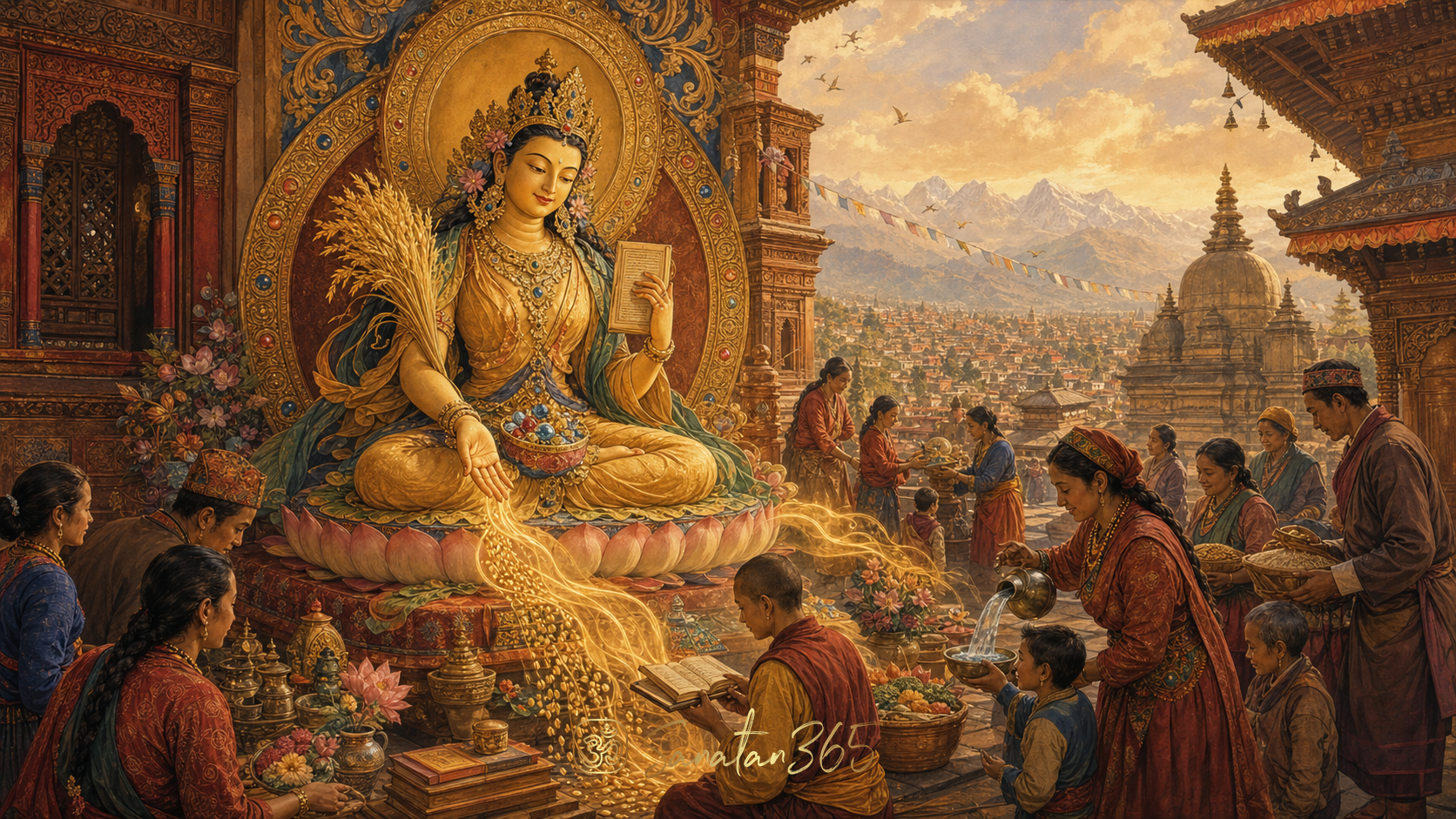
Vasudhārā (वसुधारा, “stream of treasures”) is a Buddhist goddess connected with prosperity, abundance, learning, and well-being. She is especially prominent in the Buddhist culture of Nepal’s Kathmandu Valley and also appears in Himalayan Buddhist art and ritual. Calling her only a “money goddess” shrinks a much wider religious figure into a modern marketing label.
Museum objects preserve this richer picture. The Metropolitan Museum describes Vasudhara as a goddess of wealth and abundance who also embodies the pursuit of learning; one image includes a manuscript, grain, gems, and a water pot. Its overview of cosmic Buddhas in Himalayan art places her within Buddhist relationships connected with Ratnasambhava and Jambhala. The Rubin Museum’s Project Himalayan Art essay on Vasudhara likewise grounds her in Nepalese Buddhist visual and ritual culture.
This identity matters because the internet often merges Vasudhara with Hindu goddesses of prosperity or with the Earth goddess simply because names and symbols overlap. Traditions across South Asia have influenced one another for centuries, but resemblance is not sameness. A respectful article should say plainly that this mantra is encountered in Buddhist Vasudhara practice and should not present Vasudhara as merely another name for Goddess Lakshmi or Bhudevi.
The phrase circulating online is also much shorter than complete Vasudhara liturgies. The Buddhist canon contains a work titled The Dhāraṇī of Vasudhārā, translated by 84000 from the Tibetan canonical collection. A dhāraṇī (धारणी, protective or mnemonic sacred formula) can be an extended sequence embedded in a narrative and ritual framework. That textual existence does not prove that every short internet recording is the definitive or only Vasudhara practice.
Formal Vajrayana practice may involve transmission, instructions, refuge, visualization, offerings, or commitments that cannot be reconstructed responsibly from a search snippet. In Newar Buddhist households, community and hereditary ritual specialists may preserve forms different from those taught in Tibetan lineages. A beginner can acknowledge this diversity without pretending expertise.
Key takeaway: Vasudhara belongs to specific Buddhist traditions, especially the Kathmandu Valley and Himalayan world; her practice is broader than the viral “money mantra” label.
Why Do Om Vasudhare Svaha and Om Vasudhara Svaha Appear as Variants?
Several forms appear in books, recordings, and websites:
- Om Vasudhare Swaha: a common phonetic English spelling.
- Oṃ Vasudhāre Svāhā: IAST with Vasudhāre as direct address.
- Oṃ Vasudhārāyai Svāhā: a Sanskrit dative form, broadly “to/for Vasudhara, svāhā.”
- Longer formulas: lineage texts may include additional seed syllables, epithets, requests, or dhāraṇī passages.
These differences can arise from Sanskrit grammar, manuscript transmission, Nepalese or Tibetan pronunciation, transliteration systems, and the movement from oral recitation into English spelling. Tibetan-language practice may render Sanskrit sounds according to Tibetan phonology; Newar Buddhist pronunciation may differ again. A recording that sounds like “basudhare soha” may therefore reflect a regional transmission rather than carelessness.
The safest principle is simple: do not splice formulas together or declare a popular spelling uniquely authentic. When a teacher, temple, or published liturgy provides a form, preserve that form and its instructions. When speaking generally, identify the version being discussed.
Readers new to mantra can also distinguish three related tasks:
- Transliteration represents letters from one script in another, as IAST does with diacritics.
- Transcription approximates how something sounds, which produces spellings such as “Swaha” or “Soha.”
- Translation offers meaning in another language, but cannot reproduce every ritual association.
This same care helps with other Sanskrit practices. The Japa Mala guide explains how a counting tool supports repetition, while the Japa meditation guide focuses on the discipline of returning attention. Neither makes every mantra interchangeable.
Key takeaway: “Vasudhare,” “Vasudharayai,” “Svaha,” “Swaha,” and “Soha” may reflect grammar, transliteration, or living pronunciation; a practitioner should follow one trustworthy source consistently.
How Can the Mantra Be Practised Respectfully?
A simple, non-initiatory devotional approach should remain modest. Anyone entering a formal Vajrayana or Newar Buddhist sādhanā (साधना, disciplined spiritual practice) should seek instructions from an authorized teacher in that tradition.
For general reflection, a careful practice might look like this:
- Learn the context first. Recognize Vasudhara as a Buddhist deity of abundance, generosity, and learning. Avoid relabeling her according to a different tradition for convenience.
- Choose one sourced version. If using Oṃ Vasudhāre Svāhā, keep its wording steady rather than mixing it with fragments found elsewhere.
- Sit without strain. A clean, quiet place and a stable posture are sufficient. Elaborate ritual objects are not required for a basic respectful recitation.
- Set an ethical intention. The wish may include adequate food, freedom from destructive scarcity, resources for responsible duties, and the ability to share. It need not glorify luxury or comparison.
- Recite attentively. Begin with a small number such as 9, 21, or any sustainable count, unless a teacher has specified otherwise. The widespread number 108 is meaningful in many mantra traditions, but it is not a magic threshold that forces a result.
- Close with generosity. Dedicate any steadiness or merit toward the welfare of others, and pair prayer with a real act: honest work, budgeting, giving food, supporting education, repaying a debt responsibly, or helping someone access opportunity.
Pronunciation matters because care matters, not because a minor accent error invites punishment. Listen to a reliable lineage source where possible, keep vowels unforced, and recite at a pace that preserves attention. A practitioner with a speech difference can still approach sacred practice with sincerity.
A mālā (माला, counting garland) may help, but it should not become a scoreboard. The purpose is gathered attention and continuity. Readers who want another example of how mantra meaning, deity context, and surrender stay connected can consult the Om Namah Shivaya meaning guide, while remembering that Shiva mantra practice and Buddhist Vasudhara practice are distinct.
Key takeaway: Respectful practice combines accurate context, consistent wording, modest repetition, ethical intention, and real-world generosity.
What Can and Cannot Be Expected From This Mantra?
Sacred practice can shape attention, motivation, gratitude, and the way a person relates to resources. A repeated invocation may help someone remember an intention to act with discipline or generosity. Within a devotional worldview, practitioners may also understand beneficial circumstances as blessing or merit. These are meaningful religious interpretations, but they are not measurable guarantees attached to a chant count.
The mantra cannot responsibly be promised to:
- produce a fixed amount of money;
- erase debt without repayment or negotiation;
- guarantee a job, investment return, lottery result, or business success;
- replace financial planning, legal advice, healthcare, or mental-health support;
- prove that a person facing poverty lacks faith or practised incorrectly.
That last point is essential. Economic hardship has personal, social, and structural causes. Turning wealth into a test of spiritual worth can shame people who already carry heavy burdens. Buddhist teachings on karma are also more complex than the claim that every present difficulty was individually “manifested.” Compassion requires practical help, not blame.
If financial stress is severe, recitation can sit beside concrete steps: speaking with trusted family, contacting a qualified financial counsellor, seeking legitimate employment support, reviewing expenses, or using professional crisis services where needed. Spiritual practice may accompany these actions; it should not obstruct them.
Beware of anyone who sells guaranteed Vasudhara results, demands escalating payment to “unlock” the mantra, or threatens misfortune if a ritual fee is refused. Respect for tradition never requires surrendering basic discernment.
Key takeaway: The mantra can support devotion and ethical focus, but it does not guarantee wealth or replace professional and practical action.
How Does Ethical Generosity Shape the Meaning of Abundance?
Vasudhara’s imagery does not show abundance as cash isolated from responsibility. Grain points toward nourishment. A manuscript points toward learning. Jewels can signify precious resources and qualities. The boon-giving hand suggests benefit flowing outward. Together they offer a more demanding question than “How can I get rich?”: What resources sustain life, wisdom, dignity, and generosity, and how should they circulate?
In Buddhist ethics, dāna (दान, generosity or giving) is a foundational practice. Giving loosens possessiveness and recognizes interdependence. It does not require reckless self-deprivation; responsible generosity considers duties to dependants, fair compensation, and the receiver’s dignity. Time, knowledge, protection, food, and attentive service may all express abundance.
This perspective can reshape a Vasudhara intention:
- from “Make me wealthier than others” to “May there be sufficient, honestly earned resources for wholesome purposes”;
- from hoarding to stewardship;
- from magical urgency to disciplined effort;
- from private gain alone to shared nourishment and learning;
- from shame about scarcity to compassion and practical solidarity.
Such reframing does not romanticize poverty. Food, shelter, medicine, education, and financial stability genuinely matter. The spiritual point is that material sufficiency and inner quality need not be enemies, while greed and abundance are not synonyms.
Key takeaway: Vasudhara’s abundance is most responsibly understood through nourishment, learning, sufficiency, stewardship, and generosity.
Conclusion
“Om Vasudhare Swaha” is best approached as a short Buddhist invocation associated with Vasudhara, not as an internet trick for guaranteed money. Its Sanskrit forms vary, its living pronunciations differ across communities, and its fuller practices belong to particular lineages. A respectful beginner learns the context, follows one reliable version, recites without strain, refuses exaggerated promises, and lets the aspiration for abundance mature into ethical work and generosity.
Key takeaway: Honour the mantra by joining careful words with careful conduct; let abundance mean enough to sustain life, learning, responsibility, and giving.
FAQ
Is Om Vasudhare Swaha a Hindu mantra or a Buddhist mantra?
The short formula is commonly associated with Vasudhara in Buddhist traditions, especially Nepalese and Himalayan contexts. Indian religions share languages, symbols, and long histories of exchange, but Vasudhara should not automatically be presented as identical to a Hindu goddess with similar abundance or earth associations.
What is the correct spelling: Swaha or Svaha?
Svāhā is the standard IAST transliteration of स्वाहा. Swaha is a common English phonetic spelling, while soha may reflect Tibetan pronunciation. The best choice depends on whether the writer is transliterating Sanskrit or recording a lineage’s living recitation.
Is it Vasudhare or Vasudharayai?
Both may appear in sourced formulas. Vasudhāre addresses Vasudhara directly, while Vasudhārāyai is a dative form meaning broadly “to or for Vasudhara.” Practitioners should not improvise between them; they should preserve the version supplied by a trustworthy text or teacher.
Must the mantra be chanted 108 times?
No universal rule can be inferred from popular posts. A teacher or liturgy may prescribe a count for a specific practice. For informal devotional reflection, a modest sustainable count is preferable to treating 108 repetitions as a transaction that guarantees an outcome.
Will the Om Vasudhare Swaha mantra bring money?
No result can be guaranteed. Devotees may recite for support, sufficiency, generosity, and auspicious conditions, but the mantra does not replace honest work, budgeting, professional advice, or community support. Claims of certain or instant wealth should be treated with caution.
About the author
Sanatan365 Editorial
Bringing Sanatan Dharma to modern seekers through authentic, scripture-grounded content.
Related in Mantras
 Mantras
Medha Suktam Meaning: A Vedic Prayer for Understanding
Explore the meaning of Medha Suktam, its prayer for clear understanding and memory, and ways to approach this Vedic hymn respectfully.
 Mantras
Bhaja Govindam Meaning: Devotion, Wisdom, and the Limits of Learning
Explore the meaning of Bhaja Govindam, its call to Govinda, and its reflection on learning, impermanence, and wise living.
 Mantras
Kanakadhara Stotram Meaning: Lakshmi, Compassion, and Prosperity
Kanakadhara Stotram praises Lakshmi through the image of her compassionate glance. Explore its Sanskrit meaning, traditional story, and res…