Onam 2026: Thiruvonam Date, Traditions, and Meaning
Onam 2026 reaches Thiruvonam on 26 August. Understand the ten-day festival, Pookalam, Onam Sadya, Mahabali memory, and respectful celebration.
A festival can welcome a beloved king with flowers, feed an entire household on one banana leaf, and turn abundance into a shared responsibility.
Onam 2026 reaches its principal day, Thiruvonam, on Wednesday, 26 August 2026. Celebrated in Kerala during Chingam, the first month of the Malayalam solar calendar, Onam gathers the memory of King Mahabali, Lord Vishnu's Vamana avatara, the harvest season, family reunion, Pookalam flower designs, Onam Sadya, arts, games, and generous hospitality. Its deepest question is not simply how much a home displays, but how fully it makes room for gratitude and welcome.
When is Onam 2026 and when does Thiruvonam fall?
The main Onam 2026 date is Wednesday, 26 August. Thiruvonam (തിരുവോണം, the auspicious Shravana lunar mansion as named in Malayalam) is the culminating day of the festival. The ten-day observance begins with Atham and develops through Chithira, Chothi, Vishakam, Anizham, Thriketa, Moolam, Pooradam, Uthradam, and Thiruvonam.
The Kerala Tourism Thiruvonam listing places the 2026 celebration on 26 August and notes that local temple customs can affect particular observances. The Drik Panchang Onam calendar likewise identifies Thiruvonam in the Malayalam month of Chingam. Families should follow their own temple, community, or regional calendar for local timings rather than treating one online timetable as universal.
Useful dates for planning are:
- Atham: Sunday, 16 August 2026, beginning the ten-day sequence.
- Uthradam or First Onam: Tuesday, 25 August 2026, a major preparation day.
- Thiruvonam or Second Onam: Wednesday, 26 August 2026, the principal celebration.
- Avittam and Chathayam: Thursday and Friday, 27 and 28 August, when celebrations continue in many places.
This calendar matters because Onam is not only a single feast day. The gradual preparation is part of its meaning. A Pookalam expands over time, homes are readied, relatives coordinate meals, performers rehearse, and anticipation becomes a communal practice.
Key takeaway: Thiruvonam falls on 26 August 2026, but the spirit of Onam is cultivated across the days that lead to it.
What does Onam celebrate in Kerala?
Onam is often described as Kerala's harvest festival, yet harvest is only one layer. It is also the annual welcome of Mahabali, a cherished king whose remembered reign represents wellbeing, fairness, and abundance. In the traditional story, Lord Vishnu appears as Vamana (वामन, “the dwarf one”), asks Mahabali for land measured by three steps, and then reveals the cosmic form of Trivikrama (त्रिविक्रम, “the one of three mighty strides”). Mahabali keeps his promise and is granted the blessing of returning to visit his people.
The story should not be flattened into a slogan about a “good” side defeating a “bad” side. Mahabali is remembered with love, generosity, and moral complexity. Vamana is revered as Vishnu restoring cosmic order. Kerala's Onam memory can honour the king's homecoming while Vaishnava devotion honours the avatara. The Vamana and King Bali story offers a fuller treatment of that sacred narrative.
Onam also belongs to Kerala's living cultural identity. Hindu devotional memory, agricultural gratitude, family customs, public arts, school celebrations, neighbourhood gatherings, and Malayali belonging meet within it. People from different communities may participate in its cultural hospitality while families preserve their own religious practices. That breadth does not erase the festival's roots; it shows how welcome can grow from a rooted tradition.
Three values repeatedly appear:
- Gratitude: food, rain, soil, labour, family, and community are received as gifts rather than private achievements.
- Hospitality: a beautiful home becomes meaningful when it welcomes others with dignity.
- Shared abundance: prosperity is measured by whether nourishment, joy, and respect circulate.
These values explain why a lavish Sadya and a modest meal can both carry Onam's heart. Scale is secondary to care. A household should not create debt or waste merely to imitate public spectacle.
Key takeaway: Onam remembers Mahabali and Vamana while turning harvest abundance into gratitude, hospitality, and shared joy.
How do the ten days of Onam lead to Thiruvonam?
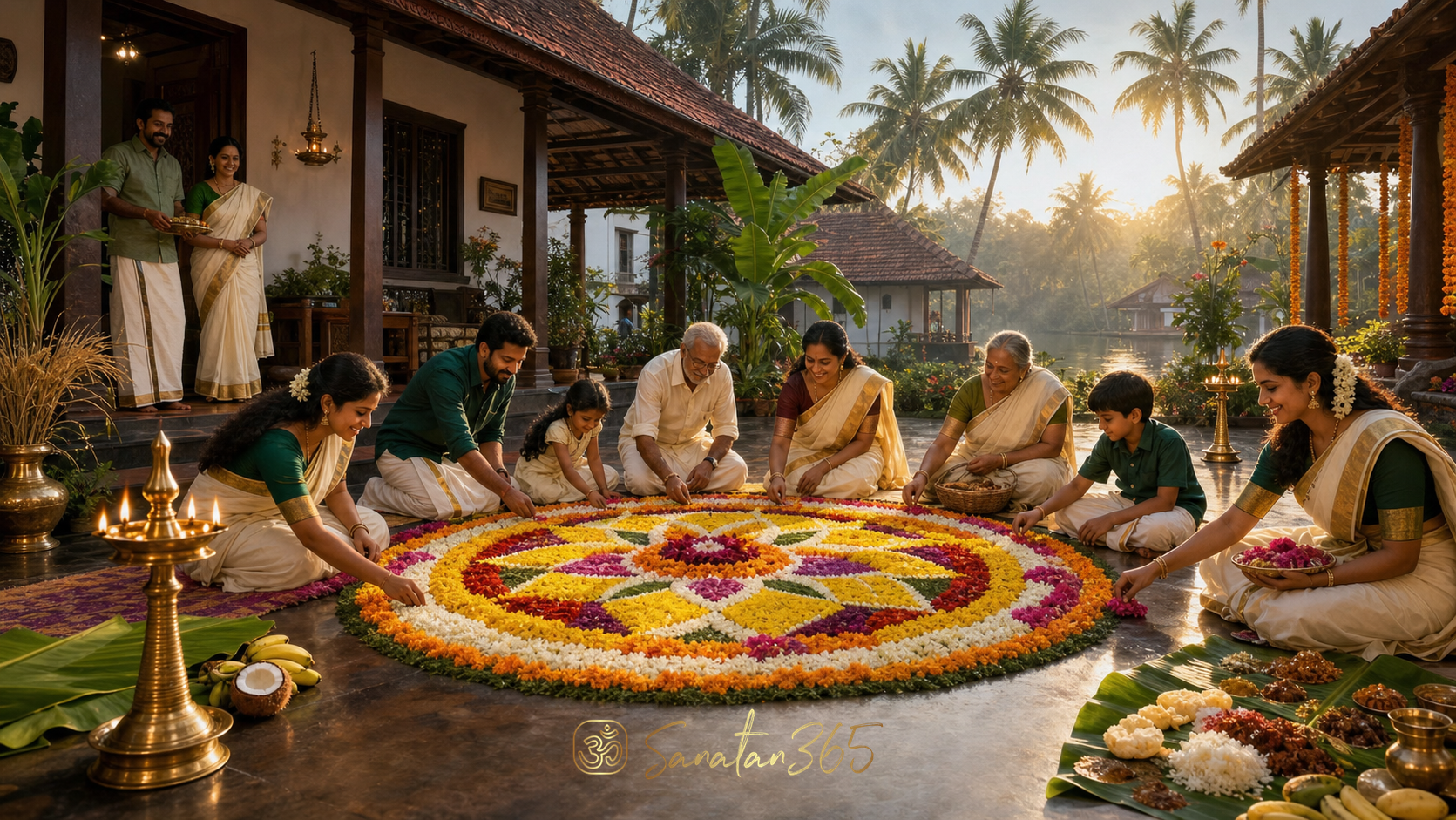
The ten-day rhythm begins gently. On Atham, many households start a small Pookalam (പൂക്കളം, “flower field” or floral floor design). More flowers, colours, and patterns may be added as Thiruvonam approaches. The growing design makes time visible: celebration is built through daily attention rather than switched on at the last minute.
Customs vary by district, family, and institution, so no single checklist describes every Onam. The broad movement is from preparation toward fullness:
- Cleaning and readiness: homes and shared spaces are prepared to receive family and guests.
- Pookalam making: floral designs develop, often through collective work and friendly creativity.
- Onakkodi: new clothes may be given or worn, expressing renewal and affection.
- Arts and games: forms such as Pulikali, Thiruvathira, community games, and Vallam Kali boat races animate public culture in their appropriate places.
- Uthradam preparation: ingredients, banana leaves, flowers, and family responsibilities are organized.
- Thiruvonam gathering: prayer, remembrance, festive clothing, Sadya, visits, gifts, and cultural celebration reach their height.
The sequence offers a useful spiritual insight. Sacred celebration includes invisible work: washing, cutting vegetables, arranging transport, checking on elders, inviting someone who might otherwise be alone, and cleaning after the guests leave. When those duties are shared fairly, celebration itself becomes seva (सेवा, “selfless service”).
Children can participate through safe, age-appropriate responsibilities such as sorting flowers, placing leaves, learning a song, welcoming relatives, or helping avoid food waste. Elders can be invited to explain how their home or village observed Onam in earlier years. The festival then becomes an exchange between generations, not merely an aesthetic event.
Key takeaway: The ten days teach that sacred joy grows through preparation, cooperation, memory, and care.
What do Pookalam and Onam Sadya mean?
Pookalam and Onam Sadya are among the festival's most recognizable traditions because both transform ordinary natural gifts into an offering of welcome.
Pookalam: beauty made together
A Pookalam is arranged from flowers and petals, commonly at the entrance or courtyard. Its circular geometry, colour, and increasing detail make the threshold feel alive. It is widely associated with welcoming Mahabali and expressing auspicious joy.
The practice can also teach ecological and social care. Families can choose seasonal local flowers, avoid dyed plastic substitutes, keep designs proportional to available resources, and compost natural petals afterward where practical. Children should be guided not to pluck flowers carelessly from protected spaces or neighbours' gardens. Beauty does not require waste.
Onam Sadya: abundance that serves
Onam Sadya (ഓണസദ്യ, the Onam feast) is a vegetarian meal traditionally served on a banana leaf. Rice is accompanied by a carefully balanced range of preparations that may include parippu, sambar, avial, olan, thoran, kalan, pachadi, pickles, pappadam, and payasam. Menus vary by region and household; the purpose is not to enforce one supposedly perfect number of dishes.
Serving order, flavour balance, and the direction of the banana leaf carry local knowledge. Newcomers should follow the host rather than policing custom. The meal honours many forms of labour: farming, transport, cooking, serving, and cleaning. Thanking that labour is as important as photographing the leaf.
Sadya also expresses the spiritual grammar of food. Hindu traditions often treat nourishment as more than consumption. The meaning of prasad explores how food, offering, grace, and sharing relate. Not every Sadya dish is automatically temple prasada, but the same disciplines of gratitude and non-waste can shape the meal.
A responsible family can plan portions, serve smaller first helpings, offer more when requested, store leftovers safely, and share surplus through trustworthy local channels. Hospitality should protect the dignity of everyone present, including the people doing the most work.
Key takeaway: Pookalam welcomes through shared beauty; Onam Sadya welcomes through nourishment, balance, and generous service.
How is Onam celebrated across Kerala and the diaspora?
Kerala does not express Onam in one uniform way. Temple associations, family histories, local art forms, urban life, village customs, and community organizations shape the celebration. Thrikkakara carries a particularly important connection with Vamana and Onam traditions. Thripunithura is known for Athachamayam festivities. Vallam Kali belongs to specific waterways and organized boat-race traditions, while Pulikali has a strong public performance identity associated especially with Thrissur.
These forms should be appreciated in context. A dance, boat race, or costume is not a generic prop to be copied without understanding. Visitors can support local artists, follow safety instructions, ask before photographing people closely, and avoid obstructing ritual or public routes.
For Malayalis living elsewhere in India or abroad, Onam often becomes a powerful form of cultural continuity. A community hall may replace the ancestral courtyard; supermarket flowers may replace a garden; friends may divide Sadya dishes across several kitchens. The materials change, but the structure of welcome remains.
A diaspora celebration can stay rooted by:
- confirming the 2026 date through a trusted local Malayali association or temple;
- inviting elders to explain words and customs rather than presenting them as decoration;
- using Malayalam names alongside clear English meanings;
- making room for children and newcomers to participate respectfully;
- crediting artists, cooks, teachers, and volunteers;
- avoiding claims that one household's method is the only authentic form.
Onam's openness is strongest when it remains specific. “Everyone is welcome” should mean guests are helped to understand the tradition, not that the tradition becomes vague.
Key takeaway: Regional and diaspora forms differ, but rooted hospitality, cultural memory, and shared work keep Onam recognizable.
How can families celebrate Onam respectfully in 2026?
A meaningful Onam does not require a large budget. It requires intention, participation, and care. Families can adapt this simple plan:
- Mark the date: plan the principal gathering for Wednesday, 26 August 2026, while following local observance guidance.
- Learn one story well: read the Mahabali and Vamana account with respect for both the king's generosity and Vishnu's restoration of dharma.
- Make a proportional Pookalam: use available flowers thoughtfully and let several generations contribute.
- Share the Sadya work: divide shopping, preparation, serving, and cleanup fairly.
- Welcome someone intentionally: include a relative, neighbour, student, or friend who would value companionship.
- Reduce waste: plan portions, reuse decorations responsibly, and compost flowers where possible.
- Preserve memory: record an elder's recollection, a family recipe, a Malayalam song, or the meaning of one custom.
If a family cannot prepare a full Sadya, a few vegetarian dishes served with gratitude are enough. If flowers are unavailable, a small natural arrangement is better than disposable imitation. If relatives are distant, a shared video call or coordinated meal can still create belonging.
The most important discipline is to resist comparison. Social media can make festivals feel like competitions in decoration, clothing, or menu size. Onam's moral imagination points elsewhere. Mahabali is welcomed into a household that is worthy not because it looks expensive, but because people are treated well within it.
Key takeaway: Celebrate Onam by making welcome concrete through truthful memory, shared labour, careful food, and inclusive family attention.
Conclusion
Onam 2026 culminates on 26 August, but its enduring significance cannot be contained in a date. Flowers gradually form a Pookalam. Many hands prepare a Sadya. Mahabali is remembered with affection, Vamana with devotion, and Kerala's harvest abundance with gratitude.
The festival asks every household to consider what prosperity is for. The clearest answer is hospitality: beauty that welcomes, food that nourishes, memory that connects generations, and abundance that refuses to become waste.
Key takeaway: Onam becomes sacred when a home turns gratitude into welcome and prosperity into shared wellbeing.
FAQ
What is the main date of Onam 2026?
Thiruvonam, the principal day of Onam 2026, falls on Wednesday, 26 August. Local temple and community customs should guide any specific observance timings.
When do the ten days of Onam begin in 2026?
The ten-day sequence begins with Atham on Sunday, 16 August 2026, and culminates with Thiruvonam on 26 August.
What is Pookalam?
Pookalam is a floral floor design traditionally created during Onam, often beginning simply on Atham and becoming more elaborate toward Thiruvonam. It expresses auspicious welcome, creativity, and collective preparation.
What is Onam Sadya?
Onam Sadya is the traditional vegetarian festival feast served on a banana leaf. Its dishes and serving customs vary, while its central values include abundance, hospitality, balance, and shared nourishment.
Why is King Mahabali remembered during Onam?
Kerala tradition remembers Mahabali as a beloved and generous king who is blessed to return to his people. His memory is connected with Lord Vishnu's Vamana avatara and with ideals of prosperity, truthfulness, and welcome.
About the author
Sanatan365 Editorial
Bringing Sanatan Dharma to modern seekers through authentic, scripture-grounded content.
Related in Festivals
 Festivals
Parivartini Ekadashi 2026: Date, Meaning, and Gentle Vrat Guide
Parivartini Ekadashi 2026 falls on September 22. Learn why it is called Parsva or Vamana Ekadashi, how it relates to Chaturmas, and how to…
 Festivals
Hartalika Teej 2026: Date, Meaning, Puja, and Parvati's Resolve
Hartalika Teej 2026 is observed on September 14 in honour of Goddess Parvati and Lord Shiva. Learn the festival's story, vrat meaning, regi…
 Festivals
Radha Ashtami 2026: Date, Meaning, and Devotion at Home
Radha Ashtami falls on 19 September 2026 in India. Explore its meaning, Braj traditions, local timing guidance, and a thoughtful home obser…