Vamana Avatar Story: King Bali, Three Steps, and Dharma
The Vamana Avatar story shows Lord Vishnu restoring cosmic balance through humility, promise, and grace rather than force.
A small boy asks for three steps of land, and the universe suddenly becomes too small to contain him.
The Vamana Avatar story is the story of Lord Vishnu appearing as Vamana (वामन, "the dwarf one") before King Bali, asking for three steps of land, and then expanding as Trivikrama (त्रिविक्रम, "the one of three mighty strides") to restore cosmic order. Its central teaching is not that humility defeats generosity, but that dharma (धर्म, sacred order and rightful conduct) tests both power and promise. Bali's greatness is preserved precisely because he keeps his word when the Divine reveals the true scale of the request.
Why does the Vamana Avatar story begin with a small request?
The Vamana Avatar story begins with smallness because smallness is the perfect mirror for pride. In the older Vedic memory, Vishnu is associated with three cosmic strides that measure the worlds; later Puranic storytelling gives that vast act a dramatic human setting through Bali's court and sacrifice. Britannica's Vamana overview notes both the Rigvedic three strides and the later story of the dwarf Vamana appearing when Bali ruled the universe.
Bali, also called Mahabali, is not a flat villain in the most thoughtful retellings. He is powerful, generous, disciplined, and beloved. Kerala's Onam tradition remembers him as a righteous and charitable ruler whose return is celebrated with affection; Kerala Tourism's Mahabali legend presents him as a ruler associated with prosperity, equality, and public love. That makes the story morally richer. Vishnu does not arrive to crush a worthless tyrant. He arrives when power, however virtuous in parts, has begun to disturb the balance of the worlds.
The devas (देवाः, luminous beings or gods) have lost their place. Bali's merit, tapas (तपस्, disciplined spiritual heat), and generosity have made him nearly unbeatable. Aditi, mother of the devas in many retellings, turns toward Vishnu. Vishnu is born as Vamana, a young Brahmin boy, and enters Bali's yajna (यज्ञ, sacred offering ritual) with a request so modest that it seems almost laughable: land measured by three steps.
Key takeaway: The small request protects the story from becoming a simple contest of strength; it becomes a test of perception, humility, and truthfulness.
What happens between King Bali and Vamana?
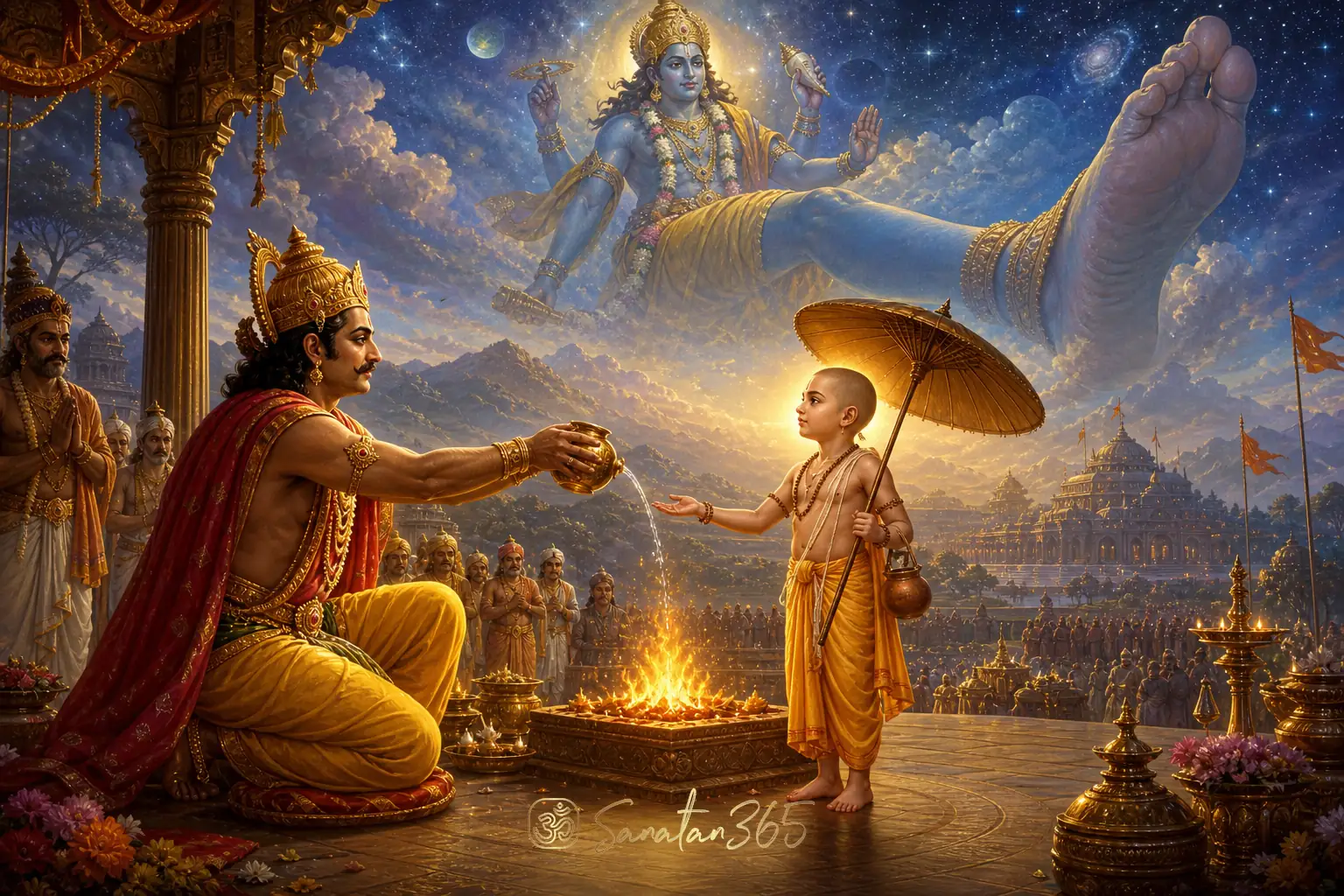
Bali is performing a grand sacrifice. The court is full of priests, gifts, fire, and royal confidence. Into that scene walks Vamana: short, radiant, carrying the marks of a Brahmin student, asking for only as much land as he can cover in three paces. Bali offers more. A king who has conquered much can give villages, cattle, gold, and whole territories. But Vamana refuses enlargement. He asks only for three steps.
This is where the story turns. Shukracharya, Bali's guru in many versions, recognizes that the visitor is no ordinary boy. He warns Bali that Vamana is Vishnu and that the request will not remain small. Bali faces a dharmic dilemma. If he withdraws his promise, he protects his kingdom but wounds his truthfulness. If he keeps his promise, he may lose everything that promise was supposed to protect.
Bali chooses satya (सत्य, truth) over possession. He pours the ritual water that seals the gift.
Then Vamana expands.
The small Brahmin becomes Trivikrama. One step covers the earth. Another reaches through the heavens. The three worlds that seemed to be under Bali's authority are revealed as already resting inside Vishnu's presence. Britannica's Dashavatara reference summarizes this Vamana episode as Vishnu countering Bali through the three-paces request and then taking a gigantic form.
When two steps have covered everything, Vishnu asks where the third should fall. Bali has no land left to give. He offers his own head.
That gesture matters. Bali is not merely defeated; he completes the gift. He gives the one thing that remains when territory, status, and sovereignty are gone: himself. Vishnu's foot on Bali's head is therefore both judgment and grace. It places the king beneath cosmic order, but it also preserves his dignity as a devotee who kept his word.
Key takeaway: Bali's defeat is not moral erasure. The story honors the moment when a powerful ruler accepts that truth is greater than ownership.
How does Trivikrama reveal the meaning of three steps of Vishnu?
The three steps of Vishnu are more than a miracle of size. They are a symbolic correction of false measurement. Bali measures land by possession. Vamana measures existence by divine order. When the small form becomes cosmic, the story asks: Who truly owns what can be crossed by one step of the Divine?
The first step gathers the earth, the field of action. This is where humans build homes, kingdoms, professions, reputations, and families. The second step reaches the heavens, the field of aspiration and merit. This is where ritual power, divine favor, and cosmic status appear. The third step asks for surrender, because once action and heaven are both seen as belonging to Vishnu, the remaining question is interior: what will the self do?
In many devotional readings, Bali's head becomes the answer. The head is the seat of pride, identity, decision, and self-importance. To offer it is to say: let the ego be measured too.
This is why Trivikrama is such a powerful name. Vikrama can mean a stride, step, or heroic advance. Tri means three. Trivikrama is not merely "giant Vishnu." It is Vishnu revealing that sacred order spans all visible and invisible domains: earth, heaven, and the inner place where a person either clings or bows.
The story also avoids a crude message that wealth or kingship is inherently wrong. Bali's generosity is real. His devotion is real. The problem is not that he has power; the problem is that even noble power can exceed its rightful place. Dharma does not destroy excellence. It places excellence back inside the whole.
Key takeaway: The three steps teach that land, heaven, and ego all become sacred only when they are aligned with the Divine.
Why is King Bali still remembered with reverence?
One of the most beautiful features of the Vamana Avatar story is that Bali remains worthy of reverence. Many myths end with the vanquished being humiliated. This one is more subtle. Bali is corrected, but he is also blessed.
In Kerala's Onam tradition, Mahabali is remembered as a beloved king whose annual return brings joy, memory, and cultural unity. Britannica's Onam article connects the festival's mythology with Vishnu appearing as Vamana while Mahabali performs a yajna. Kerala's public retellings often emphasize Mahabali's generosity, equality, and deep bond with his people. This regional memory does not erase the Puranic theme of cosmic balance; it adds emotional texture to it.
For a reader outside Kerala, this can be illuminating. Hindu storytelling often preserves multiple truths at once. Bali can be an asura (असुर, a powerful being often opposed to the devas in later mythology) whose rise unsettles the cosmic order, and he can also be a righteous ruler remembered with love. Vishnu can restrain him, and Vishnu can honor him. The story does not force a shallow choice between punishment and praise.
This layered view protects the tale from sectarian or simplistic readings. It does not say that one community's beloved king is evil. It says that greatness itself must remain answerable to dharma. Even a generous ruler must be measured by a reality larger than public admiration. Even divine intervention can carry compassion.
For families telling this story to children, Bali should not be reduced to "the bad king." A better phrasing is: Bali was a great and generous king whose power grew beyond cosmic balance; Vishnu came as Vamana to restore that balance, and Bali became even greater by keeping his promise.
Key takeaway: Bali is revered because his final act transforms loss into surrender and royal pride into devotion.
What does the Vamana Avatar story teach about humility today?
The Vamana Avatar story is deeply practical because it exposes a common human confusion: we think the small request is insignificant. A little truth, a small promise, a private habit, one ethical decision, one moment of humility. Yet dharma often enters life in exactly that form.
A person may not face a cosmic deity asking for three steps, but everyone meets versions of Vamana. A child asks for attention when work feels urgent. A parent asks for patience. A colleague asks for honesty. A ritual asks for sincerity rather than display. A mantra asks for daily steadiness rather than occasional intensity. These requests seem small until they expand and reveal the true scale of our character.
Bali's mistake is not generosity. His test is whether generosity remains true when it costs him control. That is a sharper lesson than simply "be humble." Many people are humble when nothing is at stake. Bali becomes spiritually memorable because he chooses truth when the price is visible.
For modern readers, the story offers at least four practices:
- Keep promises carefully, because a word once given shapes the self.
- Give without using generosity to decorate ego.
- Remember that success still needs limits.
- Treat correction as grace when it restores alignment with dharma.
The story is also useful for leadership. Bali's people love him, and that love matters. But popularity is not the same as cosmic rightness. A leader must ask not only, "Do people admire me?" but also, "Is my power serving the whole?" Vamana's three steps bring that hidden question into view.
Key takeaway: Humility is not thinking little of oneself; it is allowing truth to be larger than self-image, power, and possession.
How can families tell the Vamana Avatar story with depth?
The Vamana Avatar story works beautifully in a home setting because it has clear scenes: the yajna fire, the small Brahmin boy, the generous king, the warning of the guru, the cosmic expansion, and the third step. Children remember the image of Vishnu becoming vast. Adults return to the ethical tension.
A family retelling can move in five parts:
- Bali becomes powerful and generous, but the balance of the worlds is disturbed.
- Vishnu is born as Vamana, a humble Brahmin boy.
- Vamana asks for only three steps of land.
- Bali keeps his promise even after being warned.
- Vamana becomes Trivikrama, measures the worlds, and blesses Bali after Bali offers his head.
While telling the story, define the important words. Avatar (अवतार, divine descent) means the Divine taking a form for a purpose. Yajna means sacred offering. Dharma means the order that sustains life, duty, truth, and right relationship. These definitions help children hear the story as more than fantasy.
Parents can then ask gentle questions: Why did Vamana ask for so little? Why did Bali keep his word? Was Bali only wrong, or also noble? What does the third step mean? Such questions invite reflection without flattening the story into a moral slogan.
Regional context can also be included with care. In Kerala, Mahabali is lovingly remembered during Onam as a king who returns to his people. In Vaishnava and pan-Indian tellings, Vamana is praised as Vishnu restoring balance. Both memories can be held respectfully. That is one of the strengths of Sanatan storytelling: it can preserve devotion, place, ethics, and metaphysics in one living narrative.
Readers who want to place this story in a wider Vishnu context can also revisit Lord Vishnu Symbolism: Shankha, Chakra, Gada, and Padma, Vishnu Sahasranama Meaning: Why the Thousand Names Steady Devotion, and AI Vishnu Guide: Protection, Balance, and Dharma in Daily Life for related reflections on preservation, names, and dharmic balance.
Key takeaway: The best family retelling honors both Vishnu's cosmic restoration and Bali's truthfulness.
What is the single lesson of Vamana and King Bali?
The single lesson is this: what we possess is never greater than the truth we are asked to uphold. Bali's kingdom, merit, and fame are vast, but his promise becomes the doorway through which Vishnu reveals the real measure of everything.
That is why the story remains tender rather than merely dramatic. Vamana comes small because truth often arrives quietly. Trivikrama expands because truth, once honored, reveals its cosmic scale. Bali bows because the soul becomes free when it stops trying to own what belongs to the Divine.
For a seeker, the Vamana Avatar story is therefore not only about a past age. It is about today: the promise kept, the ego softened, the gift purified, the power returned to service, and the small request that becomes a path back to dharma.
Key takeaway: The third step falls wherever ego is ready to become offering.
FAQ
What is the Vamana Avatar story about?
The Vamana Avatar story is about Lord Vishnu appearing as a dwarf Brahmin before King Bali, asking for three steps of land, expanding as Trivikrama, and restoring cosmic balance. The story teaches humility, promise-keeping, and surrender to dharma.
Why did Vamana ask King Bali for three steps of land?
Vamana asked for three steps to test Bali's perception and truthfulness. The request looked small, but it revealed whether Bali would honor his promise when the Divine form expanded beyond ordinary measurement.
Is King Bali considered good or bad in Hindu tradition?
King Bali is treated with complexity. He is powerful and belongs to the asura lineage in many retellings, yet he is also remembered as generous, truthful, and devoted. Kerala's Onam tradition especially honors Mahabali as a beloved ruler.
What does Trivikrama mean?
Trivikrama means "the one of three mighty strides." It refers to Vishnu's cosmic form in which he measures the worlds through three steps, revealing that all realms ultimately rest within divine order.
What is the main moral of Vamana and Bali?
The main moral is that truth and dharma are greater than power, wealth, and reputation. Bali's greatness shines because he keeps his word even when it costs him everything.
About the author
Sanatan365 Editorial
Bringing Sanatan Dharma to modern seekers through authentic, scripture-grounded content.
Related in Stories
 Stories
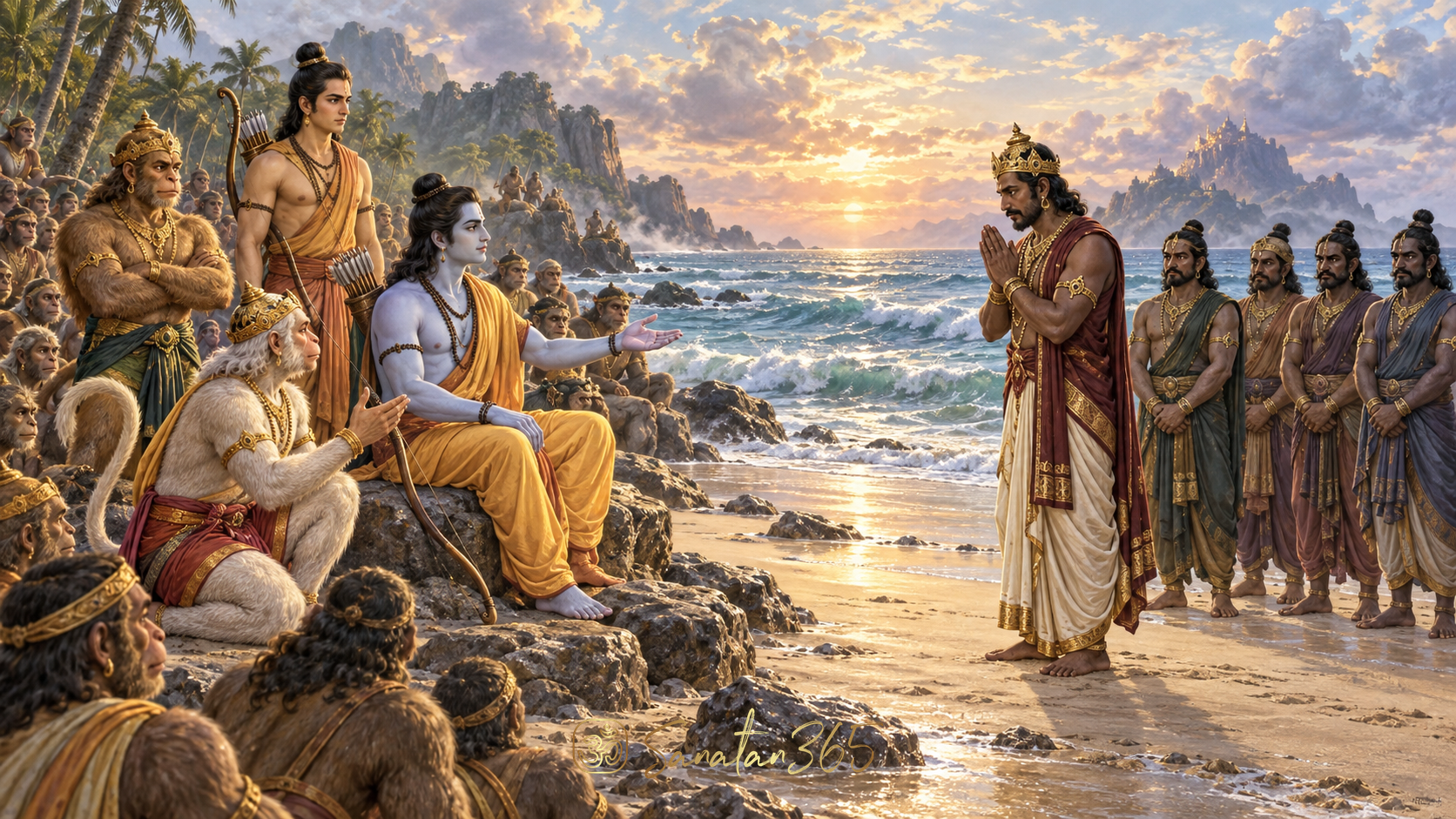
Vibhishana's Story: Why Rama Welcomed Him
Why did Vibhishana leave Lanka, and why did Rama welcome him? Read the Ramayana's debate about refuge, trust, and dharma with nuance.
 Stories
Upamanyu’s Story: Discipline, Discernment, and the Ashvins’ Grace
Upamanyu’s early Mahabharata story follows a hungry student tested by his teacher, blinded after eating harmful leaves, and restored by the…
 Stories
King Parikshit and Shukadeva: Seven Days of Sacred Listening
When King Parikshit learned that only seven days remained, the Bhagavata Purana says he turned from power toward one urgent question: what…