Planet Degrees in Kundali: Reading a Position Before Interpreting It
Learn to read a planet’s sign, degree, minute and second as an address, then check the entry before turning to interpretation.
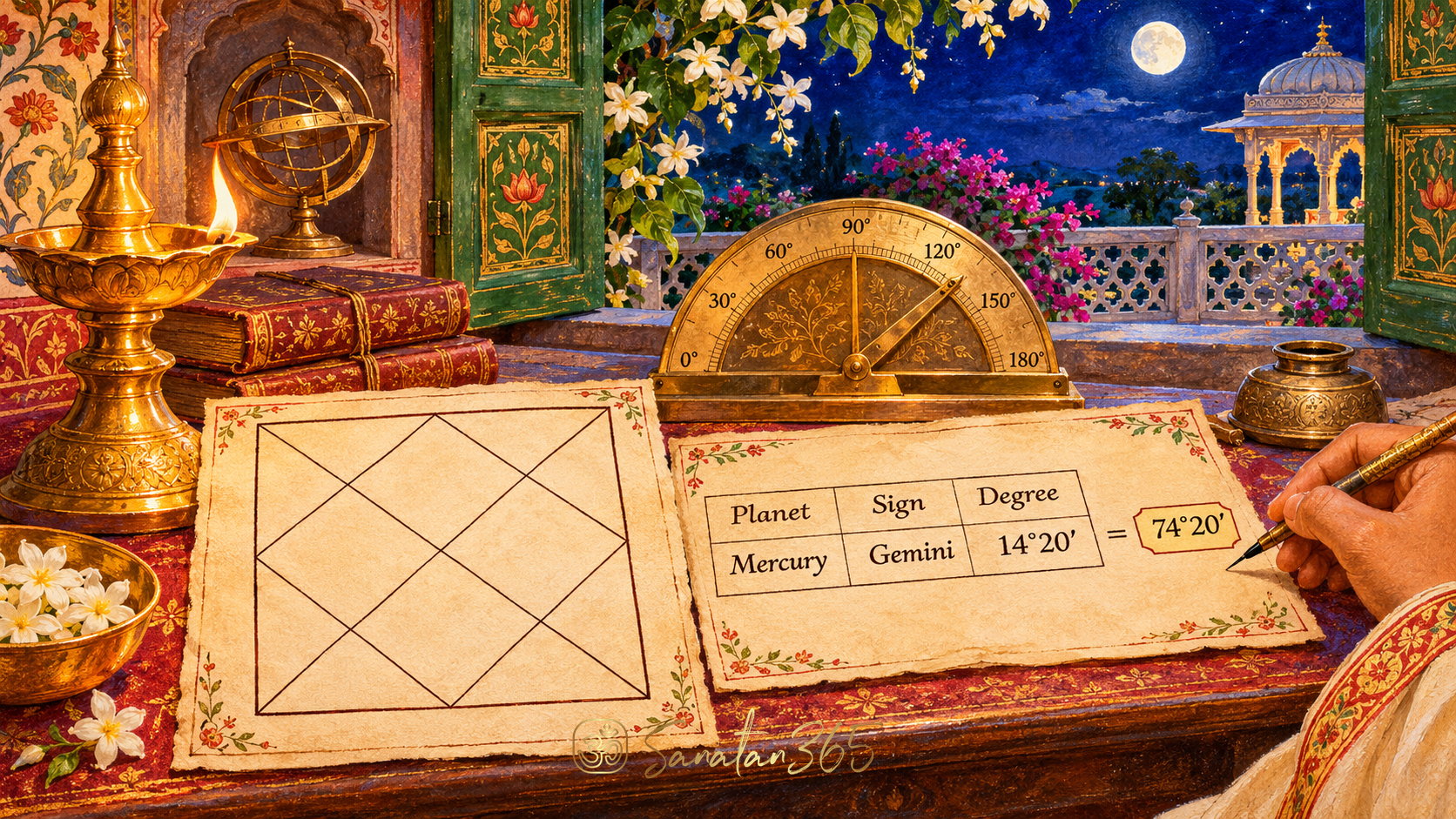
A chart entry may place a planet at 14°20′ in Gemini, while a second display gives its longitude as 74°20′. The two numbers can describe exactly the same position.
Planet degrees in kundali record a position along the zodiac. A kuṇḍalī (कुण्डली, birth chart) may show that position within a rāśi (राशि, zodiac sign), or as a longitude measured from the start of the full circle. Each sign occupies 30 degrees. Reading the sign and the number together is therefore the first step in understanding the entry. The examples below teach that reading task before any astrological interpretation is attempted.
What do planet degrees in kundali actually record?
The numerical entry is an address. It tells a reader where a plotted point belongs in the chart’s chosen zodiac. In the introductory pages of Vedic Astrology: An Integrated Approach, P. V. R. Narasimha Rao explains positions in degrees, minutes and seconds and uses the terms longitude and sphuṭa (स्फुट, the precise calculated position). The textbook divides the 360-degree zodiac into twelve equal signs. This gives each sign a span of 30 degrees.
That small amount of background is enough to begin reading an entry. A planet name identifies the point being listed. A sign name identifies its section of the circle. A degree number describes how far it has advanced from the beginning of that sign, when sign-relative notation is being used. The remaining figures refine that location. They are parts of one address, so dropping the sign or the unit can change what another reader understands.
A helpful first exercise uses a printed line rather than the whole chart. Point to the planet label, the sign label and the numerical position in turn. Then cover the interpretation column, if the report has one, and read only those three items aloud. This separates the task of locating a point from the task of deciding what a tradition says about it. Both may interest the reader, but they call for different kinds of attention.
The introduction to a Vedic birth chart gives a broader view of the chart’s components. Here the focus stays on one line of notation. A reader who can copy that line accurately is already better prepared to ask a clear question about the rest of the report.
Key takeaway: Read the planet, sign and position as one complete address.
How can one position have two numerical addresses?
Imagine a circle divided into twelve consecutive sections. The first runs from zero up to 30 degrees, the next from 30 up to 60, and the third from 60 up to 90. A point 14 degrees into the third section has travelled 74 degrees from the start of the circle. One address measures from the beginning of the section. The other measures from the beginning of the whole circle.
Using the zodiac’s usual order, the first section is Aries, the second Taurus and the third Gemini. An illustrative position of 14°20′ in Gemini therefore corresponds to 74°20′ around the full zodiac. Add the 60 degrees that precede Gemini to the 14 degrees and 20 minutes inside it. The minutes remain unchanged because the section begins at a whole-degree boundary.
Work backward to test the result. A position of 74°20′ falls between 60 and 90 degrees. Subtract 60 degrees and the remainder is 14°20′ within Gemini. The backward check is useful because it asks a different question from the forward one. Instead of remembering what was just added, it identifies which section contains the complete address.
A second invented example can help. A point at 8°10′ in the fifth sign, Leo, has four completed signs before it. Four times 30 degrees gives 120 degrees, and adding 8°10′ yields 128°10′. It is the same operation with a different starting section. Neither example is a real person’s chart or a claim about a current planetary position.
There is a practical reason to try both directions on paper. A report may abbreviate the sign name, move it between the degree and minute figures, or place it in a separate column. Once the reader understands the two address systems, changes in formatting become easier to notice. The arithmetic gives the reader a way to check the label rather than relying on where it happens to appear on the screen.
Key takeaway: A sign-relative position and a full-circle longitude can be two ways of writing one location.
Why are angular minutes different from clock minutes?
A degree can be divided into sixty angular minutes, and an angular minute into sixty angular seconds. Their symbols often resemble the punctuation marks used for minutes and seconds of time. In a longitude entry, however, they divide an angle. A value such as 14°20′ does not mean fourteen hours and twenty minutes, nor does it tell a reader how long ago a planet reached the point.
This can be made visible without a chart. Draw a short line and label its ends 14° and 15°. The space between them is one degree. A mark at 14°30′ sits halfway across that interval. A mark at 14°20′ sits one-third of the way across it. The exercise is simply a way to understand the fractions contained in the notation.
Decimal degrees use another format. Fourteen and a half degrees can be written as 14.5°, while the degree-and-minute version is 14°30′. Reading the decimal digits as minutes would give a different value. When moving between the two formats, multiply the fractional part of a degree by sixty to obtain angular minutes. For example, 0.25 of a degree gives fifteen minutes, so 14.25° is 14°15′.
A useful copying habit is to keep the symbols with the figures. If a source displays 14°20′, copy it that way before deciding to convert it. A note that says only “14.20” leaves the next reader to guess whether the dot is a decimal separator or an informal substitute for a degree-minute divider. Keeping the original format also makes it easier to find a transcription error later.
This is a place where a small question can prevent a large misunderstanding. Ask whether the report uses decimal degrees or degrees, minutes and seconds. Once that is known, the figures can be read consistently across the table. A change in the number of displayed decimal places need not be confused with a change in the underlying position.
Key takeaway: In a planetary longitude, minutes and seconds divide an angle. Preserve their units when copying the entry.
How can a chart reader check a copied entry?
Begin with the original report beside the note or screenshot being checked. Confirm that the planet label and sign label survived the copy. Then check each numerical group and its unit. A cropped image that retains a number but loses the column heading may be insufficient to reconstruct the entry. The most useful crop includes enough context to identify what the number measures.
Next, write a plain-language version. “This entry places the planet fourteen degrees and twenty angular minutes into Gemini” is longer than the table, but the sentence reveals what the reader thinks each component means. If the source instead uses full-circle longitude, the sentence should say so. A mismatch between the sentence and the source can expose an error before any further calculation is made.
Finally, try a round trip with an invented value or with the one already copied. Convert the sign-relative address to a full-circle position, then convert it back. Check whether the sign and remainder return to the original values. This does not verify the birth data or the astronomical calculation that produced the report. It checks a narrower operation that the reader can perform independently.
The exercise becomes especially useful when two people discuss a chart remotely. One can read the source line while the other repeats the complete address. They can resolve whether a figure is a degree, a minute, or a sign identifier before discussing meaning. A simple transcription check can save a conversation from beginning with two different points.
There is also a boundary between signs to keep in mind. In the equal 30-degree sign scheme, the next sign begins where the previous one ends. A value shown at the boundary may be affected by rounding in the display. If that boundary matters to the discussion, consult the more detailed original entry or the person who prepared the chart. Guessing an extra decimal place cannot restore detail that was never supplied.
Key takeaway: Check the copied labels and units, put the entry into words, and use a round-trip calculation to test the notation.
What should happen before the position is interpreted?
The reader and the person explaining the chart should first agree on the entry they are discussing. Keep the chart type and the report’s settings available. A position copied from one chart or table should be identified as coming from that source. A correct-looking number from a different display may answer a different question.
The guide to ayanamsha and zodiac reference points explains why a report’s reference system matters. The present exercise does not select that system. It teaches the reader to preserve the information that allows another person to identify it. If two reports disagree, start with their stated settings and inputs before assuming that one arithmetic conversion has failed.
It also helps to ask for the steps between the address and the interpretation. A table gives a location. A later statement may combine that location with other chart factors and a particular interpretive approach. Asking which factors are being considered keeps the explanation specific. It allows a reader to distinguish a calculation they can repeat from a traditional reading that requires a different discussion.
For a first reading, one complete entry is enough. There is no need to master every abbreviation in the report in the same sitting. A family member helping a newcomer can choose one line, explain its labels, and let the newcomer check it back. The success of that exercise is an accurate reading of the line, not a conclusion about the person whose chart is being discussed.
Return to the opening pair of numbers. Once Gemini’s starting position is taken into account, 14°20′ in that sign and 74°20′ around the zodiac are no longer in conflict. The reader has learned where the address begins. That modest skill makes the next question clearer and leaves less room for a formatting difference to be mistaken for a difference in the chart.
Key takeaway: Establish the address and its reference system before discussing the interpretation built from it.
FAQ
What do degrees next to a planet mean in a kundali?
They record its position in the zodiac used by the chart. A sign-relative entry measures from the start of the named sign. A full longitude measures from the start of the zodiac.
Is 14°20′ in Gemini the same as 74°20′?
Yes, in the equal-sign scheme described here. Gemini begins at 60 degrees, so adding 14°20′ gives 74°20′ around the full circle.
Are angular minutes the same as minutes on a clock?
No. An angular minute is one sixtieth of a degree. The entry describes an angle rather than a duration.
What should be copied with a numerical position?
Keep the planet name, sign name, units, chart type and relevant report settings. A number without its labels can be difficult to interpret correctly.
About the author
Sanatan365 Editorial
Bringing Sanatan Dharma to modern seekers through authentic, scripture-grounded content.
Related in Kundali
 Kundali
Dwadashamsha Chart Meaning: How D12 Is Calculated
Follow a worked Taurus example to see how the D12 divides a sign into twelve equal parts and why the traditional chart is associated with p…
 Kundali
Asta Graha Meaning: Reading Combust Planets Without Fear
Understand combustion in a birth chart through angular distance, solar glare and the difference between a traditional condition and a verdi…
 Kundali
Vakri Graha Meaning: Reading Retrograde Planets in a Kundali
A retrograde marker describes apparent planetary motion, not a verdict on a life. Learn how to read R and Rx in a Kundali without fear or f…

