Dwadashamsha Chart Meaning: How D12 Is Calculated
Follow a worked Taurus example to see how the D12 divides a sign into twelve equal parts and why the traditional chart is associated with parents.
A planet at 8°10′ Taurus is still in Taurus in the birth chart. In one traditional calculation, that same position gives Leo in a chart called D12. The difference begins with a ruler marked in intervals of two and a half degrees.
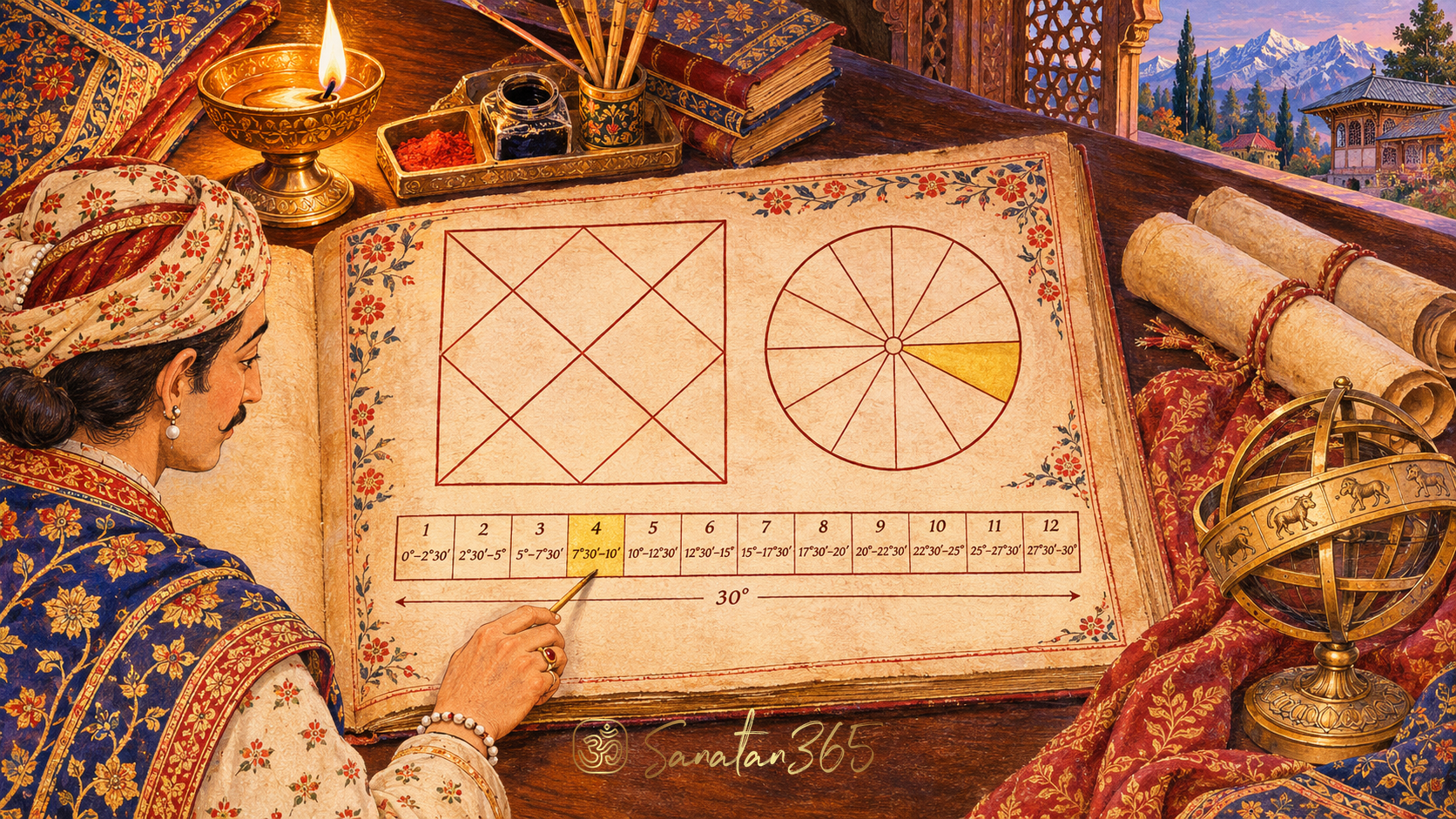
The Dwadashamsha chart meaning starts with its name. Dvādaśāṃśa (द्वादशांश, a twelfth part) divides every 30-degree zodiac sign into twelve equal segments of 2°30′ each. Each segment receives a zodiac sign, counting from the original sign. In traditional Vedic astrology, the resulting chart is associated with parents.
What is the Dwadashamsha chart meaning?
Dwadashamsha, also written Dvadashamsha, is a varga (वर्ग, a division or divisional grouping) in jyotiṣa (ज्योतिष, the traditional Indian astral discipline). The number twelve in D12 tells a reader how many parts to mark inside each sign. The whole zodiac still has its familiar twelve signs. The subdivision makes a second way to label a position already known from the birth chart.
A rāśi (राशि, zodiac sign) spans 30 degrees in this system. Divide that span by twelve and each part measures two and a half degrees. Since one degree has sixty arcminutes, a half degree is thirty arcminutes. Therefore 2.5° and 2°30′ describe exactly the same size. A reader who mistakes 2°30′ for 2.30° will move the boundary and may assign the wrong part.
The Sanskrit text of Brihat Parashara Hora Shastra 6.15 gives the counting instruction. It says to begin from the respective sign. In practice, the first twelfth of Aries is assigned Aries, the first twelfth of Taurus is assigned Taurus, and the first twelfth of Gemini is assigned Gemini. From each starting sign, the labels continue in the ordinary zodiac order. This starting point is the part of the rule that makes the result specific to D12.
The full D12 chart repeats the process for each point included by the chart maker. A table can show an original sign and degree in one column and its D12 sign in another. The original position is still useful, since the derived label can always be traced back to it. A kuṇḍalī (कुण्डली, birth chart) records the original placements. The guide to planet degrees in a Kundali explains how to read that input.
Key takeaway: Twelve equal parts establish the intervals, and the source sign establishes where to begin counting.
How is a D12 sign calculated?
Start with a sign and its precise longitude measured from the beginning of that sign. If a table shows full zodiac longitude, first identify the 30-degree sign sector and subtract its starting longitude. For example, 38°10′ around the zodiac, counted from the start of Aries, is 8°10′ into Taurus. A table that already says Taurus 8°10′ has done that conversion.
A reliable pencil-and-paper method uses arcminutes. Convert the in-sign position by multiplying its degree value by sixty and adding the minutes. There are 150 arcminutes in each D12 interval. Divide the position in arcminutes by 150 and take the whole-number quotient. That quotient counts complete intervals already passed. Add one if the aim is to write the segment number.
The first interval begins at 0°00′ and ends just before 2°30′. A position at exactly 2°30′ belongs to the second interval. This is the ordinary mathematical convention of including the lower boundary and excluding the upper one. Near a boundary, use the fullest precision available. A printed 2°30′ can be a rounded display of a position that falls slightly earlier. The precise input can settle which segment contains it.
With the segment number in hand, count the original sign as one. Move forward one zodiac sign for each additional segment. The first part has no forward move, the second has one, and the third has two. When the sequence passes Pisces, continue with Aries. A number obtained by division is only an interval index until the original sign is used to translate it into a zodiac label.
Other divisional charts use their own rules. The drekkāṇa (द्रेक्काण, a third of a sign), or D3 chart, for instance, divides each sign into three 10-degree parts. Knowing how to make a D3 helps a reader recognize the general idea of dividing a sign. The D12 label still has to come from the specific rule for the twelve parts.
Key takeaway: Find the position inside the source sign, identify its 150-arcminute segment, and count that segment from the source sign itself.
What does a worked Taurus example show?
Take the illustrative position of 8°10′ Taurus. Eight degrees contribute 480 arcminutes, and the remaining ten bring the total to 490. Three complete intervals of 150 minutes occupy 450 minutes. A fourth complete interval would need 600 minutes. The position therefore lies in segment four, which begins at 7°30′ and ends just before 10°00′.
The first five intervals of Taurus show the relationship at a glance:
- Segment 1, 0°00′ to just before 2°30′: Taurus.
- Segment 2, 2°30′ to just before 5°00′: Gemini.
- Segment 3, 5°00′ to just before 7°30′: Cancer.
- Segment 4, 7°30′ to just before 10°00′: Leo.
- Segment 5, 10°00′ to just before 12°30′: Virgo.
Count Taurus, Gemini, Cancer and Leo. Leo is the D12 label for this example. If a second position were exactly 10°00′ Taurus, it would enter segment five and receive Virgo. Those two derived labels can differ even though both underlying positions are in Taurus. That is the purpose of keeping the original reading and the division together on the page.
A second pencil check can catch mistakes in the starting sign. The same 8°10′ inside Gemini would also occupy segment four. The count would now run Gemini, Cancer, Leo and Virgo. The segment number stays the same, and the derived sign changes. Starting all counts from Aries would lose that distinction. Counting the source sign as zero when using a one-based segment number would also move every result one sign ahead.
There is a useful end check as well. The last segment of Taurus, starting at 27°30′, is the twelfth count from Taurus. It therefore corresponds to Aries, the sign immediately before Taurus in the zodiac order. At the next 30-degree boundary the source sign itself changes to Gemini, so the next sign's first interval starts a fresh count.
Key takeaway: In the example, 8°10′ Taurus is in segment four, which gives Leo when Taurus is counted first.
Why is the D12 traditionally associated with parents?
The traditional topic comes from a separate instruction. The Sanskrit text of Brihat Parashara Hora Shastra 7.3 assigns different areas of inquiry to different divisions and names parents in connection with the twelfth division. The passage explains why traditional explanations often introduce D12 under a heading about parents or family background.
The distinction between the two chapters matters. The calculation gives a derived sign from a defined input. The association with parents gives a topic that traditional interpreters consider when using the chart. Chapter 7.3 does not say that the example's Leo label by itself tells a reader something determinate about a parent. It supplies the traditional area of inquiry rather than a complete interpretation for any individual placement.
A reader may also encounter the word lineage in modern descriptions. It can serve as a broad label for the discussions grouped around the D12. The passage cited here specifically mentions parents. It is helpful to keep that narrow textual wording in view when later explanations widen the scope. A family history and a symbolic chart are different kinds of information, and a chart placement cannot establish a fact about a relative's life.
This is a useful boundary for beginners reading a chart report. A calculation can be checked independently and reproduced on paper. An interpretation should be understood as belonging to the traditional framework and read with its context. Neither the arithmetic nor the cited passage guarantees an outcome for an individual family.
Key takeaway: The traditional parent association is a topic for interpretation. The division rule is a separate, reproducible calculation.
How can readers check a D12 chart against the birth chart?
Begin with a single point and put the original position next to the derived one. Use the same chart settings for both readings, including the zodiac convention. Confirm whether the longitude is measured within a sign or across all twelve signs. Then count the twelve-part interval using the most precise value the software makes available. Working one point by hand is often enough to identify where two displays diverge.
If one chart shows a difference near a segment boundary, first check whether the degree label is rounded. If the source sign differs, compare the calculation settings and inputs before interpreting the D12. For the ascendant, the exact birth time and place matter to the underlying calculation, so a change to that input can also change the derived result. A mismatch calls for checking the original values before drawing an interpretive conclusion.
A diagram can introduce a second source of confusion. In a North Indian chart, the diamond and triangular compartments serve as positions within a house layout. The sign labels and any placement markers have to be read in that convention. A chart whose compartments look like the birth chart can still carry a different set of derived signs. Look for the chart's D12 label and refer to the original position table when checking a result.
The guide to navāṃśa (नवांश, a ninth of a sign) provides a comparison with another common divisional chart. Together the examples show why a label such as D9 or D12 matters. Each division has a particular interval size and assignment rule. A reader can trace the arithmetic before considering what a traditional reading makes of it.
When two tools agree on the original position but disagree on the derived sign, note the exact inputs before asking how each tool defines D12. For instance, a worksheet might list an interval number separately from its zodiac label. The number four in the Taurus example means the fourth segment, whereas Leo is the sign assigned by counting from Taurus. Keeping those fields separate makes it easier to share a calculation with another reader and identify the step that needs checking.
Key takeaway: Keep the original sign and degree beside the derived sign. That simple comparison makes the D12 readable and lets the reader check the calculation before interpreting it.
FAQ
How many degrees are in one D12 part?
Each part spans 2°30′, or 150 arcminutes. Twelve of these equal parts fill one 30-degree zodiac sign.
Where does the D12 sign count start?
It starts with the original sign. For a position in Taurus, the first segment is assigned Taurus, the second Gemini, and so on through the normal zodiac order.
Is the D12 the same as the twelfth house?
The D12 name refers to the division of each sign into twelve parts. The twelfth house is a location within a chart's house system. They describe different things.
What is the D12 associated with in traditional astrology?
The cited Brihat Parashara Hora Shastra passage links the twelfth division with consideration of parents. That association supplies traditional context for the chart and does not determine an outcome for a particular family.
About the author
Sanatan365 Editorial
Bringing Sanatan Dharma to modern seekers through authentic, scripture-grounded content.
Related in Kundali
 Kundali
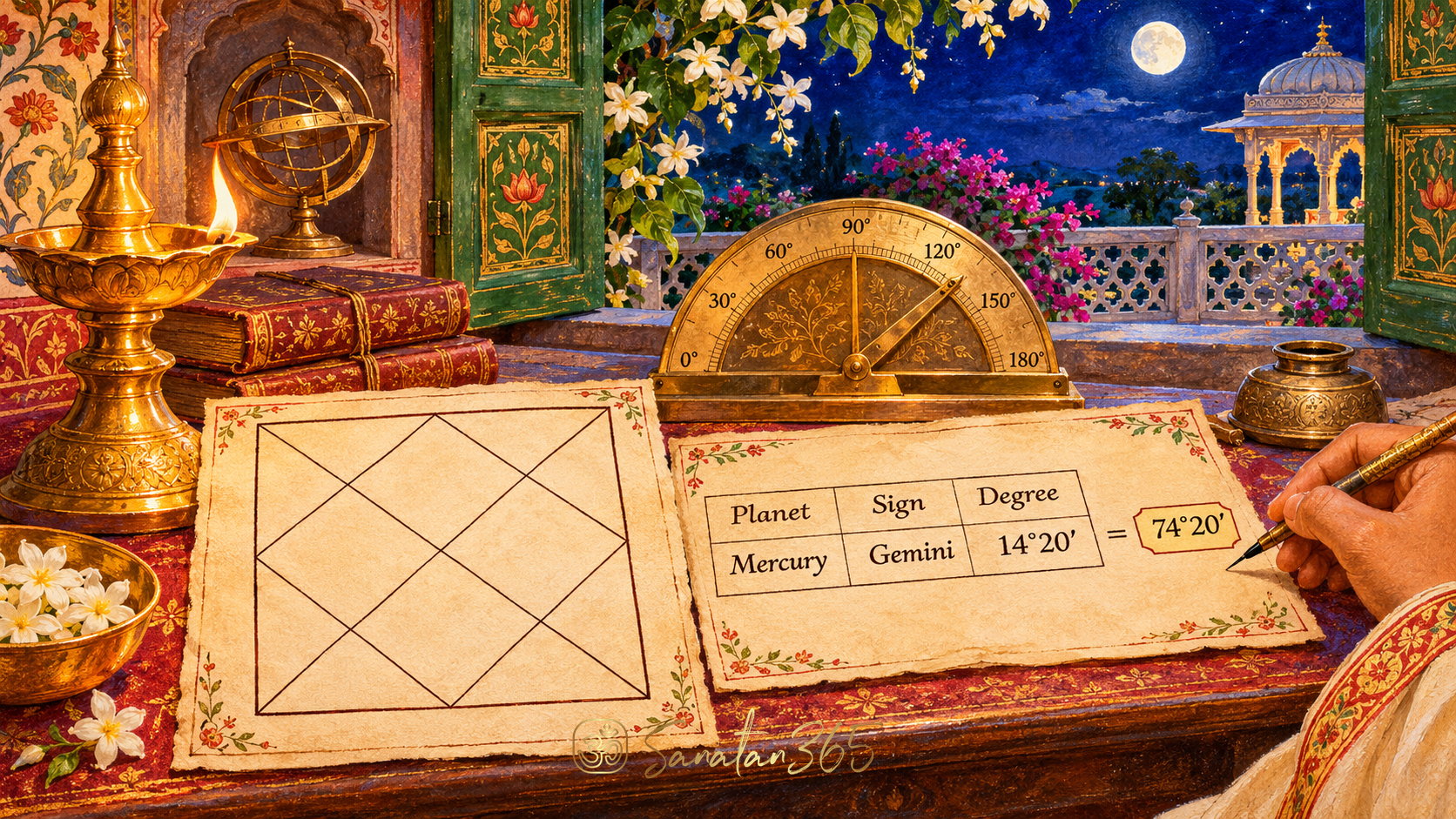
Planet Degrees in Kundali: Reading a Position Before Interpreting It
Learn to read a planet’s sign, degree, minute and second as an address, then check the entry before turning to interpretation.
 Kundali
Asta Graha Meaning: Reading Combust Planets Without Fear
Understand combustion in a birth chart through angular distance, solar glare and the difference between a traditional condition and a verdi…
 Kundali
Vakri Graha Meaning: Reading Retrograde Planets in a Kundali
A retrograde marker describes apparent planetary motion, not a verdict on a life. Learn how to read R and Rx in a Kundali without fear or f…

