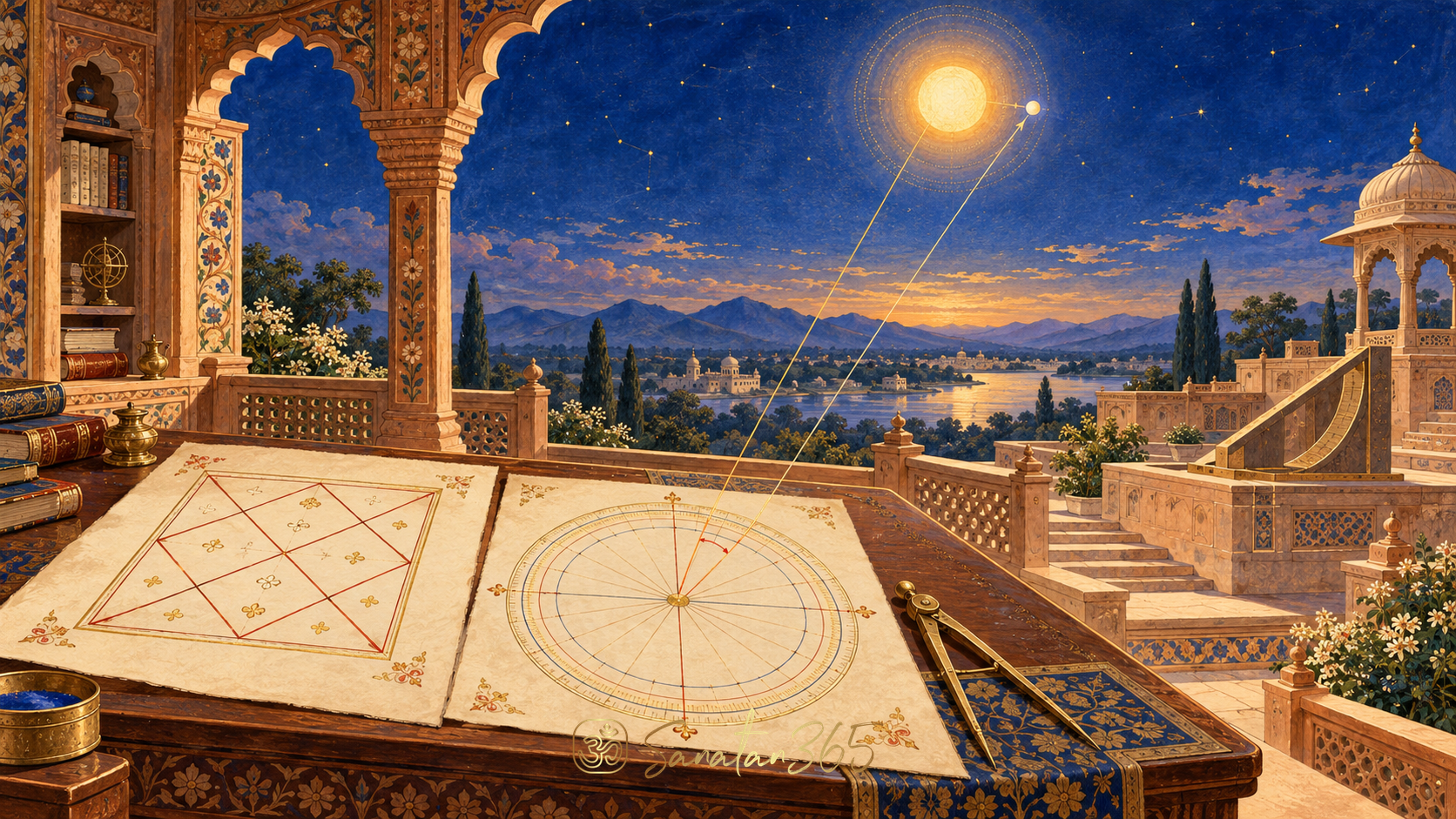
Asta Graha Meaning: Reading Combust Planets Without Fear
Understand combustion in a birth chart through angular distance, solar glare and the difference between a traditional condition and a verdict on someone’s life.
A planet can disappear into the Sun’s glare without disappearing from the sky. That distinction is a useful place to begin reading a birth chart.
Asta Graha meaning refers to a planet considered combust because it lies within a tradition-defined angular distance of the Sun. Asta (अस्त, setting or disappearance) and graha (ग्रह, a planetary factor in Hindu astrology) describe a condition used in Jyotisha (ज्योतिष, the traditional discipline of celestial calculation and interpretation). It is not a statement that a planet has physically burned, nor proof that a person’s abilities, relationships or future are damaged.
The most helpful first question is therefore not “How bad is this?” It is “What was measured, and which interpretive rule was used?” A clear answer makes room for respectful study without turning a technical label into a source of fear.
Asta Graha meaning: what does the label actually describe?
The English word combustion sounds dramatic. In everyday speech, combustion means burning. In a horoscope, however, it names an astrological condition associated with proximity to the Sun as seen from Earth. The planet continues along its orbit; the label is not an account of a physical fire.
The observational background is understandable. A comparatively faint object becomes difficult to distinguish near a brilliant source of light. A planet close to the Sun in the sky can be hidden by solar glare even though it still exists and moves normally. The traditional interpretation built around that relationship is a further step, not the same thing as the observation.
Drik Panchang’s explanation of planetary combustion describes the association with poor visibility near the Sun and records regional terms including moudhya, a name for the combustion condition. Its explanation also shows why a single universal cutoff is an inadequate introduction: the rule it cites for Venus distinguishes forward and retrograde motion.
Three layers should be kept separate:
- The sky relationship: where the Sun and another planet appear relative to each other.
- The calculation convention: which angular threshold a source or calculator applies.
- The interpretation: what a particular astrological school makes of that condition in a chart.
The first two can be described and checked. The third belongs to a traditional interpretive framework. Measurable positions do not, by themselves, establish predictions about someone’s character or future.
This distinction also protects the dignity of the reader. A chart condition is not a moral failing, a measure of devotion, or a reason to treat a child or prospective partner as deficient. Cultural literacy becomes more useful when it describes a tradition accurately without attaching a person’s worth to its categories.
Key takeaway: Combustion is a technical condition within an interpretive tradition, not literal burning or a verdict on a life.
How is Sun–planet separation read in a birth chart?
A Kundali (कुण्डली, a birth chart) usually records positions using the zodiac. A rashi (राशि, a zodiac sign) occupies thirty degrees of that circle. To understand a combustion label, a reader needs more than the names of the signs: the positions within them matter too.
Consider a deliberately simplified example. Suppose the Sun is at 28 degrees of one sign and a planet is at 2 degrees of the next. The two positions are only four degrees apart along the zodiac, although the sign names differ. Conversely, two bodies in the same sign can be much farther apart than a quick glance at the chart suggests.
The full circle introduces another easily missed detail. A position at 359 degrees and one at 3 degrees are four degrees apart along the shorter arc, not 356 degrees apart. That is arithmetic, not an astrological prediction. It illustrates why labels should come from a stated method rather than visual guesswork.
For a basic longitude-based check:
- Record the Sun’s zodiacal longitude.
- Record the planet’s longitude in the same coordinate convention.
- Find their smaller separation around the circle.
- Identify the planet-specific threshold and motion rule used by the source.
- Keep the calculation separate from any interpretation added afterward.
This simple exercise is not a replacement for a complete visibility model. Longitude difference on the zodiac and apparent separation across the sky are related but not identical quantities. Latitude, observing conditions and the calculator’s chosen method can matter. A traditional horoscope flag and a location-based visibility calendar need not be calculating exactly the same thing.
NASA’s account of conjunction and elongation supplies useful astronomical vocabulary. Elongation is a planet’s apparent angular distance from the Sun. Solar conjunction describes an alignment in which a planet appears near the Sun from Earth. Neither word carries an automatic prediction about human affairs.
For Venus, Drik Panchang cites approximate traditional limits of ten degrees during forward motion and eight during retrograde motion, while explaining that its displayed calendar timings use location-based algorithms. These figures belong to that stated example. They should not be copied as the rule for every planet or every school.
Readers do not need to memorize a table before asking a useful question. “Which threshold does this software use?” often clarifies more than an alarming red symbol beside a planet’s name.
Key takeaway: Ask for actual positions, the shorter separation and the source of the cutoff; sharing a zodiac sign is not enough information.
Is combustion the same as retrograde motion or an eclipse?
Several chart labels describe different relationships. Treating them as interchangeable creates confusion before interpretation even begins.
Vakri (वक्री, apparently moving backward) describes retrograde motion: a reversal in a planet’s apparent movement against the background sky as observed from Earth. Combustion concerns proximity to the Sun under the chosen rule. A planet can be discussed in terms of both conditions, but neither label is a definition of the other.
The distinction is explored further in this explanation of retrograde planets in a Kundali. It is a separate reader question, not another name for combustion.
An eclipse involves a more specific alignment and obscuration. A conjunction is not automatically an eclipse. Mercury and Venus can pass near the Sun in our sky without crossing its visible face. NASA distinguishes an inferior conjunction, with an inner planet approximately between Earth and Sun, from a superior conjunction, with the Sun approximately between Earth and that planet. The geometry matters; “near the Sun” is not a complete description of every event.
Nor should the word combustion be confused with physical temperature. Venus is a hot planet for reasons investigated by planetary science. Its being marked combust in a horoscope is not a report that its temperature suddenly changed at a chart threshold.
A final distinction concerns timing. A birth-chart label refers to the positions calculated for a particular birth moment. A public calendar of planetary setting and reappearance describes a changing period in the sky. Seeing the same term in both settings does not make the two questions identical.
This matters when a family sees a calendar notice and assumes that everyone born during the entire period must share the same interpretation. A calendar entry does not supply the rest of an individual chart, still less the actual circumstances of a person’s life.
Key takeaway: Combustion, retrograde motion, conjunction and eclipse describe different conditions; one label should not be used as shorthand for all the others.
Why do traditional interpretations need the whole chart?
Even within Jyotisha, an isolated label does not contain an entire interpretation. Readers encounter discussions of sign position, house placement, planetary relationships and timing systems. These belong to the tradition’s broader structure; combustion is one condition among them.
A bhava (भाव, a horoscope house) is a chart division associated with an area of life. Lagna (लग्न, the ascendant) is the rising zodiacal point used to orient many chart readings. A condition attached to a planet does not tell a reader all the other placements or the reasoning used to combine them. The introduction to Lagna and birth time explains why the chart’s orientation is itself a separate calculation.
The same caution applies to the word strength. In ordinary language, “weak” can sound like an insult. In an astrological discussion it may refer to a technical classification, not someone’s intelligence, goodness, effort or capacity to love. The guide to Shadbala, six traditional measures of planetary strength, helps distinguish an internal scoring framework from a ranking of human beings.
A careful practitioner should be able to say which part of the interpretation comes from a calculation, which comes from a textual or teaching tradition, and which remains uncertain. “The software marks this planet combust” is narrower and more accountable than “Your future is ruined.”
The broader chart should not become an excuse for unlimited claims either. Adding more factors can make an interpretation more complex without turning it into verified knowledge of future events. Respect for a tradition and honesty about its limits belong together.
For everyday decisions, the person remains more important than the label. Education depends on learning opportunities and sustained work; relationships depend on communication, consent and conduct. No combustion flag justifies ignoring evidence about those realities or denying someone fair consideration.
Key takeaway: Whole-chart context matters within the tradition, but neither context nor complexity makes deterministic promises justified.
What should a reader ask before accepting a prediction?
The most constructive response to an unfamiliar chart condition is a short, calm source check. It does not require an argument about belief. It asks the explanation to become precise enough to understand.
Start with the calculation
Ask which planet is being discussed, its position, the Sun’s position and the measured separation. Ask which motion state and threshold the calculator uses. If two applications disagree, compare their stated settings before assuming that one has discovered a hidden danger.
It also helps to ask whether the result is a birth-chart flag or an observing-calendar entry. A screenshot without a date, method or context can make a limited calculation look more universal than it is.
Ask where the interpretation comes from
A useful explanation should identify its teaching source and acknowledge where methods differ. A quotation presented without a source is not strengthened by dramatic language. Equally, a modern web article should not be silently treated as an exact translation of an ancient text.
This article uses a documented calendar explanation for the combustion concept and NASA for astronomical terminology. It does not claim to settle every classical rule or supply a personalized horoscope reading.
Keep agency and ordinary responsibilities intact
An explanation that immediately demands an expensive object, an urgent payment or a major life decision deserves scrutiny. No purchase can be promised to erase a celestial arrangement or guarantee a result. Devotional practice, if freely chosen, can remain an expression of faith rather than a transaction made under pressure.
For ceremonies, families in different regions may follow different calendar customs. Anyone seeking a ritual date can consult their own trusted priest or community calendar and ask which local convention is being followed. A date custom should not be expanded into a judgment about someone’s worth.
The practical standard is simple: the explanation should leave the reader better informed, not dependent on escalating fear. If a chart discussion begins to replace direct knowledge of a person, pause and return to the actual situation.
Key takeaway: A responsible reading names its method, distinguishes calculation from interpretation and leaves room for informed human choice.
The clearest way to understand combustion is to hold two ideas together: its celestial geometry can be examined, while the meanings attached to it remain part of a traditional interpretive system. The central takeaway is to read the condition accurately without making a human life smaller than a chart label.
FAQ
Does Asta Graha mean that a planet is physically burning?
No. In this context, combustion is an astrological term associated with angular proximity to the Sun. It does not mean the planet catches fire or stops existing.
Is every planet in the Sun’s zodiac sign combust?
Not necessarily. Sign membership alone does not establish the required angular separation. The planet’s degree, the Sun’s degree and the stated threshold must be checked; proximity can also cross a sign boundary.
Is a combust planet always bad?
That is too sweeping a conclusion. Schools interpret chart conditions in context, and the label does not establish guaranteed outcomes. It should never be used to declare a person unworthy or a future hopeless.
Why might two calculators give different results?
They may use different thresholds, motion rules, settings or calculation purposes. A longitude-based birth-chart flag and a location-based visibility calendar can answer different questions. Ask for the method before comparing interpretations.
Is combustion the same as retrograde motion?
No. Retrograde motion describes apparent backward movement against the background sky. Combustion concerns proximity to the Sun under a stated convention. They are separate conditions even when both appear in one chart.
About the author
Sanatan365 Editorial
Bringing Sanatan Dharma to modern seekers through authentic, scripture-grounded content.
Related in Kundali
 Kundali
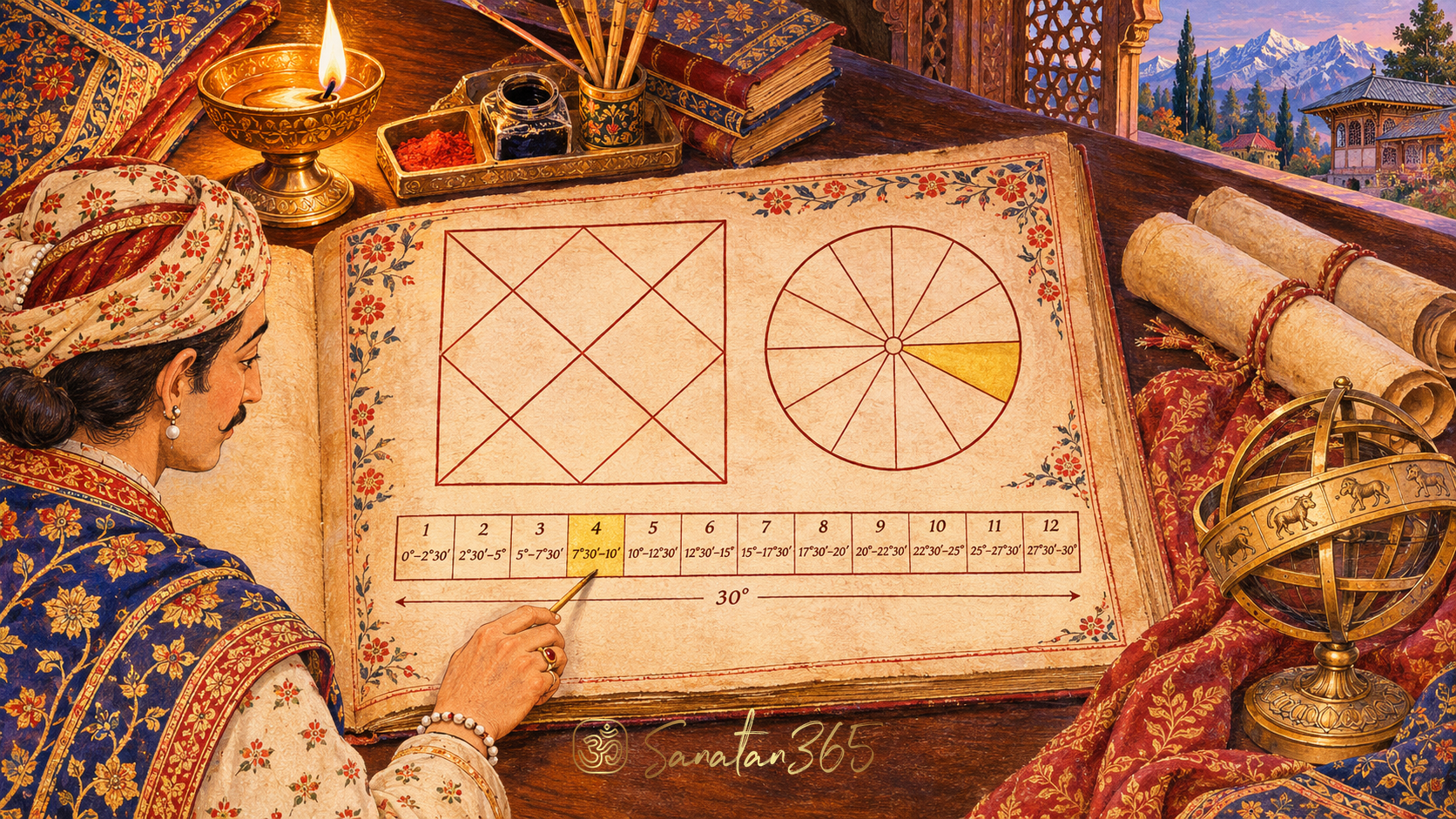
Dwadashamsha Chart Meaning: How D12 Is Calculated
Follow a worked Taurus example to see how the D12 divides a sign into twelve equal parts and why the traditional chart is associated with p…
 Kundali
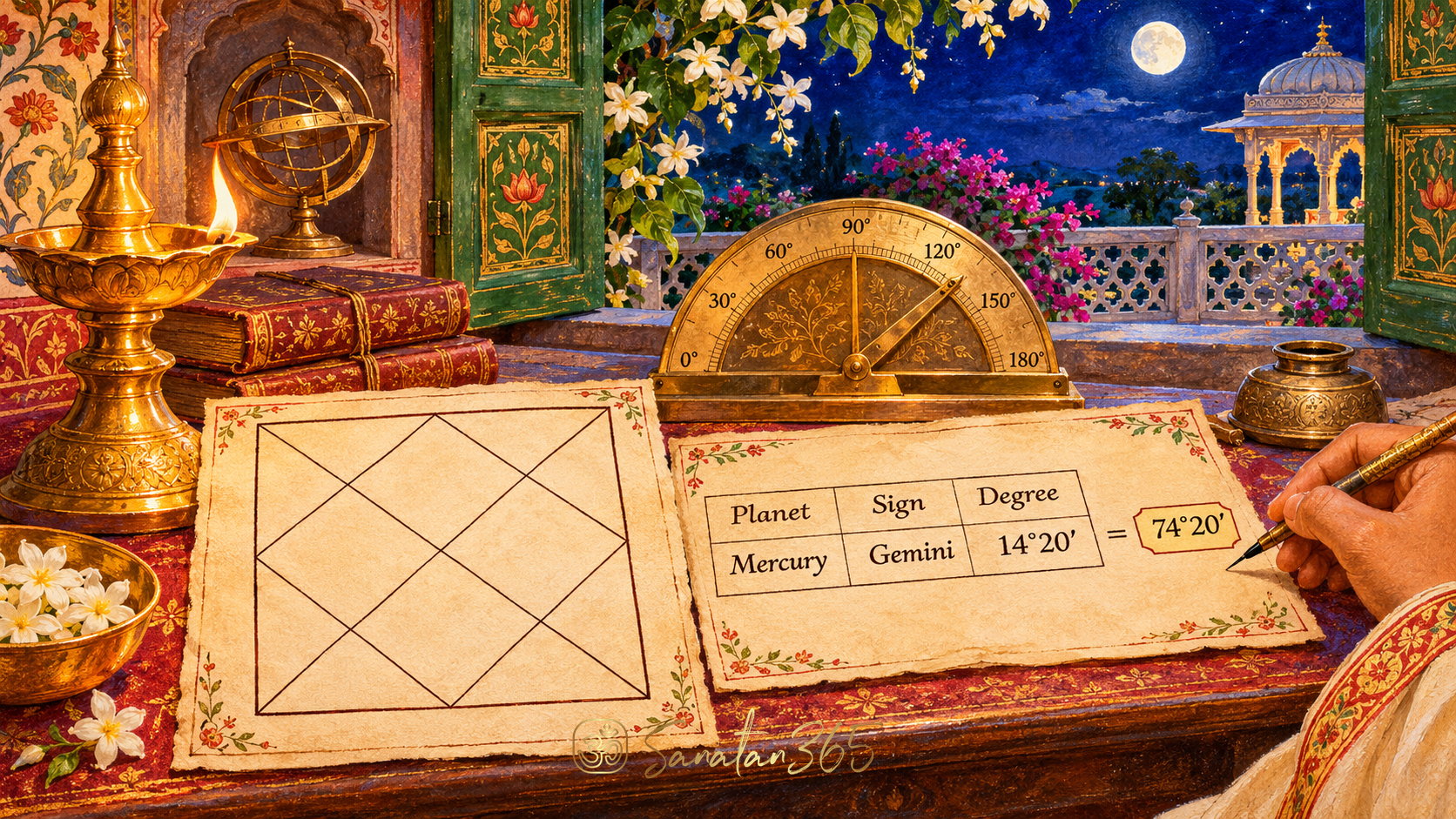
Planet Degrees in Kundali: Reading a Position Before Interpreting It
Learn to read a planet’s sign, degree, minute and second as an address, then check the entry before turning to interpretation.
 Kundali
Vakri Graha Meaning: Reading Retrograde Planets in a Kundali
A retrograde marker describes apparent planetary motion, not a verdict on a life. Learn how to read R and Rx in a Kundali without fear or f…

