Prahlada Story Meaning: Devotion, Courage, and the Presence of Vishnu
The Prahlada story shows how bhakti can remain steady even under pressure, and why the Narasimha episode is remembered as a teaching on divine presence.
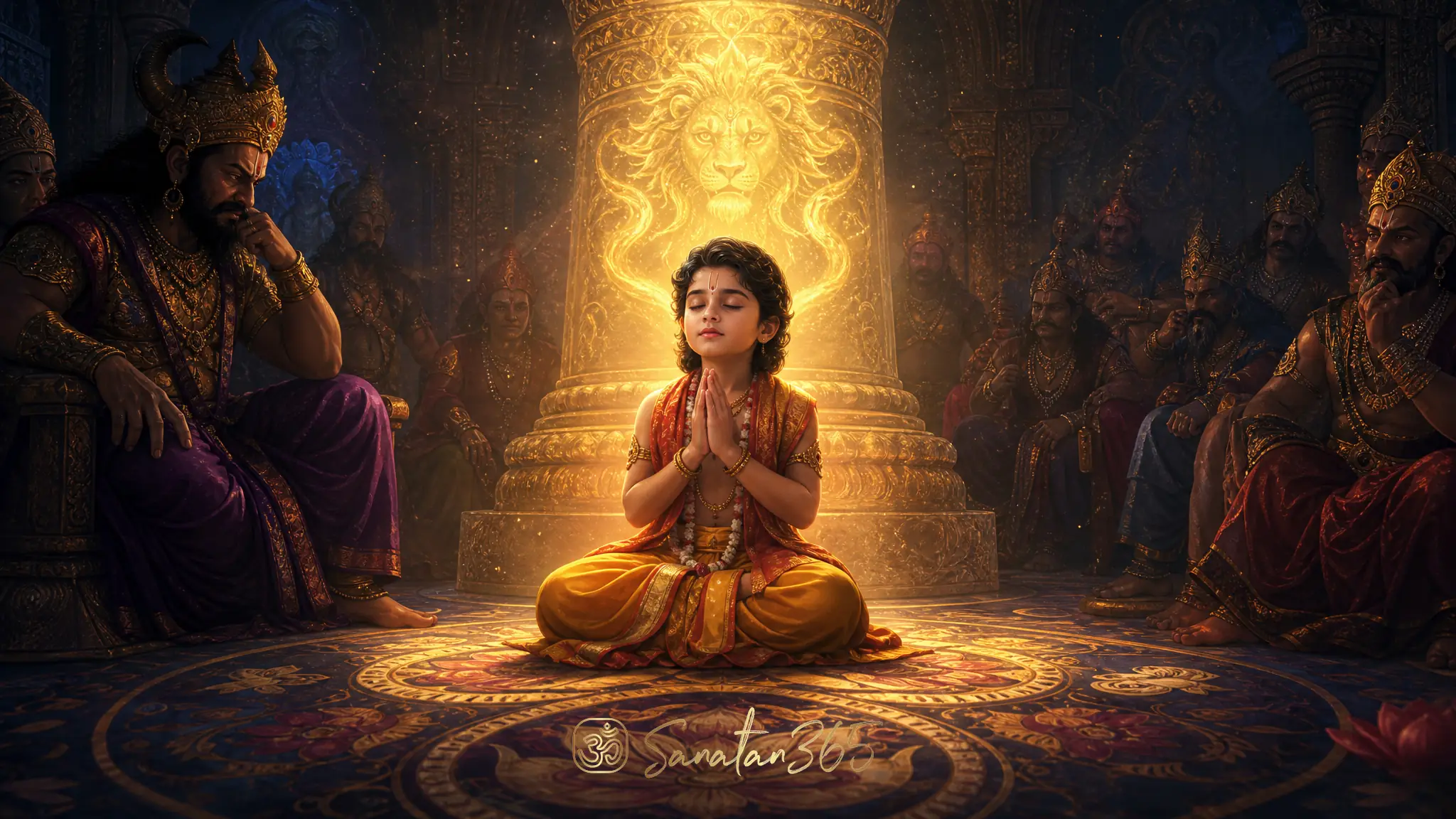
A child in a royal court says that the Divine is present even inside a pillar.
The Prahlada story meaning is that bhakti (भक्ति, loving devotion) is not weakness; it is steady trust in dharma (धर्म, sacred order) when fear, power, and pressure try to bend the heart. In Hindu tradition, Prahlada is remembered as a young devotee of Lord Vishnu who remained inwardly fearless before his father Hiranyakashipu. The story reaches its turning point when Vishnu appears as Narasimha, the man-lion avatara, to protect Prahlada and restore cosmic balance.
This story is best known through the Bhagavata Purana and Vishnu Purana traditions, and it also echoes through Holika Dahan, Narasimha worship, family storytelling, and the daily language of courage. Encyclopaedia Britannica summarizes Prahlada as an ardent devotee of Vishnu who refused to worship his father, while its Narasimha entry preserves the famous pillar moment in which Vishnu appears between ordinary categories of man and animal, day and night, indoors and outdoors. Britannica, Prahlada Britannica, Narasimha
Key takeaway: Prahlada is not only a miracle story; it is a teaching on how devotion can stay clear when the world becomes threatening.
What is the Prahlada story meaning in Hindu tradition?
The Prahlada story meaning begins with a contrast between outer power and inner steadiness. Hiranyakashipu, an asura king, gains a formidable boon and becomes proud of his strength. His son Prahlada, however, grows devoted to Vishnu, the preserver and sustainer of the universe. In many tellings, Prahlada learns devotion even before birth through the influence of Sage Narada, which gives the story a tender spiritual logic: a child can receive sacred impressions before the world tries to educate them otherwise.
Hiranyakashipu does not merely dislike Prahlada's devotion. He sees it as disobedience. To the king, worship belongs to power; to Prahlada, worship belongs to truth. This is why the story feels timeless. It asks a question that appears in homes, schools, workplaces, and public life: when authority demands the surrender of conscience, what should a person protect first?
Prahlada's answer is bhakti. He does not answer with rebellion for its own sake. He does not try to humiliate his father. He simply refuses to abandon the Divine presence he knows. In the Bhagavad Gita, Krishna says, "Among the Daityas I am Prahlada" (10.30), placing Prahlada among the great signs of divine excellence even though he is born into an asura lineage. Bhagavad Gita 10.30
That detail matters. Hindu stories often resist simplistic labels. Prahlada's birth family does not define his spiritual destiny. His devotion does. A child born in a hostile setting becomes a model of sacred remembrance. A palace built around ego becomes the place where Vishnu's presence is revealed.
Key takeaway: Prahlada teaches that spiritual identity is shaped by truth, devotion, and conduct, not by inherited surroundings alone.
Why does Hiranyakashipu oppose Prahlada's devotion?
Hiranyakashipu opposes Prahlada because devotion to Vishnu exposes the limits of his own power. The king's anger is not only political; it is spiritual insecurity. He has received a boon meant to make him difficult to kill: not by man or animal, not inside or outside, not by day or night, not on earth or in the sky, and not by ordinary weapon. Such protections make him feel beyond consequence.
Prahlada quietly challenges that illusion. He reminds his father that Vishnu is not a rival king somewhere else. Vishnu is present everywhere. This is the central theological force of the story: if the Divine is omnipresent, then no palace, throne, weapon, or argument can create a place where dharma is absent.
In the most famous scene, Hiranyakashipu asks whether Vishnu is present in a pillar. Prahlada says yes. The king strikes or challenges the pillar, and Narasimha emerges. The form itself answers the loopholes in the boon. Narasimha is neither fully human nor animal; the moment is twilight, neither day nor night; the threshold is neither indoors nor outdoors; Hiranyakashipu is held on Narasimha's lap, neither earth nor sky; and the claws are not a conventional weapon.
This is not a trick for trick's sake. The story's structure reveals a deeper point: ego tries to secure itself through clever categories, but dharma is not trapped by categories. The Divine response arrives in a form that no legalistic arrogance can control.
The Vishnu Purana and Bhagavata Purana traditions both preserve Prahlada's spiritual stature, and later devotional communities remember him as one of the great bhaktas. His greatness is not in physical force. It is in refusing to let fear redefine reality.
Key takeaway: Hiranyakashipu's downfall is the collapse of pride that believes it can outwit truth.
How does Prahlada show fearless bhakti?
Prahlada's fearlessness is not the absence of danger. It is trust in the presence of Vishnu while danger is real. That distinction keeps the story from becoming shallow inspiration. The child is threatened, pressured, and isolated. Yet he does not become hard-hearted. He remains composed, reverent, and compassionate.
Several traditional tellings describe attempts to harm Prahlada: poison, weapons, elephants, snakes, fire, and other ordeals. The details vary across retellings, but the spiritual pattern is consistent. Every external threat meets an inner remembrance that does not break.
For modern readers, this is where the story becomes practical. Fearless bhakti does not always mean dramatic miracles. It can mean:
- Remembering one's values when social pressure becomes loud.
- Speaking truth without hatred.
- Refusing to make power into an idol.
- Keeping devotion alive in childhood and family life.
- Trusting that dharma has a longer horizon than immediate victory.
Prahlada also shows that devotion is not passive. In the Bhagavata Purana tradition, he teaches other children about remembrance of Vishnu. He is young, but he becomes a teacher. This is one reason families often tell the Prahlada story to children: it honors the spiritual intelligence of the young. A child can be a carrier of truth, not merely a receiver of adult instruction.
At the same time, Prahlada does not become cruel toward his father. After Narasimha appears, Prahlada's prayers are traditionally remembered for humility and compassion. The devotee does not celebrate destruction; he honors the restoration of order.
Key takeaway: Prahlada's courage is devotional steadiness joined with compassion, not aggression.
What is the connection between Prahlada, Holika, and Holi?
The Prahlada story is closely connected with Holika Dahan, the sacred fire observed on the eve of Holi in many communities. In a popular form of the story, Hiranyakashipu's sister Holika has protection from fire. She sits in flames with Prahlada, intending that the child be destroyed. Prahlada prays, remains protected, and Holika is burned. The next day, Holi celebrates renewal, color, and the victory of devotion over destructive pride.
This Holika episode has several layers. Fire can purify, but it can also expose false confidence. Holika's protection is misused for harm, so it fails. Prahlada's vulnerability is held in devotion, so it becomes strength. The lesson is not that ritual power automatically protects a person. The lesson is that power separated from dharma becomes fragile.
Regional Holi traditions vary widely across India and the diaspora. Braj celebrates Krishna's lila with color and song. Many North Indian homes and communities remember Holika Dahan as a moral and devotional night. In some families, elders tell children the Prahlada story before the bonfire, turning the ritual into a living teaching about faith, humility, and the burning away of arrogance.
The story also keeps Holi from being reduced to color alone. Celebration is real, but it rests on a serious inner movement: the movement from fear to trust, from ego to surrender, from domination to devotion.
Key takeaway: Holika Dahan remembers that sacred fire protects dharma, not pride.
Why does Narasimha appear in such an unusual form?
Narasimha appears in a form that is theologically precise and emotionally powerful. The name comes from Sanskrit roots often understood as nara (नर, man) and simha (सिंह, lion). The form is neither ordinary human nor ordinary animal. It is fierce, protective, and impossible for Hiranyakashipu's categories to contain.
This unusual form protects two truths at once. First, the boon is not crudely ignored. The story respects its terms. Second, the boon cannot be used to violate dharma forever. Narasimha's manifestation shows that divine intelligence is subtler than ego's safeguards.
For devotees, Narasimha is often worshipped as a protector who removes fear. Yet the fearlessness he gives is not reckless. It is rooted in surrender. Prahlada does not summon Narasimha as a weapon of personal revenge. Narasimha appears because the fabric of dharma has been strained by cruelty and arrogance.
This is why devotional art often shows Prahlada calm near Narasimha's fierce form. The same divine presence that terrifies ego shelters the devotee. In Hindu thought, divine fierceness is not automatically negative. When directed by dharma, it protects life, restores order, and reveals compassion beneath intensity.
The pillar also matters. A pillar is ordinary architecture, a support inside a building. By appearing from a pillar, Vishnu's presence is revealed in the overlooked and the structural. The sacred is not limited to obvious temples or declared holy places. It can break through the very structure of a tyrant's court.
Key takeaway: Narasimha's form teaches that dharma is precise, protective, and beyond the categories ego tries to control.
What can modern families learn from the Prahlada story?
For families, the Prahlada story offers more than a dramatic tale. It gives a language for raising children with devotion and courage. Prahlada is not praised because he argues loudly. He is praised because he remembers clearly. That is a powerful lesson for children growing up in a world full of competing influences.
Parents can use the story in three grounded ways:
- Teach children that prayer is a source of steadiness, not only a request for outcomes.
- Discuss courage as truthfulness with respect, not defiance for attention.
- Show that Hindu stories carry layered meanings: ethical, devotional, philosophical, and cultural.
The story is also useful for adults. Hiranyakashipu is not only an ancient king; he is a mirror for the part of the human mind that wants control, praise, and immunity from consequence. Holika is a mirror for power used without conscience. Prahlada is a mirror for the inner child who can still trust what is sacred. Narasimha is a mirror for the Divine response that comes when truth must be protected.
In diaspora homes, the Prahlada story can help children connect Holi with meaning, not just color. In India, where many regional tellings are already alive, the story can deepen a familiar festival into reflection. In both settings, the core remains the same: devotion is not escape from the world; it is a way to stand inside the world without losing the soul's direction.
Key takeaway: Prahlada gives families a story of courage that is spiritual before it is heroic.
How should readers remember the Prahlada story today?
The most helpful way to remember the Prahlada story is to hold its balance. It is a story of miracle, but not spectacle alone. It is a story of protection, but not hatred. It is a story of divine fierceness, but also of a child's tenderness.
In daily life, Prahlada's teaching can become simple practices:
- Begin the day with one remembered name of the Divine.
- When pressured, pause before reacting and ask what dharma requires.
- Tell children Hindu stories with both wonder and meaning.
- Let Holi and Holika Dahan include reflection, gratitude, and renewal.
- Remember that no place is spiritually empty if awareness is awake.
The story's final comfort is not that devotees will never face trials. Prahlada faces many. The comfort is that devotion can remain unbroken, and that divine presence is not absent even in the court of fear.
Key takeaway: The Prahlada story remains alive whenever devotion becomes steadier than fear.
FAQ
What is the main Prahlada story meaning?
The main Prahlada story meaning is that true bhakti, or loving devotion, remains steady even under fear and pressure. Prahlada's faith in Vishnu shows that dharma is stronger than pride, cruelty, or worldly power.
Who was Prahlada's father?
Prahlada's father was Hiranyakashipu, an asura king who opposed Vishnu and demanded worship for himself. The conflict between father and son becomes a spiritual contrast between ego-driven power and God-centered devotion.
Why did Lord Vishnu appear as Narasimha?
Lord Vishnu appeared as Narasimha to protect Prahlada and restore dharma while honoring the conditions of Hiranyakashipu's boon. Narasimha is neither fully human nor animal, and the episode unfolds at twilight on a threshold, beyond the categories Hiranyakashipu tried to control.
How is Prahlada connected to Holi?
Prahlada is connected to Holi through the Holika Dahan story. Holika tries to burn Prahlada, but his devotion protects him and Holika is destroyed. Many communities remember this as the victory of devotion and humility over arrogance.
What can children learn from Prahlada?
Children can learn that courage does not always mean physical strength. Prahlada shows courage through prayer, truthfulness, respect, and steady trust in Vishnu even when adults around him misuse power.
The Prahlada story endures because it speaks to every age: when fear asks the heart to bow, devotion reminds it where to stand.
About the author
Sanatan365 Editorial
Bringing Sanatan Dharma to modern seekers through authentic, scripture-grounded content.
Related in Stories
 Stories
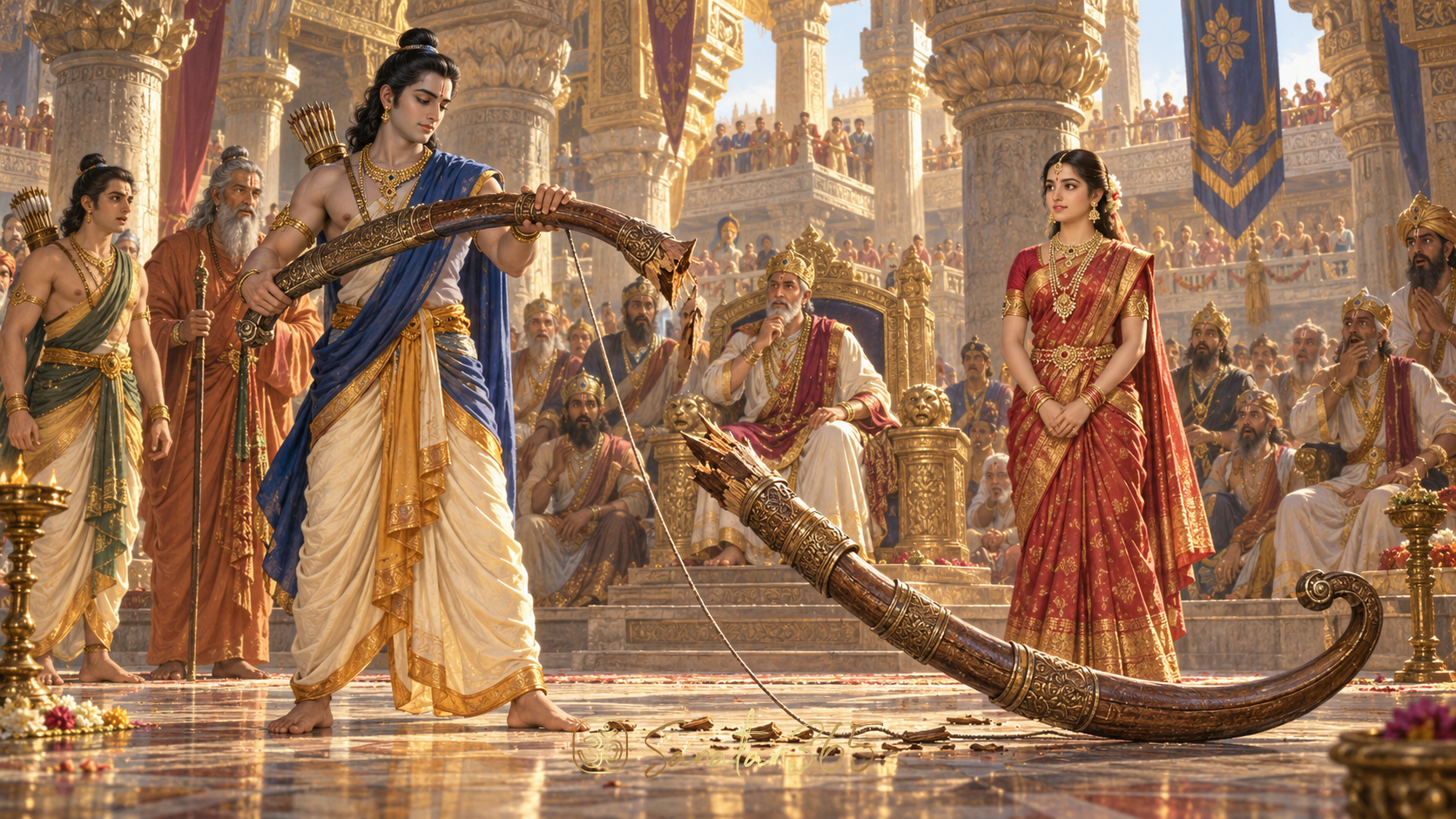
Sita Swayamvara in the Ramayana: Shiva's Bow and the Meaning of the Marriage
Read the Bala Kanda account of Rama, Sita, Janaka and Shiva's bow, and separate the text's sequence from later devotional retellings.
 Stories
King Chitraketu Story: Grief, Wisdom, and Humility in the Bhagavata
The Bhagavata Purana tells how King Chitraketu met devastating loss, listened to Narada and Angira, and learned a difficult humility. Read…
 Stories
King Ambarisha and Durvasa: A Story of Devotion and Humility
The Bhagavata Purana story of King Ambarisha and Sage Durvasa explores a difficult fast, an angry visitor, and the restraint behind devotio…