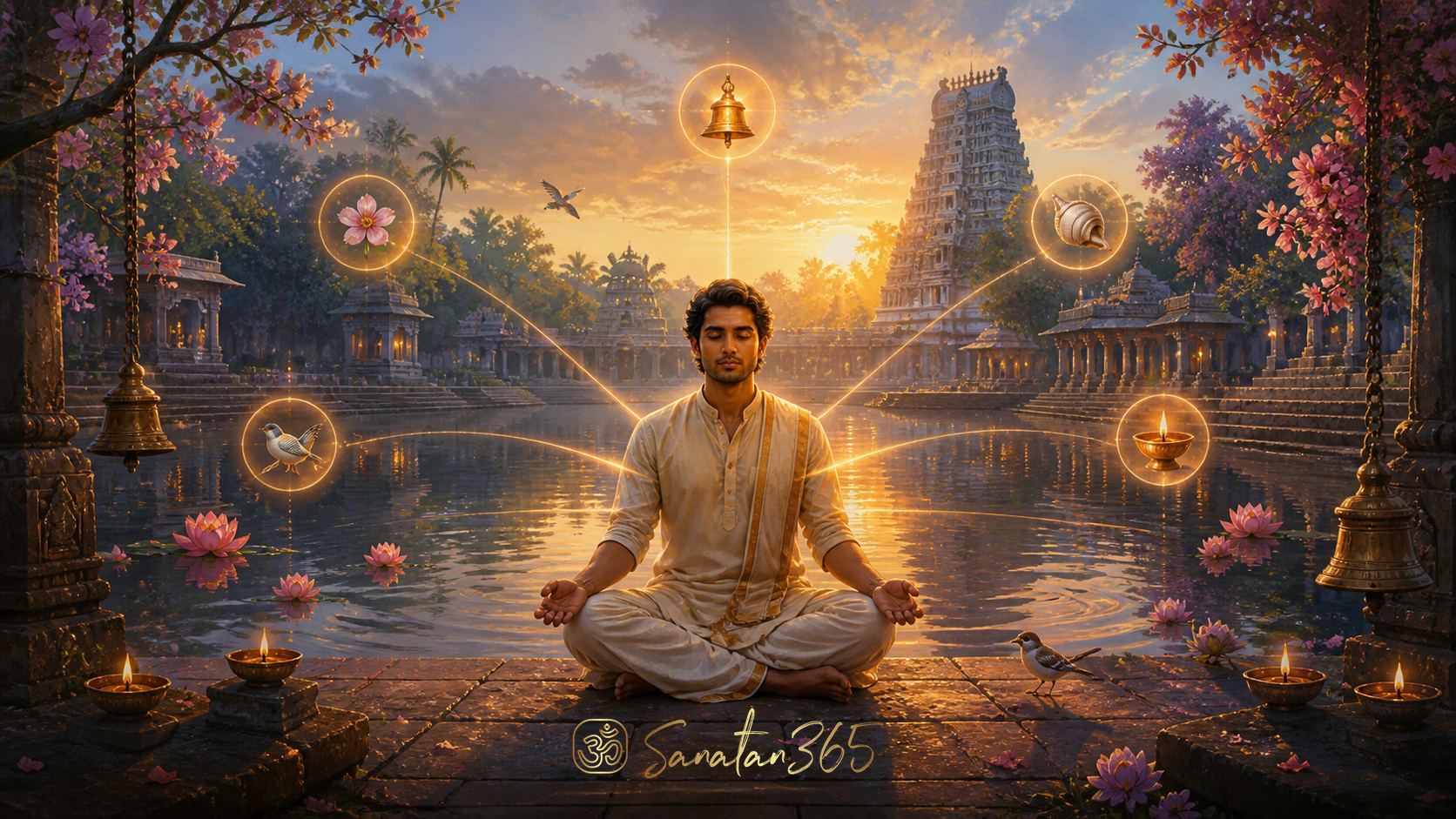
Pratyahara Meaning: How Yoga Gathers the Senses and Reclaims Attention
Pratyahara is Patanjali's practice of gathering the senses inward. Learn its scriptural meaning, what it is not, and a gentle way to practise it daily.
The most overlooked limb of yoga begins when a sound is heard without being obeyed. Pratyahara meaning comes from prati (प्रति, back or toward) and ahara (आहार, intake or nourishment): it is the disciplined gathering of the senses away from automatic pursuit and toward inner steadiness. In Patanjali's eight-limbed yoga, pratyahara is the fifth limb, the bridge between outward practices such as posture and breath regulation and inward practices such as concentration and meditation.
Pratyahara does not require rejecting the world, silencing every sound, or becoming numb. It teaches a subtler freedom: sights, sounds, tastes, scents, and sensations may be present without constantly pulling the mind outward. Attention learns that it can receive an impression without chasing it.
What Is Pratyahara Meaning in Patanjali's Yoga Sutras?
Patanjali lists pratyahara (प्रत्याहार, withdrawal or gathering of the senses) in Yoga Sutra 2.29 as the fifth of the eight limbs of yoga. The first four limbs prepare conduct, body, and breath: yama (ethical restraint), niyama (personal observance), asana (steady posture), and pranayama (regulation of vital breath). The final three train inward attention: dharana (concentration), dhyana (meditation), and samadhi (absorbed contemplation). Pratyahara stands at the threshold between them, a structure also reflected in Encyclopaedia Britannica's overview of Yoga.
Yoga Sutra 2.54 describes the senses as ceasing to follow their external objects and taking on, as it were, the nature of the mind. Sutra 2.55 then says this brings the highest mastery of the senses. These compact statements do not describe damaged or inactive senses. They describe senses no longer ruling attention through habit.
A useful image is a tortoise drawing in its limbs. Bhagavad Gita 2.58 uses precisely this comparison for a person of steady wisdom: as a tortoise withdraws its limbs, the wise person can gather the senses from their objects. The limbs still exist. The world still exists. What changes is the power to choose when to extend attention and when to let it rest.
This is why “sense withdrawal” can be an incomplete English rendering. Withdrawal may sound like escape. Gathering is closer to the lived discipline. The senses are collected, coordinated, and returned to the quiet authority of discernment.
Key takeaway: Pratyahara is the yogic capacity to receive sensory experience without surrendering the direction of attention.
Why Is Pratyahara the Bridge Between Breath and Meditation?
Meditation is difficult when every impression receives equal priority. A notification, a remembered conversation, a nearby sound, an itch, or the desire for a particular taste can each become a command. The mind then behaves less like a lamp and more like a window left open in a storm.
Patanjali places pranayama (प्राणायाम, regulation or expansion of vital breath) immediately before pratyahara. This order matters. Breath is both physical and subtle: it can be noticed, softened, and steadied without violently suppressing thought. When breath becomes calm, the senses often become less urgent. The practitioner gains a small but meaningful interval between stimulus and response.
Pratyahara uses that interval. Instead of following every sound, the practitioner notices hearing itself. Instead of fighting bodily sensation, the practitioner lets sensation appear within a larger field of awareness. Instead of demanding that the room become perfect, the practitioner stops negotiating with every imperfection.
Only then does dharana (धारणा, holding or concentration) become sustainable. Concentration needs an object: a mantra, the breath, a sacred form, a flame, or a scriptural teaching. If the senses continuously drag attention elsewhere, dharana remains fragile. Pratyahara reduces the number of inner departures.
This sequence can be seen in everyday worship. A person washes, prepares a clean place, sits steadily, regulates the breath, and then turns toward mantra or contemplation. The outer actions do not mechanically create meditation, but they make inward attention more available.
Readers who want the wider map can explore the eight limbs of yoga, where pratyahara appears as one part of Patanjali's integrated discipline.
Key takeaway: Breath steadies the threshold; pratyahara guards it; concentration then has somewhere stable to begin.
Does Pratyahara Mean Avoiding Sound, Food, Screens, or Other People?
Pratyahara is not hostility toward sensory life. Sanatan traditions celebrate colour, music, fragrance, sacred food, temple architecture, flowers, lamps, bells, and darshan. The senses can become pathways of reverence when they are offered with awareness. The problem is not that the world is vivid. The problem is compulsion.
The Bhagavad Gita makes this distinction carefully. In 2.59, it observes that sense objects may fall away from one who abstains, while the taste or longing for them can remain. Mere avoidance does not necessarily produce freedom. A person may put away a phone while inwardly replaying the desire to check it. Another may fast while thinking about food throughout the day. Outward restraint can be useful, but pratyahara asks what is happening within attention.
Nor does the practice require withdrawing from family, work, or responsibility. A householder may practise pratyahara while remaining fully present to others. In fact, gathered attention can improve listening. When the mind is not secretly pulled by five competing inputs, it can meet one person or one duty more completely.
Pratyahara is also not dissociation, emotional shutdown, or a substitute for medical or mental-health care. If inward practice intensifies distress, panic, traumatic memories, or disconnection, the wise response is to stop, ground in the present, and seek appropriate professional support. Yoga practice can complement responsible care; it should not be used to avoid it.
The aim is neither indulgence nor fear. It is sambandha (सम्बन्ध, right relationship): seeing sensory experience clearly and choosing how to respond.
Key takeaway: Pratyahara does not condemn the senses; it frees them from compulsion and places them in right relationship with discernment.
How Can Beginners Practise Pratyahara Safely?
A beginner does not need a cave, complete silence, or a long retreat. Ten gentle minutes can reveal the principle. The following practice is intentionally simple and avoids forced breath retention.
- Choose a settled place. Sit in a stable, comfortable posture. Let the spine be naturally upright without strain. Silence unnecessary notifications, but do not demand perfect quiet.
- Name the intention. Silently say, “For these few minutes, nothing needs to be chased.” This is a direction, not a battle.
- Feel three natural breaths. Do not control them at first. Notice the inhale, exhale, and the body being supported by the ground or chair.
- Open to the senses one by one. Notice sound, bodily sensation, scent, taste, and the play of light behind gently closed or lowered eyes. Give each a few moments without analysing it.
- Stop following the story. When a sound produces a thought such as “Who is that?” return from the story to the bare fact of hearing. When a sensation produces “I must move immediately,” pause and discern whether movement is actually needed.
- Gather attention around one anchor. Rest with the natural breath, a trusted mantra, or a sacred image held gently in awareness. Other impressions may remain at the edges.
- Re-enter deliberately. Open the eyes, notice the room, and choose the next action before reaching for a device or standing up.
The point is not a blank mind. Success may be as small as hearing a sound and returning once without irritation. That single return is the muscle of pratyahara.
Consistency matters more than duration. Five attentive minutes each day often teach more than an occasional hour spent fighting distraction. Those who use mantra as an anchor may also read how japa turns repetition into remembrance, using only a mantra received or chosen respectfully within their tradition.
Key takeaway: Beginner pratyahara is a practice of noticing, not following, and returning gently to one chosen center.
What Are Practical Forms of Pratyahara in Daily Life?
Formal sitting reveals the pattern, but daily life tests it. Modern environments are designed to turn attention into a commodity. Pratyahara offers a spiritual response without pretending technology itself is evil.
Create a threshold before digital input
For the first ten minutes after waking, avoid immediately receiving messages, headlines, and short videos. Begin with water, prayer, Bhumi Pranam, or three quiet breaths. This protects the mind's first direction of the day.
Eat one part of a meal without additional media
Notice aroma, texture, gratitude, and the body's signals without a screen. This is not a diet rule. It is practice in letting one sensory activity be complete rather than layered with several others.
Use sound as a doorway rather than an enemy
When a distracting sound appears, notice its beginning, texture, and ending. Hearing becomes an object of awareness. Irritation often decreases when the mind stops adding argument to sound.
Practise one-task devotion
Choose one ordinary responsibility and give it undivided attention for a short period. Washing a lamp, reading a sacred verse, helping a child, or answering one message can become tapas (तपस्, disciplined effort) when done without restless switching.
End consumption consciously
After music, a programme, or social media, pause before starting the next stream. Ask: “Is the mind nourished, agitated, or simply hungry for more?” The word ahara also means intake or nourishment, making this question especially fitting. What enters through the senses shapes the mind.
These practices are not moral contests. They are experiments in sovereignty. The goal is to recover choice, not to create pride about being more disciplined than someone else.
Key takeaway: Daily pratyahara appears wherever a person places a conscious boundary around sensory intake and chooses one complete action.
How Can Someone Tell Whether Pratyahara Is Deepening?
The clearest signs are modest. A practitioner may notice that a phone can buzz without being checked instantly. Silence may feel less threatening. A nearby conversation may be heard without pulling the entire mind into it. Craving may still arise, but it becomes visible before action.
Another sign is improved transition. The practitioner can move from work to prayer, from conversation to study, or from activity to sleep with less residue. Attention stops carrying every previous room into the next one.
Progress should not be measured by insensitivity. Becoming indifferent to a crying child, an alarm, pain, or another person's need is not yogic mastery. Discernment remains essential. The senses provide vital information; pratyahara prevents unnecessary capture, not responsible response.
Humility is also a sign. Yoga Sutra 2.55 speaks of mastery, but the mature practitioner does not display control as superiority. The freedom gained is used for clearer meditation, kinder attention, and more responsible action.
There will be uneven days. Fatigue, grief, excitement, illness, and changing responsibilities affect attention. Pratyahara is not disproved by distraction. Each return is part of the discipline.
Key takeaway: Pratyahara deepens when choice becomes more available, transitions become cleaner, and attention becomes both steadier and more responsive.
Conclusion
Pratyahara meaning is best understood as the senses coming home. Patanjali places it between breath and concentration because inner freedom needs a threshold: the world may remain vivid, but every impression no longer becomes an order. Through gentle boundaries, conscious intake, and repeated return, attention becomes available for prayer, study, service, and meditation.
Key takeaway: Pratyahara is not escape from life; it is the recovery of enough inner freedom to meet life deliberately.
FAQ
What is the simple meaning of pratyahara?
Pratyahara is the fifth limb of Patanjali's yoga. It means gathering the senses inward so that sights, sounds, tastes, scents, and sensations do not automatically control attention.
Is pratyahara the same as meditation?
No. Pratyahara prepares for meditation by reducing sensory distraction. In Patanjali's sequence, it comes before dharana, or concentration, and dhyana, or meditation.
Can pratyahara be practised with noise around?
Yes. Complete silence can help, but it is not required. A practitioner can notice sound without following the thoughts and reactions attached to it, then return gently to the breath or another chosen anchor.
How long should a beginner practise pratyahara?
Five to ten minutes is enough to begin. Regular, gentle practice is more useful than forcing a long session. Breath should remain natural and the body should not be strained.
Is reducing screen time a form of pratyahara?
It can be. Screen boundaries become pratyahara when they are used to reclaim conscious choice, not merely as punishment. The deeper practice is noticing the impulse to consume and choosing whether to follow it.
About the author
Sanatan365 Editorial
Bringing Sanatan Dharma to modern seekers through authentic, scripture-grounded content.
Related in Meditation
 Meditation
Chidakasha Dharana Meaning: Awareness of the Inner Space
Understand the space experienced with closed eyes, how observation differs from visualization, and a gentle introduction to this yogic conc…
 Meditation
Antar Mouna Meaning: Inner Silence Without Fighting Thought
Understand inner silence in Satyananda Yoga, its sensory and thought-awareness stages, and a responsible beginning that does not demand a b…
 Meditation
Ajapa Japa Meaning: The Mantra Remembered with Every Breath
Ajapa japa means remembrance that continues without deliberate repetition. Yogic traditions connect it with the natural rhythm of breath an…