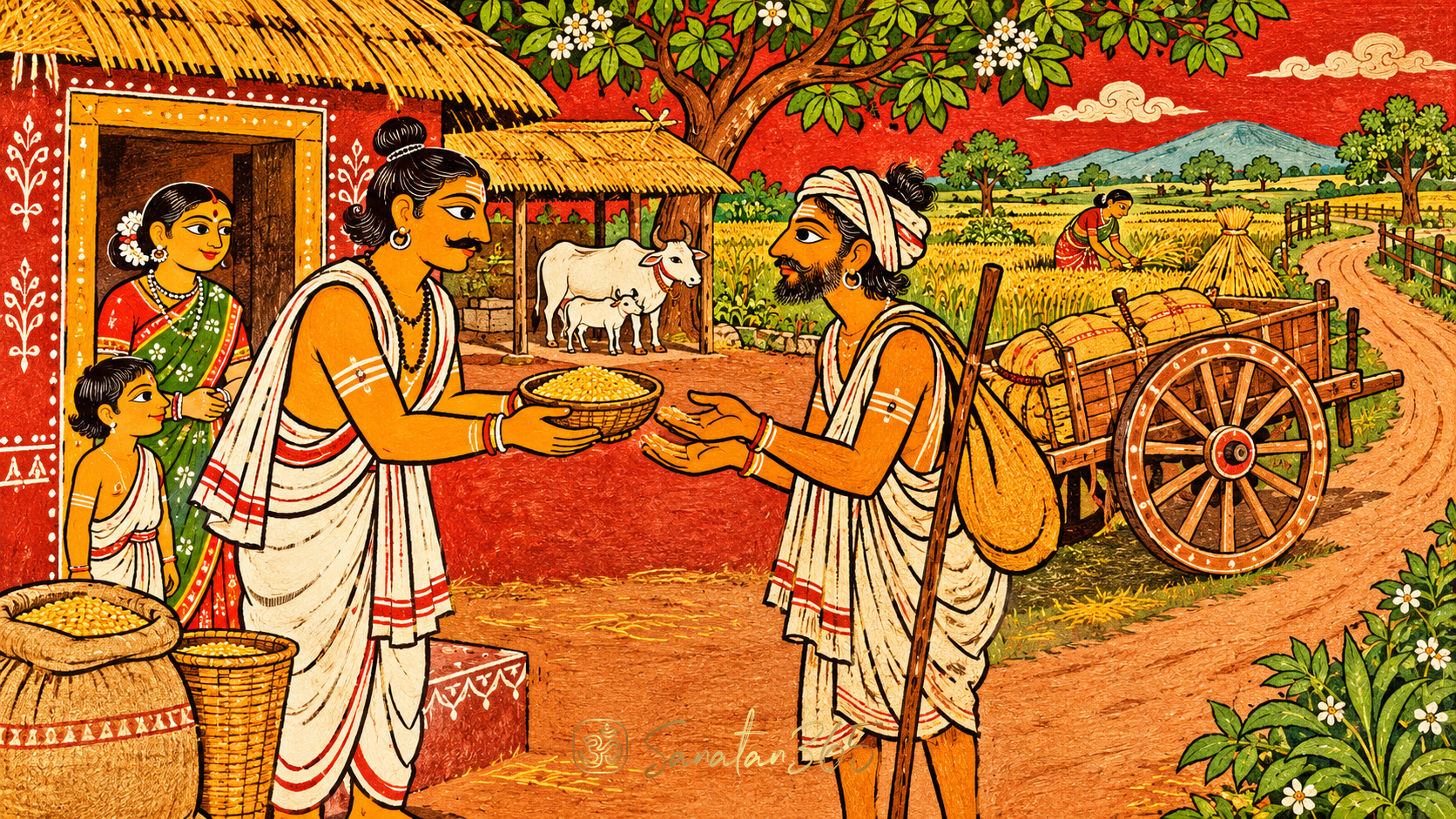
Rigveda 10.117 Meaning: Food and the Test of Friendship
A visitor asks for food, a friend must answer, and wealth turns like a wheel. Follow the argument for generosity in Rigveda 10.117.
Someone comes for food. The person who has it must decide whether a relationship will survive the request.
The Rigveda 10.117 meaning centres on giving food to a person who needs it. In this hymn of the Ṛgveda (ऋग्वेद, Vedic collection of hymns), having food creates an occasion for action. The poet tests friendship at the moment of asking, compares wealth to a turning wheel, and then asks what happens when a person keeps food for solitary use. The argument moves from a doorstep to the changing circumstances of human life.
What is the Rigveda 10.117 meaning?
The Sanskrit text of the tenth book introduces 10.117 as a praise of giving wealth and food. The hymn with Griffith's English translation shows how particular the opening examples are. Someone goes looking for a meal. Someone else has provisions. The difference between those two situations makes the next action significant.
In the opening verse the poet treats hunger as a serious condition and observes that death can also come to people who have eaten. The simple possession of food therefore does not remove human vulnerability. A person with supplies has a real capacity to respond in the present, even though supplies cannot settle everything about the future.
The second and third verses then give contrasting responses. One person with food hardens against the visitor. Another gives to the person who has come in want. As the hymn presents it, that act can establish a relationship in circumstances beyond the meal. The poet makes the response to an actual need more telling than the bare fact of owning provisions.
That shift helps a reader hear the rest of the hymn. Begin with the question of who has what. Then ask who can do something with it. The reader can bring an ordinary meal to mind, with a finite amount prepared and a person arriving unexpectedly. The practical details differ from the world of the poem, but the reader can see why a decision about one portion can reveal the way people understand their obligations.
Key takeaway. The hymn brings food, an actual request, and the response of the person who can share into the same scene.
Why does the hymn make food the test of friendship?
Verse 4 turns from a general visitor to a companion. It judges friendship through whether a person will give food to a companion who turns to them. The relevant Sanskrit word sakhā (सखा, friend or companion) names a relation that the verse expects to be visible in an act. A familiar name for the relationship no longer settles whether it is present when needed.
The verse also imagines what the visitor can do after refusal. The person can leave and seek someone willing to give, even beyond the familiar circle. This movement gives the scene two possible endings. Either a known relationship answers the need, or the visitor has to widen the search. A reader who considers both endings can see why the verse is concerned with more than the kindness of a single donor.
The scene does not give a modern household a rule about every possible request or the resources it can safely offer. Its example is a person who has provisions in front of someone in need. That difference is part of the force of the judgment. Giving from what is in hand and recognising when another source of help may be needed are practical questions a reader can think about separately.
The article on hospitality and the unexpected guest considers welcome from another textual starting point. In this hymn, the request and the response can be considered before deciding what form welcome should take. A cup and a seat might be kind. The need the poet has put in front of the listener is hunger.
Key takeaway. The poet asks what a companion can count on when they come for food.
What does the turning wheel of wealth describe?
Verse 5 changes the scale of the argument. It calls on the stronger person to give to the person in need and asks the listener to look down a longer road. Wealth moves among people, the poet says, as the wheels of a vehicle turn. The Sanskrit cakra (चक्र, wheel) gives this movement a visible form.
Imagine watching a marked section of a wheel as a cart passes. The mark rises and then comes down again. Its place at one moment is real, but a description of that place cannot tell everything about its next position. The image makes it possible to think about resources in the same way. Possession at one moment is real, and the movement of fortune makes a longer perspective appropriate.
That perspective does not suppose that today's guest will be tomorrow's giver to exactly the same person. The poem's image is wider than a two-person exchange. Wealth comes to different people. A reader may therefore understand giving as a response to what one can do now, within conditions that neither person wholly controls. The recipient need not make a promise to give the same thing in return.
The guide to giving gives a wider context for the practice of dāna (दान, giving). The turning wheel in the hymn supplies one reason to notice the opportunity. A storehouse, a harvest, or an ordinary household kitchen only shows who has something at that moment. The process of change is what makes the wheel such a fitting image.
Key takeaway. The turning wheel places today's supply within a longer account of resources passing among people.
How does the hymn describe eating alone?
In verse 6 the act of obtaining food is considered in light of what the possessor does with it. The poet speaks severely of the person who eats alone while feeding neither a trusted friend nor someone who cares for him, in Griffith’s rendering. In its context, solitary eating describes the withholding of provisions. The urgency comes from the earlier scenes of someone asking and someone having the means to answer.
That context matters for a reader who normally eats alone because of work, travel, or the timing of a household. The earlier examples give the phrase its moral setting. A clock or a head count at a table cannot settle whether the person there has turned away from anyone. The relevant question is how the person treats available food when a real claim for help is present.
Consider two short descriptions of an evening. In one, a caretaker eats later than everyone else after making sure the people in their care have had enough. In another, a person with additional food keeps it from a companion who arrives hungry. A photograph might show one diner in each case. The poem's concern becomes clearer when the reader also asks what happened before the photograph.
One way to take the verse seriously is to notice the points at which decisions about sharing are already made. A portion set aside before serving can be easier to offer than a portion improvised afterward. Sharing can also involve asking what is wanted and listening carefully to the answer. These are contemporary examples of attention to the need at hand, and the hymn itself remains the source of the underlying question.
Key takeaway. Verse 6 judges how food is kept or shared in the presence of need.
How can readers follow the hymn's sequence today?
Start by giving each of the opening scenes a working title. “Someone comes,” “a friend responds,” and “fortunes change” can serve as short cues. Write the corresponding verse numbers beside those notes. When the final image of eating alone appears, go back to the visitor at the door. That return makes it possible to see the sharp words about solitary consumption as part of the argument.
The remaining verses add concrete comparisons. They speak of work that produces food, movement that accomplishes something and differing capacities even among seemingly similar people or things. A reader can take these later comparisons one at a time. The hymn has made its demand to notice need, and the later observations keep attention on what actions and capacities actually yield.
A family reading can make the sequence easier to remember. One reader follows the arrival and response in verses 2 and 3. Another describes the kind of friendship tested in verse 4. A third tells how the wheel in verse 5 moves. Ask which detail each person had to leave out when retelling it in one sentence. The resulting conversation distinguishes a memorable image from the part of the argument it supports.
A close reading can also follow who has room to move in each scene. In the second verse the visitor has already come close enough to be turned away. In the fourth, the visitor still has the option of leaving and asking elsewhere. In the fifth, the road itself becomes a way to picture change over a longer span. These are different uses of movement. Reading them in order shows the cost of refusal to the person who must travel onward and the limited control the holder of wealth has over where resources will eventually come to rest.
A group can try a second pass through the poem with the wheel in mind. On that pass, look for each place where the person with food seems to assume that the present arrangement will last. Then ask what the next verse does to that assumption. The exercise gives the wheel a place in the sequence and brings the discussion back to the opening request.
The guide to selfless service gives language for another way to think about acting on need. This hymn gives a particular place to begin. Return to the person who asks, and read the broader images in light of what that person needed. A wheel explains why fortune can move. The answer at the door shows what a person can do in the time they have something to share.
Key takeaway. Keep the request for food at the centre when reading the friend, the wheel, and the solitary meal.
FAQ
What is Rigveda 10.117 about?
It praises giving food and wealth. Its early examples show people with food responding differently to someone who needs it. The hymn then examines what a companion can expect and compares changing wealth to turning wheels.
What does the wheel represent in verse 5?
The turning wheel is a comparison for wealth coming to different people. It lets a reader consider how today's ability to give fits into a longer pattern of change. The poem gives that ability a use in the present.
Does the hymn condemn all meals eaten alone?
The relevant verse appears after descriptions of a person who needs food and others who can help. In that setting the charge concerns someone who keeps provisions for solitary use while failing to sustain others. The surrounding verses explain the kind of conduct the poet is criticising.
How are generosity and friendship related here?
A companion who can share food has a concrete way to make friendship visible. Verse 4 treats refusal in such a situation as a failure of that relationship. It then recognises that the person asking may have to seek help elsewhere.
About the author
Sanatan365 Editorial
Bringing Sanatan Dharma to modern seekers through authentic, scripture-grounded content.
Related in Scriptures
 Scriptures
Taittiriya Upanishad 1.11 Meaning: What a Student Carries Forward
A teacher’s address after Vedic study connects truthful speech, right conduct and continued learning. Read the three commands in their sett…
 Scriptures
Manduka Sukta Meaning: Why the Rigveda Listens to Frogs
Read the Rigveda’s frog hymn through its rain-filled pool, contrasting voices, and memorable comparisons with a student and ritual singers.
 Scriptures
Ganapati Atharvashirsha Meaning: Ganesha, Reality, and Truthful Speech
Read the Ganapati Upanishad as a movement from reverence to understanding: Ganesha as Brahman, care for speaker and listener, and worship w…

