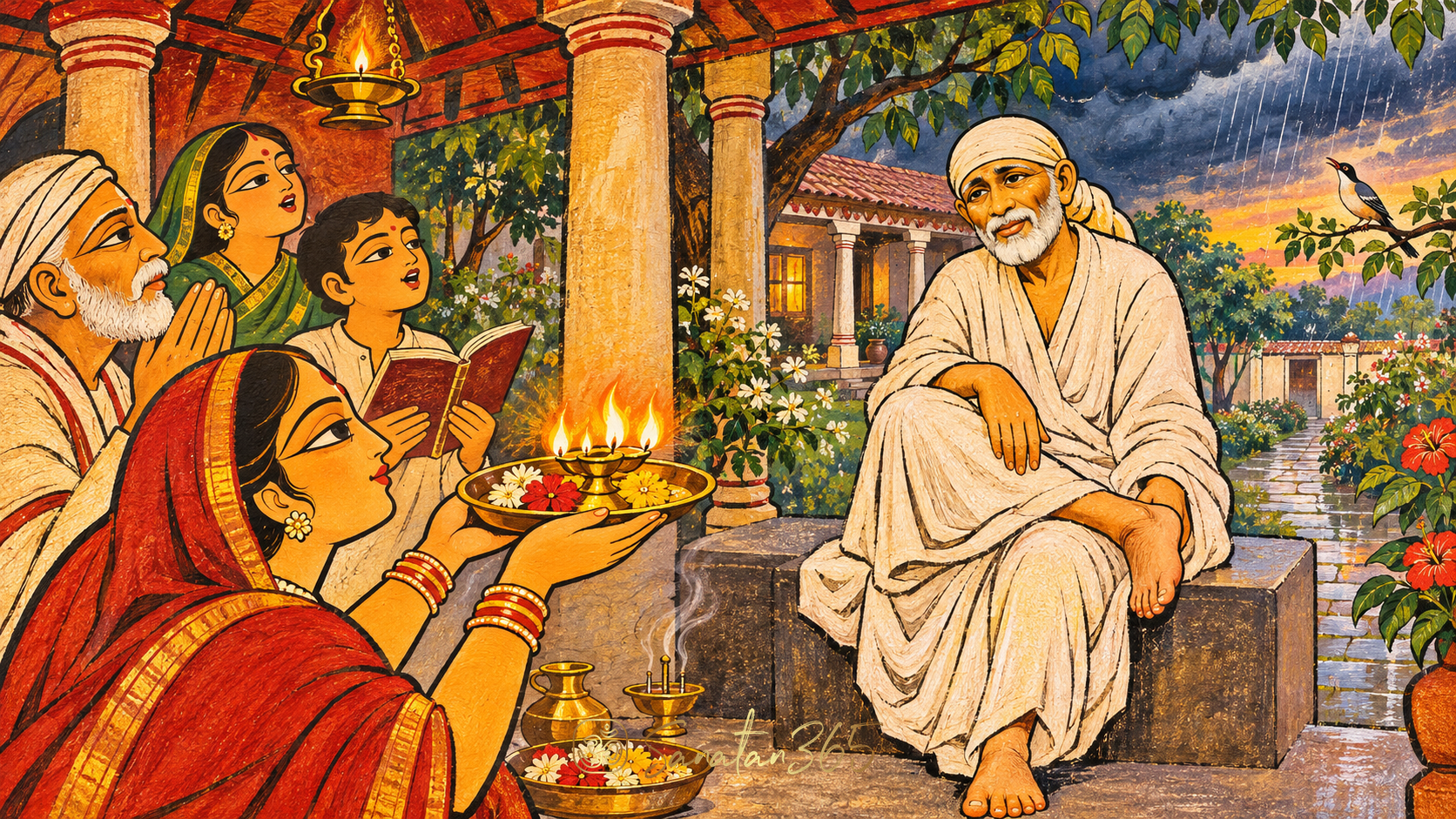
Sai Baba Aarti Meaning: Refuge, Service and the Thirst for Grace
The Marathi hymn moves from seeking refuge to valuing service. Read its images carefully, including the thirsty bird that brings the prayer to a close.
The prayer’s final image is a thirsty bird. After praise, remembrance and the language of service, a small creature waiting for water gives longing a visible form.
Sai Baba Aarti meaning centres on an offering of light and devotion to Shirdi Sai Baba, with requests for refuge and guidance. The Marathi hymn commonly identified by its opening, Āratī Sāībābā (आरती साईबाबा, an aarti addressed to Sai Baba), develops those requests through images of the teacher’s feet, service and thirst. Reading its words alongside the act of singing reveals a prayer with a direction, rather than a list of promised results.
What does Sai Baba Aarti meaning reveal in the refrain?
The official Marathi text published by the Shree Saibaba Sansthan Trust begins with a recurring appeal to Sai Baba as a giver of happiness and a place of rest for devotees. The feet supply the image of refuge. These are the song’s devotional expressions, offered here as the language of worship.
Aarti, or ārati (आरती, an offering of light in worship), names both an act and, in common usage, a song accompanying that act. In this hymn, the sung address helps direct attention toward the one receiving the offering. The flame is visible; the words express the relationship being offered with it.
A refrain gives a group somewhere to return. Some singers may know every stanza, while another person has joined for the first time. The recurring opening can gather both into the same movement without requiring identical familiarity. That is one reason to understand the refrain before attempting to memorise a longer sequence.
The image of the feet also asks for attentive reading. It belongs to a devotional vocabulary of humility and closeness to the teacher. A reader need not turn it into a judgement about personal worth. Seeking guidance can be understood as an admission that there is something still to learn.
Consider a family preparing to sing together. One person can explain the refrain’s central appeal in ordinary English before the music begins. Another can read the Marathi slowly. That brief exchange gives the repeated words a meaning shared across generations, even when language fluency differs.
The article on aarti as an offering of light explains the wider ritual idea. Here the focus is narrower: what this particular song asks, how its images relate and where its closing lines lead the listener.
A useful reading question is therefore, “What does returning to this opening change about the next stanza?” Praise, reflection and longing all sound different when held within a request for refuge. The refrain supplies a centre without making every verse say the same thing.
Key takeaway: Begin with the refrain’s relationship of devotion and refuge. Its recurring words provide the centre from which the rest of the hymn can be heard.
How does the Marathi aarti move from refuge to recognition?
The song does more than repeat its opening request. It praises inner freedom, speaks of a seeker’s devotional disposition and recognises Sai Baba through sacred names and forms. Bhāva (भाव, devotional feeling or disposition) is especially useful for understanding this movement from outward singing toward inward participation.
The Sri Shirdi Sai Baba Temple of Austin’s Aarati Book, on its printed pages ten and eleven, provides Romanised words and an English rendering. Reading it beside the official Marathi page helps a learner keep the sound of the hymn connected to its sense.
The song’s theological identifications should remain in their proper setting: they are expressions of the devotee’s recognition and praise. Saguṇa (सगुण, possessing attributes or a manifest form) and Parabrahman (परब्रह्मन्, the supreme Absolute) belong to that devotional vocabulary. They should not be reduced to decorative titles whose meanings no longer matter.
A beginner does not have to resolve every philosophical question before listening. One term can become the subject of a patient conversation. What does a manifest form make approachable? How does a name allow someone to address what might otherwise feel distant? Such questions keep learning close to the words being sung.
There is also a distinction between reading a statement of faith and making a prediction about an individual life. A hymn can voice confidence, gratitude and dependence without becoming a formula for obtaining a desired event. Respectful explanation preserves its devotional force while remaining careful about what an article can establish.
For example, the language of feeling and experience can prompt a singer to notice the quality of participation. Is the attention on the words, the shared offering or the wish to finish quickly? That is a present-day reflection inspired by the song, rather than a rule claiming to measure anyone’s faith.
Different people may respond to the same verse with different questions. Someone learning Marathi may ask about pronunciation. Another may ask about a sacred name. An experienced singer may notice a meaning previously passed over. These responses can coexist within a shared practice.
The most useful reading therefore moves between the particular word and the whole prayer. A definition gives a foothold; the refrain restores the relationship. Neither a glossary alone nor a familiar tune alone exhausts what the hymn offers.
Key takeaway: The Marathi aarti joins praise with inward attention. Explain its terms carefully and allow devotional claims to remain recognisable as the language of faith.
What do service and the chatak bird contribute to the song?
Near the close, service becomes the wealth the speaker seeks. The final bird-and-water image then gives that desire a delicate shape. Sevā (सेवा, service) names an orientation toward attending and offering; the cātaka (चातक, the chatak bird invoked in poetry) supplies an image of thirst.
The important point here is literary. The bird’s longing for pure water belongs to the hymn’s poetic world. It is unnecessary to turn the image into a claim about the drinking behaviour of a particular biological species. A metaphor can be understood through the relationship it presents: need, expectation and the desired gift.
The progression matters. A song that begins by seeking refuge arrives at a request shaped by service. A modern reader can reflect on how that movement changes the meaning of asking. The question becomes less about accumulating objects and more about the kind of relationship being sought.
That reflection can be made concrete without pretending to issue an instruction from Sai Baba. After a family gathering, someone might stay to put the books away, make space for an elder or help a younger learner find the correct page. These are ordinary examples of attentive service, offered as possible applications.
Their value does not depend on being publicly noticed. Indeed, a useful question after a shared prayer might be, “What needs attention now?” The answer could be small and practical. The song’s language provides a subject for reflection; the actual situation determines the useful action.
The bird image offers a different quality of attention. It concentrates desire. Instead of filling the close with a catalogue of requests, the poem brings the listener to a single act of longing. That economy gives the ending emotional force.
A child can approach the image through a simple question: why might a poet choose a thirsty bird to express a prayer? There is no need to supply a supposedly scientific explanation or demand one correct personal feeling. Listening to the child’s answer may open a more thoughtful conversation than testing memorised definitions.
An adult might ask how longing and service fit together. One looks toward a gift; the other concerns what can be offered. Holding both in view keeps the ending from becoming passive waiting or self-congratulation. This is an interpretive possibility, not a promise that a particular action will produce divine favour.
Key takeaway: Service and the chatak bird give the close its shape: a relationship expressed through what is offered and what is deeply sought.
Where does this hymn sit within a Shirdi aarti service?
A familiar recording title can conceal an important distinction. One hymn and a complete service are not necessarily the same unit. The Shirdi Sansthan’s official aarti listing includes this composition within its noon and sunset programmes, alongside other separately named prayers.
The Austin booklet likewise prints sequences containing several compositions. Its layout is useful evidence for a learner: a new heading or opening may mark a different song, even when a recording continues without a long pause. This article concerns the Marathi hymn beginning with Sai Baba’s aarti address, not every text in those larger sequences.
That distinction helps with finding a reliable learning resource. A person searching for meaning may encounter a short rendition, a full service, a translation or a different song addressed to Sai Baba. Checking the actual opening and text is more reliable than assuming all results under a broad title contain identical words.
A practical reading sequence can be straightforward:
- Identify the opening of the hymn being studied.
- Find the same text in the official Marathi sheet.
- Compare a temple-published transliteration and meaning.
- Notice where the hymn ends and another composition begins.
- Ask an experienced singer about unfamiliar sounds or repetitions.
The purpose is understanding, rather than constructing a universal order for every home or temple. Local practice and the chosen service can supply further guidance. This article gives no current timetable, booking instructions or rule about how every devotee must participate.
The earlier explanation of evening aarti and devotional closure offers a related perspective on the setting of evening worship. The present hymn has its own wording and progression; its meaning should not disappear into a general description of lamps at sunset.
A diaspora family may work between Marathi, Roman letters and English explanations. Each has a different use. The original preserves the words, transliteration assists with sound and translation helps with meaning. None of those tasks should be confused with another.
Key takeaway: Identify the hymn within the larger service. Its opening, ending and source text matter more than a recording’s broad title.
How can learning the aarti become a shared practice?
Learning can begin with one understood passage. A household need not make speed or volume its first measure of participation. One reader can find the source, another can follow the words and another can explain the central image in the language everyone shares.
A useful approach is to separate three tasks: reading, singing and reflecting. Reading asks what is actually on the page. Singing attends to the received musical form with help where needed. Reflection asks how the meaning might be carried into the rest of the day. The tasks support one another without becoming interchangeable.
For instance, the refrain can be read before a familiar rendition. After listening, the family can return to the service stanza or the bird image. A short conversation about one idea may be more memorable than a hurried attempt to explain every word at once.
The language of refuge also deserves gentleness. It should not become a way to judge another person’s devotion when their circumstances remain difficult. Nothing in this reading provides a basis for promising wealth, recovery or a desired outcome in exchange for a certain number of repetitions.
Questions are welcome within careful learning. “Which word means service?” and “Where does this verse end?” are useful starting points. A singer who asks for help is participating in the work of understanding. The experience need not become a public test of pronunciation or spiritual accomplishment.
The article on bhajan as everyday devotional singing provides another way to think about song and participation. The present aarti is distinctive because its particular images give the shared offering a specific emotional direction.
The final takeaway can remain close to the text: receive the refrain as an invitation to refuge, understand the wish for service and let the closing bird image make longing visible. The next act of care will arise within an actual household or community, not from a mechanical bargain attached to a song.
Key takeaway: Learn one meaningful passage together, then let understanding inform attentive participation and an ordinary act of care.
FAQ
What is the Sai Baba Aarti meaning in simple English?
The Marathi hymn offers devotion to Shirdi Sai Baba and asks for refuge and guidance. Its later images bring attention to service and longing for grace.
Is this hymn the same as an entire aarti service?
No. Temple-published programmes can contain this hymn alongside several other compositions. Checking the opening words helps identify the particular text.
Why does the song mention the chatak bird?
The closing bird-and-water image expresses longing poetically. It need not be treated as a scientific statement about a bird species.
Does a translation replace learning the original words?
A translation helps with meaning, while the Marathi text preserves the words and transliteration assists pronunciation. An experienced singer can help connect those forms of learning.
About the author
Sanatan365 Editorial
Bringing Sanatan Dharma to modern seekers through authentic, scripture-grounded content.
Related in Aarti
 Aarti
Trigunatmaka Traimurti Aarti Meaning: Singing to Gurudatta
Follow the Marathi Datta aarti from threefold form and the limits of speech to offering light, meeting the guru, and remembering the name.
 Aarti
Yuge Atthavis Aarti Meaning: Vitthal, the Brick, and the River
Read the Marathi Vitthal aarti through its standing deity, welcoming refrain, sacred river and gathering pilgrims, with clear limits on lit…
 Aarti
Lavthavati Vikrala Aarti Meaning: Shiva in a Marathi Song of Light
A close reading of a Marathi Shiva aarti, from fierce fire and flowing water to Parvati, the blue throat, and the quiet work of remembrance.

