Santosha Meaning for Kids: Contentment, Gratitude, and Enoughness
A child-friendly guide to Santosha, the Hindu practice of contentment, with stories, family exercises, and a clear distinction between gratitude and giving up.
A child can own a room full of toys and still feel that one missing toy is the only thing that matters. Santosha meaning for kids begins with a different discovery: happiness does not have to wait until everything is perfect.
Santosha (सन्तोष, santoṣa, contentment) is the Hindu practice of meeting the present moment with gratitude and steadiness. It does not mean that children should stop learning, dreaming, or asking for help. It means they can appreciate what is here while working wisely toward what may come next. For a child, Santosha can sound like: “I may not have everything I want, but I can notice what is good, do my best, and remain kind.”
What Is the Santosha Meaning for Kids?
The simplest explanation is this: Santosha is the ability to feel enough without giving up effort. It is one of the five niyamas (नियम, niyama, personal observances) named in Patanjali's Yoga Sutra 2.32. These observances describe habits that help a person care for inner life, including cleanliness, contentment, disciplined effort, self-study, and dedication to the Divine.
Yoga Sutra 2.42 connects Santosha with anuttama sukha (अनुत्तम सुख, unsurpassed well-being or happiness). This teaching does not promise that every day will be comfortable. Rather, it points to a kind of happiness that is less dependent on comparison, praise, possessions, or getting one's way. The verse is brief, but its family lesson is spacious: contentment can be practised.
Children often hear “be grateful” only after complaining. Santosha is more helpful when it becomes a regular skill rather than a correction. A family can practise noticing a nourishing meal before asking for dessert, appreciating a friend's company without needing to win the game, or enjoying a drawing without comparing it with someone else's.
Contentment also differs from forced cheerfulness. A child may feel disappointed, angry, jealous, or sad and still practise Santosha. The first step is not denying the feeling. It is recognizing: “This feeling is here, and it is not the whole of me. Something good and steady is here too.”
Key takeaway: Santosha teaches children that gratitude and difficult feelings can exist together.
Why Is Contentment Not the Same as Giving Up?
Adults sometimes worry that teaching contentment will weaken ambition. Hindu thought offers a more balanced view. The Bhagavad Gita 2.47 teaches disciplined attention to action without claiming ownership over every result. A child can prepare carefully for an exam, practise a musical instrument, or train for a race while accepting that outcomes are never completely controllable.
This creates a useful distinction:
- Giving up says, “My effort does not matter.”
- Contentment says, “My effort matters, but my worth is not decided by one result.”
- Complacency avoids needed growth.
- Santosha makes growth steadier because panic and comparison no longer lead every decision.
Imagine two children building a clay diya. One becomes upset because another child's lamp looks smoother. Santosha does not require pretending that both lamps are identical. It invites the first child to notice what was learned, admire the other child's skill without resentment, and decide whether to practise again. Appreciation and improvement can stand side by side.
This is especially important in achievement-focused homes. Praise that attends only to marks, trophies, or being “the best” can make happiness feel conditional. Parents can widen the frame by recognizing patience, honesty, recovery after mistakes, and sincere effort. The goal is not lower standards. It is a healthier source of strength.
Key takeaway: Santosha supports aspiration by separating sincere effort from anxious self-worth.
How Can Children Recognize the “More” Mind?
The mind that always asks for more is not evil; it is simply untrained. Advertising, social comparison, and instant digital rewards can strengthen the feeling that satisfaction lies one purchase, score, or notification away. Children need language for this pattern before they can work with it.
A family might call it the “more mind.” It often says:
- “I will be happy only when I get that.”
- “If someone else has more, mine is not good enough.”
- “One mistake means the whole effort failed.”
- “Being left out once means I am never included.”
- “This pleasant moment should never end.”
Naming the pattern creates a pause. A parent can ask, “Is the more mind speaking, or is there a real need?” This matters because Santosha should never be used to dismiss a child's need for safety, food, rest, medical care, affection, fairness, or support. Contentment is not an excuse for adults to ignore harm or inequality.
The Bhagavad Gita 12.13-14 describes a devotee marked by friendliness, compassion, freedom from possessiveness, steadiness, and contentment. These qualities belong together. True contentment does not make a person indifferent to others. When the grip of “mine” softens, sharing becomes easier.
Children may understand this through a lunchbox example. Being content with one's meal does not mean ignoring a classmate who has none. Santosha can inspire gratitude for one's food and a compassionate wish to share or seek an adult's help.
Key takeaway: Contentment notices enoughness while compassion notices genuine need.
What Are Simple Santosha Practices for Families?
Children learn values most deeply through repeated experiences. A lecture on gratitude rarely works as well as a small family ritual that feels natural.
1. Use the three-noticings practice
At bedtime or before dinner, each person names:
- one thing received;
- one effort they are glad they made;
- one person, animal, or part of nature they appreciate.
This keeps gratitude from becoming only about possessions. A child might say, “I received help with homework, I kept trying at football, and I liked hearing the rain.”
2. Create a sacred pause before asking for more
Before a second serving, a new toy request, or more screen time, pause for three calm breaths. The child can ask:
- Do I need this, or do I want it?
- Can I enjoy what I already have first?
- What choice will feel respectful tomorrow?
The answer may still be yes. The practice is the pause, not automatic refusal.
3. Celebrate effort without exaggeration
Specific praise strengthens steadiness: “You returned to the problem after it was difficult,” or “You congratulated your friend even though you felt disappointed.” This is more useful than constant declarations that everything a child does is perfect.
4. Practise joyful care of belongings
Once a week, children can choose books, clothes, or toys to clean, repair, arrange, share, or donate with family guidance. Caring for an object teaches that value does not always require novelty. Donation should never be forced as punishment; generosity grows best from understanding.
5. Offer a simple prayer of thanks
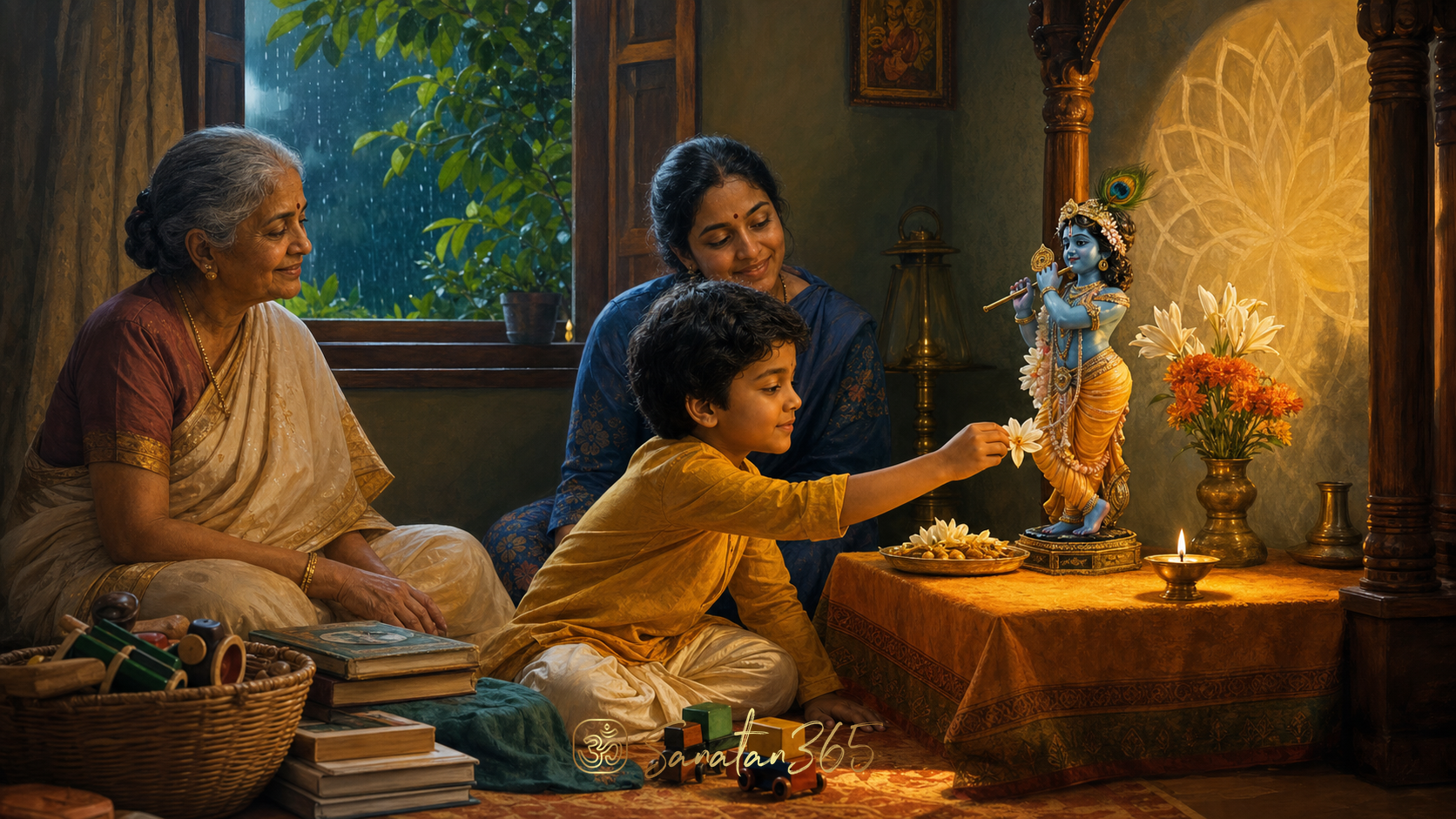
Families may light a diya, offer a flower, or fold their hands according to their tradition. A short prayer can be enough: “Thank you for this food, this home, the people who care for us, and the strength to care for others.” The practice is devotional attention, not performance.
6. Keep a “good enough” creative hour
Let children draw, build, sing, or write without grades, posting, or comparison. At the end, ask what they enjoyed and learned. This protects creativity from becoming another competition.
Key takeaway: Santosha becomes real through brief practices that families repeat without pressure.
How Should Parents Respond to Envy and Disappointment?
Comparison is normal, especially when children are developing a sense of identity. Shaming envy usually drives it underground. A steadier response has four movements: name, allow, widen, and act.
Name: “It looks like you wish you had what your friend has.”
Allow: “That feeling can be uncomfortable, but having it does not make you bad.”
Widen: “What is already supportive or enjoyable in your life right now?”
Act: “Is there a wise step we can take, such as saving, practising, asking respectfully, or letting this wish pass?”
This approach honours emotion without allowing emotion to command behaviour. It also avoids using spiritual language to silence children. “You should be content” can become hurtful when a child is grieving a loss, facing bullying, or describing a serious need. In such moments, listening and protection come first.
Parents can model Santosha by speaking honestly about their own comparisons. A simple statement such as “I noticed myself wanting a newer phone because someone else had one, so I paused and remembered what this phone already helps me do” makes the practice visible.
Mistakes are another important training ground. When a child performs poorly, families can ask three questions:
- What happened?
- What can this teach us?
- What remains good and worthy even now?
The third question prevents one result from swallowing the whole identity. It is not denial; it is proportion.
Key takeaway: Children learn contentment when adults make room for emotion, perspective, and wise next action.
How Does Santosha Grow into Seva and Care?
Contentment is sometimes pictured as a private feeling, but Hindu family life often connects inner discipline with seva (सेवा, sevā, selfless service). When children are less consumed by what they lack, they can notice what others need.
Service should remain age-appropriate and relational. A child might refill a grandparent's water glass, help a sibling arrange schoolbooks, place grain for birds where it is safe and permitted, join a neighbourhood clean-up, or contribute part of a festival gift to a trusted cause. The point is not to make children feel guilty for having comforts. It is to help gratitude become care.
Santosha also deepens environmental responsibility. The habit of repairing, reusing, sharing, and consuming thoughtfully honours the resources behind everyday objects. A pencil contains wood, labour, transport, and the support that placed it in a child's hand. Seeing these relationships can turn “ordinary” things into occasions for reverence.
For diaspora families, Santosha can bridge home traditions and modern pressures. A family practice need not reproduce every custom exactly to remain meaningful. A weekly gratitude meal, a short diya-lighting pause, a story from the Sanatan lessons collection, or a shared act of service can keep the principle alive across languages and locations.
Yet the heart of the practice is not an app, object, or perfect ritual. It is the trained capacity to recognize grace in an unfinished life.
Key takeaway: Santosha becomes generous when gratitude moves outward as service and careful use of resources.
A Seven-Day Santosha Challenge for Children
Families can try one small practice each day:
- Day one: Notice. Name three good things that usually go unnoticed.
- Day two: Care. Clean or repair one belonging instead of asking to replace it.
- Day three: Pause. Take three breaths before one non-essential request.
- Day four: Appreciate. Thank someone for a specific act.
- Day five: Reframe. Turn one disappointment into a lesson and next step.
- Day six: Share. Offer time, attention, food, or another suitable resource.
- Day seven: Reflect. Ask, “When did enough feel peaceful this week?”
No reward chart is required. If families use one, the reward should not undermine the lesson by making every grateful act a transaction. A shared walk, story, song, or family game can mark the week without turning contentment into another purchase.
The challenge can be repeated with different examples. Over time, children may begin to pause without prompting. That quiet pause is a sign of inner freedom: desire can be heard without always being obeyed.
Key takeaway: Seven small repetitions can make contentment easier to remember during real disappointments.
Santosha gives children neither a perfect life nor a command to smile through pain. It gives them a steadier centre. From that centre, they can enjoy success without clinging, face mistakes without collapse, appreciate others without constant comparison, and pursue growth without believing they are incomplete.
The single key takeaway is this: contentment is not having no wishes; it is knowing that a wish does not decide whether this moment, or this child, has worth.
FAQ
What does Santosha mean in simple words?
Santosha means contentment: appreciating what is present, accepting what cannot be controlled right now, and still making a wise effort where change is possible.
Is Santosha the same as gratitude?
Gratitude is an important part of Santosha, but Santosha is broader. It includes gratitude, emotional steadiness, freedom from constant comparison, and a healthy relationship with desire and results.
Does teaching contentment make children less ambitious?
No. Healthy contentment supports focused effort because a child's worth is not tied to one outcome. Children can set goals, practise hard, and learn from results without being ruled by fear or comparison.
Where is Santosha mentioned in the Yoga Sutras?
Patanjali includes Santosha among the five niyamas in Yoga Sutra 2.32. Yoga Sutra 2.42 connects the practice of contentment with unsurpassed well-being or happiness.
How can a child practise Santosha every day?
A child can name three things they appreciate, pause before asking for more, care for belongings, respond to disappointment with a next step, and turn gratitude into a small act of service.
About the author
Sanatan365 Editorial
Bringing Sanatan Dharma to modern seekers through authentic, scripture-grounded content.
Related in Lessons
 Lessons
Ashtavakra and Bandin: Wisdom Beyond Appearance
The Ashtavakra and Bandin story in the Mahabharata follows a young scholar who enters King Janaka's court, answers prejudice with learning,…
 Lessons
Gargi Vachaknavi: The Upanishadic Voice of Fearless Inquiry
Gargi Vachaknavi stands in the Brihadaranyaka Upanishad as a formidable questioner whose disciplined dialogue with Yajnavalkya reveals cour…
 Lessons
Andal: The Poet-Saint Who Made Longing a Path of Devotion
Discover Andal, the Tamil poet-saint whose Tiruppavai transformed sacred longing, shared song, and wholehearted surrender into a living pat…

