Sapta Puri Meaning: Seven Sacred Cities and Seven Ways of Seeing
Sapta Puri names seven sacred Hindu cities—Ayodhya, Mathura, Haridwar, Kashi, Kanchipuram, Ujjain, and Dwarka—whose landscapes hold distinct memories of ethical order, devotion, sacred time, and liberation.
Seven cities can be read as seven answers to one spiritual question: how does a place help a person remember the sacred? Sapta Puri meaning begins with sapta (सप्त, seven) and purī (पुरी, city): Ayodhya, Mathura, Maya or Haridwar, Kashi or Varanasi, Kanchi or Kanchipuram, Avantika or Ujjain, and Dvaravati or Dwarka. Hindu tradition honours them as moksha-purīs (मोक्षपुरी, cities associated with liberation), not because a journey automatically erases karma (कर्म, action and its consequences), but because each city gathers scripture, worship, memory, community, and disciplined attention into a living tirtha.
A tīrtha (तीर्थ, sacred crossing or pilgrimage place) is more than a destination. The word evokes a ford: a place where passage becomes possible. As the Encyclopaedia Britannica overview of tirtha explains, Hindu sacred geography includes rivers, mountains, temples, and cities where pilgrimage joins physical movement to religious practice. Sapta Puri brings seven such urban sacred landscapes into one remembered constellation.
What Is the Sapta Puri Meaning in Hindu Tradition?
A verse widely transmitted in the sacred-city tradition names the seven; the same customary list and its older place names are documented in the Hindu American Foundation's Sapta Puri overview:
Ayodhyā Mathurā Māyā Kāśī Kāñcī Avantikā Purī Dvārāvatī caiva saptaitā mokṣadāyikāḥ
In common translation: Ayodhya, Mathura, Maya, Kashi, Kanchi, Avantika, and Dvaravati are the seven cities associated with moksha. Names have shifted across centuries: Maya is identified with Haridwar, Avantika with Ujjain, and Dvaravati with Dwarka. “Puri” in this phrase means city; it does not add the coastal city of Puri as an eighth member.
Moksha (मोक्ष, liberation from binding ignorance and the cycle of rebirth) should be approached carefully here. Sacred travel is not a transaction in which distance purchases liberation. Hindu texts repeatedly connect freedom with knowledge, devotion, righteous action, and divine grace. A city can support those disciplines by interrupting habit, placing a pilgrim among sacred stories, and turning ordinary acts—walking, bathing, waiting, offering, listening—into attentive practice.
The seven are also notably diverse. They span the Gangetic plain, the Himalayan threshold, central India, the Tamil south, and the western coast. They honour Rama, Krishna, Shiva, Vishnu, Shakti, sacred rivers, teachers, ancestors, and many regional forms. The list does not flatten Hindu practice into a single path. It presents plurality as a sacred geography.
Key takeaway: Sapta Puri is a map of spiritual possibility, not a checklist that guarantees liberation.
Why Are These Seven Sacred Cities of Hinduism Remembered Together?
Sacred cities endure because several layers reinforce one another:
- Itihāsa (इतिहास, sacred epic history) and Purāṇa (पुराण, traditional sacred narrative) memory: The cities are connected with narratives of Rama, Krishna, Shiva, Vishnu, Devi, and generations of devotees.
- Living worship: Daily ārtī (आरती, a reverential offering of light), darśana (दर्शन, seeing and being seen by the sacred), recitation, festivals, and household customs keep memory embodied.
- Sacred geography: Rivers, ghāṭs (घाट, broad steps leading to sacred water), hills, temple streets, and the sea shape how worship is experienced.
- Teacher and community lineages: Monasteries, temples, ascetic institutions, scholars, singers, and family traditions transmit practice.
- Pilgrim discipline: Travel asks for patience, humility, simplicity, and adjustment to others.
This is why a sacred city cannot be reduced to one monument. Kashi is not only one temple; Mathura is not only one birthplace shrine; Kanchipuram is not only one gopuram (गोपुरम्, monumental temple gateway). The city itself becomes a mandala (मण्डल, an ordered sacred field) made of routes, sounds, foods, stories, thresholds, and repeated acts of reverence.
The Hindu American Foundation introduction to Sapta Puri likewise presents the seven as places whose significance comes from different divine associations and histories. Their unity lies in pilgrimage, while their strength lies in distinction. The broader practice is explored in Tirtha Yatra Meaning: Why Hindu Pilgrimage Is More Than Travel, which explains why a tirtha journey is more than religious tourism.
For a modern seeker, that distinction matters. One may encounter devotion through family memory in Ayodhya, divine play in Mathura, river discipline in Haridwar, impermanence in Kashi, temple learning in Kanchipuram, sacred time in Ujjain, or ocean-facing surrender in Dwarka. No single mood exhausts Sanatan Dharma.
Key takeaway: The seven cities belong together because each turns a different dimension of sacred life into a place that can be walked and remembered.
What Does Each Sapta Puri City Reveal?
Ayodhya: principled belonging
Ayodhya, on the Sarayu River in Uttar Pradesh, is revered as the birthplace of Lord Rama and a central landscape of the Ramayana tradition, as the Ayodhya district's official tourism overview records. Its spiritual vocabulary includes maryādā (मर्यादा, principled boundary or ethical dignity), family duty, kingship, exile, return, and the effort to align power with dharma (धर्म, sustaining ethical and cosmic order).
A pilgrim need not approach Ayodhya only through triumph. Rama's story also asks difficult questions about sacrifice, responsibility, grief, and public duty. Riverfront prayer, Ramayana recitation, and darshan invite reflection on how values survive pressure.
Mathura: divine love that overflows formality
Mathura and the wider Braj region are inseparable from Lord Krishna's birth and early līlā (लीला, divine play); the Mathura district's official tourism overview identifies the city's central Krishna birth-site tradition. Nearby Vrindavan, Govardhan, Gokul, and the Yamuna form a network of remembered episodes, songs, and devotional routes. The walking tradition around Govardhan is examined in Govardhan Parikrama Meaning: Walking Around Krishna's Hill of Protection.
Braj bhakti (भक्ति, loving devotion) often speaks through intimacy: friend, child, beloved, protector, cowherd. Music, Holi colours, Janmashtami vigils, and parikrama (परिक्रमा, reverential circumambulation) make theology participatory. Mathura reveals that reverence can include tenderness, humour within sacred narrative, longing, and song.
Haridwar: discipline at the river's threshold
Haridwar stands where the Ganga emerges from the Himalayan foothills into the plains. The city's names and traditions connect it with both Hari, Lord Vishnu, and Hara, Lord Shiva. The Haridwar district's Har Ki Pauri guide documents the celebrated ghat and its evening Ganga worship, while the city's Kumbh tradition gives the river a wider pilgrim rhythm.
Snāna (स्नान, ritual bathing) is not permission to ignore ecological or bodily responsibility. The deeper gesture is purification: approaching the river with gratitude, following local safety rules, keeping offerings environmentally responsible, and recognizing that sacred water deserves practical care.
Kashi: learning to face impermanence
Kashi, now Varanasi, is one of Hinduism's most enduring sacred cities and is especially associated with Lord Shiva. The Varanasi district's official Kashi Vishwanath page describes the temple's place in the city beside the Ganga; the ghats, cremation grounds, music, learning, and daily worship bring life and death into unusual proximity.
Kashi does not romanticize death so much as refuse to hide it. Its spiritual force lies in asking what remains when possession, status, and avoidance fall away. For many pilgrims, this becomes a call to live more truthfully now—not a reason to make simplistic claims about anyone's final destiny.
Kanchipuram: knowledge held in temple form
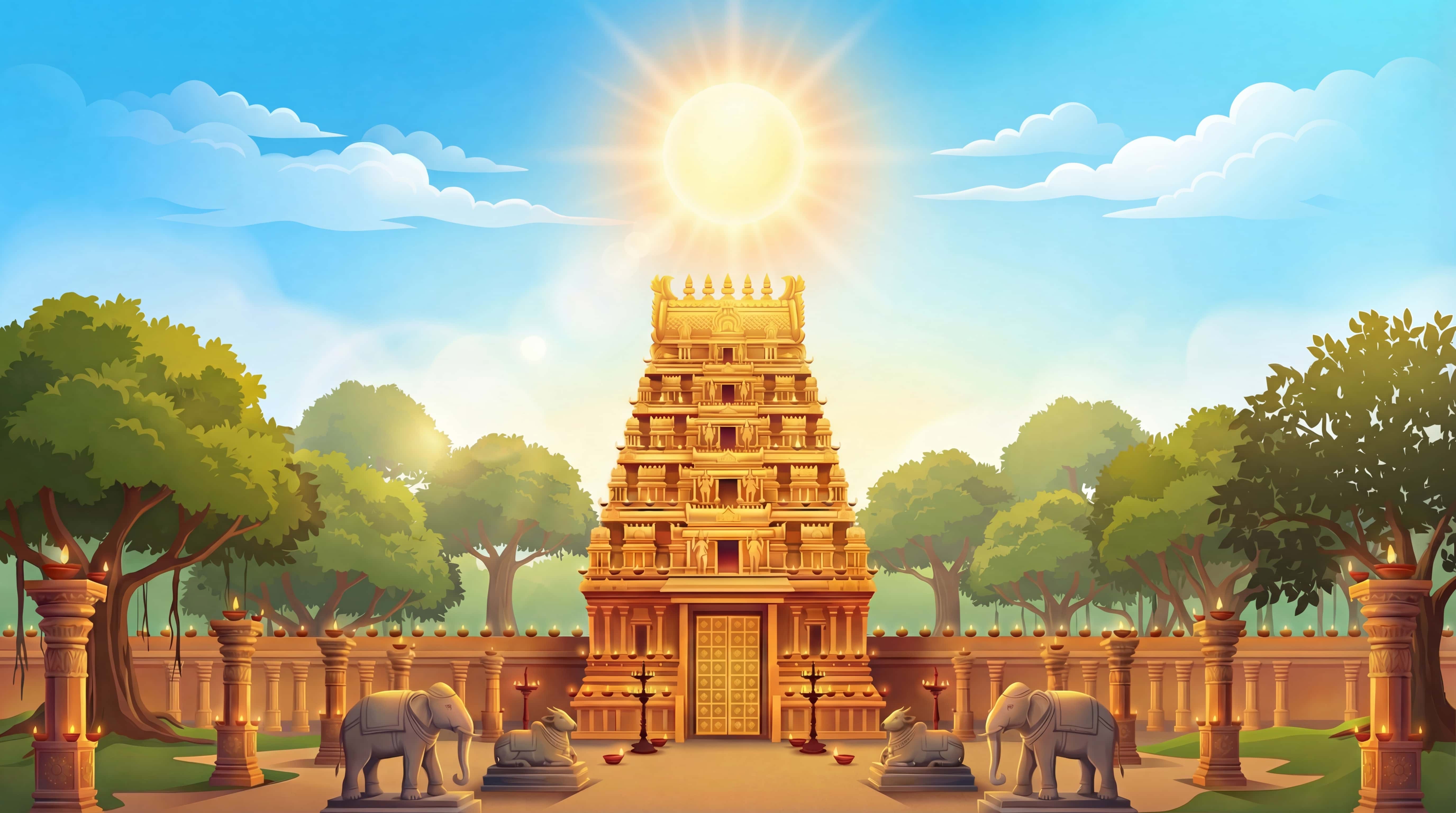
Kanchipuram in Tamil Nadu is sacred across Shaiva, Vaishnava, and Shakta traditions. The Kanchipuram district places-of-interest guide presents major shrines including Ekambareswarar, Varadaraja Perumal, and Kamakshi Amman, which express distinct theological worlds while sharing one city. The region's temple architecture, Sanskrit and Tamil learning, and philosophical lineages make Kanchi a city of both worship and study.
Here darshan unfolds through monumental temple gateways, prākāras (प्राकार, enclosed temple precincts), festival processions, recitation, and carefully maintained ritual calendars. Kanchipuram reminds pilgrims that plurality can have structure: different traditions retain their integrity while inhabiting a shared sacred landscape.
Ujjain: sacred time, Shiva, and cosmic measure
Ujjain, ancient Avantika, stands on the Shipra River and is home to the Mahakaleshwar Jyotirlinga (ज्योतिर्लिङ्ग, Shiva worshipped as a radiant linga) tradition. The Ujjain district's Mahakaleshwar overview places the shrine in the historic city, while the district's culture and heritage account records Ujjain's sacred identity and Shipra-side pilgrimage life. “Mahakala” evokes Shiva as the great reality beyond kāla (काल, time). Ujjain also holds a documented place in Indian astronomical and calendrical learning.
The city's symbolism joins time and timelessness. Calendars order ritual life; planetary observation measures change; Shiva points beyond the fear that change creates. The result is not a rejection of schedules, but a wiser relationship with them.
Dwarka: devotion at the western horizon
Dwarka in Gujarat is associated with Lord Krishna's royal city and with Dwarkadhish, Krishna as Lord of Dwarka. The Devbhumi Dwarka district's official Dwarkadhish Temple page situates the living temple tradition on India's western coast. Sea, temple flag, pilgrimage routes, and narratives of Krishna's later life create a different devotional atmosphere from Braj. Its wider four-direction pilgrimage context appears in Char Dham Yatra Meaning: Four Sacred Directions of Hindu Pilgrimage.
If Mathura remembers childhood and play, Dwarka remembers governance, protection, responsibility, and eventual departure. The western sea gives this sacred city a horizon-like quality: human structures matter, yet they remain temporary before the vastness of time and nature.
Key takeaway: The Sapta Puri cities do not repeat one message; together they hold dharma, love, purification, impermanence, learning, sacred time, and responsible leadership.
How Can a Pilgrim Approach Sapta Puri Responsibly?
Few people will visit all seven in one journey, and no such sequence is required for sincere practice. A respectful pilgrimage begins before arrival.
- Study the city before travelling. Learn its principal traditions, local names, dress expectations, photography rules, and festival pressures.
- Confirm official access information. Temple hours, entry systems, weather risks, and crowd controls change. Use temple, district, or tourism authorities rather than forwarded messages.
- Travel with regional awareness. North Indian, Gujarati, and Tamil sacred customs are not interchangeable. Observe before assuming.
- Protect rivers and streets. Avoid plastic offerings, do not leave cloth or packaging at ghats, and follow local disposal systems.
- Do not treat worshippers as scenery. Ask before photographing people, rituals, funerary spaces, or private acts of devotion.
- Make room for elders and local devotees. Pilgrimage etiquette includes patience in queues and restraint in crowded sanctums.
- Keep practice proportionate. Fasting, river bathing, long walks, and crowded travel may not suit every body. Spiritual intention does not replace medical judgment.
Those who cannot travel can still study the seven cities as a contemplative cycle. Over seven weeks, a person might read one city's central narrative, listen to a regional devotional composition, learn one historical layer, and end with a small act of sevā (सेवा, selfless service). This does not pretend that a screen equals pilgrimage. It honours sacred geography while allowing distance, disability, finances, caregiving, or age to shape an honest practice.
Internal preparation also matters. Before entering a tirtha, a pilgrim can form a sankalpa (संकल्प, a clear sacred intention): “May this visit make conduct more truthful, attention more steady, and service more generous.” Such an intention gives the return journey a purpose. The real test of pilgrimage is not how many shrines were seen, but what kind of neighbour, family member, worker, and citizen came home.
Key takeaway: Responsible pilgrimage combines devotion with preparation, regional humility, environmental care, and a change in conduct after returning.
What Do the Seven Cities Teach as One Spiritual Map?
Placed together, the seven suggest a progression without enforcing a hierarchy:
- Ayodhya asks how dharma is lived.
- Mathura asks whether the heart can love freely.
- Haridwar asks what must be cleansed and renewed.
- Kashi asks what remains when life is seen clearly.
- Kanchipuram asks how devotion and knowledge support one another.
- Ujjain asks how to live within time without being ruled by fear of it.
- Dwarka asks how responsibility can be carried without mistaking any human order for permanence.
This is the enduring power of the Sapta Puri: geography becomes a teacher. Streets preserve recitation; rivers teach continuity; temple towers organize attention; crowds test patience; unfamiliar customs loosen certainty; ancient stories meet present responsibilities.
The seven cities also correct the idea that Hindu sacredness belongs to only one language, region, deity, or method. North and South, river and sea, Rama and Krishna, Shiva and Shakti, ritual and philosophy all remain visible. Unity is not sameness. It is the capacity to recognize a shared sacred purpose through many disciplined forms.
Key takeaway: Sapta Puri turns India's regional diversity into a spiritual lesson: truth can be approached through many places without reducing their differences.
FAQ
What does Sapta Puri mean?
Sapta Puri means “seven cities.” In Hindu tradition, it refers to seven sacred pilgrimage cities associated with moksha: Ayodhya, Mathura, Haridwar, Kashi or Varanasi, Kanchipuram, Ujjain, and Dwarka.
Which are the seven sacred cities of Hinduism?
The customary list is Ayodhya, Mathura, Maya or Haridwar, Kashi or Varanasi, Kanchi or Kanchipuram, Avantika or Ujjain, and Dvaravati or Dwarka.
Is Jagannath Puri part of Sapta Puri?
No. In “Sapta Puri,” puri is the Sanskrit word for city. Jagannath Puri is an immensely important tirtha and one of the Char Dham pilgrimage centres, but it is not one of the seven cities in the customary Sapta Puri list.
Does visiting all seven cities guarantee moksha?
No journey should be presented as an automatic guarantee. Hindu traditions connect moksha with self-knowledge, devotion, dharmic action, and divine grace. Pilgrimage can support these through discipline, remembrance, darshan, and transformed conduct.
Can someone honour Sapta Puri without travelling?
Yes. A person can study each city's traditions, read relevant scripture, listen to regional devotional music, support the care of sacred places, and practise the ethical insight each city represents. This complements but does not impersonate physical pilgrimage.
The seven cities are not trophies to collect. They are seven invitations to see more clearly: duty through Ayodhya, love through Mathura, purification through Haridwar, impermanence through Kashi, learning through Kanchipuram, sacred time through Ujjain, and responsible surrender through Dwarka.
Key takeaway: The deepest Sapta Puri pilgrimage is completed when sacred seeing becomes everyday conduct.
About the author
Sanatan365 Editorial
Bringing Sanatan Dharma to modern seekers through authentic, scripture-grounded content.
Related in Pilgrimage
 Pilgrimage
Tiruvannamalai Girivalam: Meaning of the Sacred Arunachala Walk
A grounded guide to the meaning, route, traditions, and respectful practice of Girivalam around Arunachala in Tiruvannamalai.
 Pilgrimage
Narmada Parikrama Meaning: Walking with a Sacred River
Narmada Parikrama is the devotional circumambulation of the Narmada, traditionally following one bank to the river mouth and returning alon…
 Pilgrimage
Tirtha Meaning: Why Hindu Pilgrimage Is a Sacred Crossing
Tirtha means a sacred crossing place: a riverbank, temple, mountain, or landscape where pilgrimage invites devotion, humility, remembrance,…