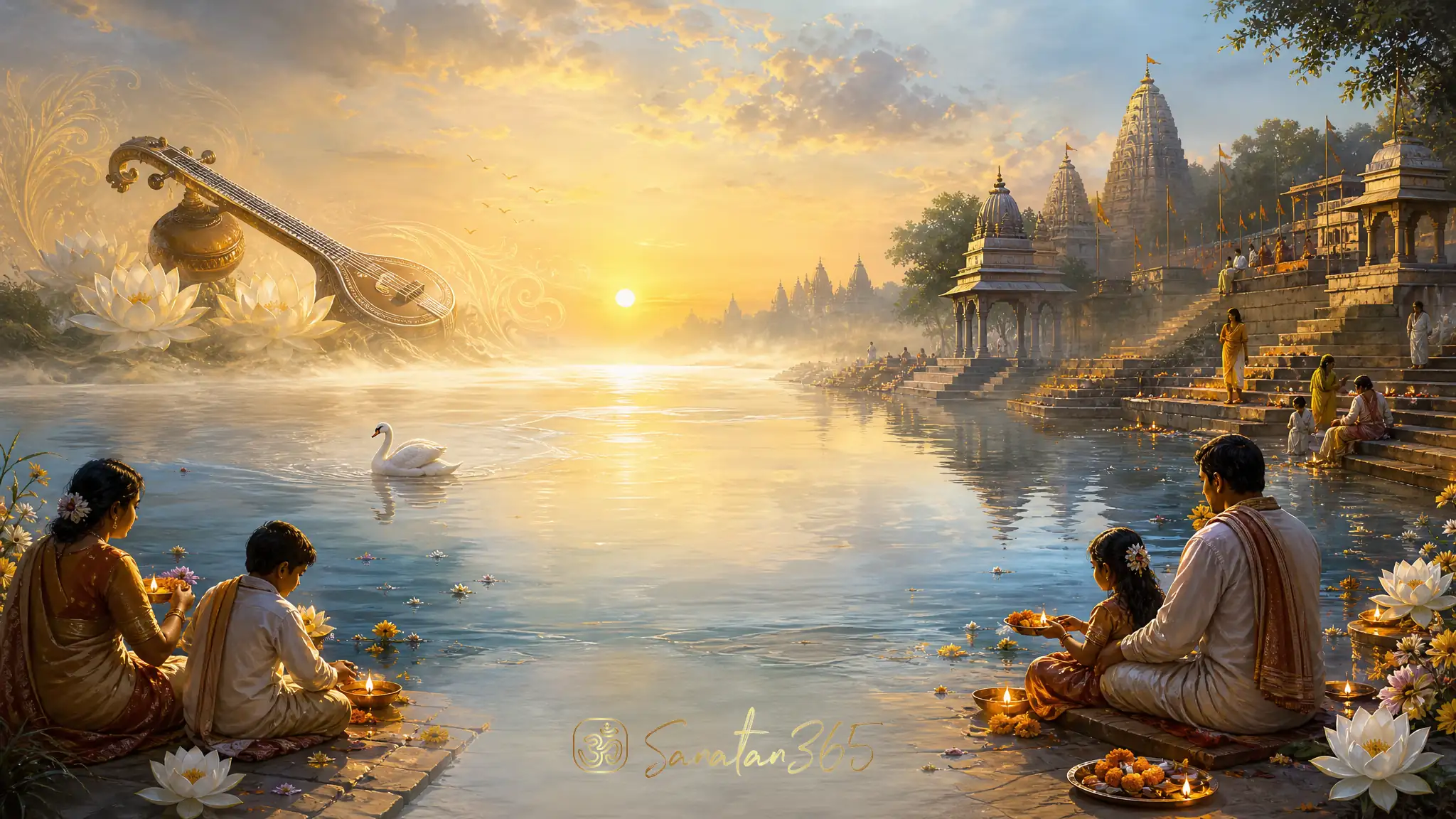
Saraswati Pushkaralu 2026: Kaleshwaram, Sacred Rivers, and the Practice of Remembrance
A clear guide to Saraswati Pushkaralu 2026 at Kaleshwaram, its river symbolism, regional practice, and what devotees can reflect on during the 12-day observance.
At Kaleshwaram, the quiet idea of a sacred river becomes a living festival.
Saraswati Pushkaralu 2026 is a 12-day Hindu river observance connected with Goddess Saraswati and the sacred geography of Kaleshwaram in Telangana. Reports from Telangana describe the current Saraswati Anthya Pushkaralu as running from May 21 to June 1, 2026, at the Kaleshwaram Triveni Sangam, where large numbers of devotees gather for snana (स्नान, sacred bathing), tarpanam (तर्पणम्, ancestral offering), dana (दान, giving), prayer, and remembrance. For many families, the festival is not only about ritual bathing. It is a way to remember that wisdom, speech, water, ancestors, and daily conduct are all connected.
Why does Saraswati Pushkaralu 2026 matter?
Saraswati Pushkaralu 2026 matters because it joins three layers of Hindu life: river reverence, regional pilgrimage, and the worship of Saraswati as the power of knowledge, speech, music, and refinement. The ongoing observance has been reported at Kaleshwaram from May 21 to June 1, 2026, with Telangana officials preparing for lakhs of pilgrims and local religious bodies describing the ritual beginning at the Triveni Sangam, a sacred confluence associated with the Godavari, Pranahita, and the subtle Saraswati tradition (Siasat, VSK Telangana).
Pushkaralu (पुष्करालु, sacred river festival) is especially important in Telugu-speaking regions, where river festivals are woven into family memory. A river is not treated as scenery. It is approached as tirtha (तीर्थ, a crossing place), a point where daily life becomes transparent to the sacred. Pilgrims bathe, offer prayers, feed others, remember ancestors, and return home with a renewed sense of discipline.
The Saraswati association gives this Pushkaralu a distinctive mood. Saraswati is not only the goddess of books and examinations. She represents refined speech, truthful learning, music, clarity, and the flow of insight. A river festival in her name asks a simple question: what should be cleansed in speech, thought, and learning?
Key takeaway: Saraswati Pushkaralu is best understood as a regional river pilgrimage that turns learning, water, ancestry, and devotion into one practice.
What is the meaning of Pushkaralu?
Pushkaralu is a sacred river festival observed in relation to specific rivers and the movement of Brihaspati (बृहस्पति, Jupiter) through the zodiac. Traditional explanations connect each Pushkaram with a river, a zodiacal sign, and a 12-year rhythm. Public summaries of Pushkaram describe it as a festival of river worship, ancestor remembrance, devotional gathering, and charity along sacred riverbanks (Pushkaralu overview, Pushkaram reference).
The exact ritual calendar may vary by region, panchangam (पञ्चाङ्गम्, Hindu almanac), and local tradition. That is why families often follow the guidance of their temple, family priest, or regional calendar. This is not a weakness of Hindu practice. It is part of its lived texture. Hindu time is local, lunar, solar, ritual, and communal all at once.
In practice, Pushkaralu usually includes:
- Snana, a sacred bath or symbolic cleansing.
- Tarpanam, offerings made in remembrance of ancestors.
- Dana, giving food, clothes, or support according to capacity.
- Puja, prayer to the river deity and associated forms of the Divine.
- Satsang, devotional listening, kirtan, or reflection.
- Pilgrimage discipline, including humility, patience, and respect for other devotees.
The deeper meaning is not that water performs magic by itself. The water becomes a sacred mirror. A person enters the river with intention, memory, gratitude, and repentance. The outer act trains the inner life.
Key takeaway: Pushkaralu is a river-centered discipline of cleansing, remembrance, giving, and returning to dharma.
Why is Kaleshwaram central to Saraswati Anthya Pushkaralu?
Kaleshwaram is central to Saraswati Anthya Pushkaralu because it is revered as a Triveni Sangam (त्रिवेणी संगम, three-river confluence) in Telangana. Reports on the 2026 observance identify the Kaleshwaram confluence as the main site where devotees are gathering from May 21 to June 1. State-level preparations, bathing ghats, crowd arrangements, and ceremonial participation have all been described in local coverage, which reflects the scale and regional importance of the festival (Siasat).
The word "Triveni" immediately brings to mind Prayagraj for many Hindus, where the Ganga, Yamuna, and invisible Saraswati meet in sacred imagination. Kaleshwaram carries its own regional force through the meeting of rivers and the presence of Kaleshwara Mukteshwara Swamy temple traditions. In such places, geography is never merely physical. The land, river, temple, and oral memory hold each other.
For Telangana families, this makes the festival both local and cosmic. The pilgrim may be standing at a specific ghat, under a specific sun, in a specific crowd. Yet the act belongs to a much older grammar of Hindu pilgrimage: approach water humbly, remember those who came before, offer what one can, and return with cleaner conduct.
For diaspora families who cannot travel, Kaleshwaram still offers a contemplative focus. One may mark the dates, read about the confluence, offer a simple prayer to Saraswati, support food distribution where possible, and teach children why rivers are addressed with reverence.
Key takeaway: Kaleshwaram matters because it gives Saraswati Pushkaralu 2026 a concrete sacred geography, not just a calendar date.
How is Goddess Saraswati connected to a river festival?
Goddess Saraswati is connected to a river festival through both name and meaning. In Vedic and later Hindu imagination, Saraswati appears as river, speech, wisdom, learning, music, and refined culture. The same flowing quality links all these forms. Water flows. Speech flows. Music flows. Understanding flows from teacher to student. A family tradition flows from elders to children.
This is why Saraswati worship should not be reduced to academic success. Vidya (विद्या, true knowledge) is more than information. It includes discrimination, humility, purity of speech, and the capacity to use learning for dharma. A person may know many facts and still speak harshly. Saraswati asks for learning that becomes graceful conduct.
In the context of Saraswati Pushkaralu 2026, a devotee can reflect on four forms of cleansing:
- Cleansing speech: avoiding gossip, cruelty, and careless exaggeration.
- Cleansing memory: honoring ancestors without being trapped by resentment.
- Cleansing learning: studying with humility rather than pride.
- Cleansing action: giving, serving, and repairing what has been neglected.
The river becomes a teacher here. It does not argue. It moves. It receives. It carries. It reminds the devotee that wisdom is not rigid possession but living flow.
Key takeaway: Saraswati's river symbolism turns the festival into a practice of purified speech, humble learning, and graceful conduct.
How can devotees observe Saraswati Pushkaralu 2026 thoughtfully?
Devotees can observe Saraswati Pushkaralu 2026 thoughtfully by combining reverence with practical responsibility. Those attending Kaleshwaram should follow local safety instructions, official crowd guidance, temple rules, and family or priestly advice. Sacred enthusiasm should never become carelessness, especially around water, crowds, elders, and children.
A thoughtful observance may include:
- Begin with sankalpa (संकल्प, sacred intention): quietly state why you are observing the day.
- Offer prayer to Saraswati: ask for clarity in speech, study, music, work, and family life.
- Remember ancestors: perform tarpanam only according to your family tradition or with proper guidance.
- Give within capacity: food, water, books, support for students, or help to pilgrims.
- Practice speech discipline: keep one day free from unnecessary criticism.
- Teach children: explain why rivers are sacred, not merely useful.
- Avoid spectacle: let the practice remain simple, sincere, and clean.
For people away from Telangana, a home observance can still be meaningful. Place a clean bowl of water near a small Saraswati image, veena symbol, book, or white flower. Recite a Saraswati prayer if it belongs to your family practice. Read a few verses from a trusted text. Donate toward education or food service. Call an elder and ask about family pilgrimage memories.
This kind of observance respects the truth that not every devotee can travel. Hindu practice has always included both yatra (यात्रा, pilgrimage) and griha-sadhana (गृह साधना, home practice). The outer distance may differ, but the inner intention can still be sincere.
Key takeaway: A strong observance is not measured by display, but by intention, safety, charity, remembrance, and changed conduct.
What should families teach children during Saraswati Pushkaralu?
Families can use Saraswati Pushkaralu to teach children that Sanatan Dharma sees nature as sacred, not disposable. A river gives water, food, movement, livelihood, memory, and beauty. To call a river "Mother" is to train gratitude. To pollute it and then worship it would be hypocrisy. Reverence must become responsibility.
Children can understand the festival through simple ideas:
- Rivers are treated with respect because they support life.
- Saraswati represents learning that should make us kinder and clearer.
- Ancestors are remembered because families do not begin with us.
- Giving is part of worship, not an optional extra.
- Sacred places need discipline, cleanliness, and patience.
This is also a moment to explain regional diversity. A child in Delhi may know the Yamuna. A child in Varanasi may know Ganga. A Telugu family may speak naturally of Pushkaralu. A family in the diaspora may know these rivers through stories, photos, prayers, and visits. All of these are valid entry points into a larger civilizational memory.
The best teaching is often not a lecture. It is a small act done well: cleaning a puja space, filling a water bowl for birds, reading a Saraswati stotram with meaning, giving notebooks to a student, or speaking gently for one full day.
Key takeaway: Saraswati Pushkaralu can teach children that sacred learning, river care, family memory, and kindness belong together.
What is the deeper lesson of Saraswati Pushkaralu 2026?
The deeper lesson of Saraswati Pushkaralu 2026 is that wisdom must flow into life. A festival can gather millions, but its test is what happens after the crowd leaves. Does speech become cleaner? Does learning become humbler? Do families remember elders with more gratitude? Do rivers receive better care? Does charity become more natural?
Hindu festivals often work this way. They take a cosmic principle and place it into the body. One walks, bathes, offers, feeds, listens, bows, and returns. The body learns what the mind alone may forget.
Saraswati, as river and wisdom, is a gentle but exacting teacher. She asks that knowledge should not stagnate. A person who learns must share. A person who speaks must speak truthfully. A person who receives from ancestors must bless the next generation. A person who worships a river must also protect water.
This is why Saraswati Pushkaralu is not only a regional event in Telangana. It is a reminder for every seeker that dharma is carried forward through living channels: rivers, teachers, families, music, memory, and daily conduct.
Key takeaway: The festival's lasting fruit is not only a completed ritual, but a cleaner relationship with speech, learning, water, ancestors, and service.
FAQ
When is Saraswati Pushkaralu 2026?
Reports from Telangana describe Saraswati Anthya Pushkaralu 2026 at Kaleshwaram as running from May 21 to June 1, 2026. Families should follow their local panchangam, temple, or priest for exact ritual timing.
Where is Saraswati Anthya Pushkaralu being observed?
The main reported 2026 observance is at Kaleshwaram Triveni Sangam in Telangana, a sacred confluence associated with regional river worship and pilgrimage practice.
What does Pushkaralu mean?
Pushkaralu is a sacred river festival connected with river worship, bathing, ancestor remembrance, charity, and the 12-year rhythm associated with Brihaspati, or Jupiter, in traditional Hindu timekeeping.
Is Saraswati Pushkaralu only for people who can travel to Kaleshwaram?
No. Travel is meaningful when possible, but devotees away from Telangana can still observe with prayer to Saraswati, charity, study, remembrance of ancestors, and respectful teaching of children at home.
What is the main spiritual lesson of Saraswati Pushkaralu?
The central lesson is that knowledge should flow into conduct. Saraswati's blessing is seen in truthful speech, humble learning, clean intention, gratitude to ancestors, care for rivers, and service to others.
The single key takeaway: Saraswati Pushkaralu 2026 invites devotees to treat wisdom like a sacred river, receiving it with humility and letting it flow through speech, family, service, and daily dharma.
About the author
Sanatan365 Editorial
Bringing Sanatan Dharma to modern seekers through authentic, scripture-grounded content.
Related in Festivals
 Festivals
Sharad Purnima 2026: Date, Moonlight Traditions, and Kojagara Puja
Sharad Purnima falls on 25 October 2026. Understand the two-date calendar question, moonlight and kheer customs, and regional Kojagara Laks…
 Festivals
Dussehra 2026: Date, Vijayadashami Meaning, and Living Traditions
Understand the 2026 Dussehra date, the meanings of Rama and Durga’s victories, regional celebrations, and a thoughtful way to observe Vijay…
 Festivals
Garba Meaning: The Lamp at the Heart of Navratri
Garba is a Gujarati devotional dance associated with Navratri. Its central lamp, shared circular rhythm and reverence for Goddess Amba expl…

