Daya Meaning for Kids: A Hindu Lesson on Compassion in Action
Daya means compassion: the ability to notice another being's pain and respond with care. This Hindu lesson helps families teach kindness through daily choices.
A child learns compassion most clearly when kindness becomes something the family does, not just something the family praises.
Daya meaning for kids is simple: daya (दया, compassion) means noticing when another person, animal, or living being may be hurting, and choosing a caring response. In Hindu thought, daya is connected with dharma (धर्म, righteous living), ahimsa (अहिंसा, non-harm), and the habit of seeing life as sacred. It is not weakness. It is strength guided by tenderness.
For families, daya becomes a daily lesson: speak gently, share fairly, help without showing off, and pause before hurting someone with words. It sits close to other child-friendly dharma lessons such as karma for kids, asteya for kids, and seva.
What is Daya Meaning for Kids in Hindu Dharma?
The best first definition is direct: daya is compassion in action. It asks a child to see beyond "What do I want?" and ask, "What is this person or being feeling, and what can I do with care?"
In Sanskrit, daya (दया) is often translated as compassion, mercy, kindness, or tender concern. For children, the word becomes easier through examples:
- Giving space to a classmate who is upset.
- Speaking softly to a younger sibling who made a mistake.
- Feeding birds or caring for a plant without treating it as a toy.
- Saying sorry when one's words hurt someone.
- Helping at home before being asked.
The Bhagavad Gita places compassion among the qualities of a refined heart. In Chapter 16, Krishna lists dayā bhūteṣu (दया भूतेषु, compassion toward living beings) among divine qualities, alongside truthfulness, non-violence, gentleness, and absence of anger (Bhagavad Gita 16.1-3). In Chapter 12, Krishna describes the beloved devotee as friendly and compassionate toward all beings (Bhagavad Gita 12.13-14).
For a child, that means daya is not only a feeling inside the heart. It is a habit that shows up in hands, words, choices, and restraint.
Key takeaway: Daya teaches children that kindness becomes real when it changes how they act.
Why Does Compassion in Hinduism Begin With Seeing Life as Sacred?
Compassion in Hinduism is deeper than being "nice." It grows from the understanding that life is interconnected and sacred. The word bhuta (भूत, living being) in dayā bhūteṣu reminds families that compassion is not limited to people who are close, similar, or easy to love.
Children can understand this without heavy philosophy. A parent might say:
"Before you act, remember that the other person also has a heart."
This is not sentimental. It is training in awareness. A child who learns daya begins to notice:
- The quiet child left out of a game.
- The helper at home who is tired.
- The grandparent who repeats a story.
- The stray animal looking for water.
- The plant that dries when everyone forgets it.
The Hindu principle of ahimsa is closely related. Ahimsa means non-harm in thought, word, and action. BAPS describes ahimsa as genuine care and compassion toward all living beings, extending beyond physical harm into speech and thought (BAPS: Compassion and Nonviolence). For children, ahimsa says, "Do not harm." Daya adds, "Act with care."
Together, they form a simple family rule: reduce hurt where possible, and increase care where needed.
Key takeaway: Hindu compassion begins when a child learns to treat life as worthy of care, not as something to dominate.
How Can Parents Teach Daya Without Lecturing?
Children learn daya through repetition, modeling, and small moments. A long lecture on compassion rarely works as well as one calm example.
One useful family method is the "pause, see, choose" habit:
- Pause before reacting.
- See what the other person may be feeling.
- Choose one caring action.
This can be used during sibling fights, school stress, meal times, and family chores. If a child grabs a toy, the teaching moment is not only "share." It is: "Pause. Look at your sister's face. What happened in her heart when you pulled it away?"
That question builds inner sight. It does not shame the child. It helps the child connect action with impact.
Families can also use three daily prompts:
- "Who needed kindness from you today?"
- "Where did you stop yourself from saying something hurtful?"
- "What is one act of daya you can do tomorrow?"
The goal is not to make a child perform goodness for praise. The goal is to make caring natural.
This connects to ahimsa as a daily Hindu practice, because non-harm is not passive. It includes the discipline to check one's own anger, teasing, impatience, and careless speech. In the Gita's list of divine qualities, compassion appears beside akrodha (अक्रोध, absence of anger), mardavam (मार्दवम्, gentleness), and kshama (क्षमा, forgiveness). These virtues support one another.
Key takeaway: Daya grows fastest when children see adults practicing it in ordinary situations.
What Does Daya Look Like at Home, School, and Online?
The modern child lives in more than one world: home, school, playground, phone, group chat, and sometimes a diaspora setting where cultural identity is still forming. Daya must travel with the child into each space.
At home, daya may look like:
- Listening when an elder speaks slowly.
- Helping a younger sibling tie shoes or pack a bag.
- Sharing food without counting who got more.
- Speaking respectfully to workers, guests, and relatives.
- Caring for books, plants, and puja items with attention.
At school, daya may look like:
- Inviting someone who is excluded.
- Not laughing when another child makes a mistake.
- Refusing to join bullying, even quietly.
- Explaining something patiently to a classmate.
- Returning borrowed things in good condition.
Online, daya may look like:
- Not forwarding embarrassing photos.
- Not mocking someone's accent, clothes, marks, or family.
- Asking, "Would I say this kindly face to face?"
- Leaving a group chat when it becomes cruel.
- Using words that do not inflame anger.
This matters because children often think compassion is only about visible suffering. But much harm happens through careless words. The tongue can become a tool of dharma or a tool of injury.
In Bhagavad Gita 12.13-14, the compassionate devotee is also described as free from malice and steady in mind. That steadiness is important for children. Daya does not mean allowing others to mistreat them. It means responding without cruelty. A child can set a boundary and still remain compassionate.
For example: "I do not like being spoken to like that. I am going to move away." This is not revenge. It is self-respect without hatred.
Key takeaway: Daya is practical enough for lunch tables, sibling fights, group chats, and playground choices.
How is Daya Different From Feeling Sorry?
Feeling sorry can stay at a distance. Daya moves closer with care.
A child may feel sorry for a friend who forgot lunch. Daya asks, "Can I share something, tell the teacher, or sit with them so they do not feel embarrassed?" A child may feel sorry for a grandparent who is lonely. Daya asks, "Can I spend ten minutes listening without rushing?"
There is also a difference between daya and pity. Pity can sometimes make the other person feel small. Daya protects dignity. It helps without announcing, "Look how kind I am."
This is where Hindu family teaching can be very strong. Acts of kindness are not trophies. They are offerings. Seva (सेवा, selfless service) teaches that helping another being can be done quietly, with humility. When daya and seva come together, children learn to serve without needing applause.
Parents can teach this through a simple sentence:
"Do the kind thing, then let it become quiet."
That quietness protects the child's heart from pride. It also protects the dignity of the person being helped.
Key takeaway: Daya is not pity or performance; it is respectful care that preserves another being's dignity.
A Simple Daya Practice for Families
Families can build compassion through a seven-day practice. Keep it simple enough that children can remember it.
Day 1: Speak one gentle sentence when you feel irritated.
Day 2: Help someone at home without being asked.
Day 3: Avoid teasing, even if others are laughing.
Day 4: Give water, food, or care to a plant, bird, or animal in a safe way.
Day 5: Notice one person who seems left out and include them.
Day 6: Say sorry for one action without making excuses.
Day 7: Do one small seva quietly.
At the end of the week, families can ask three reflective questions:
- Which act of daya felt easiest?
- Which one felt difficult?
- What did you learn about your own mind?
This practice is not a test. It is a mirror. Children begin to see that compassion often asks for self-control. It may require giving up the last word, sharing attention, or slowing down.
That is why daya is a dharmic strength. It trains the heart to stay soft without becoming weak.
Parents can make the practice stronger by linking each action to a short reflection rather than a reward. Instead of saying, "You are a good child because you shared," try, "What did you notice in your friend's face after you shared?" This keeps the focus on awareness, not performance.
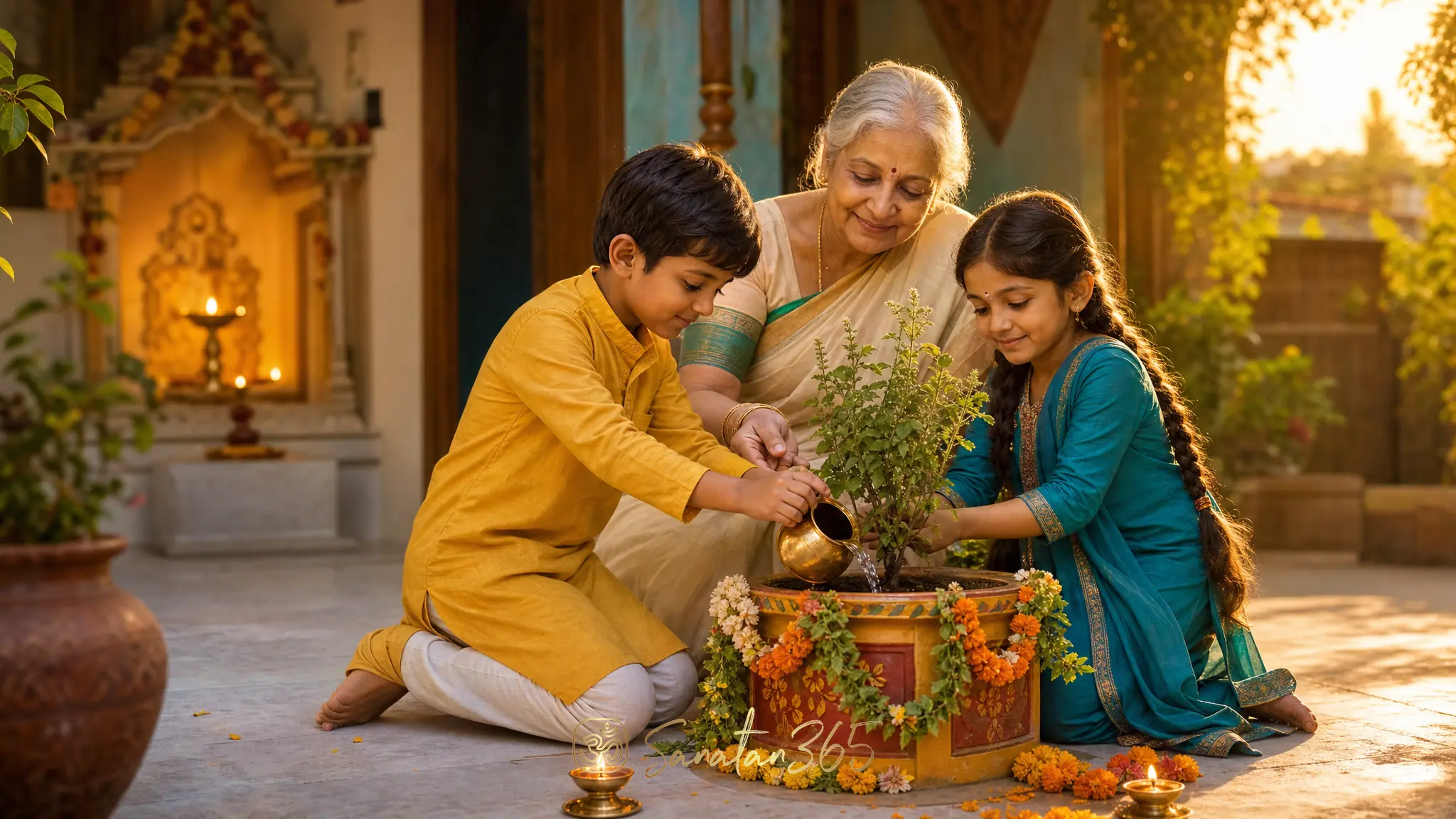
In many Indian homes, daya is also taught through small rituals of care. Watering tulsi, offering food with gratitude, touching elders' feet with respect, serving guests before oneself, and keeping a clean prayer space all teach the same inner movement: life is not only for taking. It is for honoring, tending, and giving.
For diaspora families, these practices can be especially useful because they carry culture without needing a formal classroom. A child who learns to greet elders warmly, help at community events, and explain Hindu values with humility is learning daya as lived identity.
Compassion is one of the first ways a child learns that dharma is not only taught in books; it is lived in tone of voice, shared food, careful hands, and the courage to care when no one is watching.
Key takeaway: A short family practice can turn compassion from an idea into a repeatable habit.
FAQ
What is the simple Daya meaning for kids?
Daya means compassion. For kids, it means noticing when someone or something may be hurt, sad, tired, or left out, and choosing a caring action.
Is daya the same as kindness?
Daya includes kindness, but it is deeper. Kindness may be a nice action; daya is the heart's compassionate concern that leads to the action.
How is daya connected to ahimsa?
Ahimsa means non-harm in thought, speech, and action. Daya adds active care. Together, they teach children to avoid hurting others and to help where they can.
Can a child be compassionate and still say no?
Yes. Daya does not mean accepting hurtful behavior. A child can set a firm boundary without hatred, insult, or revenge.
What is one easy daily daya practice?
Ask each night: "Who needed kindness from me today, and how did I respond?" This keeps compassion connected to real life.
About the author
Sanatan365 Editorial
Bringing Sanatan Dharma to modern seekers through authentic, scripture-grounded content.
Related in Lessons
 Lessons
Ashtavakra and Bandin: Wisdom Beyond Appearance
The Ashtavakra and Bandin story in the Mahabharata follows a young scholar who enters King Janaka's court, answers prejudice with learning,…
 Lessons
Gargi Vachaknavi: The Upanishadic Voice of Fearless Inquiry
Gargi Vachaknavi stands in the Brihadaranyaka Upanishad as a formidable questioner whose disciplined dialogue with Yajnavalkya reveals cour…
 Lessons
Andal: The Poet-Saint Who Made Longing a Path of Devotion
Discover Andal, the Tamil poet-saint whose Tiruppavai transformed sacred longing, shared song, and wholehearted surrender into a living pat…